Can nominal 12V equipment use a 13.8V output?
Check the permitted input range of every lock, reader and controller. A 12V label does not prove 13.8V compatibility. Check cable-end voltage and the minimum voltage during battery operation too.


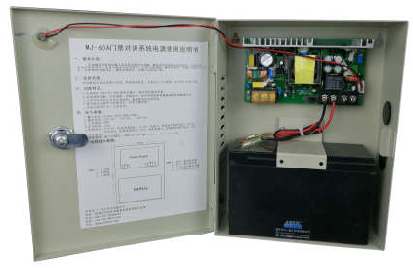

MJ Series
Sanyi Power MJ-60A/MJ-60B access control power supplies for locks, controllers and readers. Select by voltage configuration, battery charging and control. MJ-60B specifies NO/NC, 0–15s release delay and independent 12V output.
Need custom parameters or bulk pricing? Contact us for a tailored solution.
Inquire About This Product →| Available Models | MJ-60A / MJ-60B |
| Power | Verify configuration and total rated power; the model number is not a power rating |
| Input Voltage | AC 100-240V 50/60Hz |
| Output Voltage | MJ-60A: 13.8V / 21V / 30V columns; MJ-60B: V1 13.8V, V2 12V, V3 13.8V charging |
| Battery Port | Confirm voltage, capacity and charging arrangement for the exact version and runtime |
| Mounting | Wall-mount |
| Protection | Short-circuit, overload, overvoltage and battery over-discharge; verify by model |
Size access control power around lock actuation, controller/reader loads and battery operation during an outage. MJ-60A lists voltage configurations and charging management. MJ-60B also specifies NO/NC lock control, a 0–15s release delay and an independent 12V output. Model numbers or a nominal 12V label alone do not establish compatibility.
Record lock hold/release current, reader and controller loads, allowable voltage and functions needed during an outage. Door count alone is insufficient.
The MJ-60B 13.8V main output, independent 12V output and 13.8V charging channel serve different purposes. The MJ-60A voltage columns are not a generic 12V/24V rating.
For normally open/closed connections or release delay, check the MJ-60B terminal diagram and 0–15s range. Connect mains, battery and loads using the selected revision.
Runtime depends on load, usable battery capacity, condition, low-voltage protection, wiring losses and temperature. Provide target runtime and cable lengths for review.
Check the permitted input range of every lock, reader and controller. A 12V label does not prove 13.8V compatibility. Check cable-end voltage and the minimum voltage during battery operation too.
Separate voltage/charging needs from lock-control needs. MJ-60B explicitly lists NO/NC, a 0–15s delay and independent 12V output. Select MJ-60A from its own voltage and charging data, not B-model wiring.
There is no universal capacity. Calculate outage load and target duration, then account for discharge limits, ageing, temperature, recharge capability and cabinet space. A battery slot does not guarantee runtime.
Not by battery-interface availability alone. Check voltage, backup, NO/NC control, delay, terminals, charging and project interlock requirements.
Use the exact diagram for mains L/N/FG, load polarity, battery BAT terminals and lock-control contacts. Qualified personnel should verify grounding, polarity and conductor size.
Send lock/controller models, allowable voltage, hold and actuation current, door count, cable distance, battery/runtime needs, enclosure space and quantity. Sales confirms the quotation and configuration.
Based on the linked MJ-60A/MJ-60B datasheets. Do not use a current column independently of configuration and rated power. Verify the supplied revision and certification scope.
2026-05-20
How to choose a 12V battery backup UPS for CCTV camera systems — DC UPS vs AC UPS topology, 7Ah / 12Ah / 24Ah sealed lead-acid sizing, PoE NVR and hybrid analog/IP installs, runtime math, centralized distribution boxes with integrated battery position, and a Sanyi product map for retail, residential, perimeter and bank-vault deployments.
2026-04-26
A practical guide to calculating UPS battery backup time for IT racks, network closets, security rooms, and critical equipment. Covers the runtime math, load profile assumptions, derating factors, and the sizing mistakes that leave engineers short on minutes when the lights actually go out.
2026-04-24
A facility-focused comparison of EPS (Emergency Power Supply) and UPS (Uninterruptible Power Supply) for emergency lighting, fire-safety loads, and critical IT — covering code requirements, runtime, transfer time, sizing, and how to avoid specifying the wrong system.
Access Control Dedicated Power Supply
MJ Series