
A systems integrator quotes a security project: 64 IP cameras spread across an industrial yard, longest cable run 220 metres, central DC plant feeding the lot. The original BoM speced 24V for "compatibility with sensors". On commissioning day, the cameras at the far end of the yard reboot every time the IR LEDs kick in. A meter on the camera terminal shows 18.6V — the 24V rail collapsed under voltage drop and inrush. The fix wasn't another camera or thicker cable. It was switching the DC plant from 24V to 48V, halving the current and cutting drop loss to a quarter.
This is the kind of decision that gets made too late on most projects: voltage choice is treated as "whatever the device asks for", when in fact it's a system-level architectural call that affects cable cost, cabinet temperature, downtime risk, and lifetime efficiency.
This guide is for the engineer or buyer who is about to spec the DC plant for an industrial system — surveillance, automation, telecom, PoE infrastructure, lighting, or hybrid — and needs to make the 24V vs 48V call before the cable schedule is fixed.
Quick decision rules
- Choose 24V when the field bus is dominated by PLC + I/O + sensors, runs are under ~50 m, and the load mix is predominantly logic-class.
- Choose 48V when you have long copper runs, PoE PSE responsibilities, dense solenoid banks, telecom rack loads, or a planned migration to DC microgrid.
- Run both rails when a single voltage forces a costly compromise — most large cabinets do this with a 48V backbone and a local 48→24V converter.
Why the 24V / 48V Pair Won the Industry
Almost every industrial DC system you'll meet runs at one of two nominal voltages: 24V or 48V. There are technical and historical reasons for that, but the regulatory ones cement the choice.
Both sit safely under the SELV (Safety Extra-Low Voltage) ceiling of 60V DC defined by IEC 61140 and IEC 60950-1 / IEC 62368-1. SELV-class circuits are easier to certify, easier to service in the field, and exempt from a long list of high-voltage installation requirements. A DC rail that sneaks above 60V — say, a 60V battery pack at full charge — falls into a different regulatory bracket entirely.
So the practical choices for an industrial DC plant come down to 24V (factory automation, machine cabinets, security systems) and 48V (telecom, PoE infrastructure, large solenoid banks, EV-adjacent systems, lighting).
For background on industrial switching topology and DIN-rail-class reliability targets, see our Industrial DIN Rail Power Supply Selection Guide for PLC and Automation Engineers.
The Voltage-Drop Math That Drives the Decision
The single most important difference between 24V and 48V is how much copper you need to deliver the same wattage to a remote load. Power follows P = V × I, so for a fixed load, doubling the voltage halves the current. Voltage drop along a cable follows Vdrop = I × R, so halving the current halves the drop on the same cable.
It gets better than that. If you also want to keep the percentage drop the same, the rule of "≤ 3% drop on a DC feed" becomes much easier to hit at higher voltage:
| Scenario | Load | Cable | Round-trip resistance | Voltage drop | % drop |
|---|---|---|---|---|---|
| 24V × 50W × 50 m, 1.5 mm² | 2.08 A | 50 m × 2 | 0.84 Ω | 1.75 V | 7.3% ❌ |
| 48V × 50W × 50 m, 1.5 mm² | 1.04 A | 50 m × 2 | 0.84 Ω | 0.87 V | 1.8% ✅ |
| 24V × 50W × 50 m, 2.5 mm² | 2.08 A | 50 m × 2 | 0.50 Ω | 1.04 V | 4.3% ❌ |
| 24V × 50W × 50 m, 4 mm² | 2.08 A | 50 m × 2 | 0.32 Ω | 0.66 V | 2.7% ✅ |
To meet the same drop budget on a 50 m run, 24V needs 4 mm² copper where 48V is fine on 1.5 mm². Across a yard or a large factory, that cost adds up — often more than the price difference between a 24V and a 48V PSU.
Two further points the spreadsheet hides:
- Inrush. Capacitive-input loads (cameras, IR LED arrays, drives) pull 2-5× their steady current in the first few milliseconds. A 24V rail that sits at 22V at the cable end during steady state can dip to 17V during inrush — below the brown-out threshold of most embedded controllers.
- Cable heating. I²R losses scale with the square of current. A 24V system dissipates 4× more heat in the cable than a 48V system at the same power. In conduits or cable trays, that translates into ambient temperature rise inside the wire bundle, accelerated insulation aging, and de-rating.
Where 24V Genuinely Wins
24V is not a legacy choice — it's still the right call for a large class of systems.
- PLC ecosystems. Siemens S7, Allen-Bradley CompactLogix, Mitsubishi FX, Beckhoff TwinCAT, Omron CP/CJ — every major PLC family runs logic and most field I/O at 24V. Control-cabinet bills of material default to 24V because the PLC, HMI, sensors, and safety relays all expect it.
- Sensor and instrumentation rails. Proximity sensors, photo-eyes, encoders, 4-20 mA loop transmitters — overwhelmingly designed against 24V supply rails.
- Short-run security and access control. Cameras, magnetic locks, electric strikes, intercoms in a single building footprint. Our access control power supply guide covers the typical 12V / 24V load mix in detail.
- Cost-sensitive small machines. A standalone packaging machine or test fixture with a 60-150 W load and 2 m of internal cabling has zero reason to climb to 48V.
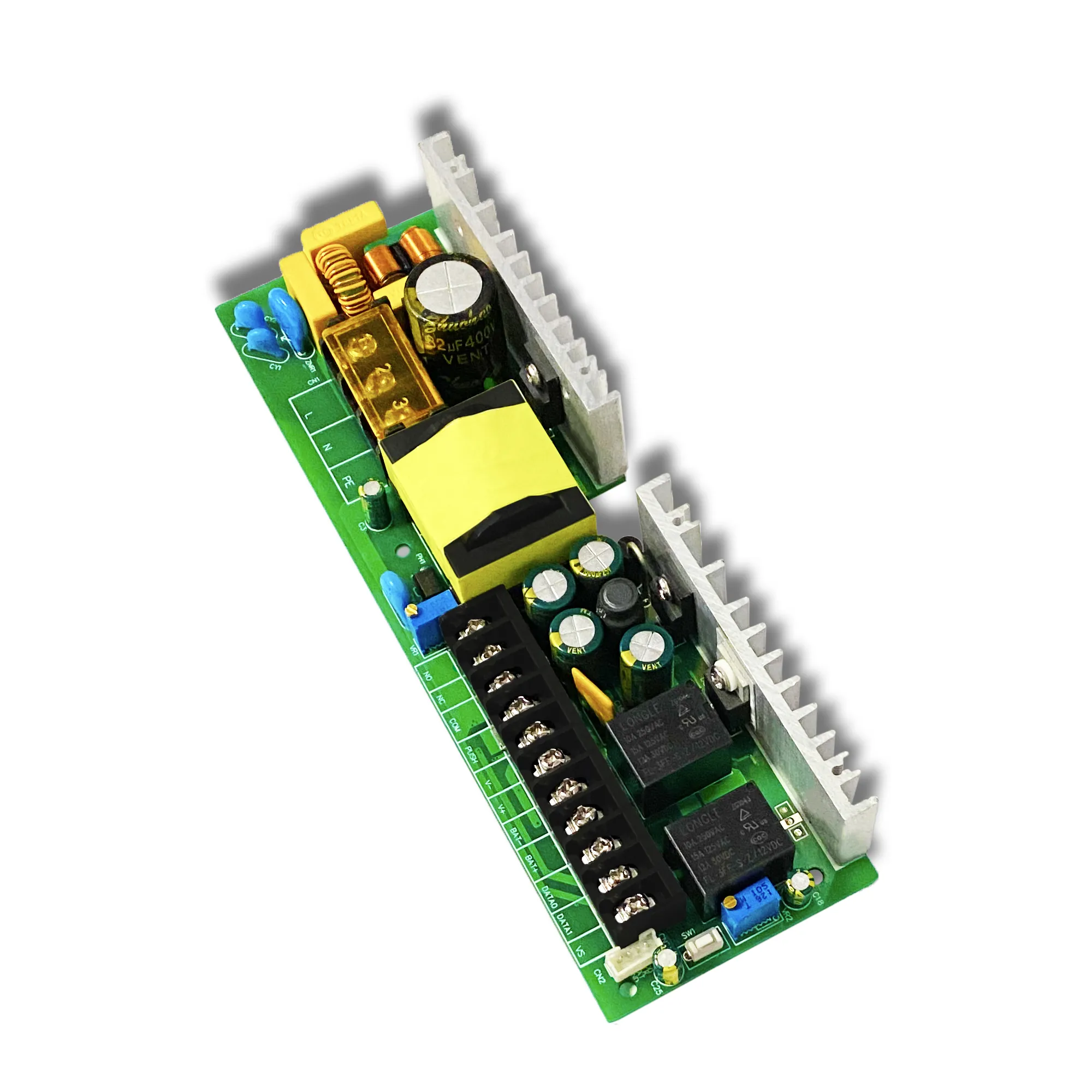
For these jobs the Sanyi SFY-Z Series 240W-480W high-power switching PSU in 24V configuration covers most surveillance and automation cabinets, and the ST Series 48W-120W standard switching PSU handles smaller boxes and panel-mount applications. Both ship with 24V output options out of the box.
Where 48V Pulls Ahead
There are five application classes where the 48V case is overwhelming, and a sixth that's coming fast.
1. PoE infrastructure (PSE side)
IEEE 802.3af / at / bt all specify a PSE output between 44V and 57V DC. There is no such thing as "24V PoE" — the standard simply doesn't allow it. If your project is going to power IP cameras, wireless APs, video phones, or SDN access switches over PoE, the upstream rail is 48V or 54V, period. For PSE-side power budgeting see our PoE Power Budget Calculator and Switch PSU Sizing Guide.
2. Long copper runs
Beyond ~50 m, the voltage-drop math above starts forcing 48V even for nominally 24V loads. The usual answer is to run a 48V backbone to remote enclosures and add a local 48V→24V buck converter where the load actually lives — saving copper without touching device firmware.
3. Solenoid valve banks and motor starters
Densely populated valve manifolds, contactor coils, brake actuators, and small servo drives can pull tens of amps at 24V. The same load at 48V draws half the current — smaller terminal blocks, smaller fuses, less heat in the cabinet, and lower I²R losses inside the busbar. Cabinet temperature rise often falls by 5-10°C just from the voltage swap.
4. Telecom and central-office racks
ETSI EN 300 132-2 defines a -48V DC input bus for telecom equipment. Servers, switches, optical line terminals, and base-station backhaul gear all expect 48V (typically -48V referenced to ground). This is a 50-year-old standard with massive installed base — picking 24V here would be a misorder.
5. EV-adjacent and 48V mild hybrid
The automotive industry settled on a 48V auxiliary rail (LV148 / VDA 320) for mild hybrid systems, which has spilled over into automotive test benches, charger pre-burn rigs, and HIL setups. Most LiFePO₄ traction packs in light EVs and AGVs sit at a 48V nominal pack voltage. Our AGV charging station power supply guide covers the charger side of that ecosystem.
6. DC microgrids and 48V data centres
Hyperscale operators are migrating toward 48V (and 400V HVDC) bus architectures to cut conversion losses. Edge DCs, telecom huts, and renewable-integrated cabinets are following. If you're greenfielding now, defaulting to a 48V backbone leaves you a clean migration path. For the high-end picture see our NVIDIA HVDC and edge AI power coverage.
Spec-Sheet Differences You Cannot Ignore
A 24V and 48V PSU of the same wattage are not the same component with a different label on the output. Three spec lines diverge meaningfully:
| Spec line | 24V industrial PSU | 48V industrial PSU |
|---|---|---|
| Output current at rated W | High (e.g. 480W → 20A) | Half (480W → 10A) |
| Output capacitor stack | Lower-voltage, larger μF | Higher-voltage, smaller μF |
| Hold-up time at full load | 10-20 ms typical | 20-30 ms typical |
| Efficiency at full load | 88-91% | 90-93% |
| Inrush current peak | Higher | Lower |
| Output ripple | Lower absolute mV | Higher absolute mV (still % spec) |
| Surge / clamp components | Sized for 24V | Sized for 48V (different MOV/TVS) |
The efficiency delta is small but compounding: a 480W cabinet running 24/7 at 91% vs 89% over five years saves roughly 1,750 kWh — meaningful at industrial tariffs, and a real heat-rejection difference inside the cabinet.
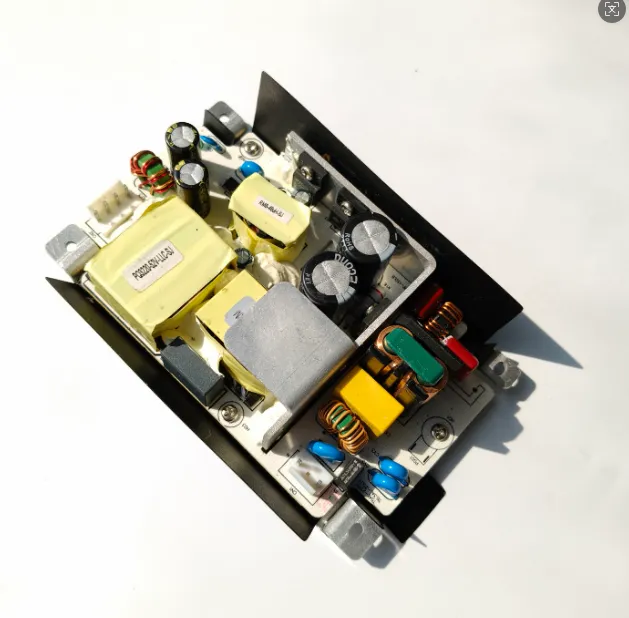
For a deeper look at the open-frame vs enclosed mechanical decision (which is independent of the voltage decision), see our Open Frame vs Enclosed Power Supply Selection Guide.
When to Run Both Rails
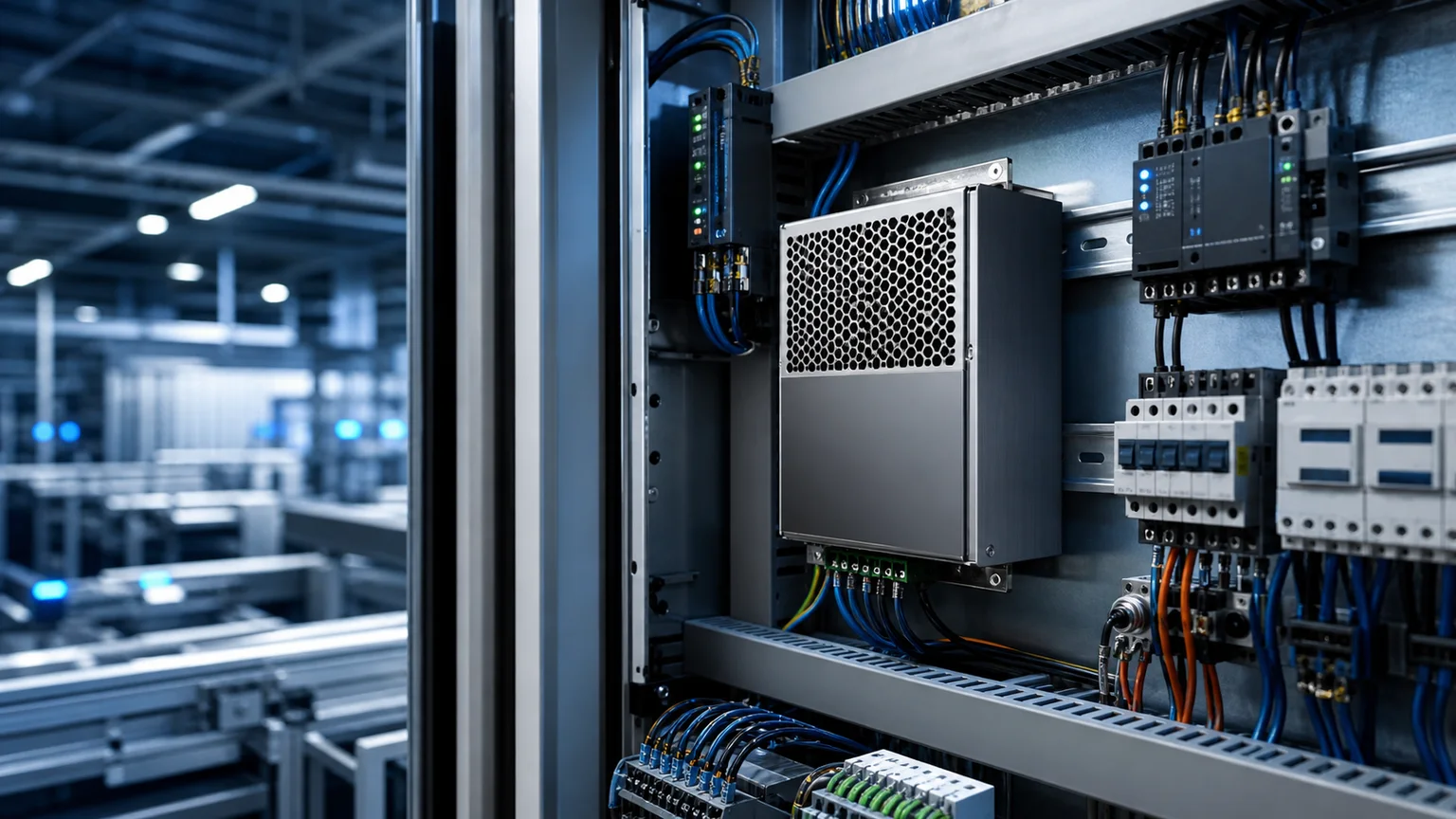
Most large industrial cabinets end up running both. The pattern looks like this:
- 48V rail powers the long-distance loads, the PoE midspan plates, the telecom rack equipment, and any motor / solenoid bank that benefits from halved current.
- 24V rail powers the PLC, HMI, safety relay, sensors, and short-run I/O.
- The 24V rail can be sourced either from a separate 24V PSU off the AC side, or from a 48V→24V DC-DC converter off the 48V backbone.
The dual-PSU approach is cheaper in components but doubles the number of input fuses and EMC filters. The DC-DC approach is cleaner but adds a single point of failure unless you redundantly source it. On safety-critical systems the dual-PSU approach usually wins because each rail can be individually fused, monitored, and battery-backed.
For 500W-class heavy backbones, the Sanyi SD-500W ultra high-power industrial switching PSU is a typical 48V backbone choice; for the cabinet-style 240-480W tier the SZ Series industrial switching PSU is the standard fit.
A Realistic Selection Walk-Through
A quick worked example. Imagine a 16-camera perimeter system, longest run 180 m, with 4 W average and 8 W peak per camera (IR LEDs lit), plus a small NVR at the head end.
- Total steady load: 16 × 4W = 64W cameras + 35W NVR = ~100W.
- Peak load with inrush: 16 × 8W × 1.5 = ~190W including head-end NVR.
- 24V option, 4 mm² copper: drop at 180 m for 4 W camera = 1.04V (4.3%), borderline. Add inrush — drop hits 6-8%, cameras brown out. Need 6 mm² minimum. Copper cost dominates.
- 48V option, 1.5 mm² copper: drop at 180 m for 4 W camera = 1.0V (2.1%), comfortable. Inrush still inside the 5% envelope. Copper cost ~40% of the 24V option.
- 48V backbone with local 48V→24V buck at each camera enclosure if cameras are 24V-only. The buck eats ~2-3% efficiency but the system installs cleanly.
The honest answer for this geometry is 48V, and the cable savings alone pay for the buck modules.
How Sanyi PSUs Map to the Decision
| Application class | Typical voltage | Suggested Sanyi line |
|---|---|---|
| Small PLC / sensor cabinet | 24V | ST Series, 48-120W |
| Mid-size automation cabinet | 24V or dual rail | SFY-Z Series, 240-480W |
| Large industrial cabinet | 24V or 48V | SZ Series, 240-480W |
| Heavy backbone / PoE infrastructure | 48V | SD-500W |
| Long-distance security yard | 48V backbone | SFY-Z Series 48V variant |
Sanyi's industrial switching PSU portfolio supports 12V / 24V / 36V / 48V output options across the SFY-Z and SZ ranges, so the same housing and form factor can serve either rail in a mixed-voltage cabinet.
Common Mistakes That Cost Real Money
- Specifying 24V because the device datasheet says "24V" — without checking the cable run. The device tolerance is usually ±10%, and 50 m of thin copper eats that envelope before inrush even hits.
- Sizing the PSU at exact load. Industrial PSUs lose ~5% headroom per 10°C above 40°C ambient. A 200W PSU in a 55°C cabinet is really a 170W PSU. Buy with 30% margin; we cover this in the DIN rail sizing guide.
- Running 48V into 24V-only sensors via a passive divider or resistor. This burns power as heat, fails on transients, and breaks the SELV chain. Use a proper buck converter.
- Ignoring grounding scheme. Telecom 48V is conventionally -48V (positive ground); industrial 48V is conventionally +48V (negative ground). Mixing the two on a shared chassis without isolation creates ground loops.
- Forgetting the surge spec. A 48V rail in a yard environment without Class III IEC 61000-4-5 surge tolerance will eat its own MOV inside the first thunderstorm season.
FAQ
Is 48V more dangerous than 24V to work on?
Both sit under the SELV ceiling of 60V DC and are considered safe to handle in dry conditions per IEC 61140. Practically, 48V can produce a noticeable tingle through wet skin where 24V cannot — but neither is in the lethal-shock category. The real safety difference shows up under fault: a short across a 480W / 48V supply pumps about half the current of a 480W / 24V supply, so arc-flash energy at the busbar terminal is materially lower at 48V. Standard industrial PPE and lockout/tagout still apply on both.
Can I run a 24V device from a 48V supply with a buck converter?
Yes, and it's a common architecture for long-run distributed systems — 48V backbone, point-of-load 48V→24V buck converters at each device cluster. Pick a buck converter rated for 2× the steady current of the load to handle inrush, with ≥ 89% efficiency and the same operating temperature class as the cabinet (-25 to +70°C for industrial, -40 to +85°C for outdoor). Don't use linear regulators or resistive dividers — they burn the voltage difference as heat and fail under transients.
Why don't industrial systems just standardise on 48V?
Three reasons. First, the PLC ecosystem — Siemens, Allen-Bradley, Mitsubishi, Omron, Beckhoff — has 50 years of installed 24V hardware. Second, low-current sensors and field I/O are designed against 24V supply rails; replacing them is a multi-year amortisation. Third, for short-run cabinets the cable savings of 48V are negligible while the PSU cost premium is real. The industry is slowly converging on 48V backbone + 24V point-of-load as the practical compromise, particularly in greenfield builds.
What about 12V — when is it ever the right choice?
12V survives in two niches: small embedded systems shipped with a desktop adapter, and battery-backed systems where a single sealed lead-acid or LiFePO₄ block sits at 12V nominal. For anything industrial — multiple devices, a real cable plant, professional installation — 12V's voltage-drop maths is even worse than 24V, and you'll be back to thicker copper or a buck converter at every load. Sanyi's SFY-Z Series does ship a 12V variant for those legacy cases, but specify it consciously, not by default.
Does going from 24V to 48V change my UPS / backup plan?
Yes. Battery banks step in 12V increments, so 24V = 2 batteries in series, 48V = 4 in series. A 48V string has a higher fault risk per cell-imbalance (more cells in series) but better usable runtime per amp-hour drawn. The DC UPS class is itself a separate decision — see our DC UPS vs industrial UPS selection guide for the architectural picture. As a rule of thumb, pick the rail voltage first based on the load, then size the battery string to match.
Bottom Line
The 24V vs 48V choice is rarely "which is better in the abstract" — it's a system-level call driven by cable distance, load mix, and ecosystem compatibility. Run 24V when your loads are PLC-class and your cables are short. Run 48V when you have copper to save, PoE to power, telecom equipment to feed, or a DC-microgrid migration on the roadmap. Run both when one rail forces a costly compromise on the other.
Get this decision right at the schematic stage and the rest of the cabinet — cable schedule, breaker sizes, terminal blocks, cabinet temperature — falls into place. Get it wrong and you're rebuilding a yard's worth of cabling at the worst possible moment.
For help matching a switching PSU to a specific 24V or 48V industrial application, the Sanyi switching power supply line covers 48W to 500W across both rails, with industrial-grade ratings designed for control cabinet, security backbone, telecom, and PoE infrastructure use.