
You're finalizing the BOM for a new product. The mechanical team has sealed the enclosure size. The electrical team has picked the DC bus voltage. Now you're staring at two columns of a supplier catalog: one labeled open frame, the other enclosed. The open-frame model is cheaper, lighter, and smaller. The enclosed model looks more robust, comes with a metal case, and advertises IP protection. Same wattage. Nearly double the price.
Which one do you specify? Pick wrong and the consequences range from minor — a couple extra dollars per unit — to expensive: thermal throttling in production, a failed EMC test two weeks before launch, or a field recall because exposed high-voltage terminals didn't pass a safety audit.
This guide breaks down the real differences between open frame vs enclosed power supply designs, when each one makes sense, and the five mistakes we see most often on customer BOMs.
What Is an Open Frame Power Supply?
An open-frame power supply is a switching PSU shipped as a bare printed-circuit-board assembly — the transformer, capacitors, heatsinks, and output terminals are all visible. There's no metal housing, no fan cover, no IP rating. The designer expects it to be integrated inside a host product's enclosure: a machine cabinet, a light fixture, a medical device chassis, a kiosk.
Open-frame PSUs are sometimes called "board-type" or "bare-board" power supplies. Sizes range from tiny 10 W modules no bigger than a credit card up to 500 W units that slot into a standard 1U rack chassis.
What Is an Enclosed Power Supply?
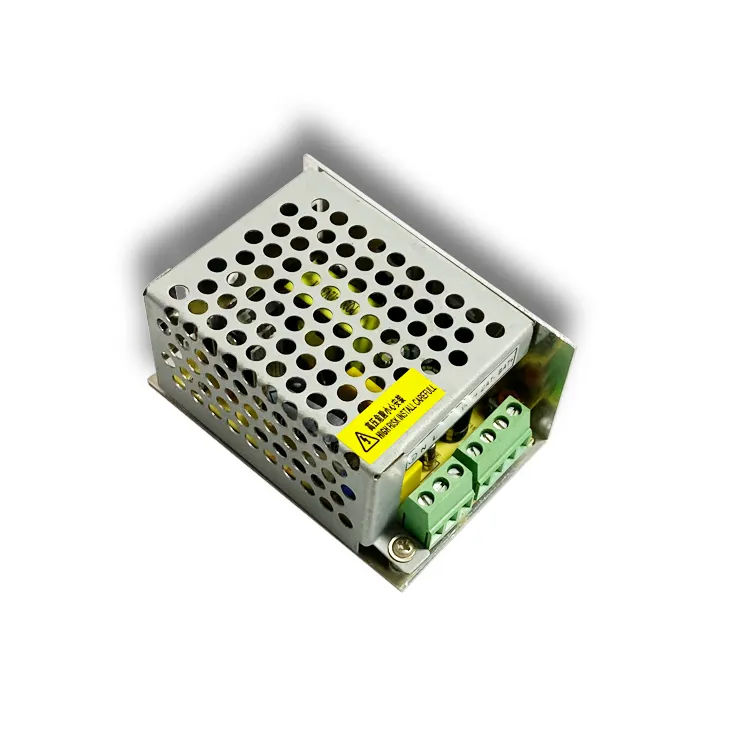
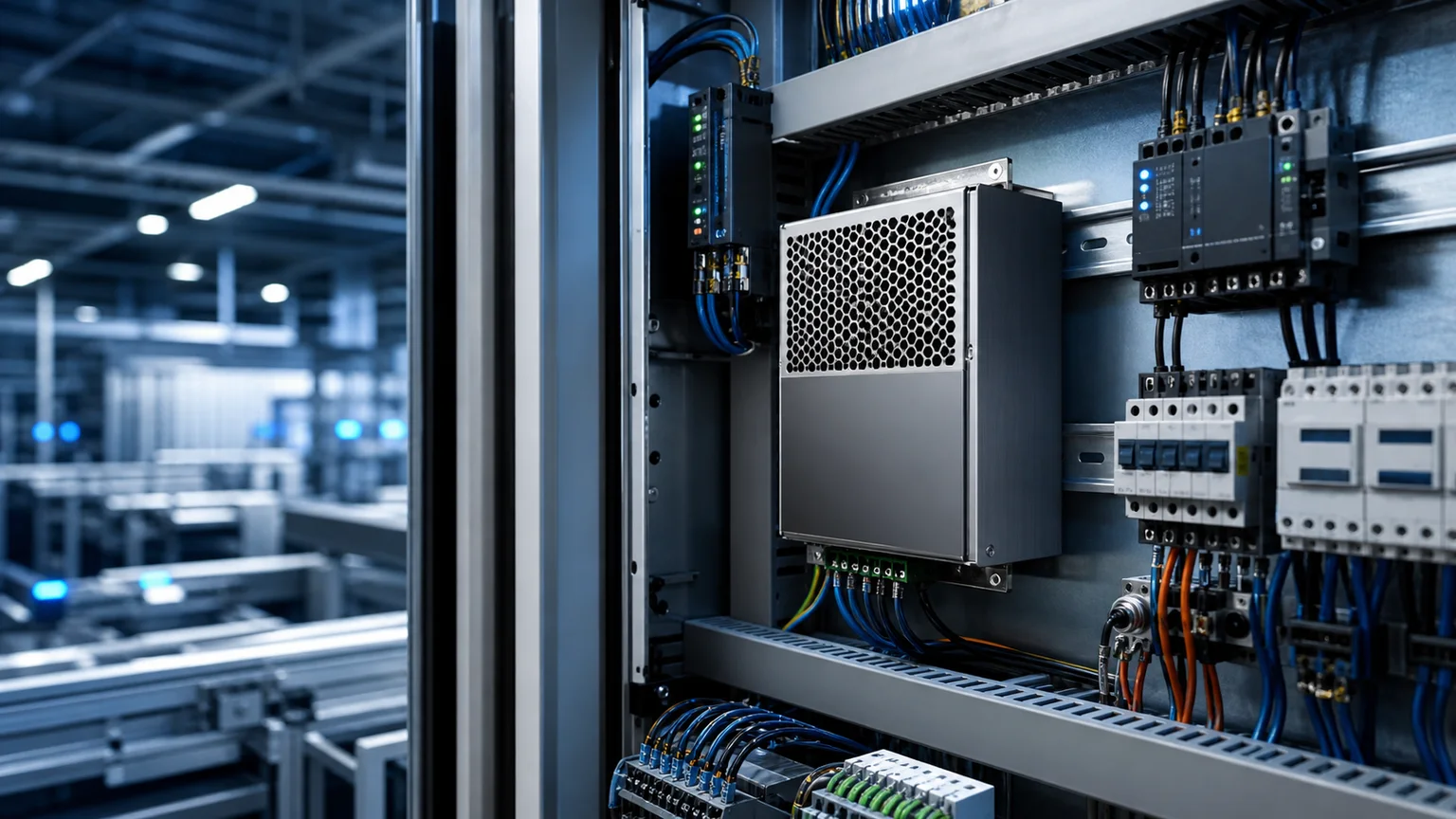
An enclosed power supply is the same basic switching circuitry, but wrapped in a ventilated metal housing — typically aluminum alloy with slotted vents or a honeycomb pattern for airflow. The housing adds mechanical protection, improves EMI shielding, and provides a clean mounting surface for standalone installation on a DIN rail, a chassis wall, or inside an equipment cabinet.
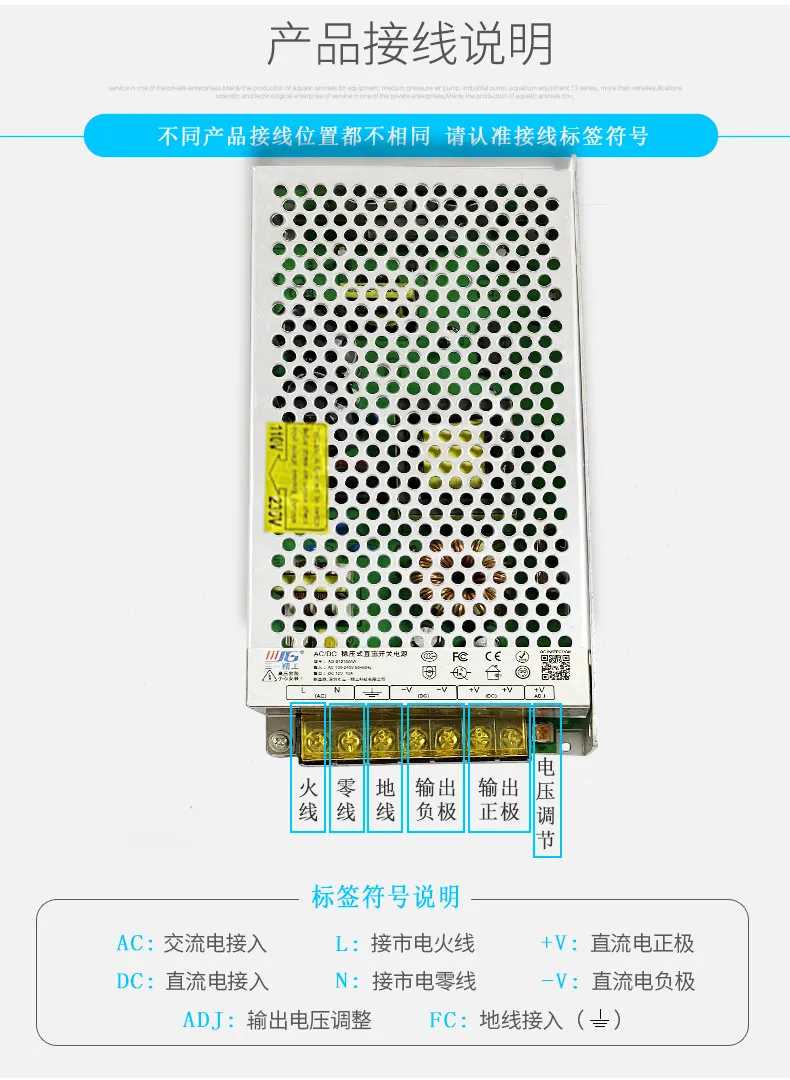
Enclosed units usually come with terminal-block wiring, screw-on L brackets, and full safety-agency approvals. They're what most people picture when they hear "industrial power supply": the rectangular metal brick you see bolted to the back of an LED video wall, a CCTV DVR, or an automation panel.
Side-by-Side Comparison
| Criterion | Open Frame PSU | Enclosed PSU |
|---|---|---|
| Housing | None — exposed PCB | Ventilated metal case |
| Weight | 30–60% lighter | Heavier (metal adds mass) |
| Footprint | Smaller, flatter profile | Larger overall volume |
| Unit cost | Lower (no housing BOM) | Higher (housing + assembly) |
| Cooling | Relies on host airflow | Built-in vents, sometimes fan |
| EMI shielding | Minimal — depends on host chassis | Housing acts as Faraday cage |
| Safety (touch protection) | Exposed high-voltage traces | Fully covered, finger-safe |
| Installation | Embedded only | Standalone or embedded |
| Field serviceability | Difficult (integrated) | Easy (swap the brick) |
| Typical certifications | CE, RoHS (component-level) | CE, FCC, 3C, UL — system-level |
| Environmental protection | None (depends on host) | IP20 typical; higher rating available |
The differences aren't arbitrary. Each row represents a design trade-off: open-frame optimizes for cost and integration density, while enclosed optimizes for robustness and deployment simplicity. Your application decides which axis matters more.
When to Choose an Open Frame Power Supply
1. You're an OEM integrating the PSU inside your own product
If the power supply lives inside a machine you designed — a kiosk, a smart locker, an industrial sensor box, a medical console — you already own the outer enclosure. Paying for a second metal case is pure BOM waste. You also have full control over airflow, EMI routing, and touch safety at the product level, so you don't need the PSU to provide any of that.
This is the number-one use case for open frame. Examples: SE Series compact open-frame supplies (10–24 W) embedded in door sensors, access-control readers, and small detectors.
2. Space and weight are critical
Medical portable equipment, drones, handheld industrial instruments, slim LED luminaires, ultra-thin displays — any product where every millimeter and every gram counts. Removing the housing can shave 20–40% off the PSU footprint and a meaningful chunk of weight. That headroom often decides whether a product hits its ID target or not.
3. You're running the supply inside a ventilated cabinet
Some cabinet designs move a lot of air — think telecom DC plants, server racks, or LED control boxes with forced-air cooling. The cabinet's own cooling is better than anything a small enclosed brick can do on its own. An open-frame PSU in this environment runs cooler than the equivalent enclosed unit, simply because hot air isn't trapped inside a metal case.
4. You need a customized mechanical footprint
Custom-board open-frame supplies can be built to match an unusual PCB shape — an L-profile, a narrow strip, a specific mounting-hole pattern. If your product's internal geometry can't accept a standard rectangular brick, a custom open-frame board is usually the only path.
When to Choose an Enclosed Power Supply
1. Standalone installation outside a host product
Wall-mounted in an electrical closet, bolted to a panel behind an LED screen, hanging on a DIN rail in a pump station — any time the power supply sits in its own physical space instead of inside another product. The metal housing is what makes that deployment safe and serviceable.
2. Industrial and harsh environments
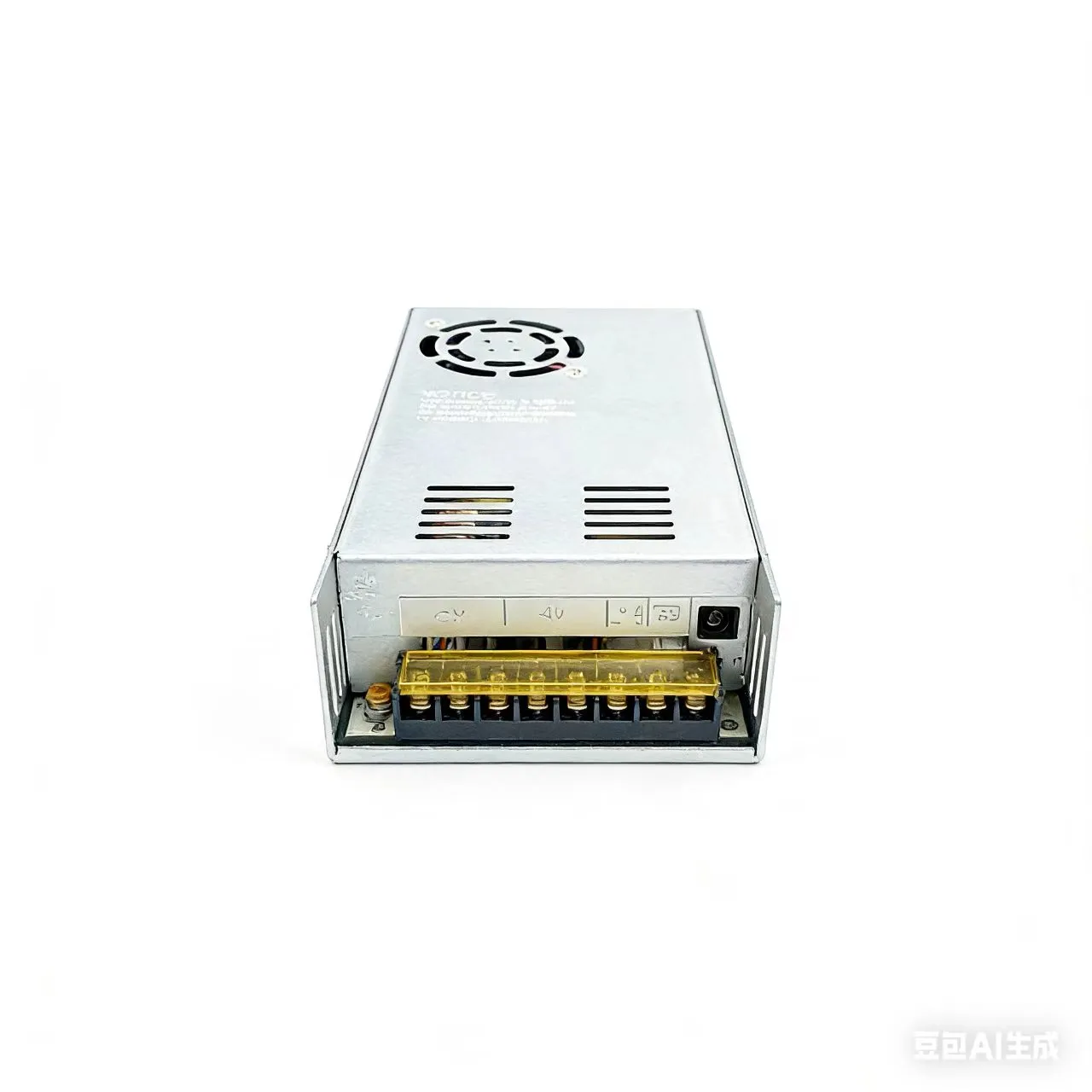
Dust, vibration, accidental impact, occasional moisture — all of these degrade an exposed PCB quickly. Enclosed PSUs survive factory floors, outdoor cabinets, and LED-sign control boxes where open-frame units would fail within months. The SZ Series industrial switching power supply (240–480 W) is a typical example: square metal housing, integrated fan, rated for long-duty-cycle full-load operation in cabinet installations.
3. Touch-safety or consumer access is a concern
If there's any possibility that non-technical staff — maintenance workers, shop owners, homeowners — could open the panel while the supply is live, an enclosed unit is mandatory. The case covers the primary-side high-voltage nodes and keeps fingers away from 300+ V DC rail capacitance. Open-frame in that scenario is not just a liability, it often fails safety-agency inspection outright.
4. EMI-sensitive environments
Medical imaging equipment, precision measurement, RF testing rooms, broadcast gear — anywhere that nearby circuits are sensitive to radiated emissions. A metal-housed enclosed PSU dramatically reduces the EMI you have to filter or shield downstream. Starting with an open-frame unit in these applications usually means adding cost later for shielding cans or additional line filters.
5. You want a single SKU that "just works"
For system integrators shipping many small projects — a security installer wiring 8 cameras here, 12 cameras there — having one enclosed PSU that can be mounted anywhere, replaced in minutes, and stocked as a single part number is faster and cheaper than customizing an integration around a bare board. The SFY-Z Series 240–480 W enclosed switching supply is a workhorse for this kind of installer-friendly deployment.
Certifications and Safety: The Detail Most People Miss
One point that tends to surprise designers new to power supply selection: the certification marks on an open-frame PSU are not the same as on an enclosed PSU of the same wattage.
Open-frame units typically carry component-level approvals (for example, CE, RoHS) — they're certified as a building block that has to be integrated into a finished product. The finished product is then responsible for its own safety certification, including the way high-voltage terminals are covered, creepage and clearance distances inside the host enclosure, and touch-current compliance.
Enclosed units usually carry system-level approvals (CE, FCC, 3C, and in some markets UL) — they can be deployed directly, on their own, because the housing itself satisfies the touch-safety and spacing requirements.
Translation: if you buy an open-frame supply and simply put it in a plastic box, you don't automatically inherit the enclosed unit's safety rating. You've just created a new product that still needs its own compliance testing. For OEMs with a mature certification process this is routine; for smaller shops it's an expensive surprise.
Five Common Selection Mistakes
Mistake 1: Picking open-frame to save money, then adding a metal box later
We see this every quarter. A project starts with an open-frame choice to shave unit cost, then the mechanical team realizes they need a sheet-metal cover for touch safety, then thermal analysis shows the cover needs vents, then EMC testing fails and a shielding shim has to be added. By the time the sum of ad-hoc fixes is totaled up, the all-in cost is often higher than a standard enclosed PSU would have been from the start.
Mistake 2: Ignoring the host enclosure's airflow budget
Open-frame PSUs assume the host provides cooling. If the host is a sealed plastic box with no ventilation, the supply will thermally throttle — efficiency drops, output ripple rises, electrolytic capacitor lifetime plummets. Always verify the host's temperature rise at full load before committing to open-frame.
Mistake 3: Assuming "enclosed = waterproof"
Most enclosed power supplies are IP20 — protected against finger contact, not water or dust. If you need true outdoor rating, you have to move up to IP65 or IP67 rainproof/waterproof models. "Enclosed" and "sealed" are not the same thing.
Mistake 4: Not checking the fan (or lack of one) against noise budget
Many enclosed high-power supplies above ~300 W include a small axial fan. That's fine in an industrial cabinet, but in a retail display, a classroom, or a hospital corridor, the fan noise becomes an unacceptable product attribute. Check the spec sheet — fan-less convection-cooled versions exist but have lower continuous-power limits.
Mistake 5: Under-specifying wattage to squeeze into the smaller open-frame footprint
Because open-frame units are smaller, there's a temptation to pick the smallest one that "barely" covers the load. In reality, running a PSU at 95% of rated output all day long dramatically reduces its service life. The 80% rule applies to both open-frame and enclosed. If you need 180 W continuous, you want a 240 W part — regardless of form factor.
Matching Sanyi Power Supply Series to Your Application
For system designers looking at Sanyi's catalog, the mapping is straightforward:
| Application | Recommended Type | Sanyi Series |
|---|---|---|
| Embedded in small OEM product (door sensor, reader, detector) | Open-frame compact | SE Series 10–24 W |
| Custom-shape board for unusual mechanical footprint | Open-frame custom | Custom 48–96 W board |
| Low-power standalone (small system, LED lighting) | Enclosed standard | ST Series 48–120 W |
| Mid-power standalone (security, low-voltage system) | Enclosed mid-power | SFY-I Series 120–200 W |
| Configurable standalone in the 200–240 W band | Enclosed adjustable | SFY-E / SF Series |
| High-power cabinet-mount industrial | Enclosed industrial | SFY-Z Series 240–480 W |
| High-power LED engineering / automation | Enclosed industrial with fan | SZ Series 240–480 W |
When the use case doesn't match cleanly — for example, you need a non-standard output voltage, a specific creepage distance for a regulatory geography, or a burn-in regime on the factory line — the right answer is usually to talk to the manufacturer early. Customizing at design time costs far less than reworking a certified BOM.
A Simple Decision Flow
If you want to cut the analysis down to a two-minute check, ask these four questions in order:
- Will the PSU live inside another product I designed? If yes, start with open-frame. If no, go enclosed.
- Does non-technical staff have physical access to the installation area? If yes, enclosed is non-negotiable.
- Is the ambient environment dirty, humid, vibrating, or outdoors? If yes, enclosed (and check the IP rating).
- Do I need FCC/CE/UL system-level approvals out of the box? If yes, enclosed. If I'll re-certify my own finished product anyway, open-frame is fine.
Four "yes" answers to the second, third, or fourth question all point to enclosed. Only a clean "yes" to question one with "no" to the others justifies an open-frame part.
FAQ
Q1: Is an open frame power supply always cheaper than an enclosed one of the same wattage?
At the line-item BOM level, yes — typically 15–30% cheaper because there's no metal housing, no extra assembly labor, and usually a simpler certification path. But total landed cost is not always lower. Once you add a host enclosure, touch-safety covers, EMI shielding, and your own compliance testing, the open-frame path can end up more expensive. Open-frame saves money when you already have most of the required surrounding infrastructure; enclosed saves money when you don't.
Q2: Can I use an open frame power supply outside a cabinet or host device?
Technically the supply will run, but it's not a safe or compliant deployment. Exposed primary-side high-voltage traces and bulk capacitance create a shock hazard, and open-frame units generally don't carry the system-level approvals required for standalone installation. If you need a PSU sitting in free air on a wall or a shelf, pick an enclosed unit. A minimum IP20 metal housing (rated against finger contact) is the right starting point.
Q3: Do open frame power supplies have UL, CE, and FCC certifications?
Many do — but the certifications they carry are component-level, meaning they've been tested as a subassembly that will be integrated into a finished product. The host product still needs its own end-device certification. When you look at a datasheet, check whether the approval is listed as "component" or "recognized component" (the UR mark) rather than a full UL listing. For OEMs this distinction is routine; for drop-in standalone use it matters a lot.
Q4: Which handles heat better, open frame or enclosed?
It depends on the surrounding environment. In still air, an enclosed PSU with internal vents or a small fan generally runs cooler because it manages its own airflow. In a well-ventilated host cabinet with forced airflow, an open-frame PSU usually runs cooler because there's no metal case trapping heat around the components. Both form factors perform equally at 50–60% load; the difference shows up at sustained full load.
Q5: Do I need extra EMI filtering if I choose an open frame power supply?
Often yes. Without a metal housing acting as a shield, radiated emissions from the switching node propagate more freely into the host system. The cure can be as simple as adding a ferrite bead on the output lead and making sure the host enclosure has good chassis grounding, or as involved as adding a dedicated EMI shielding can over the primary-side area. Budget a small allowance for EMC tuning when specifying open-frame, especially above ~100 W or above ~100 kHz switching frequencies.
The Bottom Line
Open frame vs enclosed isn't a ranking — neither format is "better" in absolute terms. Open-frame wins on unit cost, weight, and footprint when you already own the host enclosure and its certifications. Enclosed wins on installation simplicity, safety, EMI, and time-to-deploy when the supply needs to stand on its own. The expensive mistake is picking the wrong axis for your actual use case, then spending months patching around the gap.
If you're sketching a new product right now and you're not sure which side of the line you're on, send us the application, target wattage, and operating environment. A short conversation up front beats a re-spin of the BOM six weeks later.