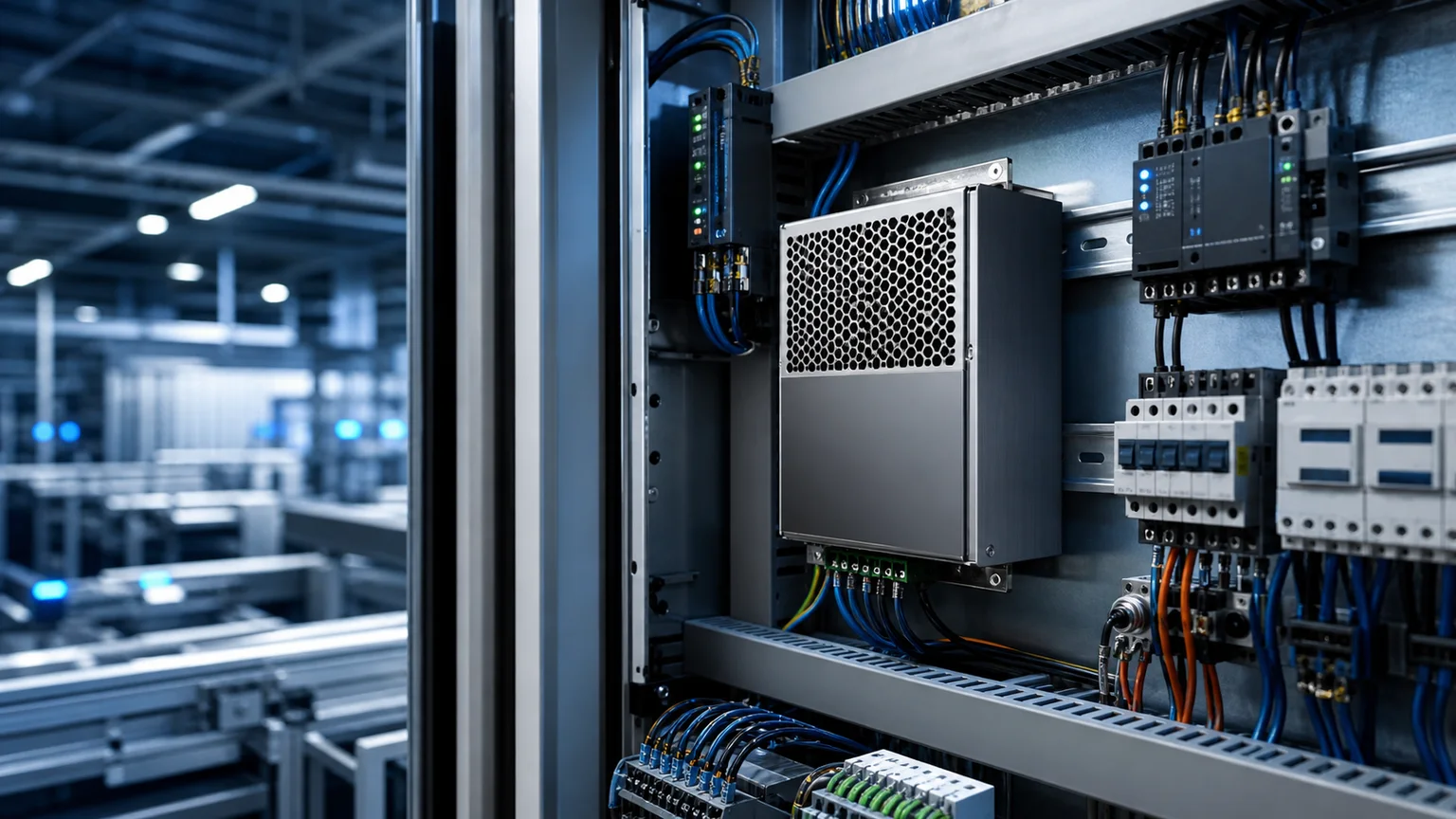

A commissioning engineer fires up a freshly built control cabinet. The PLC boots, the HMI lights up, sensors come online — looks clean. Then a pneumatic valve manifold solenoid kicks in, three contactors pull at the same instant, and the PLC drops out and reboots. Spend an afternoon with a scope and you find the 24V rail collapsing from 24.0V down to 19.4V for 80 milliseconds, every time the system tries to actuate. The PLC, the HMI, and the safety relay all see undervoltage simultaneously.
The wiring is fine. The PLC is fine. The valves are fine. The DIN rail power supply is undersized for the inrush profile — and a "200W is enough for a 150W steady load" assumption just took down the line.
This is one of the most common — and most expensive — silent design errors in industrial automation. The global industrial automation market reached USD 226 billion in 2024 and is projected to grow to ~USD 415 billion by 2030 at 10.6% CAGR (Grand View Research, 2024). Behind every one of those PLCs, HMIs, drives, and safety controllers sits a 24V DIN rail PSU — and a meaningful share of unscheduled downtime traces back to a power supply that nobody planned in detail.
Symptoms of an Undersized or Wrongly Specified DIN Rail PSU
- PLC randomly reboots when valves, contactors, or motor starters actuate — inrush dragging the 24V rail below 19V
- HMI screens flicker or lose Ethernet link during heavy I/O cycles — insufficient hold-up time / brown-out
- PSU runs hot, fan cycles, lifetime drops to 12-18 months — cabinet ambient too high, no derating margin
- Random sensor / encoder noise after upgrade — ripple & noise out of spec, no PFC
- Whole cabinet trips on a lightning event — missing surge tolerance (Class III IEC 61000-4-5)
This guide covers four things, in order: how DIN rail PSUs differ from generic 24V bricks, how to actually size one for a PLC + HMI + I/O cabinet, what spec lines matter (and which are marketing fluff), and which Sanyi industrial-grade rails fit each tier.
Why a DIN Rail PSU Is Not the Same as a Desktop 24V Brick
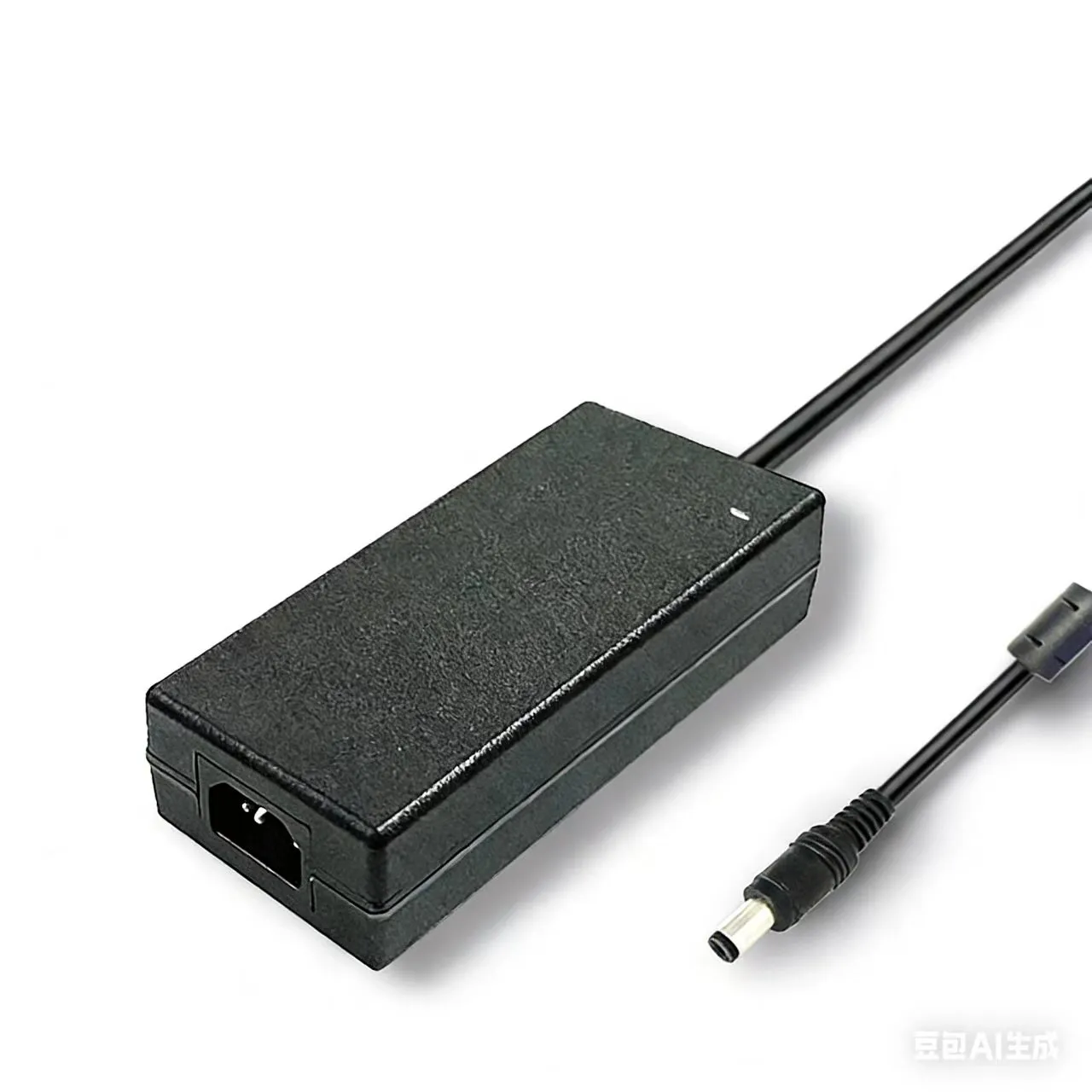
The mechanical standard is DIN EN 50022 — the 35 mm top-hat rail you see in every PLC cabinet — and it dictates the form factor: shallow depth, side-clip mount, terminal block input/output, no IEC inlet. But the form factor is the easy part. The real differences live in the spec sheet:
| Attribute | Generic Switching Brick | Industrial DIN Rail PSU |
|---|---|---|
| Operating temperature | 0 to +40°C | -25 to +70°C (with derating) |
| MTBF target | 30k-50k hrs | 300k-700k hrs at 25°C |
| Surge tolerance | None to Class II | Class III, ±2 kV line-to-line |
| Hold-up time | 5-10 ms | 20-30 ms at full load |
| Inrush capability | 100-150% rated | Often 150-200% peak for 1-3 s |
| PFC | Optional | Required >75 W (EN 61000-3-2) |
| Mounting | Wall / chassis | 35 mm DIN rail or cabinet base |
| Wiring | DC jack / pigtail | Cage-clamp or screw terminals |
| EMC class | Class A | Class B (industrial) |
A 24V automation rail can also see thousands of switching events per shift. Inductive kickback from contactor coils, solenoid valves, and stepper drives all appear as transients on the same rail that feeds the PLC's logic supply. An industrial PSU is engineered to ride through those events without resetting the controller. A desktop brick is not.
The 24V vs 48V Decision (and Why 24V Won)
Across PLC, HMI, sensor, and field I/O ecosystems, 24V DC is the de facto standard. SIEMENS S7, Allen-Bradley CompactLogix, Mitsubishi FX, Beckhoff, Omron CP/CJ — every major PLC family runs its logic and most field I/O at 24V. The reason is regulatory, not technical: 24V sits below the SELV (Safety Extra-Low Voltage) ceiling of 60V DC, so cabinets are easier to certify and field-service.
When 48V comes up:
- Long-distance field bus (1.5km+ cable runs) — voltage drop math drives the choice
- Heavy solenoid valve banks — current halved at twice the voltage means smaller wire, less heat
- PoE for industrial cameras / IIoT — 802.3bt requires 48-57V at the source
For a typical machine-side automation cabinet — PLC + HMI + ~50-150 sensors + a few solenoid valves + safety relay — 24V is almost always the right choice. Specify 48V only when you have a clear cable-length or PoE driver pulling you there.
How to Size a DIN Rail PSU for a PLC Automation Cabinet
There are four moving pieces: steady load, inrush, hold-up, and headroom. Walk through them in order.
Step 1 — Build the steady-state load list
List every device on the 24V rail with its maximum continuous current draw (not typical, not nameplate average). Typical numbers you'll meet on real projects:
| Device | Typical 24V steady current | Notes |
|---|---|---|
| PLC CPU (mid-range, e.g. S7-1200) | 0.4-0.8 A | Power supply module rating |
| HMI 7-10" color | 0.5-1.0 A | Higher with backlight at 100% |
| Digital input module (16-channel) | 0.05-0.15 A | Logic side; field side counted separately |
| Digital output module (16-channel, sourcing) | 0.1-0.3 A | Plus the load each output drives |
| Analog I/O module (8-channel) | 0.15-0.25 A | — |
| Inductive proximity sensor (PNP) | 10-15 mA | x50-150 sensors adds up fast |
| Photoelectric sensor | 25-50 mA | — |
| Encoder (incremental, 24V) | 50-150 mA | High-resolution units higher |
| Safety relay (e.g. PILZ PNOZ) | 0.04-0.08 A | Multiply by number of relays |
| Solenoid valve (24V coil, holding) | 0.15-0.30 A | Pickup current 4-8x, see Step 2 |
| Industrial Ethernet switch (5-port unmanaged) | 0.2-0.4 A | — |
| Indicator stack-light tower | 0.05-0.15 A per LED segment | — |
Step 2 — Add inrush and pickup current
Two things lie about their power needs: inductive coils and capacitive loads. The PSU has to deliver 2-8x the steady current for 50-200 milliseconds every time these turn on, without dropping the rail voltage below the PLC's brown-out threshold (typically 19.2V on a 24V system).
Worst offenders:
- Solenoid valve banks — pickup current ~5-8x holding, 50-100 ms duration
- Contactor coils (24V DC type) — ~3-4x holding, 30-50 ms
- Capacitive loads — analog I/O modules, HMI inrush at boot, output module bulk caps
- Stepper / servo logic supplies — controller-side draw, not motor power
You don't sum every inrush as if they all happen at once. You take the largest plausible simultaneous event — typically one full valve manifold actuating, or one contactor bank pulling — and add that on top of the steady load. Most industrial PSUs publish a "peak power" or "1.5x for 3s" line in the datasheet; that is the number that has to cover this transient.
Step 3 — Size for headroom
Once you have steady + inrush, multiply by 1.25-1.30 for the design margin. This buffer covers:
- Capacitor aging (PSU output caps lose ~20% capacity over 5 years)
- Cabinet ambient above the rated point (every +10°C above 25°C cuts MTBF roughly in half)
- Future I/O additions on spare channels — almost every cabinet adds I/O within 24 months
- Tolerance stack-up between datasheet typical and worst-case devices
A worked example
A typical mid-size machine cabinet — PLC + HMI + 50 sensors + 8 solenoid valves + safety relay + small Ethernet switch:
| Group | Steady current at 24V | Subtotal |
|---|---|---|
| PLC CPU + 4 I/O modules | 0.6 + 4 × 0.15 = 1.20 A | 28.8 W |
| HMI 10" | 0.8 A | 19.2 W |
| 50 sensors (mixed inductive / photoelectric, avg 25 mA) | 1.25 A | 30 W |
| 8 solenoid valves (holding 0.20 A each) | 1.60 A | 38.4 W |
| Safety relay × 2 | 0.16 A | 3.8 W |
| 5-port Ethernet switch | 0.30 A | 7.2 W |
| Stack light + misc | 0.30 A | 7.2 W |
| Steady total | 5.61 A | ~135 W |
Inrush event — one valve manifold (8 valves) pulling pickup current simultaneously: 8 × 1.0 A peak = 8 A for ~80 ms. Combined with steady load: ~5.6 + 8 = 13.6 A peak, well within the 1.5x peak rating of a properly chosen 240W PSU (10A continuous, 15A peak).
Add 30% headroom: 135 × 1.30 ≈ 175 W minimum.
Round up to the next standard rating with margin: 240 W is the right pick for this cabinet. A 200W unit would be running at 67% steady-state utilization and only 8% peak headroom — too tight for a 5-year deployment.
What Spec Lines Actually Matter (and Which Don't)
When you compare PSU datasheets, focus on these — in this order:
- Conversion efficiency — Look for ≥ 88% at 50% load for 100W class, ≥ 90% for 240W+ class. Below 85% means more heat in the cabinet, derating earlier, lifetime drops.
- MTBF at full load and 50°C — The at 50°C number, not the marketing "MTBF 700k hours" headline (which is usually at 25°C, no load). A genuine industrial PSU will publish 200k+ hrs at 50°C, full load.
- Operating temperature with derating curve — A spec of "-25 to +70°C" only matters if you read the derating curve. Most PSUs derate output ~2.5%/°C above 50°C; some industrial-grade units hold 100% to 60°C.
- Hold-up time at full load — ≥ 20 ms is the SEMI-F47 baseline for ride-through. Below 15 ms and a 60Hz half-cycle dropout will reset the cabinet.
- Surge protection class — Class III (IEC 61000-4-5) ±2 kV line-to-line, ±4 kV line-to-earth is the industrial baseline. No-name supplies skip this.
- Protection coverage — OCP (overcurrent), OVP (overvoltage), SCP (short-circuit), OTP (over-temperature). All four, not three.
- Safety certifications — CE, FCC, RoHS as a minimum. UL 508 / UL 60950 for North American panels. CB for international projects. China 3C for CN deployments.
- PFC — Required by EN 61000-3-2 above 75W input. Active PFC delivers 0.95+ power factor and reduces line harmonics; without it, large installations fail commissioning.
What doesn't matter as much as datasheets imply:
- Standby power below 0.5W on a unit that runs 24/7 — irrelevant
- Output ripple below 50 mVpp — useful but rarely the limiting factor for digital I/O
- Color of the LED — really
- "Industrial-grade" written on the box — meaningless without the certifications and curves to back it
Sanyi Industrial PSU Power Tiers for PLC and Automation Cabinets
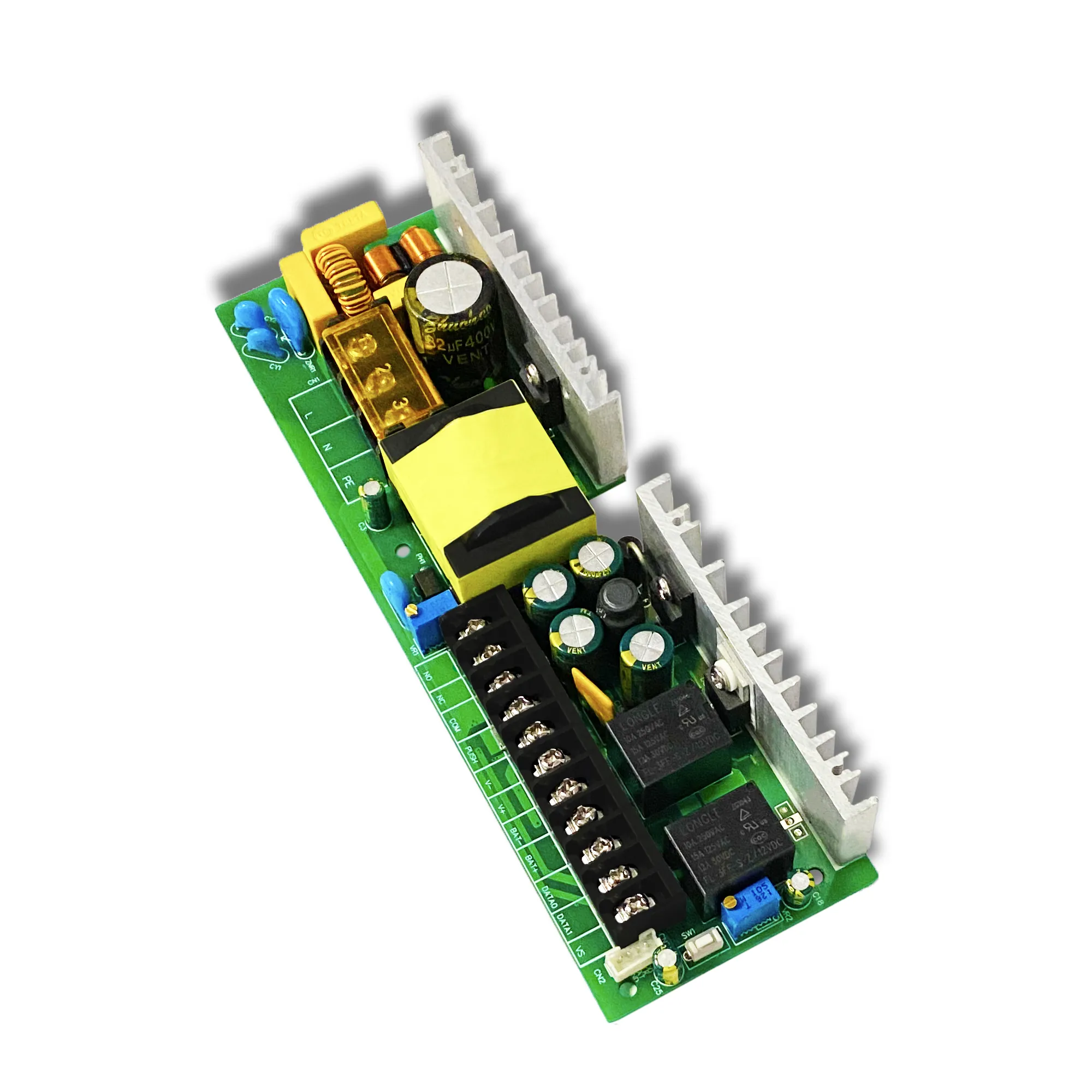
Sanyi's industrial-grade switching PSUs are designed to mount in PLC cabinets — either on 35 mm DIN rail (with a clip adapter) or directly on the cabinet base plate. All units below carry CE / RoHS at minimum, support AC 100-240V universal input, and ship with the standard four-protection set (OCP / OVP / SCP / OTP).
| Cabinet scale | PLC + I/O profile | Power class | Recommended series |
|---|---|---|---|
| Compact / sub-panel | Micro PLC, < 15 sensors, no valves | 48-120 W | ST Series 48W-120W |
| Small machine cabinet | PLC + HMI + 30-60 sensors, light I/O | 120-200 W | SFY-I Series 120W-200W |
| Standard automation cabinet | PLC + HMI + 50-150 sensors + valves + safety | 240-480 W | SFY-Z Series 240W-480W |
| Heavy / multi-cabinet, fan-cooled | Large I/O count, drive logic supplies, multi-zone | 240-480 W cabinet-mount | SZ Series 240W-480W |
Why these four tiers cover most PLC builds:
- The ST 48W-120W range fits compact cabinets where PLC + a handful of I/O is the entire bill of materials. Universal AC input, ≥ 84% efficiency, full four-protection set.
- The SFY-I 120W-200W is the "boring workhorse" tier — the one that quietly runs an OEM machine for ten years. Metal mesh housing for cabinet ventilation, 85% efficiency, 50,000+ hrs MTBF, multi-region certification (3C / CE / FCC / RoHS).
- The SFY-Z 240W-480W is the flagship industrial line: aluminum alloy housing, ≥ 87% efficiency, MTBF > 50,000 hrs published, full four-protection coverage. Multi-voltage option (12V / 24V / 36V / 48V) means the same SKU covers most automation projects.
- The SZ Series uses a square fan-cooled housing for high I/O density cabinets where ambient sits at +50°C for long stretches — ≥ 88% efficiency, multi-output (5V / 12V / 24V / 36V / 48V), built for large-scale automation and process control panels.
For very heavy single-cabinet builds (servo logic supplies, multi-axis motion), Sanyi's SW Series 500W-720W extends the range with forced-air cooling and the same protection coverage.
Redundant PSU Pair? Here's When It's Worth It
Two PSUs in a redundancy module (with diode-OR or active load-sharing) is overkill for a discrete machine cabinet — but it's the right call for: process-control panels with continuous operation, safety PLC zones, cabinets feeding a remote field I/O drop with no easy access, and any line where 30 minutes of unplanned downtime exceeds the cost of a second PSU. Size each unit at 70% of total load so either one alone keeps the line running.
What to Avoid: Three Field-Failure Patterns
Patterns you'll see when you walk a few customer sites:
1. The "I had a spare 240W brick" install. A desktop / wall-mount switching brick repurposed as the cabinet PSU. Works for a year. Then summer arrives, the cabinet ambient hits 45°C, the brick has no derating margin, capacitors cook, and the brand-new HMI dies with it because output ripple spiked outside spec.
2. The undersized "150W ought to do it" cabinet. Steady load math says 110W, so a 150W unit goes in at 73% load. Two years later the customer adds 20 sensors and a second HMI. Now it's at 95% steady. Capacitor aging takes that to 100% on hot days. PSU enters cycling thermal protection. PLC reboots three times a shift. Replacement costs more than the original "savings."
3. The "no PFC needed" assumption. Multi-cabinet line, six 200W PSUs without PFC, all on the same feeder. Line harmonics make commissioning fail the customer's electrical inspection. The retrofit is to swap every PSU. PFC isn't optional above 75W in most regions — design for it from day one.
FAQ
Q: Can I use a desktop adapter or generic switching brick instead of an industrial DIN rail PSU?
For a one-off lab demo or temporary fixture, yes. For a production cabinet, no. Generic bricks lack the surge tolerance (no Class III protection), have shorter hold-up time (5-10 ms vs 20-30 ms), and are not rated for the cabinet ambient (often 0-40°C, not -25 to +70°C). The cost difference between a generic brick and an industrial PSU is the cheapest line item in your BOM — saving on it is where projects fail.
Q: 24V vs 48V — when should I pick 48V for a PLC cabinet?
Default to 24V. It matches every major PLC ecosystem, sits below the SELV ceiling, and has the broadest sensor / I/O selection. Pick 48V only when you have a specific driver: long field bus runs (1.5 km+), heavy solenoid valve banks where wire-size cost dominates, or 802.3bt PoE feeding industrial cameras/IIoT devices. Mixing 24V and 48V on different rails inside one cabinet is normal and easy.
Q: How do I calculate the inrush / pickup current of solenoid valves?
Read the valve coil datasheet, not the catalog. Look for "pickup current" or "inrush current" — typically given as a multiple of the holding current (5-8x is normal for DC solenoid coils). Duration is 50-150 ms. The PSU has to deliver this peak without dropping the rail below the PLC brown-out threshold (~19.2V on a 24V system). Most industrial PSUs publish a peak rating like "1.5x rated for 3 seconds" — that's what you need to cover.
Q: Do I need a UPS in front of the DIN rail PSU?
Depends on the application. For machine cabinets where a controlled stop on power loss is acceptable, no. For continuous-process control (water treatment, chemical batch, semiconductor), yes — a 24V battery backup module on the DC side or a small AC UPS in front. For pure ride-through (millisecond brown-outs, not full outages), the PSU's own hold-up time is usually sufficient if you specified ≥ 20 ms.
Q: What's the right MTBF number to ask for?
Ask for MTBF at full load, 50°C ambient — not the marketing 25°C / no-load number. A genuine industrial PSU will publish 200,000+ hours at 50°C full load. Anything that only quotes the 25°C number is hiding something. Also: MTBF is a statistical fleet metric, not a guarantee for any single unit. Treat it as a comparator between products, not as "this PSU will last X years."
Q: Can I mount a Sanyi industrial PSU on a 35 mm DIN rail?
Sanyi's standard industrial PSUs (ST / SFY-I / SFY-Z / SZ series) are designed primarily for cabinet base-plate mounting with mounting feet/brackets. For 35 mm DIN rail mounting, a standard DIN clip adapter is used — common on the integrator side. If you need a strictly DIN-form-factor unit, contact us with your rail width and current requirement; custom DIN rail variants are available for OEM volume.
Summary
A correctly specified DIN rail PSU is the difference between an automation cabinet that runs untouched for ten years and one that the customer calls about every quarter. The action plan:
- List every load on the 24V rail with worst-case current, not typical
- Identify the largest plausible inrush event and confirm the PSU's peak rating covers it
- Add 30% headroom for aging, ambient, and future I/O
- Read the datasheet at 50°C, full load — not the marketing numbers
- Match the cabinet to the right power tier — ST for compact, SFY-I for small machine, SFY-Z / SZ for standard automation, SW for heavy
Next Steps
- Industrial PSU Products — Full lineup from 48W to 720W, CE / FCC / 3C / RoHS certified
- CCTV Power Supply Sizing Guide — A companion guide for distributed 12V / 24V loads
- Open-Frame vs Enclosed PSU Selection — When to use which form factor
- Contact Engineering — Bulk pricing, custom DIN rail variants, dedicated technical support for OEM and integrator projects
.webp)