


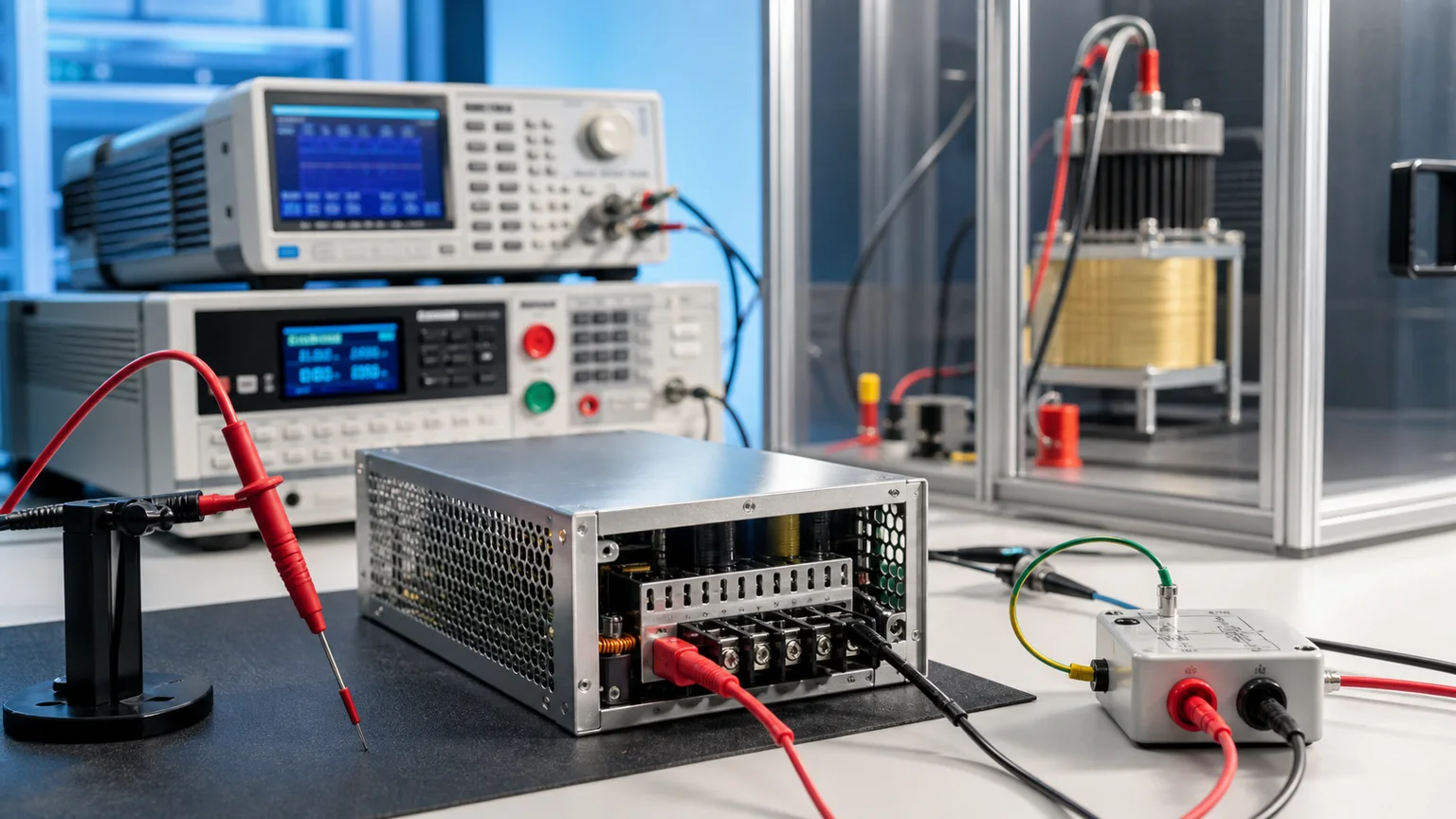

A medical device OEM finishes its third-generation patient monitor. Mechanical is signed off, the firmware passes internal QA, the clinical team is happy. The unit gets shipped to a notified body for IEC 60601-1 third-edition testing. Two weeks later the report comes back: patient leakage current at single fault condition exceeds the 100 µA limit for a Type CF applied part. The root cause sits in a single line on the bill of materials — an "industrial-grade 60W medical-style adapter" that meets 1×MOPP between primary and secondary, but not the 2×MOPP that a CF-floating SpO2 module requires. The whole device retests. Time-to-market slips by four months.
This is not a rare story. Power supply selection is one of the most common reasons medical devices fail their first IEC 60601-1 submission, alongside enclosure creepage/clearance and cable shielding. The 60601-1 third edition (3.1 + 3.2 amendments) raised the bar substantially over the second edition, and the 2014 4th-edition collateral standard 60601-1-2 EMC tightened immunity requirements again.
The global medical device market reached USD 542 billion in 2023 and is projected to grow at ~5% CAGR through 2030 (Grand View Research, 2024). Behind every CT scanner, infusion pump, ventilator, and home dialysis console sits at least one AC-DC power supply that has to meet IEC 60601-1 — and getting that selection right is the cheapest insurance an OEM can buy against a delayed launch.
Common 60601-1 Power Supply Failure Modes Seen at Notified Bodies
- 1×MOPP adapter selected for a 2×MOPP application — patient leakage current fails at single fault condition
- Industrial 4kV isolation mistaken for medical reinforced isolation — missing the second means of patient protection
- EMC immunity per 60601-1-2 4th ed. fails — radiated immunity at 10 V/m, conducted at 6 V across ISM bands
- Touch current exceeds 100 µA on enclosure — missing or undersized Y-capacitor on the secondary side
- Home-use device fails 60601-1-11 — no surge tolerance for the residential mains environment
- Risk-management file (ISO 14971) inconsistent with PSU datasheet — missing essential performance declaration
This guide walks through, in order: what IEC 60601-1 actually requires of an AC-DC power supply, the MOOP vs MOPP distinction every OEM must understand, how to map applied-part types (B, BF, CF) to isolation requirements, what 60601-1-2 4th edition does to your EMC budget, and which Sanyi platform candidates fit which medical OEM use cases.
What IEC 60601-1 Is — and What It Is Not
IEC 60601-1 is the general standard for basic safety and essential performance of medical electrical equipment. It is a horizontal standard: it applies to almost every powered medical device, and is then specialized by hundreds of "particular" standards (60601-2-XX) for individual device categories (60601-2-25 for ECGs, 60601-2-19 for infant incubators, etc.).
The third edition (IEC 60601-1:2005 + A1:2012 + A2:2020), often shortened to "60601-1 3rd ed." or "ed. 3.1 / 3.2," is the version most regulators currently require. Key concepts you must internalize before selecting a PSU:
- Means of Protection (MOP) — a barrier (insulation, creepage, clearance, protective earth, or impedance) that prevents an unsafe current from reaching either an operator or a patient.
- MOOP — Means of Operator Protection — protects the operator (clinician, technician). Borrowed from IEC 62368-1 / 60950 IT-equipment limits.
- MOPP — Means of Patient Protection — protects the patient. Stricter limits than MOOP. Higher creepage, higher dielectric strength, lower leakage budget.
- Applied Part — the part of the device that intentionally contacts the patient during normal use. Three types: B (no direct cardiac connection, modest leakage limits), BF (body floating, used for invasive but non-cardiac applications, lower leakage), CF (cardiac floating, direct cardiac contact, lowest leakage — 10 µA in single fault).
A device that only touches an operator (a network monitor in a nurse's station) needs MOOP. A device whose case the patient touches needs at least 1×MOPP. A device with an applied part that floats (electrically isolated from earth) needs 2×MOPP between mains and the applied part — usually one MOPP in the PSU and one MOPP in the device's own isolation barrier.
This is the single most expensive misunderstanding in medical PSU procurement. "60601-certified" alone says almost nothing — you need to know how many MOPPs, between which points, and whether MOOP is being substituted for MOPP somewhere in the chain.
MOOP vs MOPP — The Number That Decides Everything
A medical-grade AC-DC supply will quote its isolation in this exact format. Read carefully:
| Class | Dielectric strength (test voltage) | Creepage at 250 Vrms | Earth leakage (NC / SFC) | Patient leakage (NC / SFC) |
|---|---|---|---|---|
| 1×MOOP | ~1500 Vrms primary-secondary | ~2.5 mm | 5 mA / 10 mA | n/a |
| 2×MOOP | ~3000 Vrms (reinforced) | ~5.0 mm | 5 mA / 10 mA | n/a |
| 1×MOPP | ~1500 Vrms primary-secondary | ~4.0 mm | 500 µA / 1000 µA | 100 µA / 500 µA (B/BF) |
| 2×MOPP | ~4000 Vrms primary-secondary (reinforced) | ~8.0 mm | 500 µA / 1000 µA | 10 µA / 50 µA (CF) |
(Numbers above are summary references — always cross-check the latest 60601-1 amendment text before submission.)
The practical rule of thumb:
- Operator-only contact, no patient touch → 1×MOOP between mains and accessible parts is sufficient (e.g., a remote display in a hospital corridor).
- Patient touches the enclosure or a Type B applied part → at least 1×MOPP between mains and patient. Most OEMs use a 2×MOPP-rated medical PSU and treat that single barrier as both means.
- Type BF or CF applied part → 2×MOPP between mains and applied part is mandatory. Architecturally this is achieved by 1×MOPP in the PSU + 1×MOPP in the device's own isolation (e.g., a transformer-isolated front-end on the SpO2 or ECG channel).
- Defibrillator-proof (CF + ⚡ symbol) → adds the 5kV defibrillation discharge requirement on top of CF leakage. The applied-part barrier must survive the discharge without damaging the PSU side.
When you see a datasheet line that says "Isolation: 4 kVAC reinforced primary-to-secondary, 2×MOPP," that means the supply alone provides the two means of patient protection between mains and DC output. If it says "1×MOPP + 1×MOOP," the supply is not suitable for a CF or floating-applied-part architecture without additional isolation downstream.
Leakage Current — The Real Acceptance Criterion
60601-1 ed. 3 defines four leakage currents you must measure. The PSU determines three of them:
- Earth leakage current — current flowing from mains through the protective earth conductor. Limit: 5 mA normal condition (NC), 10 mA single fault condition (SFC). Driven by the Y-capacitor sizing on the PSU's primary.
- Touch current — current flowing from any accessible part through a person to earth. Limit: 100 µA NC / 500 µA SFC. The PSU's secondary-side Y-capacitor and the enclosure layout dominate this.
- Patient leakage current — current flowing from the applied part to earth, or from a non-applied part through the patient to earth. Limit: 100 µA NC / 500 µA SFC for B/BF, 10 µA NC / 50 µA SFC for CF.
- Patient auxiliary current — current flowing between applied-part connections in normal use. Same 10 µA / 50 µA ceiling for CF.
For a CF-floating architecture, the 10 µA single-fault budget is brutal. A single 2.2 nF Y-capacitor at 230 V / 50 Hz already conducts ~160 µA — sixteen times the limit. A medical PSU intended for CF applied parts uses drastically reduced or zero secondary Y-capacitance and pays for it in EMC headroom (which has to be recovered with better filtering, common-mode chokes, and shielded transformer construction).
This is why "replace the industrial supply with a medical one" is rarely a drop-in swap. The EMC behaviour, the touch-current envelope, and the layout requirements are all different. Plan it as a redesign of the power-input section, not a BOM substitution.
IEC 60601-1-2 4th Edition — What Changed in 2014 (and Why It Hurts)
The collateral standard for EMC, IEC 60601-1-2:2014 (4th edition), raised immunity requirements to reflect the reality of modern healthcare environments saturated with mobile phones, RFID, Bluetooth, Wi-Fi 6E, and 5G NR. The key changes vs the 3rd edition:
| Test | 3rd ed. (2007) | 4th ed. (2014) |
|---|---|---|
| Radiated RF immunity (general) | 3 V/m | 3 V/m, 80 MHz – 2.7 GHz |
| Radiated RF immunity (life-support / professional healthcare) | 10 V/m | 10 V/m + 9 spot frequencies at 9-28 V/m for ISM/cellular bands |
| Conducted RF immunity | 3 Vrms | 6 Vrms in ISM bands, 3 Vrms elsewhere |
| Surge immunity | ±2 kV line-to-earth | ±2 kV line-to-earth, ±1 kV line-to-line |
| EFT/Burst | ±2 kV power port | ±2 kV (5 kHz / 100 kHz) |
| Voltage dips/interruptions | Pre-defined limits | Tied to "essential performance" definition per ISO 14971 |
| Risk-management linkage | Loose | Test methods explicitly tied to risk file |
The big practical shift: the 4th edition explicitly ties EMC test results back to the device's risk-management file (ISO 14971) and to its essential performance definition. You can't just "pass EMC" — you have to prove that during the immunity test, the device either kept performing essentially or failed in a documented, safe manner.
For the PSU this means:
- Hold-up time matters more — voltage dips during the EMC test will reset the device unless the PSU rides through 20-30 ms of mains absence at full load.
- Output noise during conducted RF immunity has to stay within the digital subsystems' tolerance — secondary-side filtering and shielding are no longer "nice to have."
- Surge tolerance must be specified — a medical PSU that survives ±2 kV common-mode and ±1 kV differential without latching into protection.
Mapping Medical Applications to PSU Requirements
A reference table for OEM platform decisions:
| Application | Applied-part type | Isolation requirement | Typical PSU class | Key constraint |
|---|---|---|---|---|
| Bedside patient monitor | BF (NIBP, SpO2, temp) or CF (ECG) | 2×MOPP mains-to-patient | 60-120 W medical desktop adapter | Low touch current; 60601-1-2 4th ed. EMC |
| Volumetric infusion pump | B (enclosure) | 1×MOPP minimum, often 2×MOPP for redundancy | 30-60 W medical desktop / wall-mount | Long MTBF, ride-through, hold-up |
| Home-use ventilator / CPAP | B / BF | 2×MOPP + IEC 60601-1-11 home-use compliance | 60-120 W medical desktop adapter | Acoustic noise, residential surge, mechanical robustness |
| Nebulizer, blood pressure cuff | B | 1×MOPP (often 2×MOPP for safety margin) | 10-24 W medical wall-mount adapter | Low cost, broad mains range, light weight |
| Dental chair / unit | B (chair), BF (handpiece) | 2×MOPP for handpiece supply | 100-240 W desktop / built-in | Multi-output, sterilization-area EMI |
| Portable ultrasound | BF (transducer) | 2×MOPP mains-to-applied-part | 90-150 W medical desktop adapter | High-efficiency, low fan noise, battery interaction |
| Patient-near workstation (PACS/EHR) | None (operator only) | 1×MOOP sufficient | Standard ITE supply | Cost-driven; often no medical PSU needed |
| Defibrillator console | CF defib-proof | 2×MOPP + 5 kV defib withstand on applied side | 100-240 W medical | Defib-proof design at applied-part barrier |
| Hospital LED imaging luminaire | None | 1×MOOP if non-patient-touching | 100-300 W LED driver | EMC class B, long lifetime |
| AGV / hospital logistics robot | None | 1×MOOP / industrial | Industrial battery charger, not medical-class | Cycle life, IEC 60601-1-2 EMC if shared environment |
The rule: the closer the device gets to the patient — and the deeper inside the body its connection goes — the stricter the isolation, leakage, and EMC budget become. Pick the PSU class to match the worst-case applied-part type on the device, not the average.
Key Spec Lines That Actually Matter on a Medical PSU Datasheet
When evaluating a medical-grade adapter or built-in PSU, focus on these — in this order:
- Isolation rating in MOPP/MOOP terms, with the test voltage — e.g., "4 kVAC reinforced primary-to-secondary, 2×MOPP." Don't accept "medical-grade" as a substitute for an explicit MOPP count.
- Leakage current at rated input — earth leakage and touch current must be published with both NC and SFC figures, ideally at 264 VAC worst case.
- EMC compliance to 60601-1-2 4th edition — emissions Class B (suitable for both professional healthcare and home environment) and immunity per the home-healthcare or professional table, depending on intended use.
- Compliance to 60601-1-11 (home use) — only relevant for home/transit-use devices, but mandatory there. Adds residential surge, drop, and mechanical robustness on top of base 60601-1.
- Operating temperature range — most medical PSUs target 0 to +40°C ambient (clinical environment); home-use covers 5 to +40°C. Industrial medical (e.g., ambulance, MRI room) may need −20 to +50°C.
- MTBF and expected service life — published at full load, 40°C ambient. ≥ 100,000 hours MTBF is a reasonable floor; for life-supporting applications, look for published lifetime testing data rather than only an MTBF number.
- Hold-up time at full load — ≥ 20 ms is the minimum to ride through brown-outs and the EMC voltage-dip test. ≥ 30 ms for life-support applications.
- Efficiency at typical load — efficiency drives heat, fan noise, and capacitor lifetime. Look for ≥ 90% at 50% load on 60-120W class adapters.
- Certifications carried — IEC/EN 60601-1, IEC/EN 60601-1-2, plus regional safety marks (UL, CSA, CCC, PSE, KC). FDA and CE-MDR live at the device level, not the PSU level — but the PSU certificates feed into the device dossier.
- Documentation package — a credible medical-PSU vendor delivers a CB report, declarations, and traceable test data. If the vendor cannot supply these, the supply is not medical-grade regardless of marketing copy.
What does not belong in a medical PSU spec evaluation:
- "Industrial-grade 4kV isolation" — without the MOPP qualifier, it's a MOOP-class isolation.
- "Pass IEC 60950" — superseded by 62368-1; either way it's an ITE standard, not medical.
- "Compliant with 60601" without an edition number — usually means 2nd edition at best.
- A datasheet without published leakage current numbers.
Sanyi Platform Candidates for Medical OEM Evaluation
Sanyi's standard catalog focuses on industrial, commercial, and consumer power supplies. For medical OEM customers, several of our platforms are architecturally suited as starting points for medical-grade variants — designed with reinforced isolation, low secondary noise, broad universal-input range, and long-life capacitor selection. Final IEC 60601-1 / 60601-1-2 certification path is handled per project as a custom medical variant, with documentation and notified-body support delivered alongside the build.
| Medical use case | Power class | Sanyi platform candidate |
|---|---|---|
| Bedside monitor, portable ultrasound, home ventilator | 60-120 W desktop adapter | APE Series Desktop Adapter 48W-120W |
| Dental chair logic, infusion pump, nebulizer compressor | 36-96 W desktop adapter | APH Series High-Power Desktop Adapter 36W-96W |
| Blood pressure cuff, pulse oximeter, small home-care | 10-36 W premium wall-mount | APQ Series Premium Wall-Mount Adapter 10W-36W |
| Built-in PSU for diagnostic imaging cart, lab analyser | 120-200 W enclosed | SFY-I Series 120W-200W |
Why these four platforms map to medical OEM needs:
- The APE 48W-120W desktop adapter range covers the 60-120W sweet spot for bedside monitors, home ventilators, and portable ultrasound. Universal AC 100-240V input, low-profile enclosure, multi-region safety certifications as a baseline.
- The APH 36W-96W high-power desktop adapter is the workhorse for infusion pumps, nebulizer compressors, and dental unit logic supplies — moderate power, dependable, with the form factor clinical staff are used to.
- The APQ premium wall-mount 10-36W addresses the small-power home-care category where cost and weight matter as much as compliance — blood pressure cuffs, pulse oximeters, otoscopes.
- The SFY-I 120W-200W enclosed switching PSU is the platform for built-in medical applications: diagnostic imaging carts, lab analysers, sterilisation equipment — where the supply lives inside the device and a desktop adapter form factor doesn't fit.
For very low-power applications (handheld diagnostics, wearables), Sanyi's APX Wall-Mount Adapter 12W-36W and APM Universal Wall-Mount 10W-24W extend the range downward.
Custom Medical Variants — How the OEM Engagement Works
Medical-grade certification is a per-project deliverable, not an off-the-shelf SKU. A typical engagement: (1) the OEM shares the device's intended use, applied-part type, and target markets; (2) we agree on the MOPP count, leakage budget, EMC profile (60601-1-2 4th ed. professional-healthcare or home-use), and any 60601-1-11 / 60601-1-12 / 60601-1-9 collateral applicable; (3) we engineer the medical variant on the chosen platform (Y-cap reduction, secondary shielding, hold-up tuning) and submit to a notified body or accredited test house; (4) the OEM receives the CB report, certificates, and full documentation package needed for the device's own 60601 dossier.
Three Procurement Anti-Patterns to Avoid
Patterns that show up at every notified body that does medical EMC and safety:
1. The "industrial 4kV is the same as medical" assumption. An industrial supply with 4 kVAC primary-to-secondary isolation looks identical on paper to a medical 2×MOPP supply. It isn't. The industrial unit's leakage budget, creepage, and EMC profile are sized for IEC 62368-1, not for a CF-floating applied part with a 10 µA single-fault limit. Substitution will fail submission.
2. The "we'll add isolation downstream" plan. Architecting around a cheaper 1×MOPP supply by adding a secondary isolation barrier inside the device is a valid pattern — but only if the downstream barrier is engineered, tested, and documented as a means of protection. Most OEMs underestimate the creepage / clearance / dielectric work required, and the project ends up worse off than buying a 2×MOPP supply at the start.
3. The "60601 second edition is fine" shortcut. A 60601-1 ed. 2 supply that has not been re-certified to ed. 3 (or ed. 3.1 / 3.2) will be rejected by every major regulator now. Edition migration is non-trivial — different leakage method, different isolation requirements, different EMC referencing. Always specify the edition explicitly when requesting quotations.
FAQ
Q: What is the practical difference between 2×MOPP and 2×MOOP?
2×MOOP is operator protection — the same isolation level you'd build into any IT or industrial product per IEC 62368-1. 2×MOPP is patient protection — higher creepage (~8 mm vs ~5 mm at 250 V), much tighter leakage budget (especially under single-fault condition), and stricter EMC immunity if 60601-1-2 4th edition applies. A device whose patient touches its enclosure or applied part needs MOPP, not MOOP, between the patient and mains. Substituting MOOP where MOPP is required is the most common 60601 failure cause.
Q: Can I use a 60601-1 ed. 2 power supply on a new device design?
In almost no major market, no. The US, EU, China, Japan, and most others have transitioned to ed. 3.1 / 3.2 as the active edition. An ed. 2 supply will not satisfy the device-level certification you actually need to ship. Migrating from ed. 2 to ed. 3 is not a paperwork exercise — leakage is measured differently, isolation thresholds are tighter, and the EMC standard (60601-1-2) has gone through two revisions in the same period. Specify ed. 3.1 or ed. 3.2 explicitly when sourcing.
Q: My device is for home use. Do I need 60601-1-11 in addition to 60601-1?
Yes, if it's intended for use in the home healthcare environment (CPAP, home dialysis, glucose meter, home oxygen concentrator, infant monitor). 60601-1-11 adds requirements on top of 60601-1: mains surge tolerance for residential power, mechanical robustness (drop / vibration), audible alarm levels, ingress protection appropriate for home environments, and operation across a wider ambient range. The PSU has to survive the residential surge profile (≥ 1 kV line-to-line, 2 kV line-to-earth) without latching, and the device has to ride through the mains-dropout test sequences. A pure clinical 60601-1 PSU is not automatically 60601-1-11 compliant.
Q: What is "essential performance" and why does the PSU care?
Essential performance is the device's defined performance whose failure would result in unacceptable risk per ISO 14971 — for an infusion pump, accurate dose delivery; for a defibrillator, the ability to deliver a discharge. 60601-1-2 ed. 4 ties EMC test pass/fail to whether essential performance is preserved during immunity testing. Power supply hold-up time, ride-through behavior, and output noise during EMC events directly determine whether the device keeps performing essentially. This is why hold-up at full load and surge tolerance matter so much on a modern medical PSU spec.
Q: Do I need a custom PSU, or can I qualify a standard medical adapter?
For new platforms with unusual power profiles, regional certification mixes, or specific MOPP / leakage / EMC constraints, a custom medical variant gives you a much cleaner submission. For high-volume devices with stable specs, qualifying a standard medical adapter SKU is faster and lower-risk. A reasonable default: prototype on a standard adapter, freeze the platform, then commission a custom variant for production once the device's certification path is clear. This is the engagement model we typically use with OEM customers.
Q: How long does medical PSU certification typically take?
For a custom variant of an existing platform: 8-16 weeks typical from spec freeze to CB report, depending on the certification scope (60601-1 only vs 60601-1 + 60601-1-2 + 60601-1-11) and notified-body queue. Brand-new platform development is 6-12 months. Always plan the PSU certification path on a critical-path Gantt alongside the device's own clinical / regulatory timeline — the cheapest mistake is to discover at month 11 that the PSU certificate isn't ready.
Summary
A correctly specified medical-grade PSU is the difference between a device that clears 60601-1 on the first submission and one that retests for four months with the project budget bleeding. The action plan:
- Define the applied-part type first — B, BF, or CF — and let that determine the MOPP count
- Specify isolation in MOPP terms with the test voltage, not generic "4kV" or "medical-grade"
- Read the leakage current numbers at NC and SFC, at worst-case input voltage
- Match the EMC profile to the use environment — professional healthcare, home use, or transit
- Add 60601-1-11 / -1-12 / -1-9 collateral standards as the application requires
- Treat the PSU certification path as a project deliverable with its own schedule and risk file
Next Steps
- Desktop & Wall-Mount Adapter Lineup — Platform candidates from 10W to 200W for medical OEM evaluation
- Industrial DIN Rail PSU Selection Guide — Companion guide for non-patient-contact industrial sub-systems
- Open-Frame vs Enclosed PSU Selection — When to use which form factor inside a medical device
- Contact Engineering — Discuss your device's applied-part type, target markets, and certification timeline; get a project-specific medical variant proposal
.webp)
.webp)