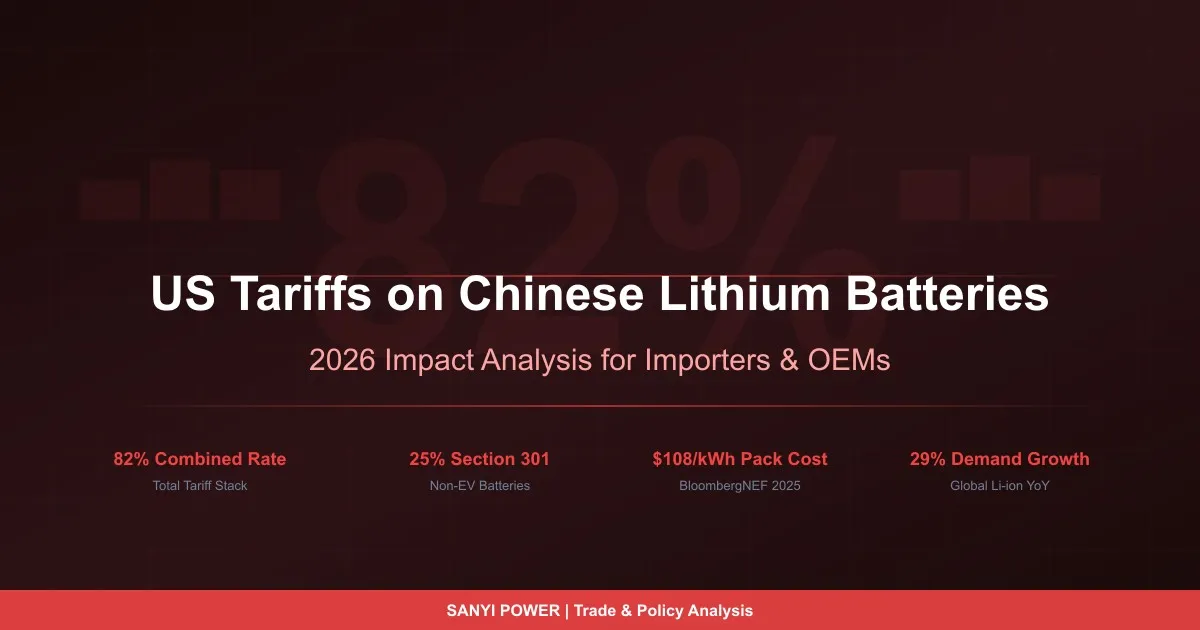

On January 1, 2026, the US Section 301 tariff on non-EV lithium batteries from China jumped from 7.5% to 25%. Stack that on top of the 3.4% base MFN duty and the 54% reciprocal tariff, and the combined rate lands at roughly 82%. A battery pack with a $100 factory price now carries about $82 in tariffs alone before it clears customs. For importers and OEMs reliant on Chinese lithium cell supply chains, 2026 demands a fundamentally different procurement playbook.
TL;DR: US tariffs on Chinese lithium batteries now total approximately 82% (3.4% base + 54% reciprocal + 25% Section 301), up from roughly 11% before 2026. Battery pack costs have dropped to $108/kWh globally (BloombergNEF via CALSTART, 2025), but tariffs erase most of that savings for US buyers. Supply chain diversification is no longer optional.
How Does the 82% Tariff Break Down?
The tariff isn't a single levy — it's three layers stacked together. According to the US Trade Representative (USTR), the Section 301 surcharge on non-EV lithium batteries rose from 7.5% to 25% effective January 1, 2026. Add the 3.4% MFN base duty and the 54% reciprocal tariff, and the combined rate reaches approximately 82.4%.
Three Layers Explained
The base MFN duty sits at 3.4% and applies to lithium-ion batteries (HTS 8507.60) from all countries. It's the standard WTO rate and has been stable for years.
The reciprocal tariff at 54% is the broadest layer. It emerged from the escalating US-China trade measures in 2025 and covers a wide range of Chinese goods, lithium batteries included.
The Section 301 surcharge makes up the final 25%. EV lithium batteries already hit this rate in September 2024 (USTR, 2024). The 2026 adjustment extends the same 25% to all non-EV lithium batteries — covering everything from power tool packs to grid-scale energy storage modules.
Which Products Are Directly Affected?
It's not just bare cells. According to US International Trade Commission (USITC) HTS classifications, all lithium-ion batteries under HTS 8507.60 — cells, modules, and complete battery packs — face the full 82% combined rate. Energy storage systems, power tool batteries, and portable power stations all fall within scope.
Lithium Batteries (HTS 8507.60)
This is the category with the largest impact. Whether it's a small consumer electronics cell or a large-format module for commercial storage, the 82% combined tariff applies if the origin is China. One important exception: batteries already assembled into finished equipment may qualify under a different HTS code with a different rate. Consult your customs broker for product-specific rulings.
Natural Graphite (HTS 2504)
A critical upstream material for lithium battery anodes is also in the crosshairs. Per USTR announcements, the Section 301 tariff on natural graphite rises to 25% by January 2026. Given that China controls roughly 70% of global graphite processing capacity, this increase will ripple through battery manufacturing costs worldwide.
Battery Chargers (HTS 8504.40)
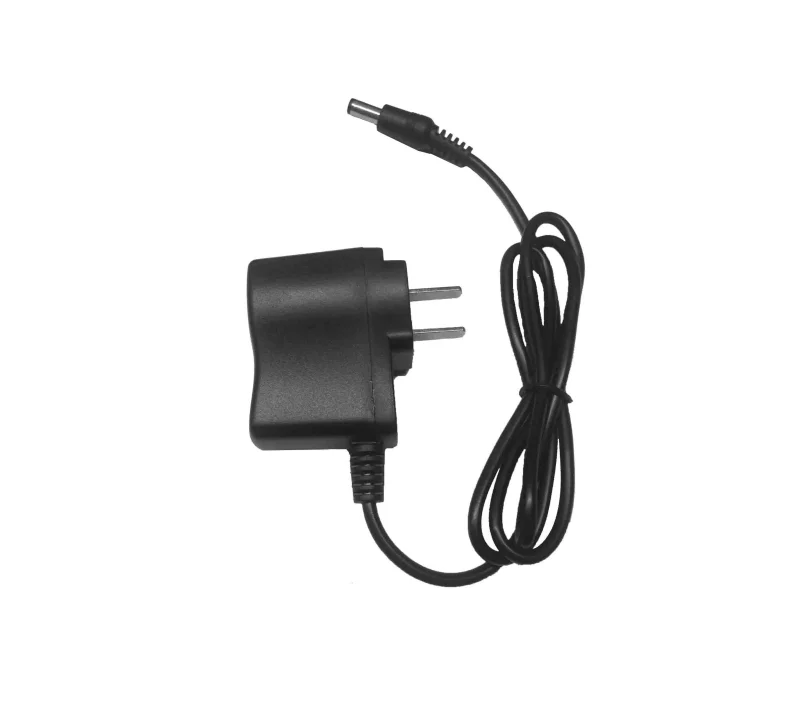
This one catches people off guard. Battery chargers aren't on the Section 301 lithium battery list specifically, but certain charger products in adjacent HTS codes are already subject to the 54% reciprocal tariff. Importers should verify each charger SKU's exact HTS classification to avoid overpaying — or worse, underpaying and facing penalties later.
What Does This Mean for the Global Lithium Battery Market?
Global lithium battery demand is still surging. Benchmark Minerals Intelligence reported that worldwide lithium-ion battery demand grew 29% in 2025, surpassing 1.2 TWh. But the US tariff wall is reshaping trade flows, forcing supply chains toward Southeast Asia and North American localization.
The Cost-Demand Paradox
Battery costs are genuinely falling. According to BloombergNEF via CALSTART, global average battery pack prices dropped to $108/kWh in 2025 — an 8% decrease from 2024. But 82% tariffs nearly wipe out that cost advantage for Chinese-origin batteries. A $108/kWh pack imported from China incurs roughly $89 in tariffs alone, pushing the landed cost close to $197/kWh.
Here's the paradox worth sitting with: global technological progress in battery manufacturing is delivering real cost reductions, but US tariff policy is neutralizing those gains for the American market. For small and mid-size OEMs that can't quickly switch suppliers, this isn't a "pay a bit more" situation. It's a question of whether their entire product pricing model still works.
Supply Chain Migration Trends
A growing number of Chinese battery manufacturers are building capacity in Southeast Asia — Vietnam, Indonesia, Malaysia — to sidestep origin-of-goods restrictions. But there's a catch. US Customs and Border Protection (CBP) is tightening scrutiny on "substantial transformation" claims. Simple assembly or relabeling won't cut it. The finished product must undergo a meaningful manufacturing change in the third country to qualify for a different origin.
How Should Importers Respond?
There's no silver bullet, but several pragmatic paths exist. Industry consultants widely recommend completing a tariff exposure audit across your existing supply chain within 30 days. Knowing the exact HTS classification and applicable rate for every SKU is the non-negotiable first step.
Short-Term Strategies (0-6 Months)
Re-examine HTS classifications. Tariff rates can vary significantly across closely related HTS codes. For example, a battery management system (BMS) imported separately may fall under a different code than a complete battery pack. Work with a specialized customs broker to ensure every product sits in the most favorable compliant classification.
Explore tariff exclusion requests. USTR periodically opens exclusion processes for Section 301 tariffs. Approval rates aren't high, but for products with no viable alternative supply source, the effort is worth pursuing.
Medium-Term Strategies (6-18 Months)
Diversify suppliers. South Korean manufacturers (Samsung SDI, LG Energy Solution), Japanese firms (Panasonic), and emerging European cell makers are all potential alternatives. While unit costs may be higher than Chinese suppliers in the short term, the tariff-adjusted landed cost gap is narrowing fast.
Pursue local sourcing. As US domestic battery capacity ramps up under the Inflation Reduction Act (IRA), some demand can shift to North American suppliers by 2027-2028. Securing letters of intent and capacity allocations now is a smart hedge.
Frequently Asked Questions (FAQ)
Does the 82% tariff apply to all Chinese lithium batteries?
Yes. All Chinese-origin lithium-ion batteries under HTS 8507.60 — including cells, modules, and packs — face the combined rate of approximately 82% (3.4% MFN + 54% reciprocal + 25% Section 301). EV lithium batteries were already raised to 25% under Section 301 in September 2024 (USTR, 2024). Batteries embedded in finished products may qualify under different HTS codes.
Are battery chargers also affected?
Battery chargers (HTS 8504.40) aren't specifically listed in the Section 301 lithium battery tariff action. However, some charger models already face the 54% reciprocal tariff depending on their exact HTS classification. Check each product's classification with your customs broker — misclassification can lead to underpayment penalties or overpayment.
Can routing through Southeast Asia avoid the tariff?
Not necessarily. US Customs and Border Protection (CBP) enforces a "substantial transformation" standard for country-of-origin determinations. Simple transshipment, repackaging, or final assembly typically doesn't qualify. If CBP determines the routing is a circumvention scheme, retroactive duties and penalties can apply.
Will tariffs continue to increase?
It's possible. US-China trade policy remains highly unpredictable. Analysis from the Peterson Institute for International Economics (PIIE) suggests further escalation can't be ruled out under the current political environment. Building supply chain resilience — rather than betting on a policy reversal — is the safer approach.
Conclusion
The 82% combined tariff marks a new era for Chinese lithium battery exports to the United States. Global demand grew 29% in 2025 (Benchmark Minerals), and pack costs fell to $108/kWh (BloombergNEF), but those tailwinds are largely offset by tariff headwinds in the US market.
For importers, the window for action is open now. In the short term, optimize HTS classifications and file exclusion requests. Over the medium term, diversify toward Korean, Japanese, and European suppliers while tracking IRA-backed domestic capacity coming online. Waiting isn't a strategy — the tariff environment is only getting more complex.
If you're sourcing charging solutions for lithium battery projects, our battery charger selector tool can help match your technical requirements quickly.