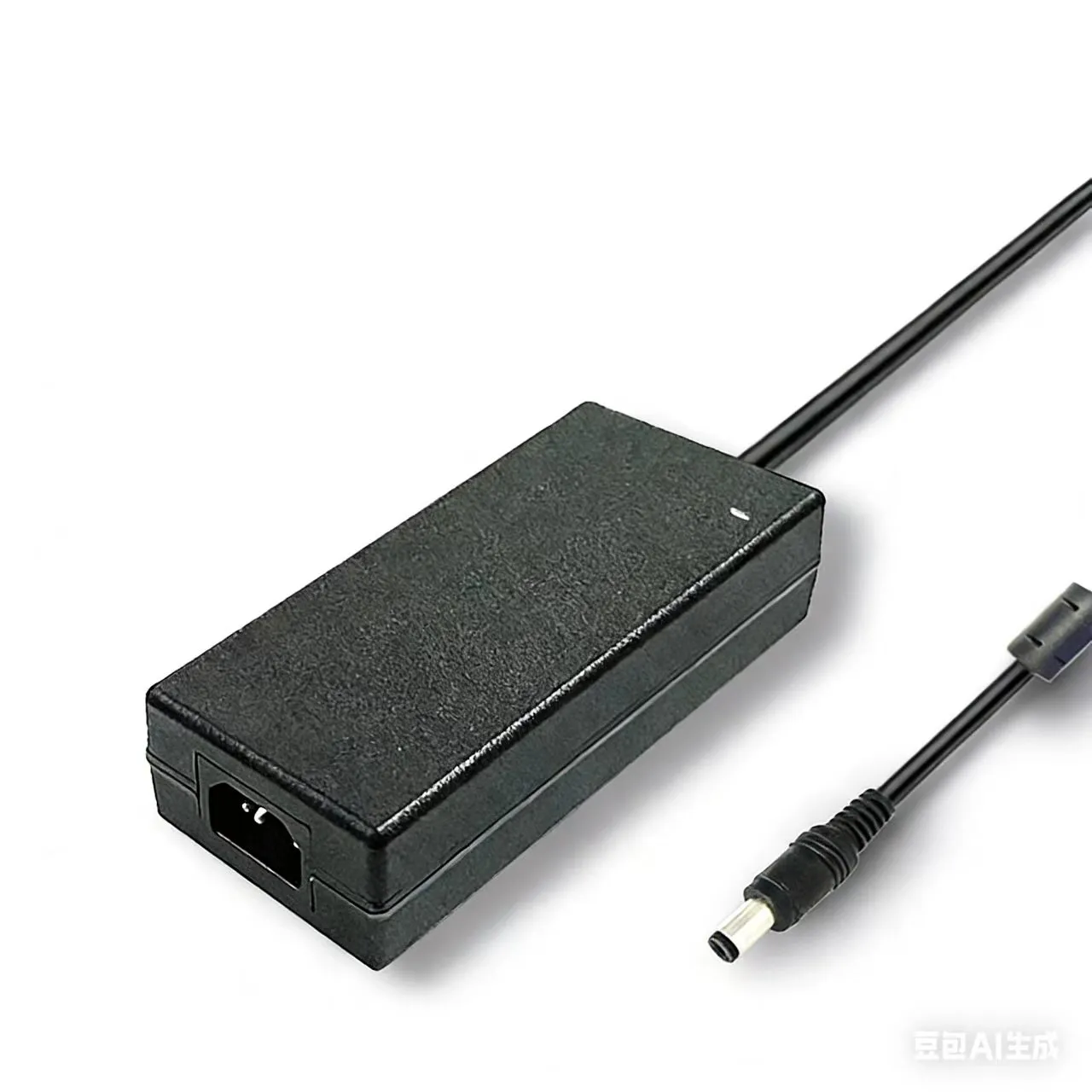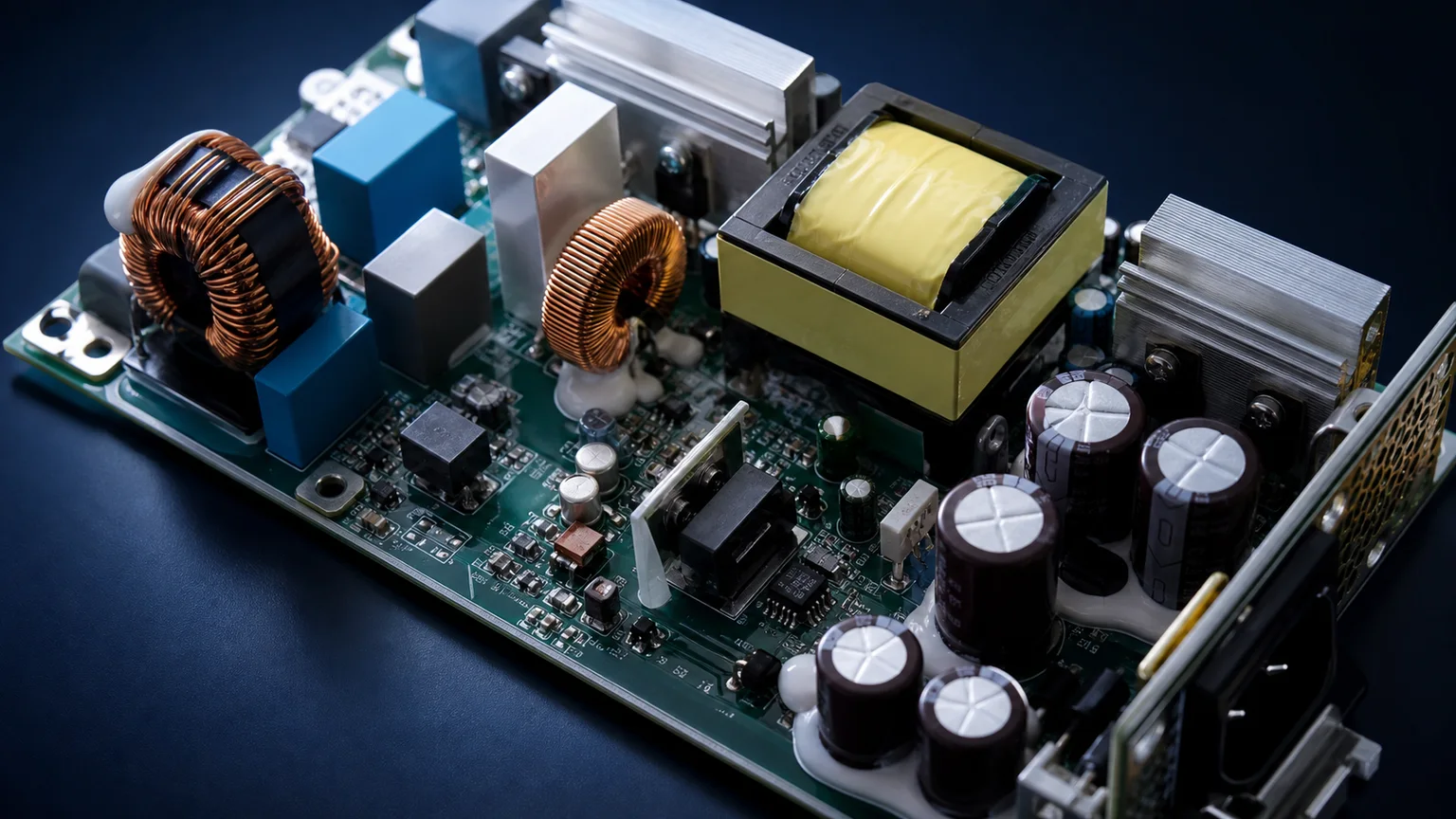

A power supply passes every certification, ships, and then a whole production line trips every time the OCP (overhead conveyor power) contactor slams across the room. The PLC reboots, the HMI blanks, the line halts — for a mains glitch that lasted 5 milliseconds. The data sheet says the supply is fine. The lab report says the supply is fine. But on the factory floor, running at 100 VAC low line with the controller drawing only 30% load, that supply drops out of regulation in 8 ms — and the 5 ms grid dip, repeated dozens of times a shift, is enough to halt the entire plant. The number nobody checked was hold-up time, and it is the difference between a supply that rides through a flicker and one that takes the line down with it.
This guide explains how hold-up time and ride-through are actually defined and specified on AC-DC adapters and switching power supplies: what hold-up time means and how it is measured, the real industry target numbers, how to size the bulk capacitor from the energy equation, why the low-line case is the worst case, how brown-out differs from blackout, how topology changes the answer, and the pitfalls that turn a "compliant" supply into a nuisance-trip generator.
Hold-Up Time vs Ride-Through vs UPS: Three Layers of Power Protection
Mains disturbances span six orders of magnitude in time, and no single mechanism covers them all. Three layers stack up, each handling a different timescale:
- Hold-up time (milliseconds) — the energy stored inside the power supply itself, in its bulk capacitor, that keeps the output in regulation after AC fails. Typically 10–20 ms. It is free (you already paid for the cap) and instantaneous, but tiny.
- Ride-through (tens to hundreds of milliseconds) — the ability to survive a voltage sag rather than a complete blackout, often defined at the system or facility level. SEMI F47 asks semiconductor-fab equipment to ride through a 50% sag for 200 ms. This needs either a large bulk reserve, a boost/active front end, or a small energy buffer.
- UPS (seconds to minutes) — an external battery or supercapacitor bank in an online, line-interactive, or standby topology that bridges to a generator or graceful shutdown.
The three are complementary, not redundant. Hold-up keeps a PSU alive across the gap between mains peaks and short grid glitches; ride-through keeps it alive across deeper sags; a UPS keeps it alive across a real outage. Designing only one layer and assuming it covers the others is how plants trip on disturbances they thought they were protected against. For the upper layers, see our online vs line-interactive vs standby UPS topology guide and data center UPS vs industrial UPS selection guide.
What Hold-Up Time Actually Means
Hold-up time is the interval from the instant AC input is removed to the instant the DC output falls below its regulation limit (commonly −5% of nominal). During that interval the converter keeps switching, but its energy comes entirely from the bulk capacitor on the high-voltage DC link, which discharges from its peak charge down to the converter's minimum operating voltage (V_min).
The critical subtlety is that hold-up is not one number — it depends on three conditions that must all be stated for the spec to mean anything:
- Load — hold-up is longest at light load (the cap drains slowly) and shortest at full load. A 16 ms@100% spec and a 16 ms@50% spec describe very different supplies.
- Line voltage — at low line the bulk cap charges to a lower peak voltage, so there is less stored energy and far less hold-up. The worst case is the lowest specified input.
- Output regulation threshold — the time depends on how far the output may droop before it counts as "dropped out," usually −5%.
A credible spec reads like "hold-up time ≥ 16 ms at 100% load, 115 VAC, output within −5%." A number quoted without load and line voltage is unverifiable — and almost always measured at the flattering high-line, half-load corner.
Industry Hold-Up Time Targets
Different standards pin hold-up to their own load and input conditions. The numbers only mean something with their test conditions attached:
| Standard / domain | Hold-up target | Load condition | Input voltage | Notes |
|---|---|---|---|---|
| Intel ATX 12V | ≥ 16 ms | 100% rated | 115 VAC | PC desktop PSU baseline |
| Intel ATX 12VO | ≥ 12–16 ms | 12 V rail at rated | 115 VAC | Single-rail mainboard spec |
| SSI EPS (server) | ≥ 10 ms @100% / ≥ 22 ms @50% | 100% / 50% | 115 VAC | Server / workstation PSU |
| Intel DPS (server) | ≥ 12 ms | rated | 115 VAC | Redundant server supply |
| Medical ICU equipment | ~20 ms (typical) | rated | nominal | IEC 60601-1 sets no fixed value; clinical practice drives it |
| Industrial DIN-rail | ≥ 20 ms | rated | nominal | Common automation requirement |
| Semiconductor fab — SEMI F47 | ride through 200 ms | — | 50% voltage sag | Facility ride-through, not pure hold-up |
Note the SSI line: the same supply quotes 10 ms at full load but 22 ms at half load — proof that load condition is half the spec. And note that IEC 60601-1 mandates no fixed hold-up value for medical equipment; the ~20 ms figure is a practical target driven by ICU continuity needs, not a regulatory minimum.
Sizing the Bulk Capacitor: The Energy Equation
Hold-up is an energy problem. The bulk capacitor stores E = ½CV², and during hold-up it gives up the energy between its starting voltage V₁ and the converter's minimum operating voltage V₂:
E_available = ½C(V₁² − V₂²)
That energy must feed the output power P_out for the hold-up time t, accounting for converter efficiency η:
P_out · t / η = ½C(V₁² − V₂²)
Solving for the capacitance:
C_bulk ≈ 2 · P_out · t / [η · (V₁² − V₂²)]
Worked example. A 240 W supply needs 16 ms of hold-up at η = 0.9. After the bridge rectifier the bulk cap charges to roughly V₁ = 120 V (low-line peak, see below), and the converter still regulates down to V₂ = 80 V:
C ≈ 2 × 240 × 0.016 / [0.9 × (120² − 80²)] = 7.68 / [0.9 × 8000] = ≈ 1070 µF... at low line.
If you instead (wrongly) size at high line where V₁ ≈ 320 V, the same 16 ms needs only ~110 µF. That order-of-magnitude gap between low-line and high-line sizing is exactly why so many supplies pass on the bench and fail in the field — they were sized for the easy corner.
Universal Input 85–265 VAC: Why Low Line Is the Worst Case
A universal-input supply must hold up across the whole 85–265 VAC range, and the bulk cap voltage tracks the peak of the rectified line:
- At 85 VAC low line: V_peak = 85 × √2 ≈ 120 VDC → small (V₁² − V₂²), short hold-up.
- At 265 VAC high line: V_peak = 265 × √2 ≈ 375 VDC → large (V₁² − V₂²), long hold-up.
Because energy goes as V², the hold-up at high line can be 4–9× longer than at low line for the same capacitor. A supply specified "20 ms hold-up" tested at 230 VAC may deliver only 4–5 ms at 90 VAC — and a 5 ms grid glitch will then take it down. This is why the spec must state the test voltage, and why a serious data sheet quotes hold-up at the lowest operating input, not the highest. PFC-boosted front ends partly escape this trap by holding the bulk rail near 385–400 V regardless of input, which is one reason active PFC matters beyond efficiency — see our active vs passive PFC selection guide.
Brown-Out vs Blackout: Two Different Failure Paths
"AC failed" can mean two physically different events, and a supply rides through them by different mechanisms:
- Blackout — input drops to zero instantly. The bulk capacitor alone supports the output; hold-up time is exactly the energy-equation result above. The controller stays in normal mode until V_bulk falls to V_min, then drops out cleanly.
- Brown-out — input sags and stays low (e.g., 85 VAC → 60 VAC) without disappearing. The bulk cap charges to a reduced peak and the supply may operate continuously at the edge, or the controller may enter UVLO (under-voltage lockout) and shut down to protect itself even though some input remains. Brown-out can be more hazardous than blackout because repeated marginal operation and UVLO chattering stress the converter without a clean restart.
A supply that survives a clean blackout can still misbehave during a slow brown-out if its UVLO hysteresis and soft-start are not tuned for it. Both paths must be validated; testing only an abrupt blackout misses the brown-out failure mode entirely.
How Topology Changes Hold-Up
The same bulk capacitor delivers very different hold-up depending on how low the converter can keep regulating — that is, on V_min, which is a topology property:
| Topology | Typical V_min | Hold-up for same bulk cap | Why |
|---|---|---|---|
| LLC resonant | 60–70 VDC | Longest (1.5–2×) | Wide gain range; resonant tank keeps output up as V_bulk falls deep |
| Hard-switched forward | 100–110 VDC | Baseline | Limited duty-cycle range caps how low V_bulk can go |
| Hard-switched flyback | ~100 VDC | Baseline | Duty-cycle and transformer ratio limit minimum input |
Because hold-up scales with (V₁² − V₂²), pushing V_min from 100 V down to 65 V dramatically enlarges the usable energy window. An LLC stage can squeeze 1.5–2× the hold-up out of the same bulk capacitor a hard-switched forward would use — or hit the same hold-up target with a smaller, cheaper cap. This is one of the strongest practical arguments for resonant topologies; the full trade-off is in our LLC resonant vs hard-switched topology selection guide.
Bulk Cap Sizing Quick-Reference Table
Using the energy equation with η = 0.9, V₁ = 120 V (low line) and V₂ = 80 V, the required bulk capacitance for common power and hold-up combinations:
| Output power | 10 ms hold-up | 16 ms hold-up | 20 ms hold-up |
|---|---|---|---|
| 65 W | ≈ 180 µF | ≈ 290 µF | ≈ 360 µF |
| 120 W | ≈ 330 µF | ≈ 535 µF | ≈ 670 µF |
| 240 W | ≈ 670 µF | ≈ 1070 µF | ≈ 1330 µF |
These are low-line worst-case values — the numbers you must design to. At high line (V₁ ≈ 320 V) the same targets need roughly one-tenth the capacitance, but sizing there is the classic field-failure trap. Always size at the lowest specified input.
Bulk Cap vs Inrush Current: The Trade-Off
Hold-up tempts you toward an ever-larger bulk capacitor, but the bigger the cap, the worse the inrush current at power-on, because that empty capacitor looks like a near-short to the mains at the first peak:
- Bigger bulk cap → longer hold-up, but a larger charging surge that can weld relay contacts, nuisance-trip breakers, and stress the bridge rectifier.
- Inrush limiting is the counterweight: an NTC thermistor is cheap and self-resetting but wastes power continuously and is slow to re-protect after a brief power cycle; an active inrush limiter (relay-bypassed resistor or MOSFET soft-charge) costs more but limits cold and warm starts cleanly.
Sizing the bulk cap is therefore a two-sided optimization: enough capacitance for hold-up, but not so much that inrush becomes unmanageable. The two specs pull in opposite directions and must be balanced together — see our industrial power supply inrush current limiting guide for the limiter side of the same capacitor.
Electrolytic Aging: Why Hold-Up Decays Over Life
The bulk capacitor is almost always an aluminum electrolytic, and electrolytics wear out: the electrolyte slowly dries, capacitance falls and ESR rises over years of operation. Both directly erode hold-up:
- Lower capacitance shrinks the stored energy ½CV² and shortens hold-up proportionally.
- Higher ESR wastes a growing fraction of the ripple and discharge current as heat, further reducing the energy delivered to the output.
A supply that ships with 16 ms of hold-up can drift to 8–11 ms after 5 years — a 30–50% loss — at which point a glitch it once survived now drops it out. The wear-out rate follows the Arrhenius 10 °C rule: every 10 °C rise in cap temperature roughly halves life. This is why 105 °C long-life electrolytics and conservative ripple-current derating matter for any supply that must hold up for a decade, and why hold-up should be specified with end-of-life margin, not just the day-one number. The same aging physics drives the capacitor wear-out term in reliability models — see our power supply MTBF reliability calculation guide.
.webp)
Five Common Hold-Up Spec Pitfalls
- Hold-up quoted only at 230 VAC high line. The most common trap — the high-line number can be 4–9× the low-line reality. A "20 ms" supply may give 4–5 ms at 90 VAC. Always demand the low-line, full-load figure.
- Load condition left unstated. "16 ms hold-up" with no load is meaningless: it might be the half-load number. Compare specs only at the same load percentage, ideally 100%.
- Y-capacitor leakage counted as hold-up load. During hold-up the only real load is the output and the converter's own consumption; ignoring or mis-attributing standby and leakage paths distorts the calculation.
- Bench-tested at initial voltage with no aging margin. A new unit measured at day-one capacitance flatters the spec. Design with end-of-life capacitance (often 80% of initial) so the supply still meets hold-up after 5+ years.
- CC-mode and multi-rail edge cases. A supply that has entered constant-current limiting no longer behaves like a constant-power load, so the energy-equation hold-up calculation breaks down. And on multi-output supplies the 5 V and 12 V rails can have different hold-up — measure each rail, not just the main one.
Sanyi Power Supply Ecosystem — Hold-Up Designed for the Low-Line Corner
Sanyi designs its USB-PD, desktop and industrial power lines to real low-line hold-up targets, not flattering high-line numbers. The platforms pair 105 °C long-life electrolytic bulk capacitors — sized with end-of-life margin against electrolytic aging — with LLC resonant topology whose wide gain range pushes V_min low enough to hold ≥16 ms at 100% load, verified at 90 VAC. The HP high-power adapter series (up to 240W) carries the bulk reserve for high-power loads, and the APN desktop adapter series applies the same hold-up discipline across mid-power desktop and IT equipment. For dense charging, the SY-C260W multi-mode charger and the higher-output SY-C500W high-power charger balance bulk capacitance against inrush so hold-up does not come at the cost of an unmanageable cold-start surge.
Because hold-up is a system trade-off — bulk capacitance, topology V_min, inrush limiting, and aging margin all at once — our supplies are characterized at the line and load corner your application actually sees. Contact our power engineering team with your input voltage range, required hold-up time, load profile and expected service life, and we will recommend a platform that rides through your grid's real disturbances.
FAQ
How much shorter is hold-up at low line versus high line? Dramatically — typically 4–9× shorter at low line. Because hold-up energy scales with the square of the bulk-cap voltage, a supply that charges to ~375 V at 265 VAC but only ~120 V at 85 VAC stores far less usable energy at low line. A "20 ms" spec measured at 230 VAC can collapse to 4–5 ms at 90 VAC. That is why a serious data sheet always quotes hold-up at the lowest specified input voltage and full load, not the high-line, half-load corner.
Is a bigger bulk capacitor always better for hold-up? No. A larger bulk cap does extend hold-up, but it also increases the inrush current at power-on, because an empty capacitor looks like a near-short to the mains. Too large a cap can weld relay contacts, nuisance-trip breakers, and stress the bridge rectifier, and it adds cost and volume. The right answer balances hold-up against inrush — usually enough capacitance to meet the hold-up target with end-of-life margin, paired with proper NTC or active inrush limiting, not the biggest cap that fits.
Why does LLC resonant topology give longer hold-up? Because hold-up depends on how low the converter can keep regulating (V_min), and LLC's wide resonant gain range lets it keep the output in regulation as the bulk rail falls to 60–70 V, versus 100–110 V for a hard-switched forward or flyback. Since usable energy is ½C(V₁² − V₂²), dropping V₂ from 100 V to 65 V greatly enlarges the energy window — so an LLC stage gets 1.5–2× the hold-up from the same bulk capacitor, or meets the same target with a smaller, cheaper cap.
How do I account for hold-up after the supply ages? Aluminum electrolytics dry out over years: capacitance falls and ESR rises, both of which shorten hold-up. A unit shipping with 16 ms can lose 30–50% over 5 years, dropping to 8–11 ms. Design with end-of-life capacitance (often ~80% of the initial value) rather than the day-one number, use 105 °C long-life parts, derate ripple current, and remember the Arrhenius rule — every 10 °C cooler roughly doubles cap life. Specify hold-up with that aging margin baked in so the supply still rides through glitches at end of life.
What is the difference between hold-up time and a UPS? They cover different timescales. Hold-up time is the 10–20 ms of energy stored inside the power supply's own bulk capacitor — free, instantaneous, but tiny, enough only to bridge the gap between mains peaks and short grid glitches. A UPS is an external battery or supercapacitor bank that provides seconds to minutes of runtime to bridge a real outage to a generator or a graceful shutdown. Hold-up rides through flickers; ride-through (e.g., SEMI F47, ~200 ms) rides through deeper sags; a UPS rides through actual blackouts. They are complementary layers, not substitutes.