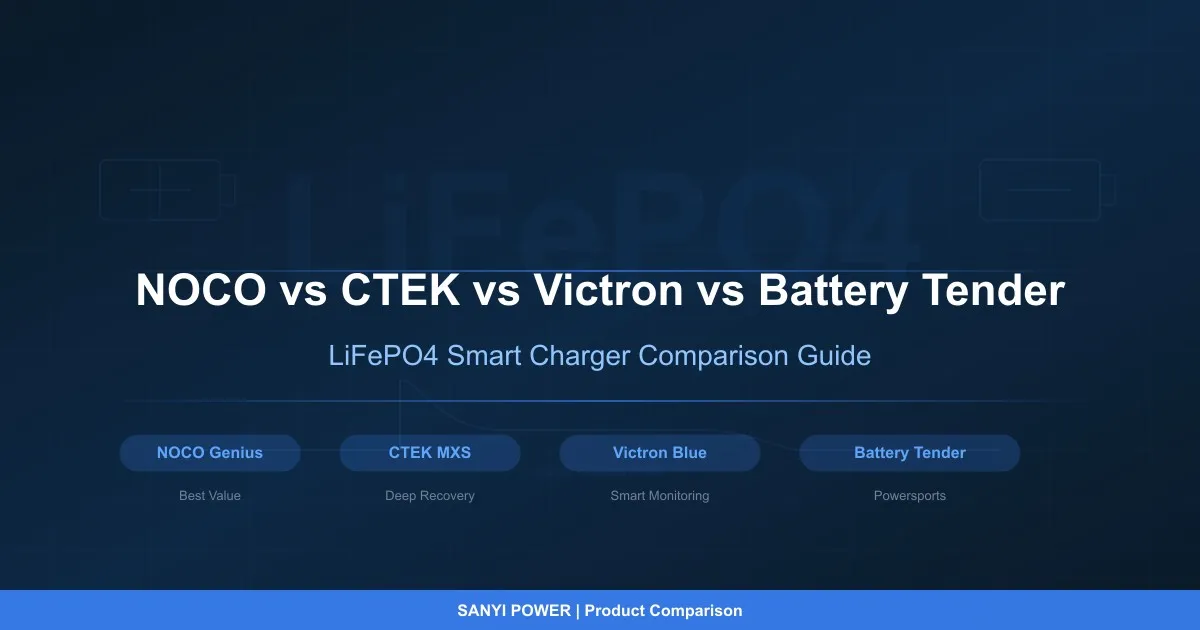

Lithium iron phosphate (LiFePO4) batteries are rapidly replacing lead-acid across RVs, boats, golf carts, and solar storage systems. But plugging a LFP battery into the wrong charger can shorten its life or trigger BMS shutdowns. LiFePO4 requires a specific CC-CV charge profile with a 14.6V cutoff (3.65V per cell) — different from both lead-acid and NMC lithium-ion. This guide compares four leading smart charger brands to help you pick the right one for your setup.
TL;DR: LFP battery market share reached 44% in 2025, overtaking NMC for the first time (InsideEVs/CALSTART, 2025). Among the four chargers compared here, CTEK leads in deep-discharge recovery (charges from as low as 2V), Victron wins on remote monitoring and waterproofing, NOCO offers the best value and widest retail availability, and Battery Tender dominates the motorcycle and powersports segment.
Why Do LiFePO4 Batteries Need a Dedicated Charger?
LiFePO4 cells require a 14.6V charge cutoff (3.65V/cell), while standard lead-acid chargers float at 13.5-13.8V and NMC lithium-ion needs 16.8V (4.2V/cell) — none are interchangeable. According to Battery University testing data (Battery University, 2023), charging LFP cells at incorrect voltages causes capacity loss exceeding 15% within 100 cycles.
LiFePO4 uses a CC-CV (constant current, constant voltage) charging curve. The charger delivers constant current until hitting 14.6V, then holds that voltage while current tapers to a cutoff threshold. Unlike lead-acid, LFP batteries do not need — and should not receive — a trickle float charge. Prolonged float charging degrades the iron phosphate crystal structure over time.
Can you get away with a lead-acid charger in a pinch? Short answer: no. Even if the bulk voltage seems close enough, the equalization stage on lead-acid chargers pushes voltage above 15.5V. This trips the BMS overvoltage protection. Worse, some chargers cycle on and off repeatedly as the BMS engages and disengages, causing unnecessary stress on both the BMS and the cells.
Who Makes These Chargers?
These four brands span the full spectrum from consumer-friendly to industrial-grade. NOCO, founded in 1914 in Ohio, is one of the top-selling charger brands on Amazon in the US market (Amazon Best Sellers, 2025). CTEK, founded in Sweden in 1997, is known for engineering quality and patented reconditioning technology.
NOCO (United States)
NOCO is headquartered in Cleveland, Ohio, with a product range from 1A to 26A. The Genius series is their flagship — the Genius5 retails around $35, making it one of the most affordable LiFePO4-compatible chargers available. NOCO's biggest strength is distribution: you'll find it at Amazon, AutoZone, Walmart, and most auto parts stores.
The trade-off? NOCO has a minimum charge threshold of 7V. If a battery drops below 7V, the Genius series won't recognize it and refuses to start charging. For deeply discharged batteries, this is a real limitation.
CTEK (Sweden)
CTEK offers a 5-year warranty — arguably the longest in the charger industry. Their CS FREE and MXS series can initiate charging from as low as 2V, meaning they can attempt recovery on severely over-discharged batteries. This "brick recovery" capability is CTEK's key differentiator.
Victron Energy (Netherlands)
Victron is the benchmark brand for off-grid and marine power systems. Their Blue Smart IP65/IP67 series includes Bluetooth APP monitoring, letting you check charge current, voltage, and temperature in real time. The IP67 waterproof rating means the charger survives full submersion — critical for marine and outdoor installations. Pricing sits in the $80-200 range.
Battery Tender (Deltran, United States)
Battery Tender is the legacy name in motorcycle maintenance charging. Deltran holds the leading installed base in the North American motorcycle and powersports market (Motorcycle.com, 2024). Their Junior series starts around $25, though most models deliver just 0.75A-1.25A — better suited for maintenance than fast charging. Newer models include a LiFePO4 mode, but older units don't support it.
How Do the Key Specs Compare?
Benchmarking flagship 12V LiFePO4 models from each brand, CTEK leads on warranty and deep-discharge recovery, Victron dominates smart features and waterproofing, and NOCO wins on price. According to Victron's official specifications (Victron Energy, 2025), Blue Smart IP65 chargers achieve over 95% charging efficiency.
| Specification | NOCO Genius5 | CTEK MXS 5.0 | Victron Blue Smart IP65 | Battery Tender Plus |
|---|---|---|---|---|
| Origin | USA (Ohio) | Sweden | Netherlands | USA (Florida) |
| Charge Current | 5A | 5A (0.8A trickle) | 5A / 10A / 15A options | 1.25A |
| LiFePO4 Mode | Yes | Yes | Yes (dedicated curve) | Select models |
| Charge Cutoff | 14.6V | 14.4V (adjustable) | 14.2V (adjustable to 14.6V) | 14.4V |
| Min. Start Voltage | 7V | 2V | ~5V | ~4V |
| Charge Stages | Auto multi-stage | 8-stage | 6/8-stage (programmable) | 4-stage |
| Waterproof Rating | IP65 | IP65 | IP65 / IP67 | None (indoor) |
| Bluetooth / APP | No | No (CS FREE yes) | Yes (VictronConnect) | No |
| Warranty | 3 years | 5 years | 5 years | 10 years (limited) |
| Price (USD) | ~$35 | ~$80 | ~$90-150 | ~$40 |
Which Charger Fits Your Application?
Your application determines which specs matter most. According to the RV Industry Association, LiFePO4 adoption in new RVs reached 32% in 2024 (RVIA, 2024), driving demand for higher-current chargers with remote monitoring capabilities.
RV / Camping
Go with the Victron Blue Smart IP65 15A. Large LiFePO4 banks need high charge current, and the Bluetooth app lets you monitor battery status from the cab. IP65 weatherproofing handles outdoor conditions well. On a tighter budget? The NOCO Genius10 (10A) is a solid alternative.
Marine / Boat
The Victron Blue Smart IP67 is the only truly marine-grade option here. IP67 submersion protection isn't a luxury on the water — it's a necessity. Salt spray, humidity, and wave splash will compromise IP65 units within a few seasons.
Motorcycle / Powersports
Pick the Battery Tender Junior or NOCO Genius1. Motorcycle batteries are typically 4-10Ah, so a gentle 1A charge rate is actually healthier for them. Battery Tender's quick-connect pigtail harness is the de facto standard in the motorcycle world. Nearly every custom build has one pre-wired.
Golf Cart / Solar Storage
High-capacity setups (100Ah+) need 10A or more. The NOCO Genius10 or Victron Blue Smart 15A are your best bets. CTEK falls short here — at 5A max, charging a 100Ah battery takes over 20 hours.
What Safety Concerns Should You Watch For?
LiFePO4 is one of the safest lithium chemistries available, with a thermal runaway threshold above 270 degrees C — far higher than NMC's 150 degrees C (Journal of Power Sources, 2019). But safe chemistry doesn't mean you can ignore charging parameters.
First rule: verify that your charger's LiFePO4 mode actually outputs 14.6V. Some brands label a mode as "lithium" when it's really designed for NMC at 16.8V. That voltage will damage LFP cells. Always check the spec sheet for exact voltage figures before purchasing.
Cold-weather charging is the other commonly overlooked risk. LiFePO4 batteries should never be charged below 0 degrees C. Lithium plates onto the anode surface as dendrites, permanently reducing capacity. Victron's some models accept an external temperature sensor and automatically halt charging in freezing conditions. NOCO and CTEK don't currently offer this feature — you'll need to monitor ambient temperature yourself.
What Does the 2025 LFP Market Shift Mean for Chargers?
LFP battery global market share hit 44% in 2025, surpassing NMC for the first time (InsideEVs/CALSTART, 2025). This crossover isn't limited to electric vehicles — LFP adoption is growing even faster in energy storage, RVs, marine, and power tools.
For consumers, the implication is straightforward: LiFePO4-specific chargers are no longer niche products. They're mainstream. We expect all four brands to further refine their LFP charging algorithms over the next two years. Victron already pushes OTA firmware updates through its app — that kind of flexibility has real long-term value.
Will today's charger become obsolete? Unlikely. The LiFePO4 charge standard (CC-CV to 14.6V) is dictated by cell chemistry, not a protocol that changes with each product generation. A quality charger purchased today will work perfectly fine across the battery's 3,000+ cycle lifespan.
Frequently Asked Questions
Can I use a regular lead-acid charger on a LiFePO4 battery?
No. Lead-acid chargers include an equalization stage that pushes voltage above 15.5V, triggering the LFP battery's BMS overvoltage protection. Sustained incorrect-voltage charging degrades LFP capacity by over 15% within 100 cycles (Battery University, 2023). Always use a charger with a dedicated LiFePO4 mode.
Is CTEK or NOCO better for recovering a dead battery?
CTEK is the clear winner for recovery scenarios. The CTEK MXS series initiates charging from as low as 2V, allowing it to recover severely over-discharged batteries. NOCO's Genius series requires at least 7V to start — batteries below that threshold trigger an error code. If deep discharge is a realistic risk in your use case, CTEK provides more peace of mind.
Is Victron's Bluetooth worth the extra cost?
For desktop charging of a single battery, probably not. But when the charger is mounted under an RV chassis, inside a boat engine bay, or in a sealed solar storage cabinet — anywhere you can't easily see the indicator LEDs — Bluetooth monitoring becomes genuinely useful. Victron's VictronConnect app also lets you modify charge parameters and review historical data.
Do LiFePO4 chargers need temperature compensation?
LiFePO4 doesn't need the temperature-compensated float charging that lead-acid requires (where float voltage adjusts based on ambient temperature). However, LFP cells must never be charged below 0 degrees C — low-temperature charging causes lithium dendrite plating that permanently damages capacity. Victron supports an external temperature sensor for automatic cold-weather shutoff. The other three brands don't currently offer this feature.
The Bottom Line: Match the Charger to Your Needs
There's no single "best" charger — only the best fit for your specific situation. NOCO wins the value category at $35 with the widest retail availability. CTEK earns its premium with 2V deep-discharge recovery and a 5-year warranty. Victron commands the RV and marine segments through Bluetooth monitoring and IP67 waterproofing. Battery Tender remains the default for motorcycle owners everywhere.
The selection logic is simple: determine your battery capacity and application, then match charge current and protection rating accordingly. And remember — the LiFePO4 charge standard won't change anytime soon. A good charger will serve you across your battery's full 3,000+ cycle lifespan.
For OEM buyers sourcing custom LiFePO4 chargers, explore our battery charger sizing tool.
Meta description: Comparing NOCO, CTEK, Victron, and Battery Tender LiFePO4 smart chargers. LFP hit 44% market share in 2025 — here's how to pick the right charger.