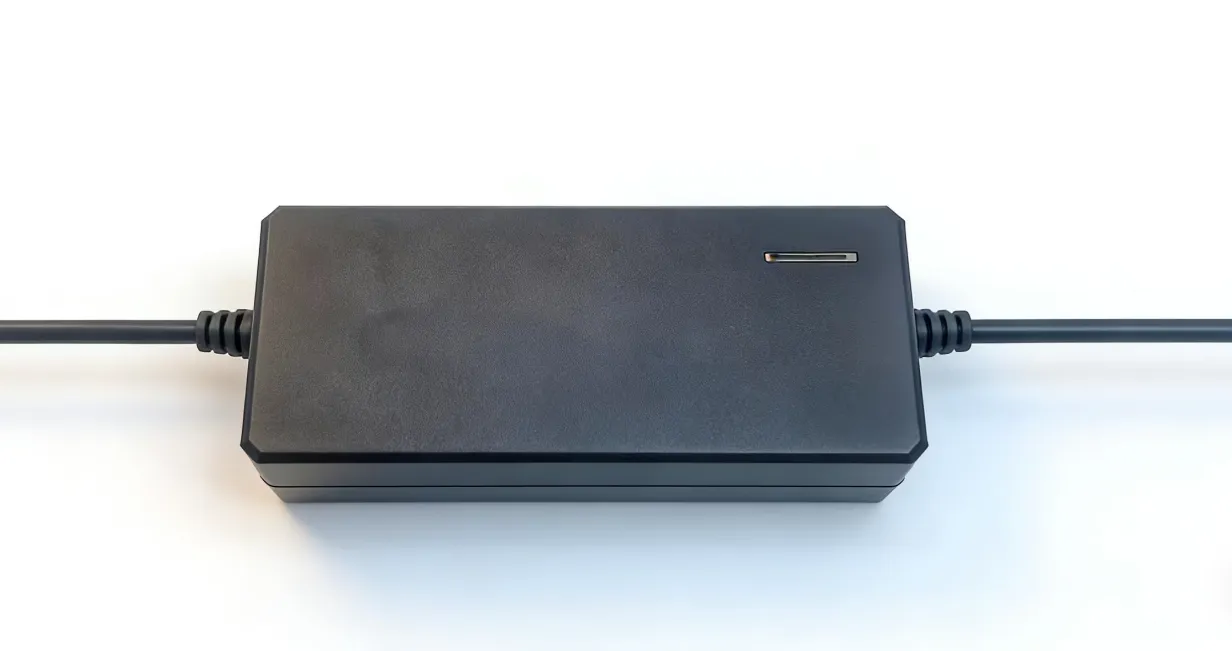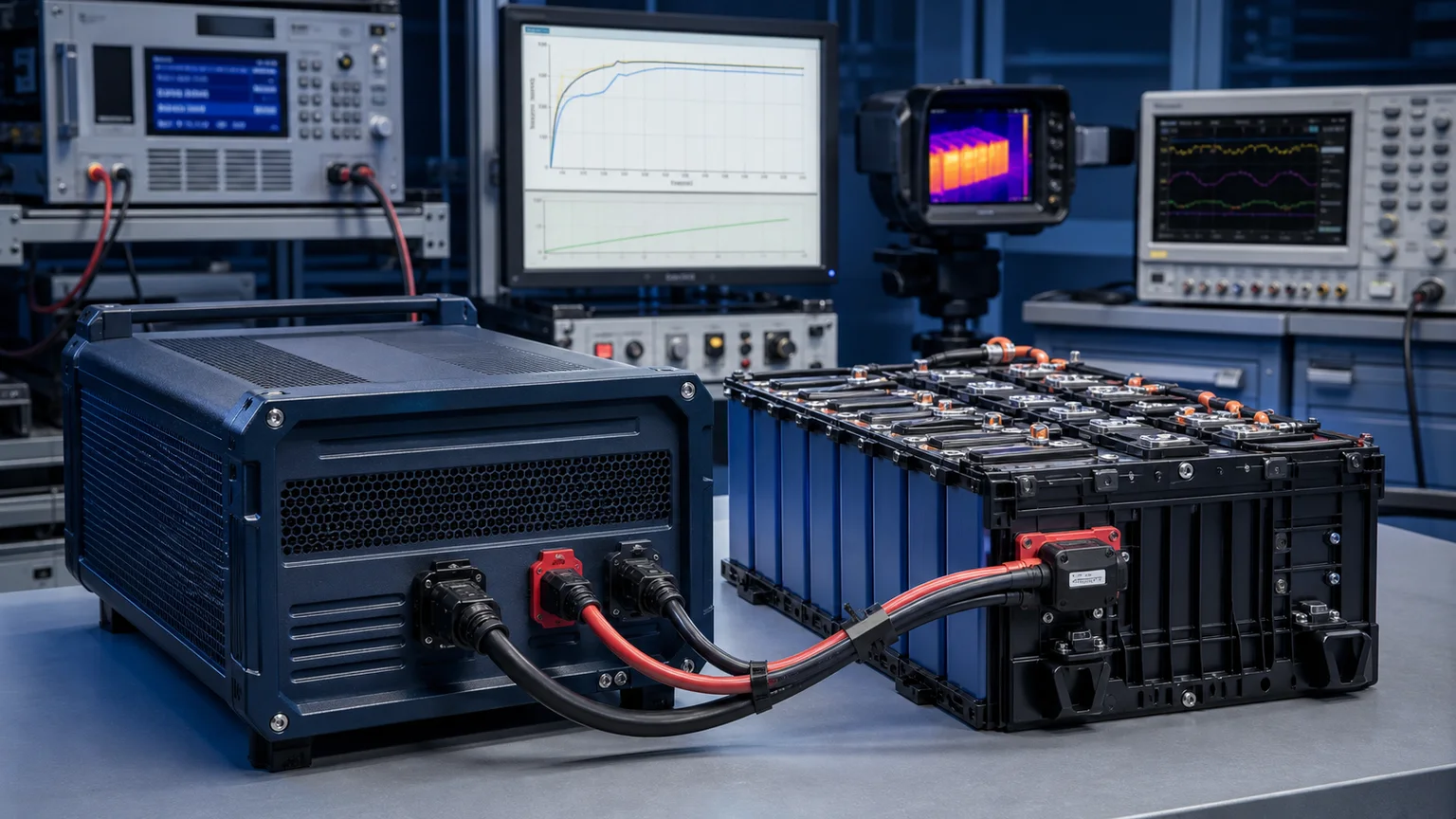

A 24V mobility scooter and power wheelchair charger looks superficially identical to a 24V e-bike or golf-cart charger — same nominal voltage, similar power class, similar enclosure size. It is not the same product. The user group changes everything. The person plugging it in is, in most cases, an elderly adult, a wheelchair user with limited dexterity, or a caregiver acting on their behalf. The charger lives in a bedroom and runs unattended overnight, every night, for years. It is a Durable Medical Equipment (DME) accessory, often reimbursed under Medicare HCPCS code E2368, and it sits in a regulatory envelope that consumer e-bike and golf-cart chargers do not have to enter.
This guide covers 24V mobility scooter and power wheelchair charger selection in 2026 — the medical compliance boundary between UL 1310 Class 2 and IEC 60601-1, charge-profile differences between 2× 12 V SLA / gel cell banks and 8s LiFePO4 retrofits, connector taxonomy, the OEM replacement map across Pride Mobility, Drive Medical, Golden Technologies, Permobil, Invacare, Shoprider and Merits, TSA rules for portable travel scooters, and the safety features that make overnight charging in an elderly home actually safe.
Why Mobility Scooter Chargers Are a Distinct Category
A mobility scooter is, under FDA classification, a Class II medical device (21 CFR 890.3890 for powered wheelchairs, 21 CFR 890.3800 for motorized three-wheeled vehicles). The device itself is medical. The off-board charger is usually treated as a powered accessory under UL 1310 Class 2 safety listing, not the full IEC 60601-1 medical electrical equipment standard. The dividing line: chargers used only when the user is not seated in the chair fall under UL 1310; onboard chargers operable with a patient in contact may require IEC 60601-1. For most "wall-pack to scooter inlet" use cases, UL 1310 Class 2 is the de-facto credential, and any DME-channel replacement should carry it.
Elderly-user safety is the second pillar. Charger faults that an e-bike rider would shrug off — a missed connection, reversed polarity, over-temperature shutdown — can leave a vulnerable user stranded the next morning. Worse, charger failures producing smoke or fire in the bedroom of someone with limited mobility have catastrophic life-safety implications. Aftermarket mobility chargers therefore implement defense-in-depth: reverse-polarity protection, over-temperature shutdown with thermal-fuse backup, output short-circuit auto-recovery, input under-voltage lockout, and a bicolor LED indicator readable by users with diminished color vision.
DME distribution is the third constraint. Mobility chargers sell primarily through DME suppliers and scooter stores, usually as warranty-replacement parts. The aftermarket must match the OEM's exact connector, charge profile and LED behavior — substituting a generic 24 V charger with the right amps but the wrong absorption voltage will void the battery warranty and may trigger BMS lockout on LFP retrofits.
For the broader context, the medical-grade power supply IEC 60601-1 selection guide covers what carries over (leakage current, mains isolation) and what does not (patient-contact MOPP requirements that off-board chargers sidestep).
24V Battery Bank Architecture in Mobility Scooters and Power Wheelchairs
The "24V" label is nominal. The actual bank is one of three architectures, and the charger has to match all three:
2× 12V SLA in series — the dominant architecture. Two VRLA batteries in BCI Group U1, U1R (reversed terminals), SC22NF / 22NF (~55 Ah) or Group 24 (~75 Ah for bariatric chairs), wired in series. Bulk-absorption voltage 29.0–29.4 V, float 27.0–27.6 V. Standard on every Pride Go-Go, Drive Scout, Golden Buzzaround, Shoprider and Merits travel scooter.
2× 12V gel cell in series — smaller share, common on Invacare and some Permobil chairs. Gel needs tighter absorption (28.2–28.8 V) and cannot tolerate equalization — applying a flooded-style 30 V stage dries the gel out within months. A charger configured for "SLA" on a gel pack overcharges it.
8s LiFePO4 — the retrofit and increasingly the OEM choice on premium chairs (Permobil F5 Corpus VS, Pride Jazzy Evo) since 2022. Charge ceiling 29.2 V (3.65 V/cell) for full saturation or 28.8 V (3.6 V/cell) for cycle-life-conservative charging. No float stage — the BMS opens the charge MOSFET when balancing finishes. A lead-acid charger holding 27.6 V float forever never triggers BMS balancing, causing cell drift.
| Pack chemistry | Absorption | Float | Equalize |
|---|---|---|---|
| 2× 12V SLA | 29.0–29.4 V | 27.0–27.6 V | 30.0–30.5 V optional |
| 2× 12V gel | 28.2–28.8 V | 27.0–27.3 V | none |
| 8s LiFePO4 | 28.8–29.2 V | none (BMS cutoff) | none |
A chemistry-select switch is non-negotiable for any charger that will see service across multiple pack types.
SLA / Gel Cell vs LiFePO4 — Charge Profile Differences
Mobility scooter SLA charging follows a three-stage IUoU profile: bulk constant-current at 0.10–0.20 C until 29.0–29.4 V, absorption constant-voltage at the same ceiling until current tapers to ~0.02 C, then float at 27.0–27.6 V indefinitely. A 24 Ah Group U1 pack on a 5 A charger completes bulk in ~3 h, absorption in ~2 h, then floats safely overnight.
Gel uses the same stages with tighter voltage ceilings and lower terminal current — bulk to 28.5 V, absorption ~90 min, float at 27.0 V. The 13.8 V/cell float that AGM and SLA accept is roughly 0.4 V too high for gel and dries the pack out within 18 months. This is the dominant cause of "my batteries only lasted a year and a half" complaints.
LiFePO4 is two-stage CC-CV: constant current to 29.2 V, then CV at 29.2 V while current tapers to the BMS termination threshold (typically 0.02 C). No float stage — the BMS opens the charge FET when balancing finishes and the pack sits at ~27.2 V open-circuit until next discharge. A charger that tries to hold 29.2 V indefinitely produces repeated BMS-open / charger-restart cycles, harmless to the pack but visually confusing through the night.
Connector Types — 3-pin XLR / 4-pin XLR / DIN / Anderson SB50
3-pin XLR (Neutrik-style) — the volume connector for travel scooters and entry-level power wheelchairs. Pin 1 negative, pin 2 positive, pin 3 often unused. Used by Pride Go-Go series, Drive Medical Scout / Spitfire, Golden Buzzaround / Companion / GB119D, Shoprider Echo / Dasher, Merits Mini-Coupe / Pioneer. Typical output 24 V / 1.5–3.8 A.
4-pin XLR — Pride's mid-range and full-size power wheelchairs (Jazzy Select, 614HD, 1450 bariatric), Invacare TDX SP2, Golden Compass / Avenger. Pins 3–4 are OEM-specific (battery-temperature thermistor or charging-enable interlock). Re-pinning a 3-pin works electrically but disables temperature compensation. Typical 24 V / 5–8 A.
3-pin DIN (round) — Invacare Pronto M41 / M51, older Permobil C300 / C500. Not cross-compatible with XLR. Typical 24 V / 4–6 A.
Anderson SB50 (gray housing) — premium and bariatric chairs (Permobil F5 Corpus VS, Pride Jazzy 1170XL bariatric, Quantum Q6 Edge HD), most onboard chargers for chairs over 350 lb capacity. SB50 is rated 50 A continuous — heritage from forklift and golf-cart applications. Typical 24 V / 8–12 A.
OEM Replacement Map — Pride / Drive / Golden / Permobil / Invacare / Shoprider / Merits
Compatibility reference for off-board replacement. Aftermarket compatibility means matched voltage, connector and charge profile with equivalent safety listing — not OEM brand affiliation.
| OEM | Series | Connector | Output | Aftermarket spec |
|---|---|---|---|---|
| Pride Mobility | Go-Go Elite / Sport / Traveller | 3-pin XLR | 24V / 2.0 A SLA | 24V / 2–3 A SLA, 3-pin XLR, UL 1310 |
| Pride Mobility | Jazzy Select / 614HD / 1450 | 4-pin XLR | 24V / 5–8 A SLA | 24V / 5–8 A SLA, 4-pin XLR, UL 1310 |
| Pride Mobility | Jazzy Evo (LFP) | 4-pin XLR | 24V / 5 A LFP | 24V / 5 A LFP, 4-pin XLR, UL 1310 |
| Drive Medical | Scout 3 / 4, Spitfire | 3-pin XLR | 24V / 2.0 A SLA | 24V / 2 A SLA, 3-pin XLR, UL 1310 |
| Drive Medical | Phoenix HD3 / HD4 | 3-pin XLR | 24V / 5.0 A SLA | 24V / 5 A SLA, 3-pin XLR, UL 1310 |
| Golden Technologies | Buzzaround EX / LT / XL | 3-pin XLR | 24V / 2.0–3.8 A SLA | 24V / 2–4 A SLA, 3-pin XLR, UL 1310 |
| Golden Technologies | Companion / Avenger | 4-pin XLR | 24V / 5.0 A SLA | 24V / 5 A SLA, 4-pin XLR, UL 1310 |
| Permobil | F3 / F5 Corpus VS (LFP) | Anderson SB50 | 24V / 8–10 A LFP | 24V / 8–10 A LFP, SB50, UL 1310 |
| Invacare | Pronto M41 / M51, TDX SP2 | DIN / 4-pin XLR | 24V / 5–8 A SLA | 24V / 5–8 A SLA, matched connector, UL 1310 |
| Shoprider | Echo / Dasher / Smartie | 3-pin XLR | 24V / 2.0 A SLA | 24V / 2 A SLA, 3-pin XLR, UL 1310 |
| Merits | Mini-Coupe / Pioneer | 3-pin XLR | 24V / 2–5 A SLA | 24V / 2–5 A SLA, 3-pin XLR, UL 1310 |
For LFP retrofits of any SLA-era scooter, the connector stays but the output mode must switch to LiFePO4 (29.2 V CV, no float). The LiFePO4 vs lead-acid battery charger selection guide covers the underlying chemistry differences.
Travel and TSA — Portable Folding Chargers, Lithium Wh Limits, Airline Compliance
Travel scooters (Pride Go-Go Folding, Drive Scout 3, Golden Buzzaround Carry-On) fold for airline check-in, and the charger travels too.
TSA / FAA rules: the scooter battery, if removable and under 300 Wh (24 V × 12 Ah = 288 Wh fits; 24 V × 17 Ah = 408 Wh does not), travels in the cabin under the assistive-device exemption. For LFP-retrofitted packs or any pack over 300 Wh, the airline must be notified 48 hours in advance — pack in the cabin, terminals taped, hard case. Two spare batteries per passenger maximum.
The charger travels as standard cabin electronics, like a laptop brick. A travel-scooter charger of 24 V / 2 A draws ~60 W and is unconditionally allowed in carry-on. International travelers should confirm 100–240 V AC universal input — many older OEM chargers are 120 V North America only and will fail on European outlets.
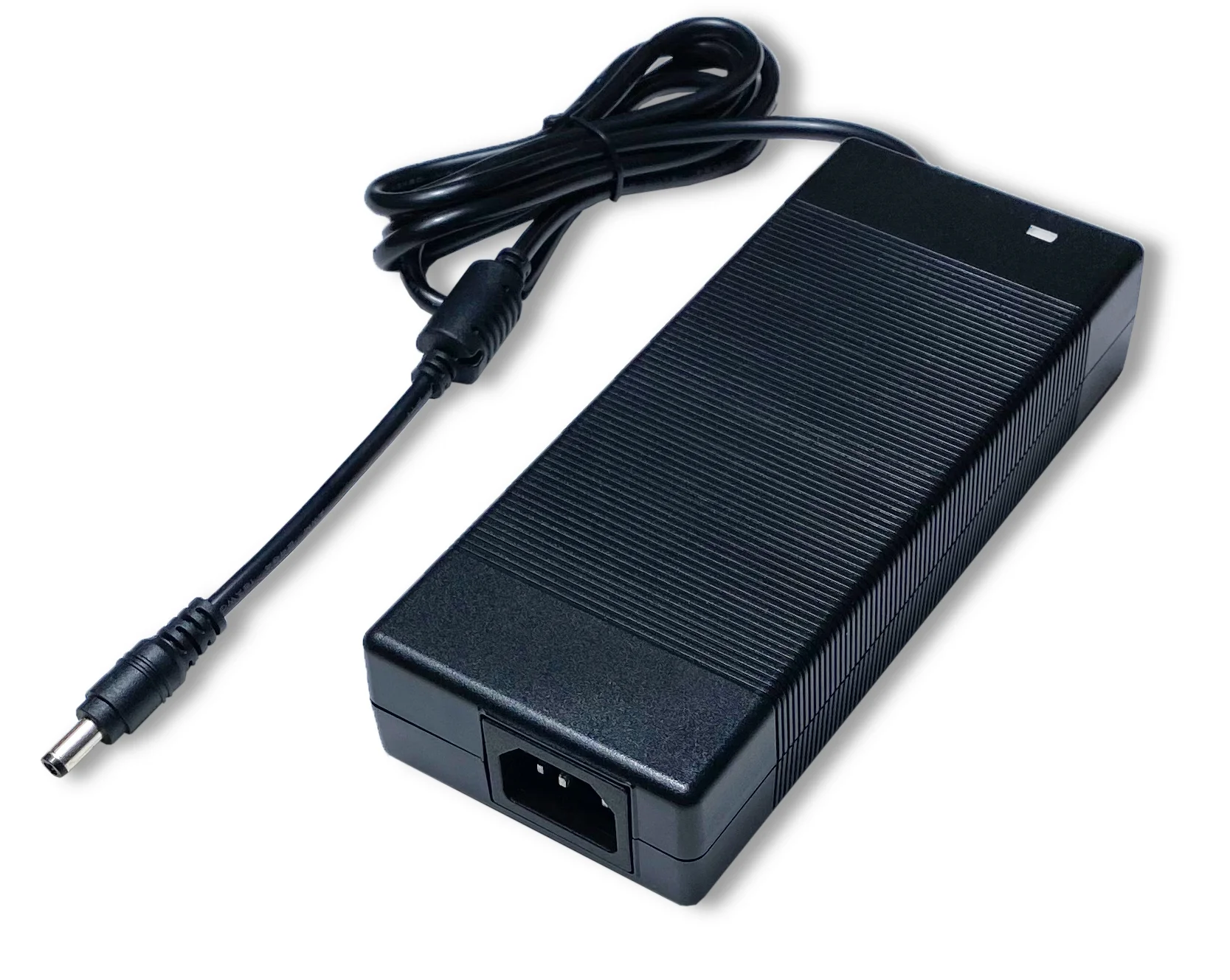
Folding travel chargers are typically 24 V / 2–3 A in a 96–150 W desktop form factor. The Sanyi APN Series desktop adapter covers the 48 W–144 W band with a 24 V configurable output and luggage-friendly packaging suited to travel scooter aftermarket builds.
Safety Features for Elderly Users — Reverse Polarity, Over-Temp, Unattended Overnight
A charger plugged into a bedroom wall in the home of an 82-year-old user is a different safety problem than an industrial power supply. Five protection layers are non-negotiable:
- Reverse-polarity protection — output current must not flow on a miswired plug. An output MOSFET latches off until the user disconnects, removes the fault, and reconnects.
- Over-temperature shutdown with thermal-fuse backup — primary NTC thermistor on the secondary rectifier, secondary thermal fuse at 110–120 °C as backup. Catches "charger buried under a blanket or pushed behind a bookshelf" failure modes.
- Output short-circuit auto-recovery — frayed cables and damaged connectors produce shorts. Auto-recovery retries every 5–10 s; if the short clears, the charger resumes silently rather than latching off.
- Input under-voltage lockout — brown-outs from window AC units or microwaves on the same circuit must not produce uncontrolled output. UVLO holds the output disabled until AC recovers above 90 V, then performs a clean soft-start.
- Auto-shutoff / maintenance mode after full charge — SLA drops to float; LFP enters sleep below 50 mA quiescent draw. Users can leave the charger plugged in for weeks (snowbird storage, summer cottage closure) without damaging the pack. The trickle charger vs float charger vs battery maintainer guide covers when long-term maintenance applies and when it does not.
The visual indicator matters too. A bicolor LED — red during charge, green when complete — is the convention every DME user knows. Replacing the LED with a multi-character LCD that requires reading text is wrong for users with diminished vision. Match the OEM color-only cue.
Buying Checklist
- UL 1310 Class 2 listing with file number traceable in UL's directory; cUL for Canadian DME, CE for European import.
- Output voltage matches chemistry: 29.0–29.4 V SLA, 28.5 V gel, 29.2 V LFP. Chemistry-select switch preferred.
- Output current at 0.10–0.20 C of pack capacity: 24 Ah → 2.4–4.8 A; 55 Ah → 5.5–11 A. Higher current acceptable for LFP.
- Connector matches OEM exactly — 3-pin XLR / 4-pin XLR / DIN / Anderson SB50.
- Universal input 100–240 V AC, 50/60 Hz.
- Reverse polarity, over-temperature, short-circuit, UVLO explicitly listed.
- Bicolor LED indicator (red charge / green complete) — color-only, no text-only LCD.
- Cable length ≥ 1.5 m on both AC inlet and DC chair sides.
- No interference with chair BMS or charge-port interlock — verify against OEM service manual.
Sanyi Product Map for Mobility Scooter & Power Wheelchair
Sanyi's 24 V output platforms cover the full mobility-charger band from travel scooters to bariatric power wheelchairs:
- Sanyi APN Series Desktop Adapter (48 W–144 W) — 24 V configurable output, universal 100–240 V AC input, foldable AC plug option. Sized for 24 V / 2 A and 24 V / 3 A travel scooter applications (Pride Go-Go, Drive Scout 3, Golden Buzzaround Carry-On).
- Sanyi HP Series High-Power Adapter (120 W–480 W) — 24 V / 5 A and 24 V / 8 A bands covering Pride Jazzy Select / 614HD / 1450, Golden Companion / Avenger and Invacare TDX SP2 4-pin XLR applications.
- Sanyi SY-C260W Smart Charger — 260 W intelligent charger with chemistry-select profile for SLA / AGM / gel / LFP, integrated three-stage IUoU algorithm, bicolor LED, full UL 1310 Class 2 protection set. Sized for standard 24 V mobility scooter and power wheelchair packs using Group U1 / SC22NF / 22NF.
- Sanyi SY-C500W Smart Charger — 500 W intelligent charger for bariatric and heavy-duty power wheelchair applications (Pride Jazzy 1170XL bariatric, Permobil F5, Quantum Q6 Edge HD), Anderson SB50 connector option, chemistry-select including LFP profile.
All four platforms ship with UL 1310 Class 2 safety listing and the protection set described above. For DME distribution partners, OEM private-label production is available across the full mobility band — contact Sanyi sales to specify connector pinout, LED behavior and chemistry profile to match your existing OEM service catalogue.
FAQ
Q: Can I use my e-bike charger on my mobility scooter if both are nominally 24 V? A: Voltage matches but three things usually don't — connector (e-bike ships DC barrel or XT60, not XLR), charge profile (e-bike chargers terminate at 29.2 V for LFP and never float, while a mobility SLA pack needs indefinite 27.6 V float), and safety listing (e-bike chargers list under UL 2849 or EN 50604, not UL 1310 Class 2). Forcing an e-bike charger onto a mobility scooter voids the battery warranty and may void DME insurance coverage.
Q: My charger LED stays red and never turns green — broken charger or dead batteries? A: The charger is almost certainly fine. Disconnect, measure pack voltage at rest with a multimeter, and check whether it stabilizes above 24.0 V. A pack that won't hold above 23.0 V at rest after a full overnight charge is sulfated (lead-acid) or has a BMS fault (LFP) and needs replacement. A pack holding above 25.0 V but the LED still won't turn green usually has a charger profile mismatched to the chemistry — verify the chemistry-select switch.
Q: Can I leave the charger plugged in 24/7 between rides? A: For SLA / AGM with a properly configured three-stage charger, yes — the charger drops to float at 27.0–27.6 V and replaces self-discharge indefinitely. For gel, yes only if the charger is configured to gel float at 27.0 V — a 27.6 V float dries gel out within a year. For LFP, yes but the charger should enter sleep mode below 50 mA quiescent draw; continuous CV at 29.2 V is not what LFP wants for long-term storage.
Q: I'm flying with my Pride Go-Go Folding scooter — does the charger have to go in checked baggage? A: No. The charger is treated as a standard cabin electronic device. The battery is the regulated item: removable and under 300 Wh travels in the cabin under the assistive-device exemption. The charger goes in your roller-bag or laptop sleeve. Always call the airline 48 hours in advance to confirm assistive-device protocol and document the call in your reservation.
Q: My scooter shop sold me a "universal 24V mobility charger" — should I trust it? A: Verify three things on the label or datasheet. First, a UL or cUL file number for UL 1310 Class 2 (look it up at productiq.ulprospector.com — anything not searchable is not actually listed). Second, a chemistry-select switch confirming the output voltage matches your pack (29.0–29.4 V SLA, 28.5 V gel, 29.2 V LFP). Third, the exact connector matching your scooter. A "universal" charger lacking chemistry-select or shipping with a single fixed connector is universal only across SLA packs with one connector — confirm the match before the first charge.