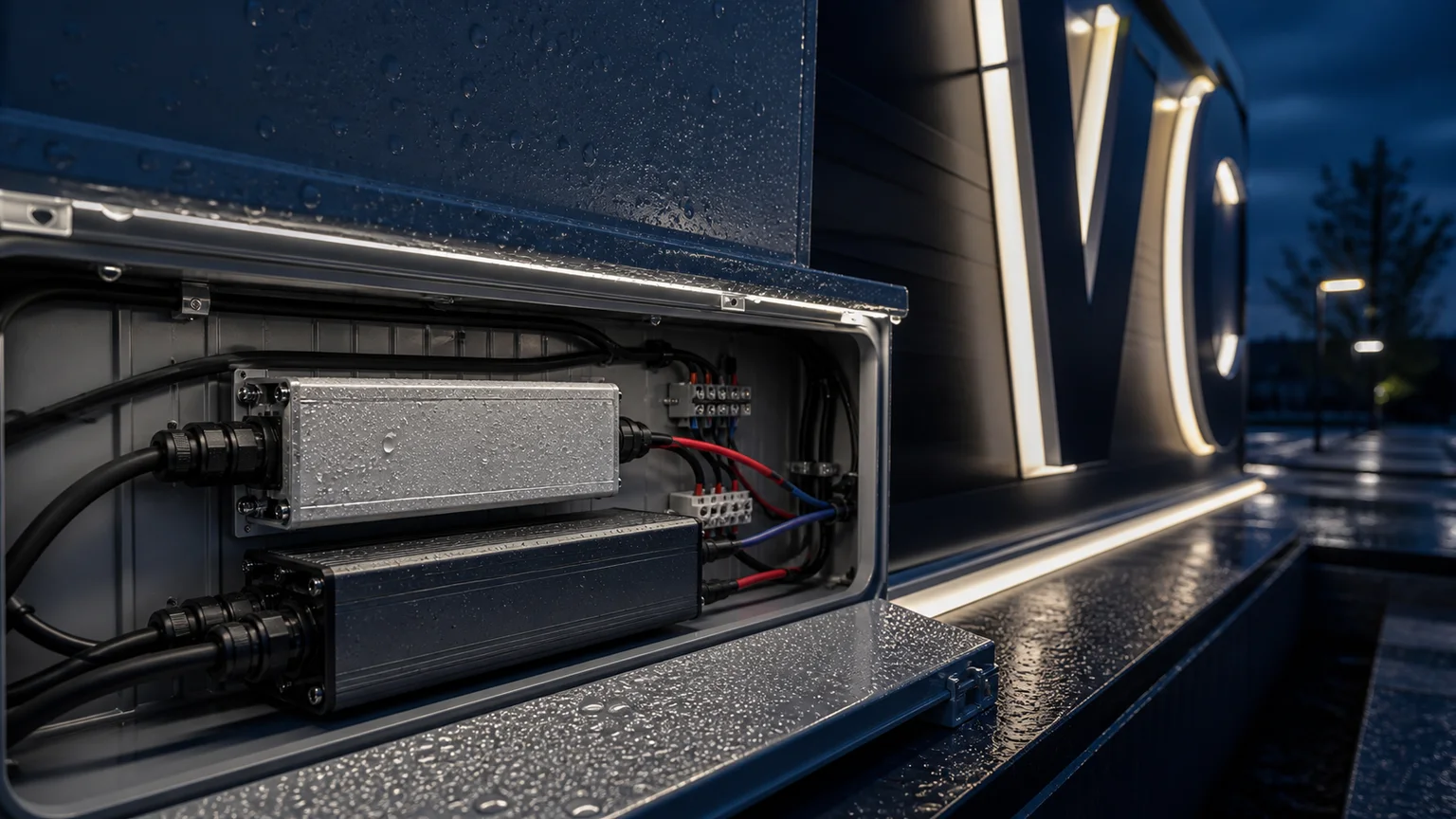

A contractor finishes a channel-letter sign on a retail storefront in April. By June, the first thunderstorm rolls through. A week later the client calls: half the letters are dark. The installer drives back, opens the enclosure — the power supply is corroded, the PCB is green, water pooled inside the housing. The product was labeled "waterproof." It was IP54.
Choosing the wrong IP-rated power supply is the single most common root cause of early failures in outdoor LED, signage, and industrial installations. The IP numbers look similar on a datasheet. The consequences in the field are not. This guide breaks down what IP65, IP67, and IP68 actually protect against, which one your application really needs, and the specs that matter as much as the IP rating itself.
What IP Ratings Actually Mean
IP stands for Ingress Protection, defined by international standard IEC 60529. The rating always has two digits — the first describes protection against solid objects, the second against liquid ingress. Each digit is tested independently, and a higher number does not simply "include" the lower ones.
The first digit: solids
| Digit | Protection |
|---|---|
| 4 | Tools and small wires > 1 mm |
| 5 | Dust-protected (limited ingress, no harmful effect) |
| 6 | Dust-tight (complete seal) |
For outdoor power supplies, you almost always want a 6 here. Dust, fine sand, and airborne debris will otherwise build up on the PCB and become a conductive layer once humidity rises.
The second digit: liquids
| Digit | Protection | Test condition |
|---|---|---|
| 4 | Splashing water from any direction | 10 min spray |
| 5 | Water jets from any direction | 12.5 L/min, 3 m distance |
| 6 | Powerful water jets | 100 L/min, 3 m distance |
| 7 | Temporary immersion | 1 m depth, 30 min |
| 8 | Continuous immersion | Manufacturer-defined depth and duration |
Notice something critical: IP67 and IP68 are not supersets of IP65 or IP66. A case designed to survive a static immersion test may still fail under high-pressure jets, because the seal geometry is optimized for different stress patterns. Many premium outdoor power supplies are dual-rated (IP66/IP67) for exactly this reason.
IP65 vs IP67 vs IP68 Head-to-Head
| Spec | IP65 | IP67 | IP68 |
|---|---|---|---|
| Dust | Dust-tight | Dust-tight | Dust-tight |
| Rain / water jets | Yes | Yes (most) | Yes (most) |
| Temporary submersion | No | Up to 1 m / 30 min | Deeper, longer (per manufacturer) |
| Continuous submersion | No | No | Yes |
| Typical housing | Sealed plastic or metal with gasket | Potted / fully sealed | Fully potted metal |
| Typical cost premium | Baseline | +15–30% | +30–60% |
| Heat dissipation | Good | Moderate | Limited (requires larger housing) |
| Best fit | Storefront signage, covered outdoor | Landscape lighting, marine deck, exposed outdoor | Underwater, fountains, pool lights |
The cost and thermal trade-off is the part most buyers miss. A potted IP68 unit traps heat because its sealed case cannot convect air across the PCB. That forces the design to use larger thermal mass, aluminum housing, or derated output — all of which raise BOM cost. Over-specifying the IP rating directly shrinks your usable wattage per dollar.
Three Misconceptions That Blow Budgets
"Higher IP is always safer." No. An IP68 driver in a dry attic is a waste of money, runs hotter than an IP20 driver of the same wattage, and often has a shorter MTBF because heat is the primary stressor for electrolytic capacitors. Match the rating to the actual environment.
"IP67 means waterproof forever." IP67 is a temporary immersion test — 30 minutes at 1 meter. It says nothing about long-term exposure, UV degradation of the housing, or salt-water corrosion. For continuous submersion you need IP68, and for salt-fog environments you need an additional IEC 60068-2-11 salt-spray evaluation.
"Rainproof equals IP65." The term "rainproof" is marketing language, not a standard. Some "rainproof" products pass IP54 water-splash only, which is fine under a canopy but will fail in driving horizontal rain. If the datasheet doesn't carry an explicit IP number, treat the unit as IP54 at best and plan accordingly.
Selection Guide by Application
Outdoor channel-letter signage and exposed storefronts — IP65 minimum, IP66 recommended
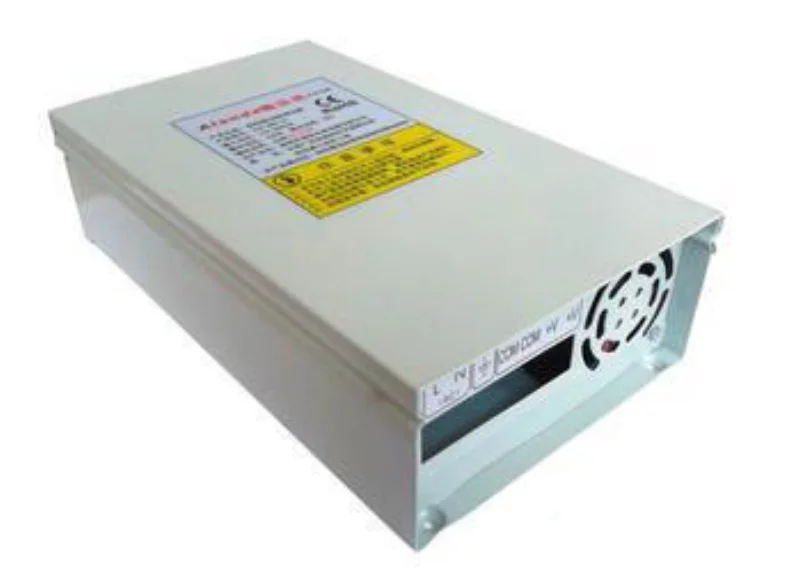
Channel letters mount on façades that see direct rain, wind-driven water, and cleaning jets. IP65 is the floor; IP66 is the safer bet in coastal or storm-prone regions. A good reference choice is Sanyi's SNT rainproof switching power supply, which covers 36W–96W with a weather-resistant enclosure and an operating range of -30°C to +60°C, matching the temperature swings that façade installations actually see over a year.
Landscape lighting, pathway lights, in-ground fixtures — IP67
Lights mounted near the ground face puddling after rain and routine lawn-sprinkler spray. They may also be buried in mulch or snow for months. An IP67 fully-sealed driver like the SYG waterproof series handles the 36W–72W range typical for landscape runs and survives seasonal immersion without corroding.
Underwater, fountain, pool, and water-feature lighting — IP68 mandatory
Any fixture permanently below the waterline requires IP68. For larger architectural water features running long 12V/24V low-voltage lines, a high-dissipation design like the 1703 aluminum waterproof power supply pairs a fully sealed aluminum case with the thermal mass needed for continuous submersion duty.
Outdoor LED billboards and large light-box signs — IP65 driver + IP54 cabinet
For large-format signage housed inside ventilated cabinets, you can often use an IP65-rated driver because the cabinet itself provides secondary weather protection. In this tier the LA-series LED drivers at 150W–200W or up to 400W offer aluminum-housing heat dissipation with constant-current/voltage output. Budget the IP rating at the assembly level, not just the driver level.
Semi-outdoor — covered walkways, gas-station canopies, parking decks
These locations see humidity and splashing but no direct rain. IP54 is acceptable, IP65 is comfortable, and anything above IP65 is usually overkill unless the site is power-washed routinely.
Industrial washdown areas — IP67 or higher, often with IP69K
Food processing, pharmaceutical, and commercial kitchens clean with high-pressure high-temperature water jets. IP67 is the minimum; IP69K (tested per ISO 20653 at 80°C, 100 bar) is the proper spec. Verify the datasheet explicitly lists IP69K — many IP67-rated supplies will fail pressure-washing.
Beyond the IP Number: Specs That Actually Decide Reliability
The IP rating is necessary but not sufficient. Four other line items on the datasheet determine whether the unit survives year two.
Operating temperature range. An IP67 supply rated 0°C to +40°C is useless on a rooftop in Phoenix or a winter streetlight in Minnesota. Look for -30°C to +60°C or wider on outdoor units, and remember that ambient temperature inside a sealed enclosure is usually 15–25°C above outdoor air.
Housing material. Plastic housings are cheaper and lighter but degrade under UV and flex with thermal cycling, eventually breaking the gasket seal. For multi-year outdoor deployment, aluminum housings are the durable choice — and they double as heatsinks, which matters more the higher you go on the IP scale.
Cable gland and connector sealing. The case itself is often fine; the cable entry is where water intrudes. Confirm that glands are torqued to spec, use strain relief, and enter the enclosure from below when possible so water runs away from the seal, not toward it.
Active PFC and EMC class. For installations larger than a single fixture — signage arrays, street-lighting runs, LED billboards — an active-PFC supply reduces harmonic load on the building circuit and is increasingly a code requirement in commercial buildings. Pair this with a Class B EMI rating if the installation is near residential areas.
Installation Checklist
Before you commission an outdoor or wet-location install, walk through this list:
- IP rating on the driver matches or exceeds the worst-case exposure for that mounting location
- Operating temperature range covers both the coldest night and the hottest sun-loaded afternoon at your site
- Housing material is rated for UV if it will see direct sunlight
- Cable glands are the correct diameter for the cable OD, torqued, and mounted pointing downward
- Drainage hole (if the enclosure has one) is at the low point and unblocked
- Driver is mounted with adequate airflow on all sides — sealed IP67/IP68 units still need convection on the outside of the case
- The driver is derated to 80% of nameplate wattage for long-duty runs, per the same rule of thumb covered in our LED strip power supply guide
- Certification labels (CE, FCC, CB, or regional equivalents) are present on the actual unit, not only on the marketing page
FAQ
Q: Is IP66 better than IP67 for outdoor rain exposure? A: For rain and pressure-washing, IP66 is actually equally valid — it tests powerful water jets, which driving rain resembles more than a static dunk does. IP67 adds temporary immersion protection but not necessarily better jet resistance. Many high-end outdoor supplies carry a dual IP66/IP67 rating specifically because the two tests stress seals differently and a good design passes both.
Q: Can I just put an IP20 indoor power supply inside a weatherproof junction box outdoors? A: Only if the box itself carries an IP65 or higher rating and is installed with proper cable glands, drainage, and thermal clearance. Many contractors try this and lose the install because the box heats up beyond the driver's operating temperature, because a cable-gland is overtightened and cracks, or because condensation forms inside a sealed-but-unventilated box. A purpose-built rainproof power supply is almost always cheaper by the time you cost in the compliant enclosure.
Q: How long does an IP67 waterproof power supply actually last outdoors? A: A well-specified IP67 unit with aluminum housing, -30°C to +70°C range, active PFC, and properly torqued cable glands typically delivers 5–8 years in outdoor service before the first capacitor replacement. Failure modes at the end of life are almost never water ingress — they're electrolytic capacitor dry-out from thermal cycling. Choosing an oversized unit and running it at 60–70% load extends this meaningfully.
Q: Do I need IP68 for a driver installed under a waterproof cover above ground? A: Usually not. If the driver never sees standing water and the cover itself is weather-sealed, IP65 is normally sufficient and delivers better thermal performance than IP68. Reserve IP68 for applications where the driver will actually be submerged — fountains, pool lights, below-waterline marine fixtures, or buried in-ground installations where drainage cannot be guaranteed.
Q: What about salt water and coastal environments? A: IP ratings test with fresh water, not salt water. For coastal or marine applications, look for an additional salt-spray test per IEC 60068-2-11 (typically 48–96 hours) and specify a corrosion-resistant housing finish. Standard IP67 anodized aluminum will still corrode at the seams within 2–3 years in an oceanfront install without salt-spray qualification.
About Sanyi Technology. Shenzhen Sanyi Technology Co., Ltd manufactures switching power supplies, LED drivers, PoE power supplies, and outdoor waterproof power solutions for global OEMs and system integrators. Explore our rainproof, IP67 fully-sealed, and aluminum waterproof product lines, or contact our engineering team for application-specific selection support.
正面.webp)