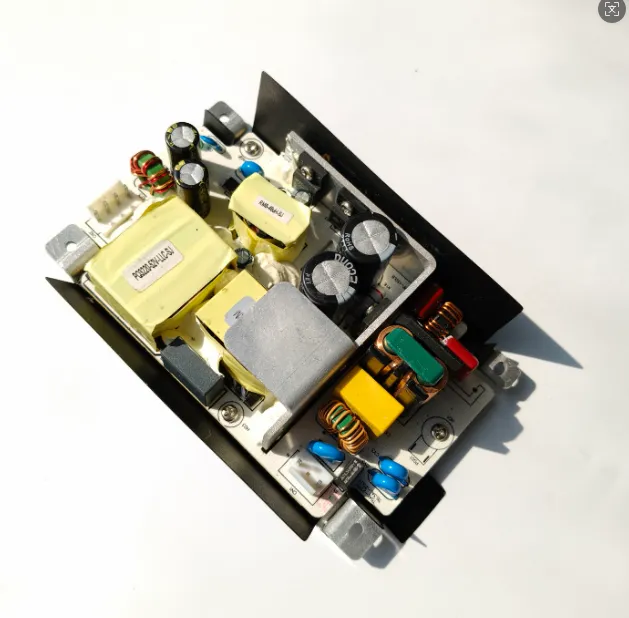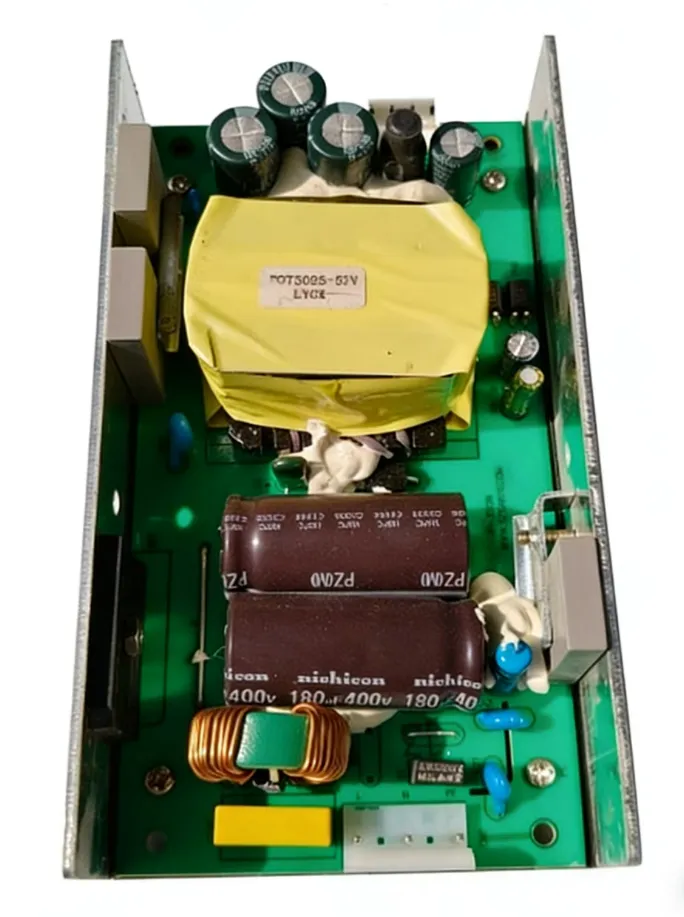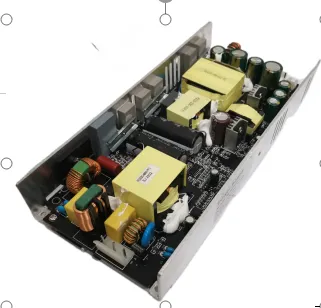

A PoE switch power supply must support two different jobs: delivering power to the PSE circuitry and supporting the switch electronics. A large main-rail wattage does not guarantee sufficient auxiliary power. Check voltage, continuous current and startup demand for each rail separately. Dual outputs do not, by themselves, provide redundancy.
The Sanyi PF-480 dual-output datasheet lists 24V, 48V and 52V main-rail versions, each with a 12V, 2A auxiliary output rated at 24W. A project requiring a 12V, 48W auxiliary rail needs 4A. That requirement is not covered by the listed 12V, 2A rating.
Identify the load on each output
The higher-voltage rail commonly supplies the switch PSE circuitry. The lower-voltage rail may supply the control board, fans or other electronics, depending on the system design. Two outputs do not imply two independent AC sources or galvanic isolation between those outputs. This terminology is also different from a dual-signature PoE powered device.
A suitable DC voltage is not a substitute for PSE detection and power management. Microchip's PoE power overview describes validation of a powered device before power is applied. Check the selected PSE controller's input requirements; do not connect a 52V supply directly to an Ethernet port in place of that circuitry.
Read the PF-480 ratings by complete model number
The following values are from page 1 of the PF-480W dual-output datasheet. Do not combine ratings from different variants.
| Model | CH1 rated output | CH2 rated output |
|---|---|---|
| PF-480-2412 | 24V / 20A | 12V / 2A / 24W |
| PF-480-4812 | 48V / 10A | 12V / 2A / 24W |
| PF-480-5212 | 52V / 9.2A | 12V / 2A / 24W |
The rated-power row identifies 480W for CH1 and 24W for CH2. Multiplying 52V by 9.2A gives 478.4W, so rounded power labels should not be treated as exact values under every condition. Adding the two power columns also does not establish unrestricted simultaneous 504W operation. Confirm combined-load limits for the supplied version and installation.
The datasheet specifies 100–264Vac input at 50/60Hz and dimensions of 220 × 99.6 × 37.8mm. It describes PFC and LLC topology and an optional temperature-controlled fan. Confirm the fan option, airflow and mechanical clearance for the ordered version. See the PF-series PoE power supply page for available documentation.
Make two separate power budgets
For the main rail, account for simultaneous port demand, PSE losses and the reserve required by the application. If starting from powered-device consumption, include cable losses; if using a port-side budget, avoid counting the same losses twice. The PoE power calculator helps organize port requirements, but final selection must also consider the actual switch circuitry.
For the auxiliary rail, list the control board, fans and every other load supplied from 12V. Where a downstream DC/DC converter is used, budget its input demand at the 12V rail, not only the power delivered to its load.
As a calculation example, suppose a design draws 240W from the main rail and 18W from the 12V rail in steady operation. The auxiliary current is 18 ÷ 12 = 1.5A. That alone does not validate a 2A auxiliary supply: startup, fan inrush, operating-mode changes and combined loading may still cause voltage dips or resets. These are illustrative figures, not measured product results.
For port-count and simultaneous-use planning, read the PoE power budget and switch sizing guide.
Specify a 48W auxiliary requirement clearly
First specify the voltage: 48W is a power requirement, not a 48V rail. At 12V, a continuous 48W load requires 4A. At another voltage, the required current changes.
A useful request for quotation includes:
- Main-rail voltage, continuous current and transient load;
- Auxiliary voltage, continuous power, startup peak and peak duration;
- Whether both outputs must operate at full load simultaneously;
- PSE design, switch port count, control board and fan configuration;
- AC input range, enclosure, cooling and expected ambient temperature;
- Connector pinout, mounting requirements, purchase quantity and destination market.
The existing PF-480 dual-output sheet does not establish a continuous 12V, 4A auxiliary capability. Obtain a specification or engineering confirmation for the exact required version before sample qualification. Spare main-rail capacity is not evidence that an auxiliary rail can deliver twice its stated current.
Validate the two rails together
| Test condition | What to observe | What to record |
|---|---|---|
| Light main load, active auxiliary load | Board startup and auxiliary regulation | Both voltages and currents; startup result |
| Active main load, light auxiliary load | Effect of port-load changes on the auxiliary rail | Load combination and recovery behavior |
| Both outputs loaded | Regulation, protection behavior and cooling | Simultaneous readings and critical temperatures |
| Startup, shutdown and load changes | Switch resets, fan cycling or port power interruptions | Trigger, duration and repeatability |
The datasheet states general measurement conditions of 220Vac input, rated load and 25°C ambient, and includes an operating-temperature range and derating curve. The top of the temperature range must not be interpreted as full-power capability. Validate the actual enclosure and airflow against the derating requirements.
Module-level EMC entries do not replace testing of the finished switch. Cabling, grounding, the enclosure and the control board affect system performance. Mains, dielectric and live-circuit measurements require qualified personnel and suitable isolation, protection and measurement equipment.
FAQ
Does dual output mean a redundant power supply?
No. It describes two outputs from a module. Redundant operation additionally requires independent sources, fault isolation and appropriate switching or sharing arrangements.
Does PF-480-5212 provide a 48W auxiliary output?
The current PF-480 dual-output datasheet lists 12V, 2A and 24W. A 12V, 48W requirement needs 4A and must be matched to a separately confirmed specification or version.
Can unused 52V capacity be transferred to the 12V rail?
Do not assume so. The auxiliary rectifier, winding, conductors, connector and protection have their own limits. Follow its stated rating and verify combined loading.
Should a switch use a 48V or 52V main rail?
Select it according to the PSE input range, port-power design, cabling and load requirements. Port count alone is insufficient; verify the complete model and sample in the intended system.
Discuss your switch power requirements
Download documentation from the PF-series PoE power supply directory. To discuss a project, contact Sanyi Power with each rail's voltage, current, startup demand and cooling conditions. If the auxiliary requirement is 48W, state its voltage and whether that is continuous or transient power. You can also email contact@szsanyi.com.
Sources
- Sanyi PF-480W dual-output datasheet: page 1 for model ratings, input and test conditions; page 2 for mechanical outline and derating.
- Microchip: Power over Ethernet: powered-device detection and power management.