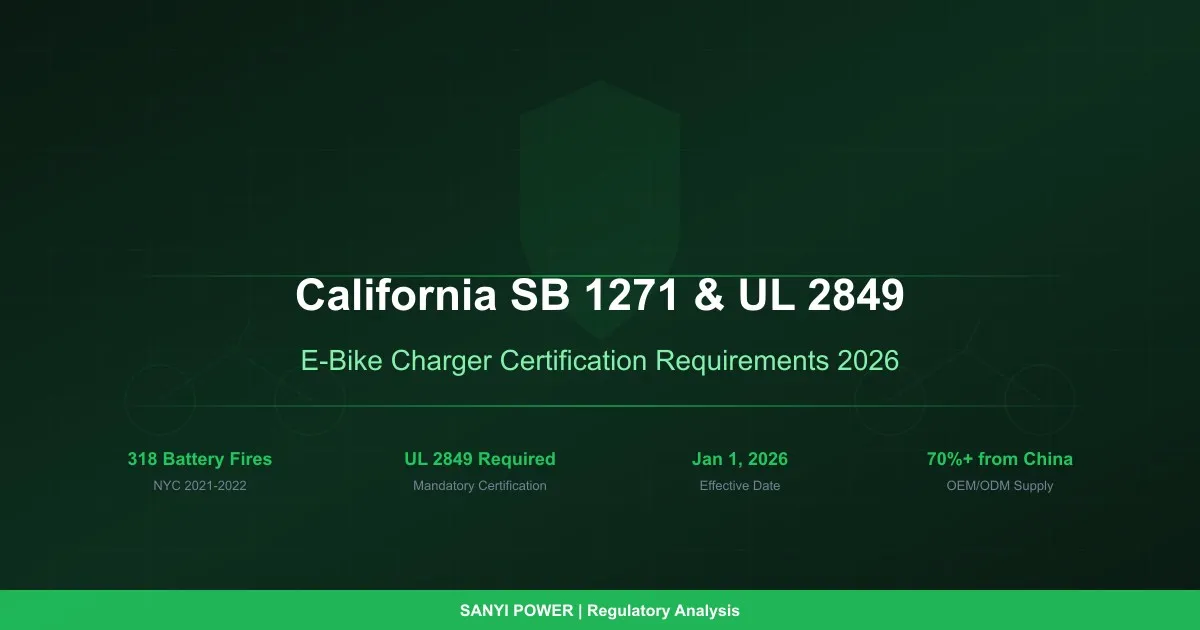

Key Takeaways: California's SB 1271 took effect on January 1, 2026, requiring all e-bikes, batteries, and charging systems sold in the state to be tested by accredited laboratories and certified to UL 2849 or EN 15194. This is the first comprehensive, mandatory e-bike electrical safety regulation at the state level in the US — and it has major implications for every manufacturer selling into the American market.
TL;DR: California SB 1271 now requires all e-bike chargers to carry UL 2849 certification as of January 2026, with rental e-bikes following by 2028. New York City recorded 318 e-bike battery fires causing 226 injuries between 2021 and 2022 (NYC Fire Department, 2024), fueling a nationwide regulatory push. Uncertified products can no longer enter the California market.
Why Is the US Mandating E-Bike Certification?
New York City's fire department recorded 318 lithium-ion battery fires from e-bikes between 2021 and 2022, injuring 226 people (NYC Fire Department, 2024). Most incidents involved substandard chargers or mismatched battery packs, pushing states to act on electrical safety legislation.
The root cause is simple: no federal-level mandatory certification existed for e-bike electrical components. Consumers could easily buy chargers and battery packs with zero safety testing. When cheap aftermarket chargers were paired with incompatible batteries, the risks of overcharging and thermal runaway spiked dramatically.
California isn't acting alone. New York State implemented lithium-ion battery model tag guidance effective January 5, 2026. Massachusetts has issued its own lithium-ion battery safety reminders. The US Consumer Product Safety Commission (CPSC) issued a fire hazard warning for Rad Power Bikes batteries in 2026 (CPSC, 2026). The regulatory direction is clear: nationwide mandatory certification is a matter of when, not if.
What Does SB 1271 Actually Require?
SB 1271 mandates that every e-bike, battery, and charger sold in California must be tested by an accredited laboratory (California Legislature, 2024). Products that don't meet these requirements are prohibited from sale in the state's market.
Which Certification Standards Qualify?
The law recognizes two international standards:
- UL 2849 (US standard) — covers the complete e-bike electrical system, including the electrical drive train, battery system, and charger system
- EN 15194 (EU standard) — the European electrically power-assisted cycle safety standard
For manufacturers targeting the US market, UL 2849 is the primary path. Products with existing EN 15194 certification can use that as evidence of compliance, but obtaining UL 2849 alongside it is advisable for long-term coverage.
Labeling Requirements
Starting in 2026, every certified product must prominently display:
- The testing laboratory's name and/or logo
- The specific certification standard met (e.g., UL 2849)
This applies to charger housings, battery packs, and complete e-bikes. No label means no proof of certification — retailers and enforcement agencies can use this as a straightforward compliance check.
What Does UL 2849 Actually Test?
UL 2849, published by UL Solutions, is a safety standard for e-bike electrical systems covering three core subsystems: the electrical drive train, battery system, and charger system (UL Solutions, 2024). It's not just a "charger certification" — it validates the entire electrical safety loop of the vehicle.
Charger-Specific Tests
For chargers, UL 2849 primarily verifies:
- Electrical safety: insulation, grounding, overcurrent protection, short-circuit protection
- Water resistance: IP rating validation, simulating rain and splash conditions
- Thermal management: temperature rise during charging, ensuring no thermal runaway trigger
- Compatibility: communication and protection mechanisms between charger and paired battery
Battery System Tests
Battery testing is even more rigorous:
- Overcharge and over-discharge protection
- Short-circuit protection response time
- Mechanical shock tests (drop, vibration)
- Thermal abuse testing (simulating external fire exposure)
Based on industry experience, charger certification typically takes 8-12 weeks, while battery system certification requires 12-16 weeks. If the charger and battery are already independently certified, whole-vehicle certification can be shortened to 6-8 weeks. We recommend budgeting at least 6 months for the full certification process.
What Are the Key Compliance Deadlines?
Here's the timeline every manufacturer and importer needs to track:
- September 2024 — California governor signs SB 1271 into law
- January 1, 2026 — Law takes effect; retail e-bikes, batteries, and chargers must be certified
- January 5, 2026 — New York State lithium-ion battery label guidance takes effect
- January 1, 2028 — Rental e-bikes must meet the same certification requirements
The 2028 rental deadline is easy to overlook, but it hits shared mobility companies hard. Rental fleets see higher usage frequency, harsher charging environments, and faster battery degradation — exactly the high-risk scenarios for fires. The two-year grace period seems generous, but shared mobility platforms realistically need to start swapping non-compliant equipment by mid-2027.
How Does This Affect Chinese Export Manufacturers?
Industry estimates suggest that over 70% of e-bikes sold in the US are manufactured by Chinese OEM/ODM suppliers. SB 1271 means chargers and batteries without UL 2849 certification will lose access to California — the largest e-bike market in the United States.
Immediate Action Items
Charger manufacturers should prioritize the following:
- Identify which product models ship to the US market and schedule certification accordingly
- Select an ILAC-recognized testing laboratory — UL, TUV, Intertek, and similar accredited labs
- Update product labels and packaging to accommodate certification marks
- Audit your BOM and supply chain to ensure critical safety components (fuses, optocouplers, transformers) carry UL recognition
Expected Certification Costs
From what we've observed in the industry, UL 2849 certification for a single charger model typically costs between $15,000 and $30,000, depending on power rating and product complexity. If the charger is certified as part of a whole-vehicle submission, costs can be shared. Smaller manufacturers should consider certifying their top 1-2 highest-volume models first, then expanding coverage gradually.
Manufacturers still waiting on the sidelines should recognize a pattern: California often sets the regulatory template for the rest of the country. Other states will follow. Investing in certification now is preparation for long-term US market access, not just a California-specific expense.
Frequently Asked Questions
Can a charger with CE marking be sold in California under SB 1271?
Not directly. CE marking is based on European standards and doesn't automatically satisfy SB 1271. However, if the product has been tested to EN 15194 specifically, that certification is accepted under the law. The product label must still display the testing lab's name and the certification standard number. CE marking alone, without EN 15194 test evidence, won't qualify.
Do standalone charger manufacturers need separate certification?
Yes. While UL 2849 covers the entire e-bike electrical system, chargers can be tested and certified as an independent subsystem. E-bike manufacturers will require their charger suppliers to provide standalone UL 2849 charger subsystem reports. If you're a charger OEM, proactively completing certification gives you a competitive edge with brand customers.
Is there any urgency for rental e-bikes before 2028?
Legally, rental e-bikes are exempt until January 1, 2028. Practically, preparation should start much sooner. Shared mobility platforms typically have 12-18 month procurement cycles and 2-3 year equipment lifespans. Rental vehicles purchased in late 2026 will still be in service when the 2028 deadline arrives. The CPSC's 2026 fire hazard warning on Rad Power Bikes batteries (CPSC, 2026) signals that enforcement intensity will only increase.
Does SB 1271 apply to electric scooters and other micromobility devices?
Currently, SB 1271 applies specifically to electric bicycles as defined in state law. Electric scooters, electric unicycles, and other micromobility devices are not covered. However, given the universal nature of lithium-ion battery safety concerns, regulatory expansion to these categories is worth monitoring closely.
Conclusion
SB 1271 and UL 2849 mark a turning point for the US e-bike market — the shift from voluntary compliance to mandatory certification. For charger manufacturers, particularly those in China's export supply chain, this is both a challenge and an opportunity. Companies that complete certification first will hold a clear market access advantage.
The key actions: start the certification process now, prioritize your highest-volume models, and budget at least 6 months. Keep a close watch on follow-up legislation in New York, Massachusetts, and other states.
If you're designing an e-bike charging solution and need to determine the right power parameters, our charger sizing calculator can help.