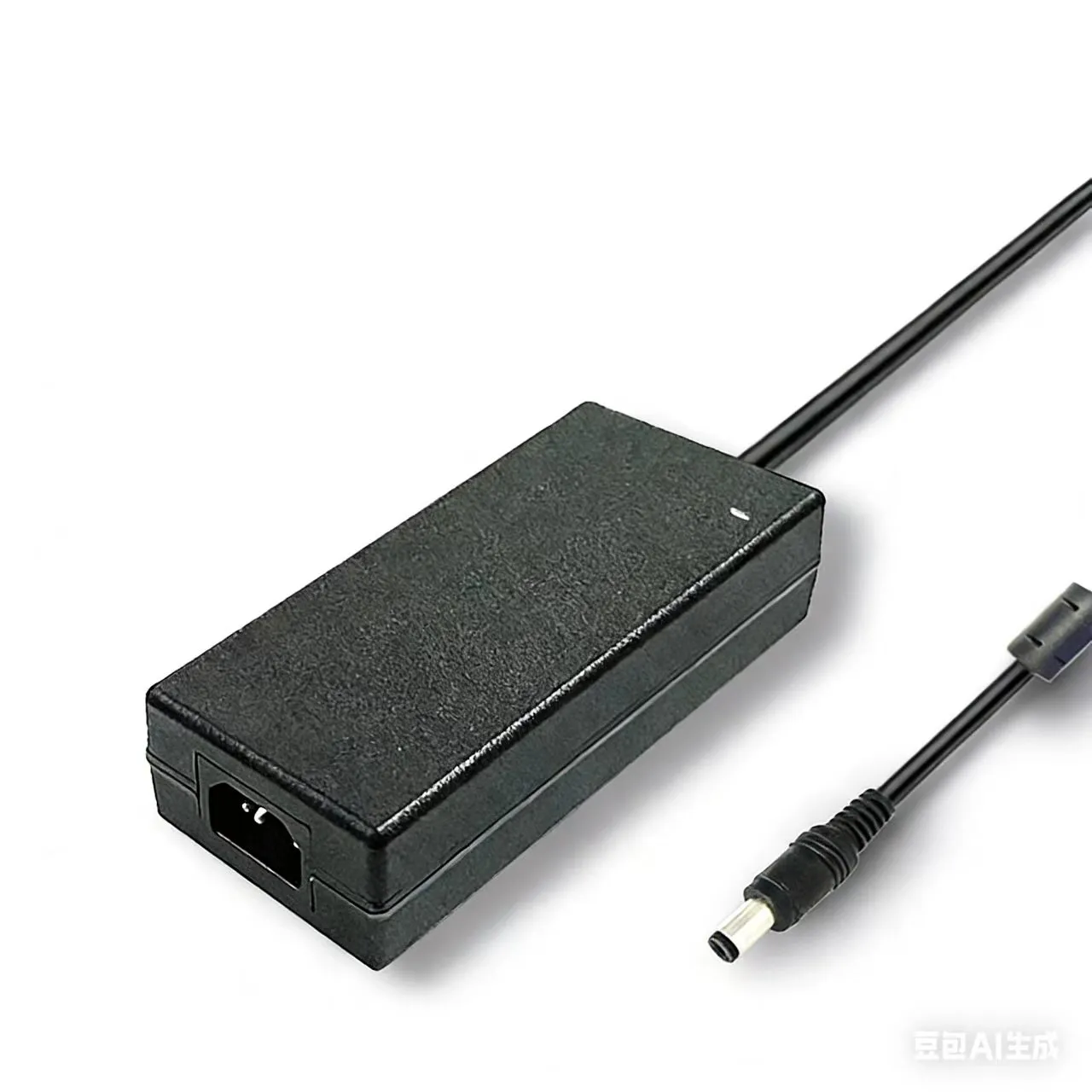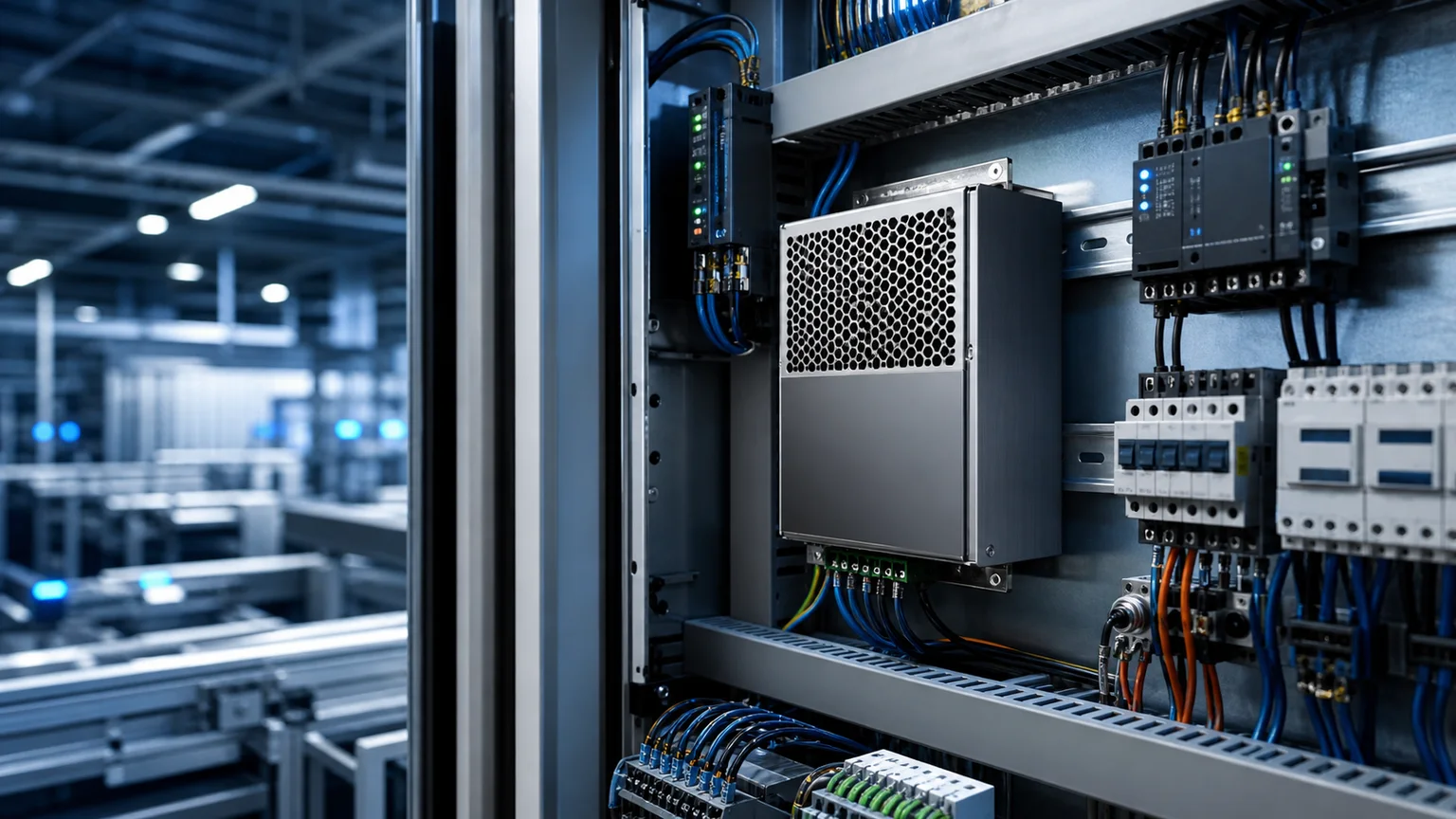

A rolling-stock OEM is preparing the type-test campaign for a new metro fleet. Mechanical, traction, and HVAC are signed off. Then the on-board passenger information system fails its EMC pre-compliance: the DC-DC converter feeding the network switches re-resets every time the train enters a substation handover and the 110 V battery rail sags below nominal. A second look at the spec sheet says "24/110 V wide-input DC-DC, industrial grade" — but nothing about EN 50155, no Class S2 interruption tolerance, no EN 50121-3-2 emissions data. The converter is sound for an industrial automation cabinet. It is not sound for a train.
This is one of the most common — and most expensive — silent specification errors in railway electronics procurement. An "industrial DC-DC" and a "railway DC-DC" look almost identical on a one-line BOM but differ in roughly thirty test parameters, half of which only show up at type-test or worse, in the field. A delayed type-test costs a railway program weeks; a field failure on a passenger-information system after revenue service costs reputation.
This guide walks rolling-stock procurement, system integrators, and design engineers through how to select an EN 50155-compliant DC-DC converter without surprises: what the standard actually requires, what its companion standards add, the topology decision, the procurement checklist, and how to verify a vendor's claim.
Failure Modes That Trace Back to a Wrongly Specified Railway DC-DC
- On-board IP camera or PIS resets when the train transits a sub-station section gap — missing Class S2 supply interruption tolerance
- Converter MTBF drops to 18 months in tropical service — temperature class T1 selected for a TX environment
- EMC pre-compliance fails radiated emissions on the carbody bus — no EN 50121-3-2 conformity at the converter input
- Loose-mount converter cracks PCB at 6 months — missing EN 61373 Category 1 Class B vibration qualification
- Material certificate rejected by the integrator — housing or potting compound not EN 45545-2 R22/R23 hazard-level compliant
- Type test fails dielectric withstand — insulation coordination not aligned to EN 50124-1 overvoltage category
Why Railway DC-DC Converters Need EN 50155 Compliance
Industrial-grade and railway-grade DC-DC converters live in different worlds. An industrial DIN-rail PSU sees a stable mains, predictable cabinet ambient, mild vibration, and a benign EMC environment dominated by VFD harmonics. A railway converter sees a battery rail that swings from below 0.7 × nominal to above 1.4 × nominal during regenerative braking and section-gap traversal, ambient extremes from sub-arctic depots to desert mainlines, mechanical shock from rail joints, and the harshest EMC environment in mass transport — high-voltage traction, pantograph arcing, and trackside signaling all coupled into a metallic carbody.
EN 50155 ("Railway applications — Rolling stock — Electronic equipment") is the umbrella standard that consolidates these requirements for on-board electronics. Any electronic assembly mounted on rolling stock — passenger information systems, on-board diagnostics, train control gateways, network switches, IP cameras, communication radios — must be EN 50155-compliant. The DC-DC converter inside that assembly is, in practice, the component most likely to fail one of the EN 50155 type tests if it was not engineered for the standard.
The global rolling stock market is sustained spend. CER (Community of European Railway and Infrastructure Companies) member states alone are committed to over EUR 200 billion in rail infrastructure and rolling-stock investment by 2030, and Asia-Pacific metro programs are adding hundreds of new vehicles per year through 2030 (UIC Rail Industry Outlook, 2024). For tier-1 suppliers feeding into those programs, getting the DC-DC selection right is non-optional.
What EN 50155 Actually Requires — and the Companion Standards Behind It
EN 50155 is not a single test list. It is a system standard that calls out a family of companion standards, each of which adds its own test campaign. Understanding the family is the first step in writing a defensible procurement specification.
The standard family at a glance
- EN 50155 — General requirements for on-board electronic equipment: power supply behavior, environmental classes, software requirements, design and documentation rules.
- EN 50121-3-2 — EMC for rolling stock apparatus: emissions and immunity at the equipment level, harmonized with the EU Railway Interoperability Directive.
- EN 61373 — Shock and vibration testing of railway rolling-stock equipment, with categories (1, 2, 3) describing where the equipment is mounted (carbody-mounted, bogie-mounted, axle-mounted) and classes A and B within Category 1 for body-mounted vs. cab-mounted.
- EN 45545-2 — Fire protection of railway vehicles, classifying materials by hazard level (HL1, HL2, HL3) and listing requirement sets (R22, R23, R24…) keyed to the function of the part.
- EN 50124-1 — Insulation coordination: clearances, creepage, and dielectric withstand for railway applications, with overvoltage category and pollution degree.
- EN 50125-1 — Environmental conditions for on-board equipment: temperature, humidity, altitude, water ingress.
A compliance-ready railway DC-DC converter will reference all of these in its declaration of conformity — not just EN 50155 alone. A datasheet that only says "EN 50155 compliant" without naming the companion standards has not been fully tested.
Power supply behavior: nominal rails and supply variation
EN 50155 lists the nominal on-board battery voltages used across the world's rolling stock: 24 V, 36 V, 48 V, 72 V, 96 V, and 110 V DC are the headline ratings. Around each nominal value, the standard requires the converter to operate continuously across a wide tolerance band — typically 0.7 × Un to 1.25 × Un — and to ride through transient excursions to 0.6 × Un on the low side and 1.4 × Un on the high side for defined durations. A multi-rail-input converter (e.g., 24/48/72/110 V "wide-input railway") is the most procurement-friendly approach because a single SKU can serve multiple fleets.
Supply interruption classes (S1 / S2 / S3)
Section gaps, neutral sections, and pantograph bounce produce brief interruptions of the auxiliary battery rail. EN 50155 defines classes for the interruption duration the equipment must ride through:
- Class S1 — must tolerate a 10 ms interruption.
- Class S2 — must tolerate a 20 ms interruption.
- Class S3 — must tolerate a 30 ms interruption.
Some applications require even longer hold-up. For passenger information, signaling gateways, and any system whose reset is operationally visible, Class S2 or S3 should be the procurement floor, regardless of what the cheapest "industrial DC-DC" on the bid sheet offers.
Temperature classes (T1, T2, T3, TX)
EN 50155 defines operating ambient classes that map to where the equipment is installed (interior cab, equipment cabinet, underframe, rooftop) and the climate where the fleet runs. Common classes referenced in tender documents:
- T1 — −25 °C to +55 °C
- T2 — −40 °C to +55 °C
- T3 — −25 °C to +70 °C
- TX — −40 °C to +70 °C, with short-term excursions to +85 °C for limited duration
Roof-mounted and underframe equipment in tropical or desert service almost always need T3 or TX. Selecting T1 because the data sheet was cheaper is one of the leading causes of two-year MTBF on revenue-service trains.
EMC, insulation, vibration, fire
EN 50121-3-2 sets the conducted and radiated emission limits and the immunity tests (surge, EFT/burst, electrostatic discharge, radiated immunity at high field strength). EN 61373 sets the random-vibration profile and the long-life endurance test. EN 45545-2 governs whether the converter's plastics, potting, sleeving, and labels can be installed inside the carbody. EN 50124-1 sets the insulation coordination — the clearance and creepage between the input battery rail, the output rail, and the chassis. All four must be addressed in the converter design, not bolted on later by the integrator.
Topology Choice: Isolated vs Non-Isolated DC-DC for Rolling Stock
Most on-board EN 50155 DC-DC converters are galvanically isolated between input and output. There are concrete reasons for that.
- Battery rail noise rejection — pantograph bounce, traction inverter switching, and trackside signaling couple high-frequency noise into the auxiliary battery. Isolation is the cleanest way to keep that noise out of sensitive payload electronics (radios, IP cameras, fiber transceivers).
- Insulation coordination per EN 50124-1 — high-voltage classes require reinforced isolation between the battery rail (which can sit on a non-grounded reference) and the equipment chassis.
- Earth-fault localization — railways often run with isolated battery systems and continuous earth-fault monitoring. A non-isolated converter can defeat that monitoring strategy.
- Repeatable EMC behavior — isolated topologies with shielded transformers are far easier to certify against EN 50121-3-2 than non-isolated buck/boost stages with long ground returns.
Non-isolated DC-DC stages are still used inside the converter for local rail generation (point-of-load buck or boost downstream of the isolation barrier) and occasionally for low-voltage payload regulation where chassis reference is shared. For the main on-board bus DC-DC step-down, isolated is the default.
A second decision is single output vs. multiple outputs. A converter feeding a payload that needs only one rail (e.g., a 24 V network switch from a 110 V battery) should be a single-output design with full output regulation. A converter feeding mixed analog/digital payloads (a passenger information module with 24 V, 12 V, and 5 V demands) is better served by a single isolated front end and downstream point-of-load regulators inside the payload assembly — keeping the cross-regulation problem out of the safety-relevant front end.
Selection Checklist: A Procurement-Ready Spec Sheet
When a procurement team writes a tender line for "EN 50155 DC-DC converter," the spec sheet should explicitly call out every parameter below. Anything left implicit will be filled in by the cheapest bidder in the way that helps them, not the integrator.
| Parameter | What to specify | Why it matters |
|---|---|---|
| Nominal input voltage | 24 / 48 / 72 / 96 / 110 V (or wide-input) | Must match the fleet's battery rail; wide-input simplifies multi-fleet platforms. |
| Input voltage range | 0.7 Un to 1.25 Un continuous, 0.6 Un to 1.4 Un transient | Covers regenerative braking surges and battery low-state-of-charge. |
| Supply interruption class | S1, S2, or S3 preferred | Defines hold-up time during section-gap and pantograph bounce events. |
| Temperature class | T1 / T2 / T3 / TX for harsh service | Defines operating ambient; underframe and rooftop need T3 or TX. |
| EMC compliance | EN 50121-3-2, with both emission and immunity test reports | Required at type test; non-conformity will not be patched in software. |
| Vibration / shock | EN 61373 Category 1 Class A or B | Body-mount Class B is the typical procurement floor for cab and saloon. |
| Fire protection | EN 45545-2, materials list with hazard level (HL2 typical) | Required for all components installed inside the carbody. |
| Insulation | EN 50124-1 with declared overvoltage category | Defines dielectric withstand and creepage; do not skip on 110 V systems. |
| Isolation voltage | Reinforced isolation, declared in kVrms | Validates the insulation barrier for safety-relevant payloads. |
| Efficiency | Curve over load and input range, not single point | A single-point efficiency tells you nothing about real on-board duty. |
| MTBF | Vendor calculation method (Telcordia / MIL-HDBK-217) and target hours | Set procurement floor; trace to vendor design margin. |
| IP rating | IP20 / IP54 / IP65 depending on mount location | Underframe and rooftop need ingress protection. See our IP65/IP67/IP68 selection guide for ingress class definitions. |
| Mechanical | Conduction-cooled or fan-cooled; mounting interface | Fan-cooled units in dusty service have worse MTBF than conduction-cooled. |
| Documentation | Declaration of conformity + named test reports per standard | "EN 50155 compliant" without test reports is a marketing claim, not a procurement record. |
Common On-Board Application Scenarios
Different on-board systems push the EN 50155 envelope differently. Knowing the application up front lets the procurement team tier the spec.
- Passenger information systems (PIS) and on-board displays — usually 24 V or 12 V payload, fed from 110 V battery via an isolated DC-DC. Class S2 / S3 strongly preferred to avoid visible reset during section gaps. Temperature class T2 or T3 typical for saloon installation.
- On-board signaling gateways and ETCS interfaces — safety-relevant. Reinforced isolation, redundant supplies, and the highest interruption class the budget allows. EN 50124-1 insulation coordination is a hard line item.
- On-board IP cameras and CCTV recorders — often PoE payload downstream of a DC-DC. Total loop must hold up through interruption events without losing recording continuity. Cabinet ambient typically T2 or T3; rooftop cameras need T3 or TX. Our PoE power budget calculator and switch sizing guide covers the downstream PoE math once the DC-DC front end is sized.
- On-board diagnostics and condition-monitoring units — moderate power, T2 or T3 typical. Often run continuously even when the train is parked; converter no-load and standby losses become an operational cost.
- Train communication radios (LTE-R, GSM-R, 5G) — sensitive RF payload. EMC immunity per EN 50121-3-2 at the converter is non-negotiable; cheap "industrial DC-DC" units with poor common-mode filtering are a frequent root cause of radio desense.
- HVAC controllers and saloon lighting drivers — higher power, often distributed converters. Long-life MTBF and conduction-cooled construction preferred over fan-cooled.
How to Verify Vendor Compliance
Procurement teams should treat any railway DC-DC vendor claim as unverified until the test reports are on the desk. The following documentation set is the procurement gate:
- Declaration of Conformity (DoC) — naming EN 50155 and every companion standard claimed (EN 50121-3-2, EN 61373, EN 45545-2, EN 50124-1, EN 50125-1).
- Type test reports from a recognized lab (or the vendor's own type-test laboratory with traceable calibration). Each report should match the cited test class — e.g., EN 61373 report must state Category and Class; EN 50155 supply test must state interruption class S1/S2/S3.
- Material declaration per EN 45545-2 — listing materials of housing, potting, sleeving, and labels with hazard level and requirement set.
- Reliability prediction — MTBF method (Telcordia SR-332 issue 4 / MIL-HDBK-217F) with environmental class (typical: GB / ground benign for protected cabinet, GF / ground fixed for harsher environments).
- CE marking dossier and EU Declaration — for European programs, the EMC, RoHS, and (where applicable) RED conformity files.
- Long-term availability statement — railway programs run 30+ years; a part that goes EOL in five years becomes an obsolescence problem the integrator owns.
Ask for sample units and run an independent EMC pre-scan at the integrator's lab before locking the BOM. A 2-day pre-scan on a sample is the cheapest insurance against a 6-month type-test slip.
Where Sanyi Fits: Trackside, Depot, and Station-Side Power Infrastructure
Sanyi's industrial AC-DC product line is engineered for the trackside, depot, station, and signaling-room infrastructure that surrounds a rolling stock fleet — not the on-board DC-DC converter itself. For procurement teams sourcing the wider railway power chain, the following industrial-grade Sanyi platforms map onto common adjacent applications:
- Trackside cabinet and signaling-room AC-DC supplies — for protected indoor cabinets feeding control electronics, the SZ Series Industrial Switching Power Supply 240W-480W and the SFY-Z Series 240W-480W are mainstream choices, with full overcurrent / overvoltage / overtemperature protection and aluminum-housing thermal design.
- Station passenger-information and CCTV cabinet power — mid-power needs are well served by the SFY-I Series 120W-200W for typical 24 V cabinets, or by POE-300W and POE-480W PFC platforms when the downstream load is PoE-based station CCTV and access points.
- Depot maintenance and shop-floor PSUs — for workshop test benches and depot cabinets, our industrial DIN rail power supply selection guide walks through the full power-tier map.
For the on-board EN 50155 DC-DC converter itself, Sanyi works with rail integrators on a project basis. Reach out via the inquiry channel below with the target fleet's nominal battery voltage, the payload class (PIS / signaling / CCTV / radio), the temperature class (T1 / T2 / T3 / TX), and the EN 61373 vibration category — and we will scope the right platform.
FAQ
Is EN 50155 the same as IEC 60571?
They are closely related but not identical. IEC 60571 is the international standard for "Railway applications — Electronic equipment used on rolling stock"; EN 50155 is the European harmonized version. Many tender documents reference one and accept the other, but procurement teams should confirm the exact issue (e.g., EN 50155:2017 vs. earlier editions) and ensure the test report matches. They cover broadly the same scope — power, environment, EMC, design, and documentation — with minor differences in clauses and dates.
What is the difference between Class S1, S2, and S3 supply interruption?
All three define the duration of an auxiliary battery rail interruption that the converter must ride through without resetting the load. Class S1 = 10 ms, Class S2 = 20 ms, Class S3 = 30 ms. Class S2 is the typical floor for passenger-visible systems (PIS, CCTV); Class S3 is preferred for safety-relevant gateways. The longer the class, the more bulk capacitance or hold-up energy the converter needs — and the higher the unit cost.
Do I need EN 45545-2 hazard level HL2 or HL3 for a roof-mounted converter?
HL2 is the most common procurement floor for components installed inside the carbody, and it is what the majority of rolling-stock OEMs ask for in their general supplier specs. HL3 is required for high-risk locations and for fleets running long tunnels or high-occupancy operating conditions where evacuation time is constrained. The exact requirement is set by the integrator's fire risk assessment per EN 45545-1; ask for the project's specific hazard level before committing the BOM.
Can I use an "industrial-grade wide-input DC-DC" if I add external filtering to make EMC pass?
Almost never a good idea. An industrial-grade DC-DC that did not pass EN 50121-3-2 at design time will usually fail other EN 50155 clauses too — temperature class, interruption class, vibration, fire material, insulation coordination. Patching one parameter (EMC) with an external filter does not fix the others, and the integrator inherits all the unaddressed risk. Source a converter that was designed to EN 50155 from day one and demand the test reports for every cited clause.
Conclusion: Specify the Standard, Not the Slogan
The single most useful thing a railway procurement team can do is write the spec sheet against the standards, not the slogans. "EN 50155 compliant" on a one-line BOM commits a vendor to nothing. A spec line that says "EN 50155:2017 compliant; supply interruption Class S2; temperature class T3; EN 50121-3-2 emissions and immunity per type test report; EN 61373 Category 1 Class B; EN 45545-2 HL2 R22/R23 materials; EN 50124-1 OV3 / PD2; isolation reinforced 3 kVrms" commits the vendor to a defensible compliance package and the test reports to back it up.
If you are scoping a new fleet program or qualifying a tier-1 supplier, talk to our team early — specifying the right power platform at preliminary design saves a delayed type test later.
.webp)