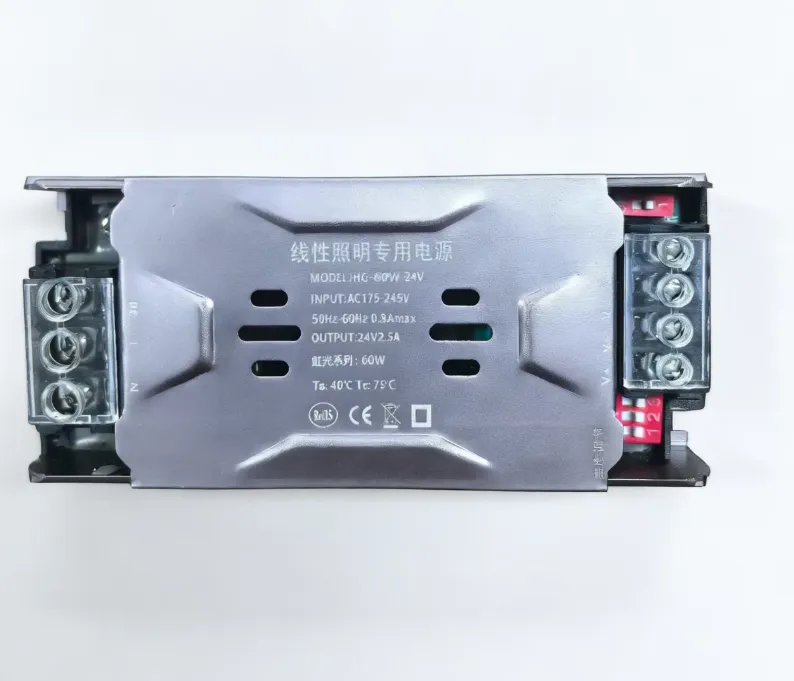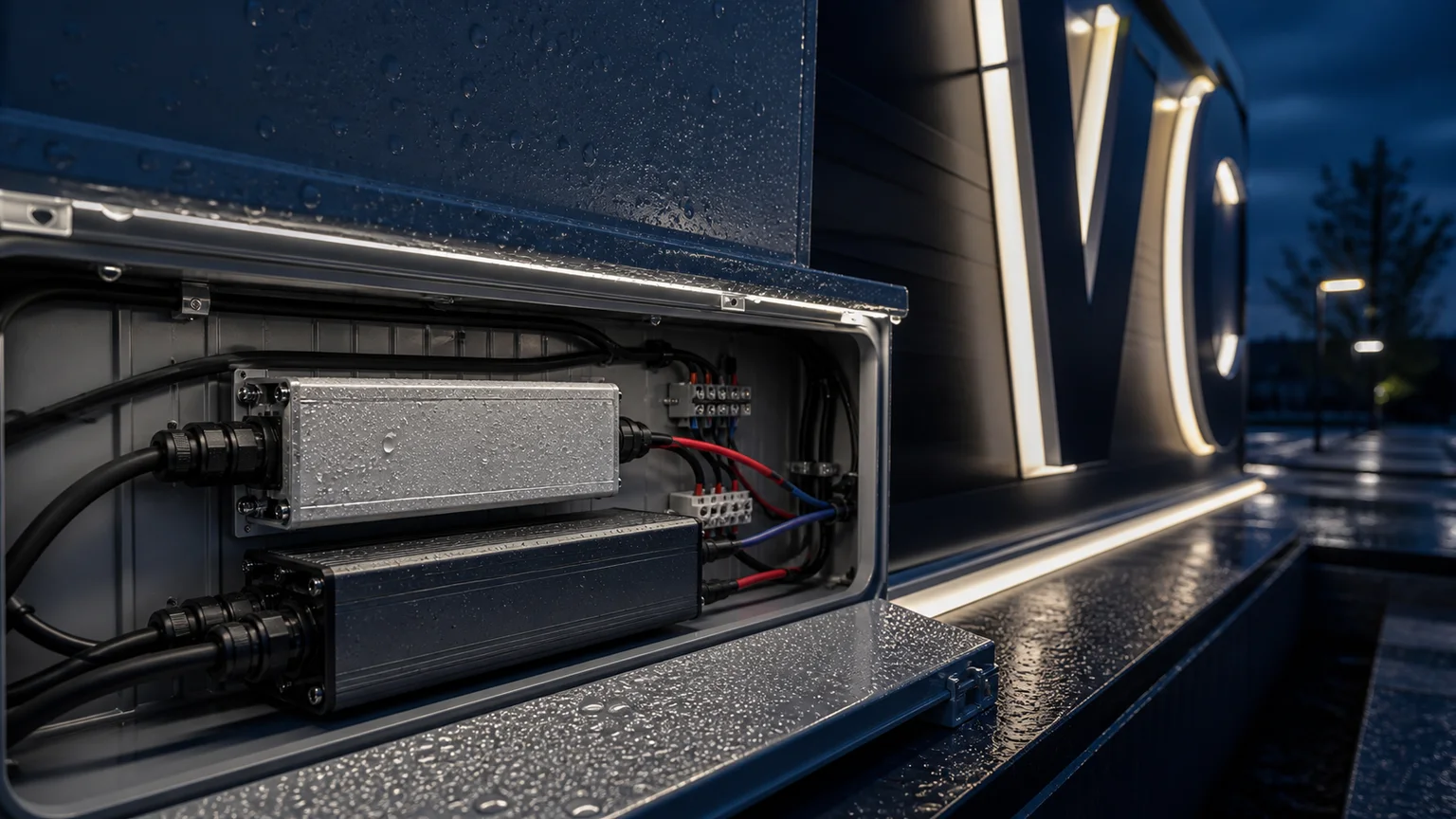

Key Takeaways: A failed channel letter sign almost never fails because the LEDs are bad — it fails because the power supply was undersized, mounted in the wrong enclosure, or asked to push current down 30 ft of #18 wire. This guide is for sign shops and signage installers: the four decisions that actually determine whether your sign survives a Texas summer or a Minnesota January. Pick voltage, size for 80% load, match IP rating to mount location, and bound voltage drop to 5%. Get those right and the rest is craftsmanship.
TL;DR: For most modern channel letter modules use 12V for letters under ~30 in (760 mm) per run and 24V for larger letter cabinets, light-box signs, and architectural raceway-fed installations. Choose IP65 for under-canopy or eave-protected mounts, IP66/IP67 for fully exposed wall-mounted faces. Size the power supply to load no higher than 80% of nameplate at full sign output, then add 20–30% for ambient temperature derating in southern climates. Keep voltage drop on the 12V/24V DC side below 5% by upsizing wire and shortening runs — not by cranking output voltage.
Why Channel Letter Sign Power Is Different from LED Strip Power
If you have read our LED strip power supply guide, you already know the basics of constant-voltage LED sizing. But channel letter signs and light box signs have three properties that strip lighting installers rarely face:
- Modules instead of continuous strip. Channel letter signs use injection-molded LED modules — typically 3 LEDs in a "stick" rated 0.72 W or 1.5 W per module — chained inside the cavity of each letter. Density per letter varies by stroke width, not a clean per-meter figure.
- Mixed run lengths in the same cabinet. A "STARBUCKS" sign has a short "S" and a long "U-C-K-S" tail. A single power supply can feed letters with very different LED counts. Voltage drop across the longest run determines how much you can pack on one PSU.
- The PSU lives outdoors with the sign. For wall-mounted signs the power supply is typically mounted on the back side of the sign cabinet or in a small remote enclosure within a few feet. It sees the same rain, dust, and 50°C summer roof temperature the LEDs do. Indoor electronics specs do not apply.
That is why this guide is structured around outdoor service life, not just nominal wattage.
Step 1 — Pick a Voltage System: 12V or 24V?
Almost every channel letter module sold today is offered in 12V or 24V. Some Asian factories also ship 5V and 36V variants for very small or very large letters, but they are rare in North American and European sign supply chains.
When 12V Wins
- Smaller letters (≤ 30 in / 760 mm tall) with 5–10 modules per letter. Voltage drop on short runs is negligible at 12V, and 12V modules are slightly cheaper per piece.
- Repair-friendly retrofits. If the existing sign was wired 12V, do not mix-and-match.
- Reverse-channel halo letters where each letter is fed individually — short cable runs, no voltage-drop concern.
When 24V Wins
- Letters ≥ 36 in (915 mm) tall, large stroke widths, or long cabinets — anywhere the longest module chain exceeds about 10 ft (3 m). At twice the voltage, a 24V system delivers the same wattage at half the current, which means voltage drop falls by 4× on the same gauge wire (drop scales with current squared in dissipation, but linearly in V = IR voltage). For a typical 0.72 W module string, 24V can support roughly twice the run length before brightness falls off.
- Light-box signs with internal LED-module backplanes covering 12 ft² or more.
- Raceway-mounted bar signs where the PSU sits 6–10 ft from the farthest letter.
- Mixed letter cabinets with one PSU feeding everything — the headroom matters.
What to Avoid
- Driving 12V modules from a 24V supply through a buck regulator inside the cabinet. Field reliability is poor; a dedicated 12V PSU is cheaper and lasts longer.
- Mixing 12V and 24V modules on the same circuit. They have different forward voltage and will not balance.
Step 2 — Size the Power Supply: The 80% Rule
Total your sign's load by counting modules and multiplying by the module nameplate wattage:
Sign load (W) = (modules per letter × number of letters) × module wattage
Then apply the 80% loading rule: pick a PSU whose nameplate wattage is at least 1.25× the calculated load. This is not a marketing rule — it is a basic thermal rule that comes straight from the heat-rise behavior of switching power supplies on hot summer days.
Worked Example: A Typical Storefront Channel Letter Sign
A 7-letter storefront sign — say "WELLNESS" — using 24-inch letters with 8 modules per letter at 0.72 W per module:
- Modules per letter: 8
- Letters: 7 (we will say 8 if there is a logo dot)
- Total modules: 64
- Module wattage: 0.72 W
- Sign load: 64 × 0.72 W = 46.1 W
- Required PSU rating (÷ 0.80): 46.1 ÷ 0.80 = 57.6 W → choose a 60W PSU
In practice you would specify a 60W or 75W rainproof unit to leave summer-temperature headroom. Sanyi's SNT-series rainproof switching power supply covers 36W, 60W, and 75W ratings at 12V or 24V output and is sized for exactly this kind of single-cabinet storefront sign.
Worked Example: A Larger Pylon Sign
A two-sided pylon sign with 4 ft (1220 mm) letters, 28 modules per letter face, 6 letters, both faces:
- Modules per letter face: 28
- Faces: 2
- Letters: 6
- Total modules: 28 × 2 × 6 = 336
- Module wattage: 1.5 W (24V high-output module)
- Sign load: 336 × 1.5 W = 504 W
- Required PSU rating (÷ 0.80): 504 ÷ 0.80 = 630 W
For a sign of this scale you typically split across two 360 W or 480 W aluminum-housed waterproof units mounted in a back-of-cabinet enclosure. Sanyi's aluminum waterproof power supply (1703 / 1704 series) offers 240W–480W ratings with IP67 sealing — a common choice for pylon and monument signs that need durable, large-area distribution.
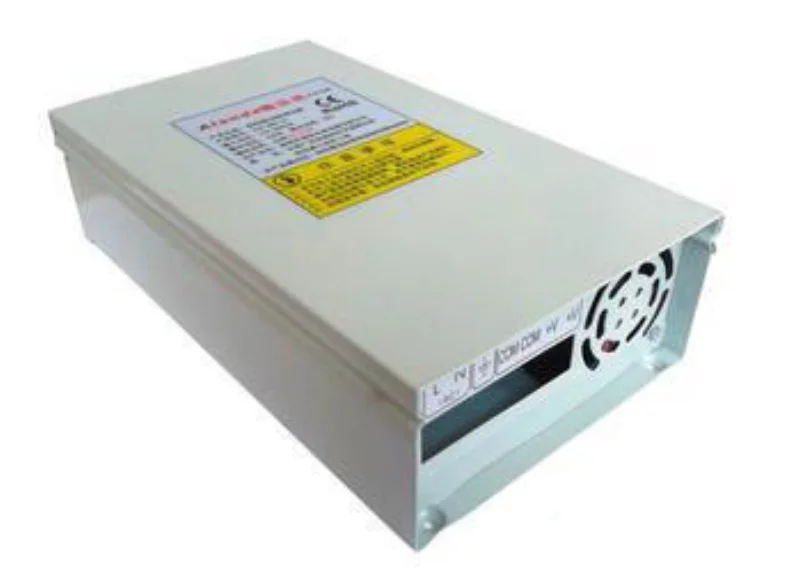 SNT Series 36W–96W rainproof PSU — a typical fit for single-cabinet storefront channel letters
Don't Forget Ambient Derating
Power supplies are typically rated at 25°C ambient. A back-of-cabinet PSU on a south-facing wall in Phoenix can see internal cabinet temperatures of 55–60°C in July. Most quality outdoor PSUs derate linearly above 50°C — typically 2–3% of rated output per degree Celsius. For installations in hot climates, add another 20–30% margin on top of the 80% rule, which means picking a 96W unit where the math says 60W.
For more on the physics behind that derating curve, see our power supply derating curve guide.
Step 3 — Match the IP Rating to the Mount Location
Three IP ratings dominate the outdoor sign world. Pick the lowest one that suits the actual installation, since each step up adds cost and reduces convection cooling.
| IP Rating | Where It Belongs | Typical Sign Application |
|---|---|---|
| IP65 | Eave-protected, under-canopy, or vented enclosure with rain shielding | Storefront channel letters under awnings, mall ID signs |
| IP66 | Fully exposed wall-mount, direct rain, no overhang | Wall-mounted channel letters on facades |
| IP67 | Submersion risk, or installations with frequent driving rain / pressure-wash | Pylon signs, ground-level monuments, exposed light boxes |
For a deeper treatment of IP code definitions and how they map to test conditions, see our IP65/IP67/IP68 waterproof power supply guide.
Where Sign Shops Get This Wrong
The most common failure pattern we see in field returns is an IP65-rated PSU mounted directly to a south-facing fascia with no overhang. The unit survives the first season, but driving rain in the second winter forces moisture past the gland into the AC entry. The unit fails, the sign goes dark on the coldest morning of the year, and the customer calls the sign shop, not the PSU vendor. Always step up to IP66 or IP67 for fully exposed mounts — the extra cost per cabinet is dwarfed by one truck-roll service call.
For the most demanding installations — fountain backlighting, in-ground monument lighting, or coastal salt-air exposure — the SYG-series IP67 waterproof power supply is fully potted and rated for pressure-wash and partial submersion environments.
Step 4 — Bound the Voltage Drop on the DC Side
The biggest installer mistake on long-cabinet signs is treating 12V or 24V wiring like it is the same as 120V branch circuit wiring. It is not. At low voltage, even a few hundred milliohms of cable resistance translates to visible brightness falloff. Here is the rule of thumb:
Keep DC voltage drop below 5% from PSU output to the farthest module.
Beyond 5% you start seeing dimmer letters at the end of the run, and at 10%+ you also stress the closer modules with above-rated voltage when you compensate by cranking the output trimmer.
Voltage Drop Reference for 12V vs 24V Channel Letter Cabinets
For a typical 5-letter sign drawing 50 W (about 4.2 A on 12V or 2.1 A on 24V), with modules wired down a raceway from a single PSU:
| Run Length | 12V on #18 AWG | 12V on #16 AWG | 24V on #18 AWG | 24V on #16 AWG |
|---|---|---|---|---|
| 10 ft | 5.4% (marginal) | 3.4% (OK) | 1.4% (excellent) | 0.9% (excellent) |
| 20 ft | 10.8% (fail) | 6.8% (fail) | 2.7% (OK) | 1.7% (excellent) |
| 30 ft | 16.3% (fail) | 10.2% (fail) | 4.1% (OK) | 2.6% (excellent) |
This is the strongest single argument for 24V on larger signs. 24V cuts voltage drop by 4× at the same wire gauge and current draw, because both V and I drop by half (V = IR; halve the current and the absolute drop halves; halve the source voltage and the percentage halves again).
If the run is genuinely long — say a horizontal raceway feeding a 30 ft cabinet — split into two PSUs in the cabinet feeding from each end, instead of a single PSU at one end. Two 60W units almost always outperform one 150W unit in this geometry.
Step 5 — Mounting and Service Considerations
A few non-electrical things that determine whether your sign comes back to bite you:
- Mount the PSU on the back of the cabinet, not inside the face cavity. The face cavity sees direct solar load and runs hot. The back is shaded and convects cooler air.
- Leave 25 mm (1 in) air clearance around all four sides of the PSU. Skipping this in a tight raceway is the #2 reason for premature thermal failure (after IP rating mismatch).
- Use strain relief cable glands rated to the PSU's IP class. A IP67 PSU with an unsealed knockout entry is no longer IP67.
- Install a dedicated outdoor-rated AC disconnect upstream. Photocells fail; service calls happen. A flippable disconnect saves hours per installation over the sign's life.
- Label the PSU output voltage on the cabinet. Five years from now another installer will replace it. Make their life easier.
For light-box signs and slim-profile lightboxes that need a PSU to fit inside a 1.5 in (38 mm) cabinet depth, the SL-series ultra-slim switching power supply and SK-series slim PSU are the slimmest indoor / semi-indoor options at 120W–200W and 60W–120W ratings respectively. They are not weatherproof — pair them with an IP-rated outer cabinet.
Common Sign Power Supply Mistakes (and How to Avoid Them)
A short audit checklist for sign shops reviewing field installations:
- PSU loaded above 90% of nameplate. Reduces life from ~50,000 hr to ~20,000 hr. Step up one size.
- IP65 PSU mounted in direct rain exposure. Move to IP66/67 or add a drip shield.
- 12V system on 30 ft cabinet. Either re-spec to 24V or add a second PSU at the far end.
- Output trim cranked to 13.5V to "fix" dim letters at the tail. This kills the closer modules. Fix the wire gauge or split the supply instead.
- Single PSU at one end of a long raceway. Split feed from both ends.
- PSU AC entry pointed up. Should always face down so condensation drips out, not in.
- No service disconnect. Every commercial sign should have an outdoor-rated AC disconnect for safe service access.
Related Reading
If your sign install includes any of these adjacent scopes, these guides cover the matching power-supply decisions:
- LED strip power supply guide — for cove, accent, and linear strip lighting integrated into the architecture
- Slim LED display power supply guide — for indoor digital signage and flat LED displays
- IP65/IP67/IP68 waterproof power supply selection guide — for the IP code details
- Power supply derating curve guide — for hot-climate sizing
- Open-frame vs enclosed power supply — relevant when fitting a PSU inside a tight light-box cabinet
Frequently Asked Questions
1. How many channel letter modules can one 60W power supply drive?
A typical 0.72 W per module figure means a 60W PSU loaded at 80% (48W usable) drives about 66 modules. For 1.5 W high-output modules, the same 60W PSU drives about 32 modules. Always count modules per letter and multiply across the full sign before sizing — it is rarely the simple per-letter intuition that bites you, it is the totaling.
2. Can I use one indoor power supply for an outdoor channel letter sign if the PSU is mounted inside the cabinet?
Not safely. The "cabinet" of a channel letter sign is open to convected outdoor air, often has weep holes, and condenses moisture inside on cold mornings. An indoor-rated (IP20) PSU will see the same humidity the LEDs do. Use a rainproof (IP65) or waterproof (IP66/IP67) PSU rated for outdoor service.
3. Why do my letter ends look dimmer after the sign has been on for a few minutes?
This is the classic voltage-drop-plus-thermal-coefficient pattern. As wire warms, its resistance climbs about 0.4% per degree Celsius. Combined with marginal voltage drop at install time, the tail of the run loses brightness as the cable heats. The fix is upsizing the wire gauge (#18 → #16 or #14), shortening the run, or moving from 12V to 24V — not turning up the PSU output trimmer.
4. Is a 12V or 24V system more efficient overall?
For runs over ~10 ft, 24V wins on system efficiency because resistive losses in the DC wiring drop by 4× at the same gauge. For very short installations (single small letter, halo-mount initial-cap signs) the difference is negligible and 12V is fine. End-to-end PSU efficiency itself is similar — modern outdoor sign PSUs run 87–91% efficient at full load whether 12V or 24V output.
5. Do I need a different power supply for white channel letters versus colored channel letters?
Not in a different category, but possibly different wattage. White and warm-white modules typically draw 0.72–1.0 W each. Red and amber modules draw less (~0.5 W) because of higher LED forward efficacy. RGB modules draw 1.5–2.5 W per module at full white. Calculate per-color load before picking PSU size — a sign with mostly-red lettering needs a smaller PSU than the same module count in white.
6. What is the typical service life of an outdoor sign power supply?
Quality outdoor PSUs are designed for 50,000–100,000 hours MTBF at rated load and 25°C ambient. In real-world conditions — 40–50°C cabinet temperature, 70–80% loading, occasional thermal cycling — expect 6–10 years of reliable service before output capacitors begin to age out. Plan PSU replacement into the sign's mid-life service interval rather than waiting for failure.
Need a Power Supply Sized to Your Sign?
Sanyi has been supplying LED channel letter and light-box sign power supplies to North American, European, and Australian sign shops since 2008. Our outdoor catalog covers the full range — from SNT rainproof 36W–96W for storefront channel letters, to SYG IP67 waterproof 36W–72W for high-exposure mounts, to aluminum 240W–480W for pylon and monument signs, plus the SL-series ultra-slim 120W–200W for tight light-box cabinets. If you are sourcing PSUs for a multi-store rollout or a custom sign program, contact our sign-lighting team for sizing, IP rating recommendations, and a sample matched to your module wattage and cabinet geometry.
正面.webp)