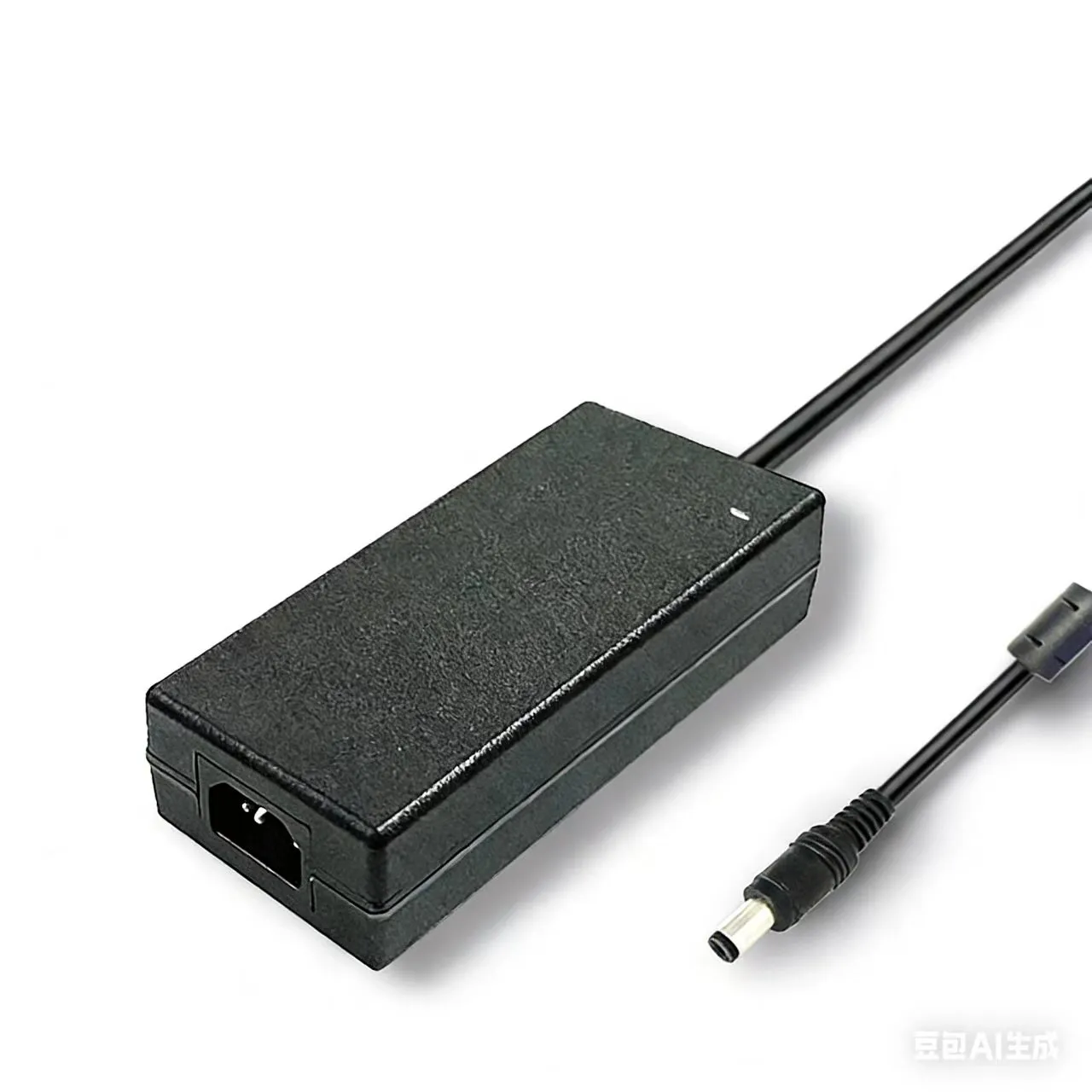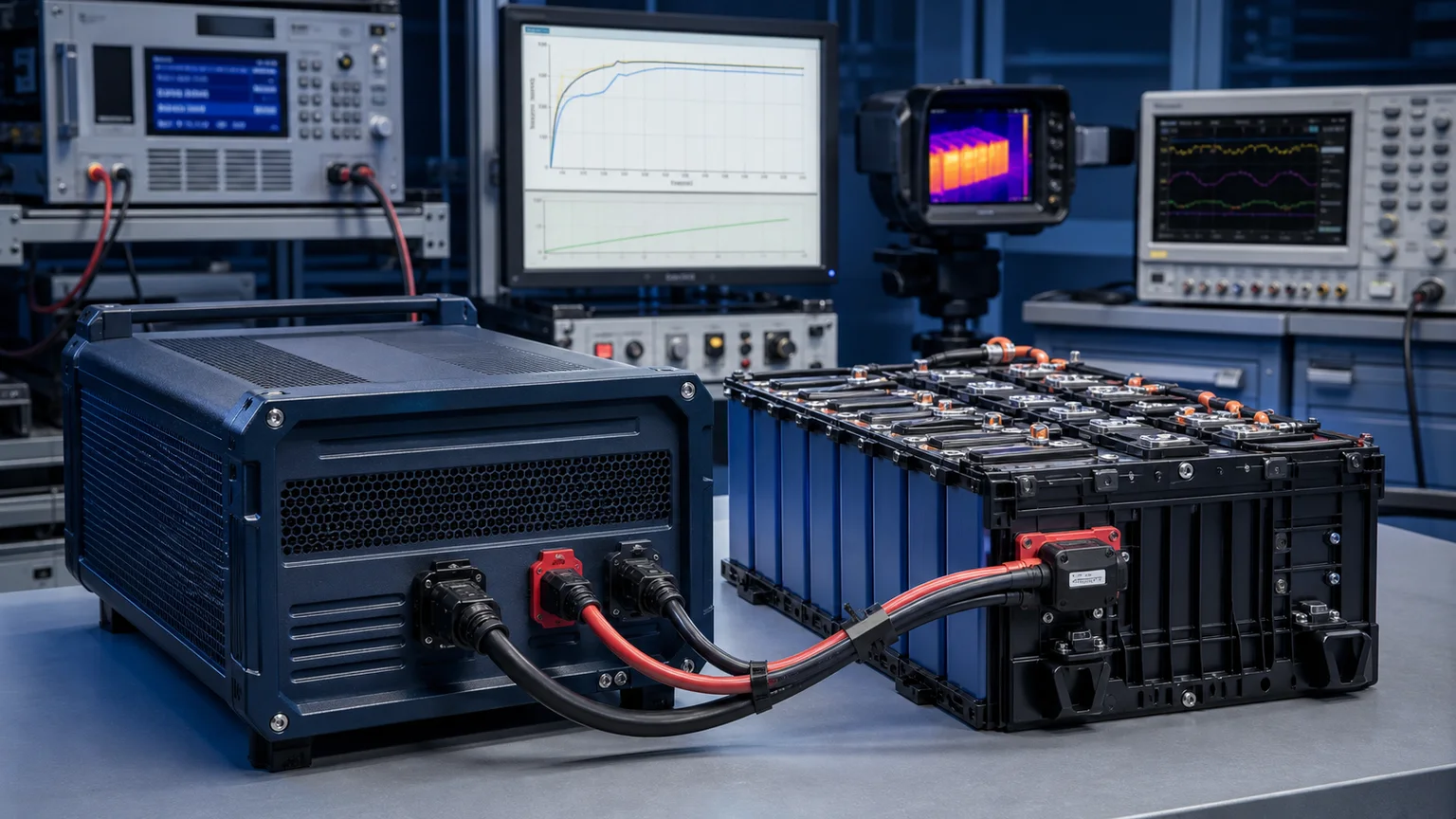

It's 03:47 on a Tuesday in a 40,000 m² fulfillment center. Forty AGVs are running picking loops to feed a wave of e-commerce orders that has to ship before sunrise. One of the units — call it AGV-17 — pulls into its opportunity-charging dock between picks, sits for the standard 90 seconds, and rolls back out. Two loops later it stops dead in the middle of an aisle, battery drained. A floor controller flags it, a human walks over, the wave shipment misses its cut-off, and the WMS log later shows AGV-17 took only 38 seconds of usable charge during that dock visit instead of 90 — because the charging station's PSU was thermally throttling under sustained load and the constant-current phase collapsed.
The AGV is fine. The battery is fine. The fleet management software is fine. The charging station's power supply is undersized — or wrongly specified — for a real 24/7 opportunity-charging duty cycle.
This is the silent failure mode that nobody puts in an RFP. The global AGV market reached USD 5.55 billion in 2024 and is projected to grow to ~USD 15.07 billion by 2030 at 18.2% CAGR (Grand View Research, 2024). E-commerce fulfillment, automotive assembly lines, semiconductor fabs, cold-chain warehouses — every one of them is adding AGV and AMR fleets faster than they're sizing the power infrastructure that keeps the fleet on the floor. And the moment a single charging dock under-delivers, the bottleneck propagates through the whole fleet's scheduling.
Symptoms of a Wrongly Specified AGV Charging Station PSU
- AGVs return from opportunity charging with less SoC gain than the dwell time predicts — thermal throttling, CC stage collapsing
- Charging dock fan cycles audibly during peak shifts, AGVs queue up — cabinet ambient + duty cycle exceed design
- Random communication faults between dock and AGV BMS — CAN/RS-485 noise from poorly filtered PSU output
- Battery cycle life drops 20-30% vs spec sheet at 18 months — charger CV plateau drifting, overcharging cells
- Whole charging zone trips on a substation transient — missing surge tolerance, no inrush coordination
- Fleet uptime drops from 95% to 88% after adding 10 more AGVs — charging infrastructure became the constraint
This guide covers, in order: the three AGV charging modes and what each one demands from the power supply, how to size the dock for a real fleet duty cycle, the spec lines that matter (CC/CV accuracy, efficiency, MTBF, communication), and which Sanyi power tiers fit each AGV class.
Why AGV Charging Is Not Just "Big Charger Plus Battery"
A consumer EV charger ships a car off the wall once a night. An AGV charger is a 24/7 fixture, often called multiple times per hour, by a fleet whose scheduling is brittle to a single under-delivering dock. The differences:
| Attribute | Generic Industrial Charger | AGV Charging Station |
|---|---|---|
| Duty cycle | 30-50% over a shift | 80-95% sustained, 24/7 in 3-shift facilities |
| Charging events per dock | 5-15 per day | 40-200 per day in opportunity mode |
| Communication | None or simple LED status | CAN 2.0B / RS-485 to BMS, plus integration with WMS / FMS |
| CC accuracy | ±2-3% | ±1% required to match LiFePO4 CC/CV profile |
| CV plateau drift | ±100 mV ok | ±20 mV target for 4000+ cycle life |
| Hold-up / brown-out | Not critical | 20-30 ms hold-up so a substation glitch doesn't crash mid-charge |
| MTBF target | 50k-100k hrs | 300k+ hrs at 50°C, because dock downtime stops the fleet |
| Cabinet ambient | 25-35°C office-grade | -10 to +50°C, often +45°C during summer peak |
| Connector cycle life | 1k-5k mating cycles | 50k-200k mating cycles for contact docks |
An AGV dock that can't ride through a 30 ms substation transient will reset the charging session, which the BMS interprets as an abnormal disconnect. Multiply that across a 60-AGV fleet during a brown-out and you've got a fleet-wide reschedule.
The Three AGV Charging Modes — and What Each One Demands
Every fleet ends up using one of these three patterns, and the power supply needs to be sized to that pattern, not to a generic "kW per dock" headline number.
1. Opportunity Charging — short, frequent, high power
The AGV pulls into a dock between tasks, sits for 30-180 seconds, takes a partial top-up, and rolls back out. The fleet never goes through a deep discharge; the battery stays in a comfortable 30-80% SoC band.
- Typical power per dock: 6 kW to 15 kW
- Typical dwell time: 60-120 seconds
- Charge rate: 1C to 2C of pack capacity (limited by LiFePO4 cell chemistry, not the charger)
- Daily charge events per dock: 40-200
- What this demands from the PSU: sustained full-power output without thermal derating, very fast CC ramp-up (under 200 ms from contact to full current), CV stage tightly regulated even as the next dock is hot from the previous session
This is where most fleets fail silently. A 15 kW charger that's spec'd at 25°C ambient will deliver maybe 11-12 kW at the back end of a hot shift, and the AGV scheduler doesn't know the dock is shorting the fleet.
2. Fast Charging — battery-swap-equivalent without the swap
The AGV is taken out of duty for 15-45 minutes for a deep recharge, typically from 20% to 90% SoC. Common in single-shift or double-shift facilities where the third shift is maintenance.
- Typical power per dock: 15 kW to 40 kW
- Typical dwell time: 15-45 minutes
- Charge rate: 0.5C to 1.5C
- Daily charge events per dock: 8-20
- What this demands from the PSU: very high efficiency at 50-80% load (the long tail of the charge), accurate CV plateau to protect cell life, controlled wind-down at the CC-to-CV transition
Fast charging is where the connector and contact resistance start to dominate failure modes. At 30 kW and 100A+ contact current, a 5 mΩ contact degradation puts 50W into a connector that wasn't designed for it.
3. Overnight Charging — boring, predictable, the easy mode
The AGV docks at end-of-shift and sits for 4-8 hours. Common in single-shift e-commerce ops and any facility with fleet sizes small enough that downtime is acceptable.
- Typical power per dock: 1.5 kW to 6 kW
- Typical dwell time: 4-8 hours
- Charge rate: 0.2C to 0.5C
- Daily charge events per dock: 1-2
- What this demands from the PSU: efficiency at light load (much of the charge happens in the long CV tail at 10-20% rated current), low standby draw, gentle CV plateau for maximum cycle life
This mode is the easiest from a charger spec standpoint — and the most forgiving of an under-spec'd PSU. If your fleet runs in this mode and you've still got dock issues, the problem is almost certainly mechanical (contact wear, alignment) rather than electrical.
Charging Station Architectures: Contact, Wireless, Auto-Docking
Three physical implementations are common across smart warehouses, and each one shifts the burden differently between mechanical engineering and power electronics.
| Architecture | Contact Method | Power Range | Strengths | Weaknesses |
|---|---|---|---|---|
| Contact dock | Spring-loaded brushes / pads | 3 kW to 40 kW | Highest efficiency (95%+), simple, cheapest | Contact wear, alignment-sensitive, occasional arcing on engagement |
| Wireless (inductive) | Resonant coil pair, no contact | 1 kW to 11 kW | Zero mechanical wear, sealed, IP65+ tolerant | 88-92% efficiency, larger air gap losses, higher BOM cost |
| Auto-docking robotic arm | Servo-positioned high-current connector | 15 kW to 60 kW | Fastest, highest power density | Most complex, single point of failure, alignment software intensive |
For a typical Amazon / JD-style picking warehouse with hundreds of low-power AGVs running opportunity charging, contact docks at 6-15 kW are the default — they're cheap, efficient, and the brushes are field-replaceable in 5 minutes. Wireless makes sense in clean rooms, food/pharma, and ATEX zones where any spark is unacceptable. Auto-docking is for heavy-lift AMRs and AGV trains in automotive plants where the per-event power is 30 kW+.
Key Parameters: What to Spec for an AGV Charger PSU
Walk down this list in order — none of these are "nice to have" for a 24/7 fleet.
Charging power tiers and battery class match
| AGV class | Battery pack | Typical PSU class | Charging mode |
|---|---|---|---|
| Light-duty pick-and-place AGV | 24V / 48V LiFePO4, 30-100 Ah | 0.5 kW to 3 kW | Overnight or opportunity |
| Standard payload AGV (500-1500 kg) | 48V LiFePO4, 100-300 Ah | 3 kW to 6 kW | Opportunity (most common) |
| Heavy AGV / forklift AGV (1500-5000 kg) | 80V LiFePO4, 200-600 Ah | 6 kW to 15 kW | Opportunity or fast |
| AMR train / tugger fleet | 80V-120V LiFePO4, 400-1000 Ah | 15 kW to 40 kW | Fast |
Battery chemistry and CC/CV profile
LiFePO4 (LFP) dominates new AGV builds — it's safer, longer cycle life (3000-6000 cycles vs 1000-2000 for NMC), better thermal behavior, and the 3.2V cell voltage maps cleanly onto 24V/48V/80V system voltages. The charge profile is two-phase:
- Constant current (CC): the charger holds rated current until pack voltage reaches the absorption setpoint (typically 3.55-3.65 V/cell, so 56.8-58.4V on a 16-cell 48V pack). This phase delivers ~80% of the SoC gain in opportunity charging.
- Constant voltage (CV) absorption: charger holds the absorption voltage and current tapers from rated down to ~3% of rated. The CV plateau is where overcharging happens if the PSU regulation drifts — and where battery life is silently destroyed at 6-12 months out.
The PSU spec lines that matter for LiFePO4 cycle life:
- Output voltage accuracy: ±0.5% at the CV plateau (so ±300 mV on 58.4V) is the bar; ±0.2% is excellent
- Output current regulation: ±1% during CC, no overshoot at CC→CV transition
- Ripple at CV plateau: ≤ 100 mVpp; the BMS sees ripple as instantaneous overvoltage on the worst cell
- Temperature compensation: -3 mV/°C/cell is standard; the charger should accept a thermistor input or CAN-fed temperature from the BMS
Efficiency and the duty-cycle math
A 10 kW dock that runs at 92% efficiency dissipates 870W as heat in its enclosure. That same dock at 88% dissipates 1364W — half a kilowatt of additional cabinet heat that has to be exhausted, often in a +35°C warehouse aisle. Specify ≥ 92% peak efficiency and ≥ 89% across the 30-100% load range for any opportunity-charging dock; the alternative is shorter PSU lifetime and a fan that audibly cycles during peak shifts.
MTBF — at 50°C, full load, please
The marketing MTBF number is at 25°C, no load — useless. Ask the vendor for MTBF at 50°C, full load. A genuine industrial AGV-class PSU publishes 200-300k hours under those conditions. Anything that can only quote the 25°C number is hiding the derating curve.
Surge tolerance and ride-through
A typical industrial substation sees several Class III (IEC 61000-4-5) ±2 kV transients per month from contactor switching, lightning, and load-bank tests. An AGV dock without proper surge filtering will reset its session, the BMS will log an abnormal disconnect, the AGV will return to the floor with less charge than scheduled, and the fleet manager will spend a Tuesday morning hunting an intermittent fault. Specify Class III surge protection and ≥ 20 ms hold-up time at full load as a floor.
Smart Integration: CAN Bus, Remote Monitoring, WMS Pairing
Modern AGV chargers don't just push current — they're a node on the fleet's nervous system.
- CAN 2.0B to BMS (or RS-485 / Modbus RTU as a fallback) — the charger should query SoC, cell voltages, temperature, and SoH from the BMS, then adapt its CC and CV setpoints to the cell-by-cell condition. A "dumb" charger that just pushes 0.5C until it hits a fixed CV setpoint will overcharge the weakest cell in the pack, every time, and that's the cell that kills the pack at 18 months.
- Ethernet / Modbus TCP to FMS / WMS — the fleet manager needs to know per-dock availability, real-time charge rate, session SoC delta, and fault state. A dock that drops out of FMS visibility for an hour can desynchronize the entire fleet's scheduling.
- Local data buffering — when the FMS link is down, the dock should buffer the last 24-72 hours of session logs and replay on reconnect. Cloud-only telemetry that loses data on link failure is a regression vs the old serial-port chargers from 2010.
- Firmware update path — over-the-air firmware updates should be signed, with a fail-safe fallback partition. A botched firmware update that bricks 40 docks at once is a fleet-down event.
The integration is where third-party "industrial" chargers fall apart. Many publish a CAN spec on paper and ship a firmware that doesn't match the documented protocol — the integration phase quietly becomes a six-month custom engineering project. Validate the CAN profile against your BMS vendor before you commit to a charger family.
Sanyi Power Supply Tiers for AGV Charging Stations
Sanyi's industrial PSU and charger families cover the full AGV charging power range — from sub-3 kW overnight docks to 40 kW+ multi-bay fast-charging banks. All units below carry CE / 3C / RoHS at minimum, support AC 100-240V or 380V three-phase universal input, and ship with full four-protection coverage (OCP / OVP / SCP / OTP).
| Charging mode | AGV class | Power class | Recommended product |
|---|---|---|---|
| Overnight | Light-duty pick AGV | 260 W | SY-C260W-5A High-Power Charger |
| Overnight / opportunity | Standard payload AGV | 500 W | SY-C500W-10A High-Power Charger |
| Opportunity / fast | Standard to heavy AGV | 1000-1600 W | SY-C1000/1200/1600W Ultra High-Power Charger |
| Charging dock auxiliary supply | Control logic, CAN bridge, HMI | 240-480 W | SFY-Z Series 240W-480W |
| High-power dock backbone PSU | Heavy AGV / multi-bay banks | 500-720 W modules | SW Series 500W-720W |
| Buffered energy storage at the dock | Peak shaving for opportunity charging | 3500 W | 3500W Bidirectional Inverter ESS |
Why these tiers cover most AGV charging deployments:
- SY-C260W-5A is the right pick for light-duty pick-and-place AGVs running a single-shift overnight cycle. Smart charging management, full four-protection, aluminum housing for cabinet integration.
- SY-C500W-10A is the workhorse for the standard payload AGV market — 500W / 10A is enough for a 48V / 100Ah pack to fully charge in 4-5 hours overnight, or to take a meaningful opportunity top-up between picks. Wide AC 100-240V input simplifies multi-region deployment.
- SY-C1000/1200/1600W ultra-high-power series is built for heavy AGV and forklift-AGV fleets — 25A output, smart temperature-controlled fan for sustained 24/7 operation, and the thermal headroom that an opportunity-charging dock actually needs at +45°C ambient.
- SFY-Z 240W-480W handles the auxiliary 24V loads inside the dock cabinet — control logic, CAN bridge, HMI, status indicators, contactor coils. Aluminum housing, ≥ 87% efficiency, MTBF > 50,000 hrs.
- SW Series 500W-720W is the modular backbone for high-power dock cabinets — multiple SW units in parallel-redundant configuration give you the 6-15 kW per dock that opportunity charging demands, with the option to hot-swap a failed module without taking the dock out of service.
- 3500W ESS sits behind a fast-charging bay to buffer peak demand from the grid — drawing steady 5-10 kW from the substation while delivering 30-40 kW peaks to the bay during the short CC phase. Avoids costly grid-connection upgrades for facilities that are already at their feeder capacity.
N+1 Redundancy at the Dock — When It's Worth It
Single-PSU docks are fine for overnight charging where a failed dock means rerouting one AGV the next morning. For 24/7 opportunity charging, fast-charge bays serving heavy AGVs, and any dock whose failure cascades through the fleet schedule, design for N+1 modular redundancy: e.g., three SW-500W modules in a 1000W dock, sized so two carry full load. The cost of a third module is a fraction of a single fleet-down event.
Three Field-Failure Patterns to Avoid
Patterns the integration team will see repeatedly:
1. The "spec'd at 25°C" dock. A 10 kW charger spec'd at 25°C ambient is installed in a warehouse aisle that hits +42°C in summer. The thermal derating curve (which nobody read) cuts output to 7.5 kW at +42°C. The opportunity-charging schedule was built around 10 kW. AGVs return from charge with less SoC than the scheduler expects. Fleet uptime drops, customer flags it, root cause isn't found for three months because the charger reports "OK" — it's just delivering less power than spec'd at the actual ambient.
2. The "we'll add CAN later" charger. Procurement saves 15% by buying a charger family without proper CAN-to-BMS integration. Six months in, the integration team discovers that without per-cell awareness, the CV plateau is overcharging the weakest cell on every cycle. By month 18, packs are failing at 60% of rated cycle life. The cost of premature pack replacement dwarfs the original "savings" by 10-20x.
3. The "single 60 kW transformer for the whole bank" feeder design. Six 10 kW docks all on one 60 kW feeder, no power factor correction, no peak-shaving buffer. During shift change, all six docks go to full load simultaneously. The feeder voltage sags 8%, the line-side breaker eventually trips, and the whole charging zone goes dark mid-wave. Fix is either to add active PFC (mandatory above 75W input per EN 61000-3-2 anyway), upgrade the feeder, or add a buffered ESS to flatten the demand curve.
FAQ
Q: Can I use a generic industrial battery charger instead of an AGV-specific charger?
For an overnight-only fleet of 5-10 light-duty AGVs, a generic LiFePO4 industrial charger from a reputable vendor is workable. For opportunity charging, fast charging, or any fleet over ~20 AGVs, no — you need CAN-to-BMS integration, the thermal headroom for 80%+ duty cycle, the ride-through tolerance for substation transients, and the FMS integration to surface dock state to the fleet scheduler. A generic charger missing any of those becomes the silent bottleneck of the fleet.
Q: What's the right charging mode for a new AGV deployment?
Start with the duty cycle. Single-shift, low fleet utilization (under 50% AGV active time): overnight charging is cheapest and easiest. Two- or three-shift operation, fleet utilization 60%+: opportunity charging is the only way to keep the fleet on the floor without 1.5-2x the AGV count. Fast charging is reserved for fleets where opportunity dock siting isn't feasible (large open warehouses, ATEX zones) or where peak-period throughput swings make opportunity insufficient.
Q: How does LiFePO4 differ from NMC/Li-ion for AGV charging?
LiFePO4 is the new-build default for AGVs: 3000-6000 cycle life, much safer thermal behavior (no thermal-runaway propagation in well-designed packs), and the 3.2V cell voltage maps cleanly to standard system voltages. The charge profile is the same two-phase CC/CV, but LiFePO4 tolerates higher peak charge rates (up to 2C in modern cells vs 0.5-1C for NMC) — which is what makes opportunity charging viable in the first place. NMC is still seen in legacy AGV fleets and in weight-critical AMRs where the higher energy density justifies the cycle-life trade-off.
Q: Do I need a separate UPS or buffered ESS at the charging station?
Depends on the role. For overnight charging, no — a session interruption just means the AGV resumes charging on the next reconnect. For opportunity charging in a 24/7 fleet, a small buffered ESS behind a fast-charging bay is often the cheapest way to avoid a grid-feeder upgrade. For continuous-process facilities (semiconductor fab, cold chain) where a brown-out can't take the AGV fleet offline, a dedicated UPS in front of the charging zone is the right call. The PSU's own 20-30 ms hold-up handles the millisecond-class transients regardless.
Q: What CAN protocol does the AGV charger need to speak?
There's no single standard — the dominant patterns are CANopen CiA 418/419 for industrial battery management, J1939 for heavy AGVs and AMR trains derived from off-highway vehicle platforms, and a handful of proprietary BMS-to-charger protocols from major AGV vendors. Always validate the charger's CAN profile against your specific AGV fleet's BMS before committing to a charger family — paper-spec compatibility frequently fails in firmware practice. For mixed-vendor fleets, a CAN bridge / protocol translator at the dock is sometimes the cleanest answer.
Q: How long do AGV charging contact brushes typically last?
Spring-loaded brush contacts in a well-designed dock should last 50,000 to 200,000 mating cycles — that's 1-3 years in a high-utilization opportunity-charging deployment with 60-80 cycles per day. Wear rate scales with contact current squared, so a 15 kW dock at 100A contact current wears ~3x faster than a 6 kW dock at 50A. Plan for brush replacement as scheduled maintenance, not as a fault response. Track contact resistance with the dock's diagnostic output if available — a >5 mΩ rise from baseline is the early-warning signal.
Summary
Sizing an AGV charging station's power supply correctly is the difference between a fleet that runs at 95%+ uptime for years and one that hits a silent bottleneck at month 6 nobody can find. The action plan:
- Choose the charging mode by fleet duty cycle, not by what the AGV vendor's reference design uses
- Spec the PSU at the actual cabinet ambient, not at the 25°C marketing number — read the derating curve
- Demand CAN-to-BMS integration and validate the protocol against your specific BMS family before purchase
- Design for N+1 modular redundancy on any dock whose failure propagates through the fleet schedule
- Match the charger power class to the AGV battery and dwell time — SY-C260W for overnight pick AGVs, SY-C500W for standard payload, SY-C1000-1600W for heavy and opportunity, SW + ESS for multi-bay fast-charging banks
Next Steps
- Industrial PSU & Charger Products — Full lineup from 260W to 3500W ESS, CE / FCC / 3C / RoHS certified
- Industrial DIN Rail PSU Selection Guide — Companion guide for the 24V control logic inside the charging dock
- LiFePO4 Charger Comparison Guide — Deep-dive on CC/CV profiles and cycle-life optimization
- Contact Engineering — Bulk pricing, custom AGV charging dock designs, CAN profile validation, OEM and integrator support
.webp)