
If you're a PoE switch maker bidding into the 2026 Chinese market — or an integrator buying those switches in volume — you already know the pressure. Every quarter the landed price per port drops another percentage point. The PCB gets thinner, the enclosure gets lighter, the brand on the box matters less, and somewhere in every line-item review the question comes up: "where else can we cut cost on the BOM?"
One answer, almost always, is the internal power module. It's a significant slice of the BOM, it sits inside the chassis where no buyer ever looks at it, and a cheaper one passes the factory cold-boot test just fine. The warranty returns don't show up until 12, 18, 24 months into deployment — long after the sale has closed and the supplier has moved on.
The cheapest PoE power module wins the bid. The customer loses three years later.
Silicon carbide (SiC) PoE power supplies are starting to break this equation. They give integrators a clear reliability advantage at a landed cost that can compete in serious-tier procurement — not premium-tier, not race-to-the-bottom-tier, the tier where IP cameras are expected to work in unventilated roadside cabinets for five summers in a row. This guide walks through the procurement pain points, what SiC actually brings to the PoE power problem, and how to spec a module in the 48W–150W range that doesn't silently become the weakest link in the install.
The Procurement Pain Point: Why Cheap PoE Power Modules Quietly Fail
PoE switch power is not the same problem as USB-charger power or LED-driver power. Three factors make it special, and all three get cut first when procurement chases price:
1. 48V/54V continuous duty, 24/7. A consumer charger delivers rated power in one-hour bursts, cools down between calls, and lives a total of maybe 200 operating hours a year. A PoE switch power module delivers rated power continuously for five years, heats up on day one, and never cools back down. Caps and magnetics that were "good enough" for burst-mode duty age 10× faster on continuous duty.
2. Thermal environment nobody measured. PoE switches end up in drop ceilings, wall cabinets, rooftop enclosures, DIN-rail cabinets in factories, roadside boxes baked by afternoon sun. Ambient is routinely 45–55 °C. The "room-temperature" efficiency numbers in the datasheet become meaningless the moment the unit is deployed outside a climate-controlled telecom room.
3. Load profiles that punish low-quality designs. A full load of PDs (IP cameras, APs, intercoms) negotiate power simultaneously at switch boot. Each camera pulls an inrush spike. The module has to ride through that burst cold, every morning after a power cycle, for years. Inadequate hold-up capacitance, marginal transformer design, or low-grade FETs all survive the factory test and fail in the field 18 months later.
Put these three factors together and the "cheap PoE power module" problem is not ethical — it is physics. The same design that works for a desktop adapter genuinely doesn't work for a PoE switch that lives in a 55 °C cabinet for five years. Buying on price alone is buying a time bomb with a 24-month fuse.
Why PoE Applications Are Particularly Unforgiving
The sectors that dominate PoE demand — security, building automation, industrial networking — all share a common attribute: power failure has cascading cost.
- Security / IP surveillance. A PoE switch failure takes 16 or 48 cameras offline at once. The customer has no footage during the outage window. Liability exposure multiplies.
- Access control integrated with PoE. Doors that unlock on power loss, doors that lock on power loss — either failure mode is a building-safety incident, not a ticket.
- Building automation / lighting. PoE-powered LED fixtures, occupancy sensors, HVAC controllers — a power module failure blacks out a floor.
- Industrial networking. PoE edge switches on plant floors, in pump stations, on outdoor scales. Downtime is measured in dollars-per-minute, and nobody climbs a 6-meter pole to swap a switch on a Tuesday.
For these buyers, a $2 savings on the BOM that costs a $6,000 truck roll is not a savings. It's a debt with compound interest. Reliability is not a premium feature in this segment — it is the table-stakes specification. And that is exactly where SiC-based power designs start to change the math.
What Silicon Carbide (SiC) Brings to PoE Power Supplies
Silicon carbide is a wide-bandgap semiconductor material that has been adopted across EV powertrains, data-center power, solar inverters, and now PoE. Relative to conventional silicon, SiC-based PoE power designs deliver — at the finished-product level — a set of advantages that map directly onto the pain points above:
- Higher efficiency across the full load range. Less of the input energy becomes waste heat, which means the module runs cooler at the same output power. A cooler module means caps age slower, transformer insulation ages slower, and the whole unit stays inside its safe operating envelope when the cabinet hits 55 °C.
- Smaller form factor for the same wattage. SiC-based designs enable more compact magnetics and smaller overall footprint. For switch makers trying to fit a PoE power module inside a 1U or slim metal chassis, the space savings translate into design freedom — room for better airflow, better EMI shielding, or more port density.
- Higher operating temperature tolerance. SiC devices maintain performance at junction temperatures that silicon cannot sustain. In practice this widens the safe ambient window for the finished module, letting it live in the 55 °C cabinet that killed the cheap module 18 months into deployment.
- Longer expected service life (MTBF). Lower operating temperature, lower electrical stress on surrounding components, and higher-reliability switching devices all compound into longer time-to-failure. For a module in 24/7 duty, every 10 °C of temperature reduction roughly doubles the life of the electrolytic capacitors — and capacitor life is typically what sets the module's service life.
- Cleaner switching characteristics. Better EMI behavior simplifies the PoE switch's EMC compliance and reduces the emission margin consumed by the power stage. Switch makers selling into CE/FCC/3C markets recover cost elsewhere because the PoE module is no longer the EMC bottleneck.
- Tighter regulation under dynamic load. Faster transient response means the 48V/54V bus holds its rail tighter when 16 cameras simultaneously negotiate and pull inrush. The PDs see a cleaner PoE voltage, and the switch's own PoE controller has more margin to work with.
The important caveat: these are product-level advantages. The details of how they are delivered — specific topology choices, control strategies, device selection, magnetics design — are proprietary, and any supplier who discloses those details in a marketing brochure is either not doing the actual engineering or not protecting their IP. Judge suppliers on measured results (MTBF, efficiency curves, derating data, field return rates), not on implementation disclosure.
Sanyi's 48W–150W SiC PoE Power Supply Range
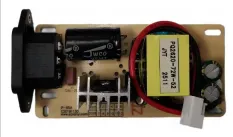
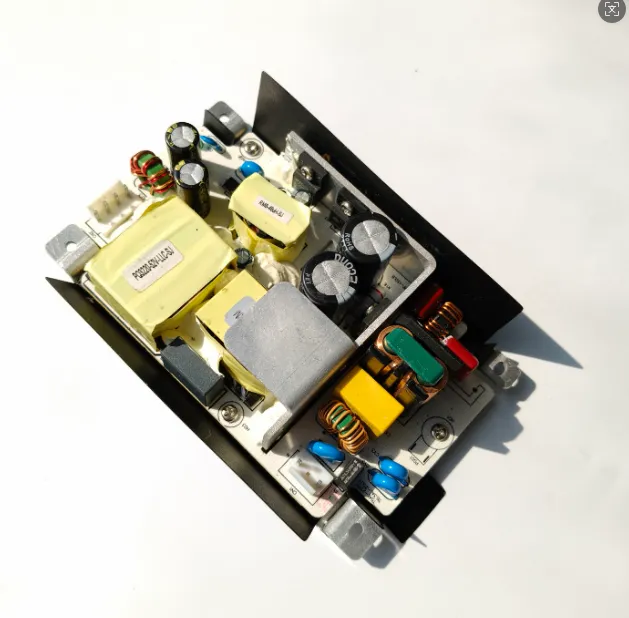
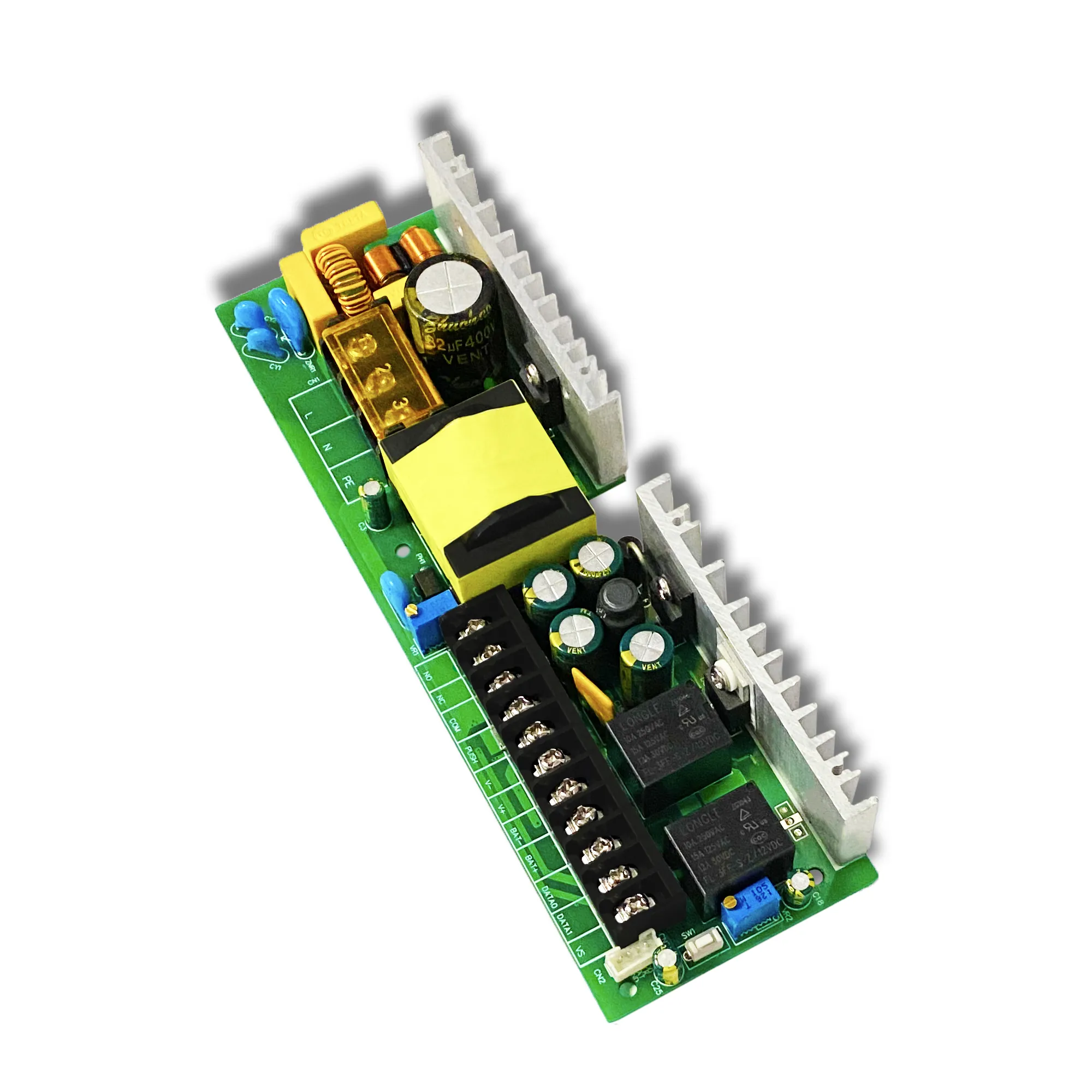
Sanyi Power's PoE module range covers the sweet spot for 4-port through 24-port PoE+ and PoE++ switches, in both open-frame (for built-in integration into a switch chassis) and enclosed formats. Every unit in the range is designed around the continuous-duty, elevated-ambient, long-service-life profile described above — not around datasheet-only ratings that collapse in a roadside cabinet.
| Model | Power | Typical application | Port count compatibility |
|---|---|---|---|
| POE-48W | 48W | Small-office/residential PoE+ switches | 4–6 ports PoE+ |
| POE-65W | 65W | Mid-size security / AP-feeder switches | 4–6 ports PoE+ with headroom |
| POE-96W | 96W | 8-port PoE+ switches, small building installs | 4–8 ports PoE+ |
| POE-120W | 120W | 8-port PoE+ and entry PoE++ switches | 8 ports PoE+, 4 ports PoE++ |
All four are available in both open-frame (for built-in integration with the switch PCB) and external-adapter formats. Key shared characteristics across the range: full CE / FCC / 3C / RoHS certification, wide-input AC 100–240V, high-efficiency design, continuous-duty thermal rating, and the reliability-first engineering approach that the security, building, and industrial PoE segments actually require.
For larger systems, the same engineering philosophy extends up-range to the POE-300W PFC and POE-480W PFC modules — the right choice when you're powering 16-port or 24-port PoE++ switches feeding dense camera or AP deployments.
Application Scenarios Where SiC PoE Modules Pay Back
Not every PoE install justifies the SiC tier. These do:
- Outdoor and semi-outdoor cabinets. Cabinets on light poles, in roadside boxes, on building exteriors. Ambient routinely above 50 °C in summer, below freezing in winter. Conventional modules fail on thermal cycling first.
- Industrial plant floors. High ambient, dust ingress, constant vibration, upstream power that carries motor-inverter noise. The SiC module's tighter EMI behavior and higher thermal headroom matter most here.
- 24/7 critical-uptime installs. Banks, pharmacies, hospitals, data-center adjacent deployments. Any site where the per-incident cost of downtime exceeds the total BOM cost of the switch.
- Long-warranty OEM programs. Switch makers offering 5-year or lifetime warranties can't absorb 3-year-MTBF power modules. Moving to SiC shifts the module's expected service life past the warranty envelope, converting a known field-failure liability into a non-issue.
- AI-era PoE++ and high-power edge devices. As PoE delivers 60W or 90W per port to compute-capable edge devices (AI cameras, edge AI gateways, 5G small cells), the aggregate power per switch climbs fast. Efficiency and thermal headroom become the limiting factors.
If your install doesn't hit any of these conditions — a 4-port desktop switch in a climate-controlled office, powered 8 hours a day, replaced every 3 years — a conventional module is fine. If it hits any of them, the SiC tier is no longer optional, it is the minimum responsible spec.
Reliability vs Cost: The New Procurement Math
The old equation was binary: cheap module, low reliability, or expensive module, high reliability. SiC doesn't eliminate the tradeoff but it moves both curves:
| Dimension | Conventional cheap module | SiC-based module (48W–150W) |
|---|---|---|
| Unit price | Lowest | Competitive (not premium-tier) |
| Full-load efficiency at 25 °C | 84–87% | ≥ 90% |
| Efficiency at 55 °C ambient | Drops 3–5 pts | Holds ≥ 88% |
| Typical field MTBF | 30,000–50,000 h | 80,000–150,000 h |
| Enclosure footprint | Baseline | 10–30% smaller |
| EMI margin | Marginal, risks re-spins | Comfortable |
| Warranty-period return rate | High on outdoor installs | Low |
The unit price gap has narrowed to the point where the total-cost-of-ownership math now usually favors SiC for any install that will see elevated ambient, continuous duty, or a warranty longer than 2 years. That covers most of the PoE market outside of desktop office switches.
How to Evaluate a PoE Power Module Supplier
Questions to put to any supplier before you commit BOM:
- Show the efficiency curve at 50 °C ambient, not 25 °C. If the datasheet only has a room-temperature curve, that is your answer.
- What is the derating curve for output power vs ambient? A module rated 120W at 25 °C might be rated 85W at 55 °C. That is what you are actually buying.
- Provide field MTBF, not calculated MTBF. Calculated MTBF from component data sheets is optimistic. Field MTBF from real deployed units is what matters.
- Certification scope. CE, FCC, 3C, RoHS as baseline. Ask whether the certificates cover the built-in open-frame version or only the external enclosed version — they are two different UL/CE submissions.
- Hold-up time and inrush behavior under cold boot with full PD population. The module has to ride through 24-port simultaneous PD negotiation at minus-20 °C on a roadside cabinet. Ask for data.
- Field return rate / failure rate from existing customers. A supplier that cannot answer this question does not have the data. A supplier that can is telling you something real about their quality system.
For system-level context on how module output sizing maps to PoE port count and PD class mix, see our PoE power budget and switch sizing guide. For the broader security-install sizing problem, including the power infrastructure around the switch itself, see the CCTV power supply sizing guide.
FAQ
Q: What does "silicon carbide PoE power supply" actually mean for my switch? A: It means the power module inside (or connected to) the switch uses SiC-based power-conversion components instead of conventional silicon. For the end product, this translates into higher efficiency, cooler operation, smaller form factor, and longer service life. You don't need to understand the internal engineering — you evaluate it the same way you evaluate any power supply: efficiency, derating, MTBF, certifications, field return rate.
Q: Is SiC PoE power worth the cost premium for a basic 8-port PoE+ switch? A: Depends on deployment environment. In a climate-controlled office with 8-hour daily duty, probably not — a conventional 96W module is fine. In a ceiling cabinet that hits 50 °C in summer, feeding 8 IP cameras 24/7 for 5 years, the SiC module's service life advantage alone typically pays back the price delta by avoiding a single truck-roll to replace a failed switch.
Q: Can I retrofit a SiC external PoE power supply to an existing switch that came with a cheap built-in module? A: Yes, if the switch has an external DC input option. Many mid-tier PoE switches accept either a built-in power module or an external 48V/54V adapter. An external SiC module upstream of the switch is a common field upgrade when the OEM module fails or the original install is moving to a more demanding environment. Check the switch's DC input voltage and current requirements, then match to an appropriate Sanyi POE-48W through POE-120W external unit.
Q: Do SiC PoE modules pass CE, FCC, and 3C without issue? A: Yes. SiC switching behavior is generally cleaner than conventional designs, which simplifies rather than complicates EMC compliance. The Sanyi PoE module range ships with full CE / FCC / 3C / RoHS certification as standard. For UL-required markets (U.S. commercial installations, AHJ-inspected jobs), verify that the specific model and format (open-frame vs enclosed) you're ordering carries the certification scope you need.
Q: What's the difference between built-in (open-frame) and external (enclosed) PoE modules in the SiC range? A: Built-in (open-frame) modules integrate directly onto the switch PCB or chassis — used by switch makers who want a compact, integrated design with no external power brick. External (enclosed) modules sit outside the switch in a full metal housing, connected by a DC cable — used for field upgrades, for installations where the switch chassis has no room for a built-in module, or where the buyer wants to separate power and switching for serviceability. Both formats share the same SiC design philosophy and the same reliability profile — the choice is about mechanical integration, not about electrical performance.
Closing
PoE switch power has been a quiet casualty of the race to the bottom. The module inside the switch is where quality has been getting trimmed for a decade, and it is where the majority of avoidable field failures trace back to. Silicon carbide technology gives integrators and switch makers a way out of that tradeoff — not a premium tier priced for data-center buyers, but a reliability-first 48W–150W range that wins procurement on total-cost-of-ownership instead of on sticker price.
If you're bidding a PoE-heavy project, specifying a new switch SKU, or auditing why your current switches are generating warranty returns, the power module is usually the place to look first. Contact Sanyi Power with your switch's port count, PoE class mix, deployment environment, and expected service life and we'll map that to a specific module from the 48W–150W SiC range — or tell you straight if a smaller conventional module would do the job just as well for your use case.