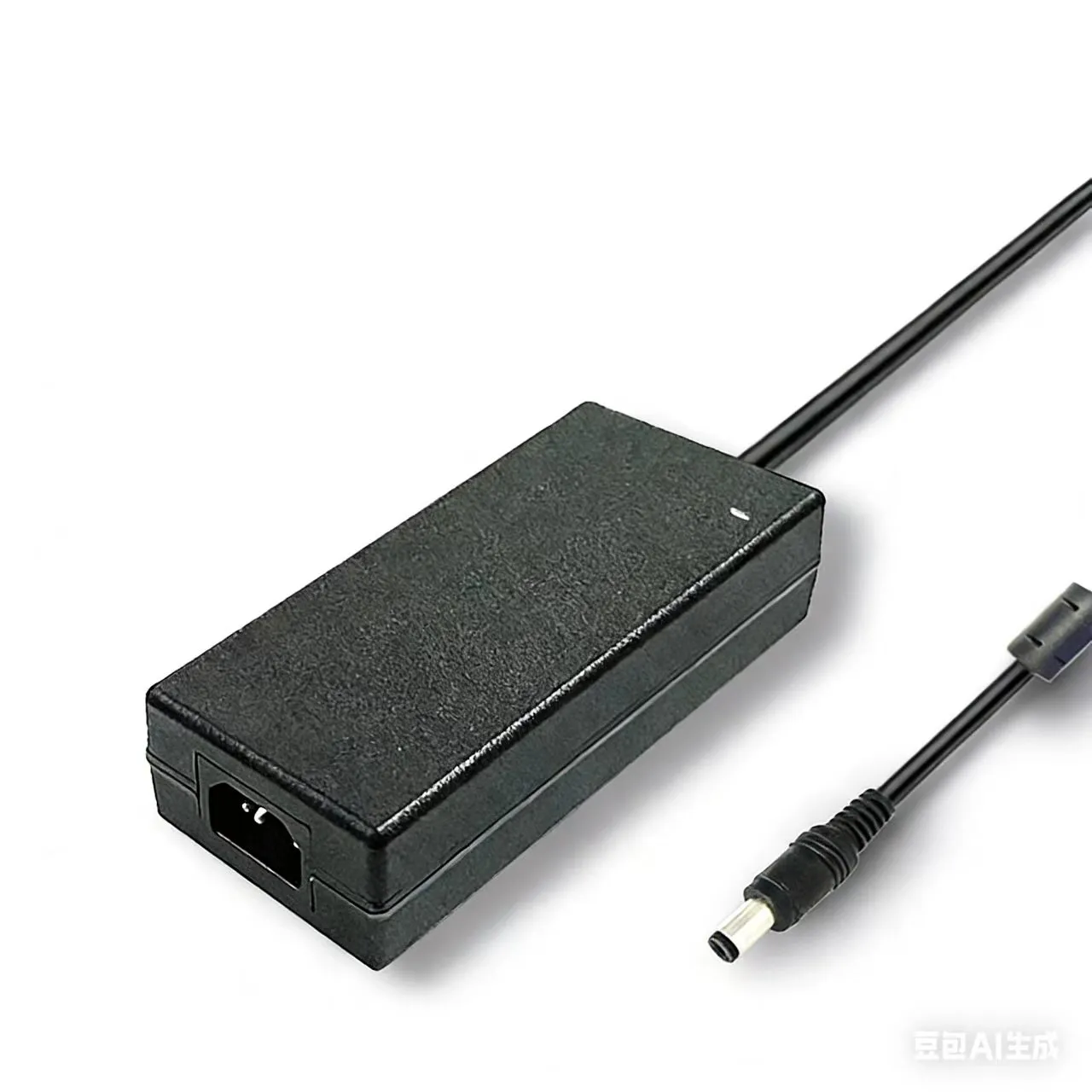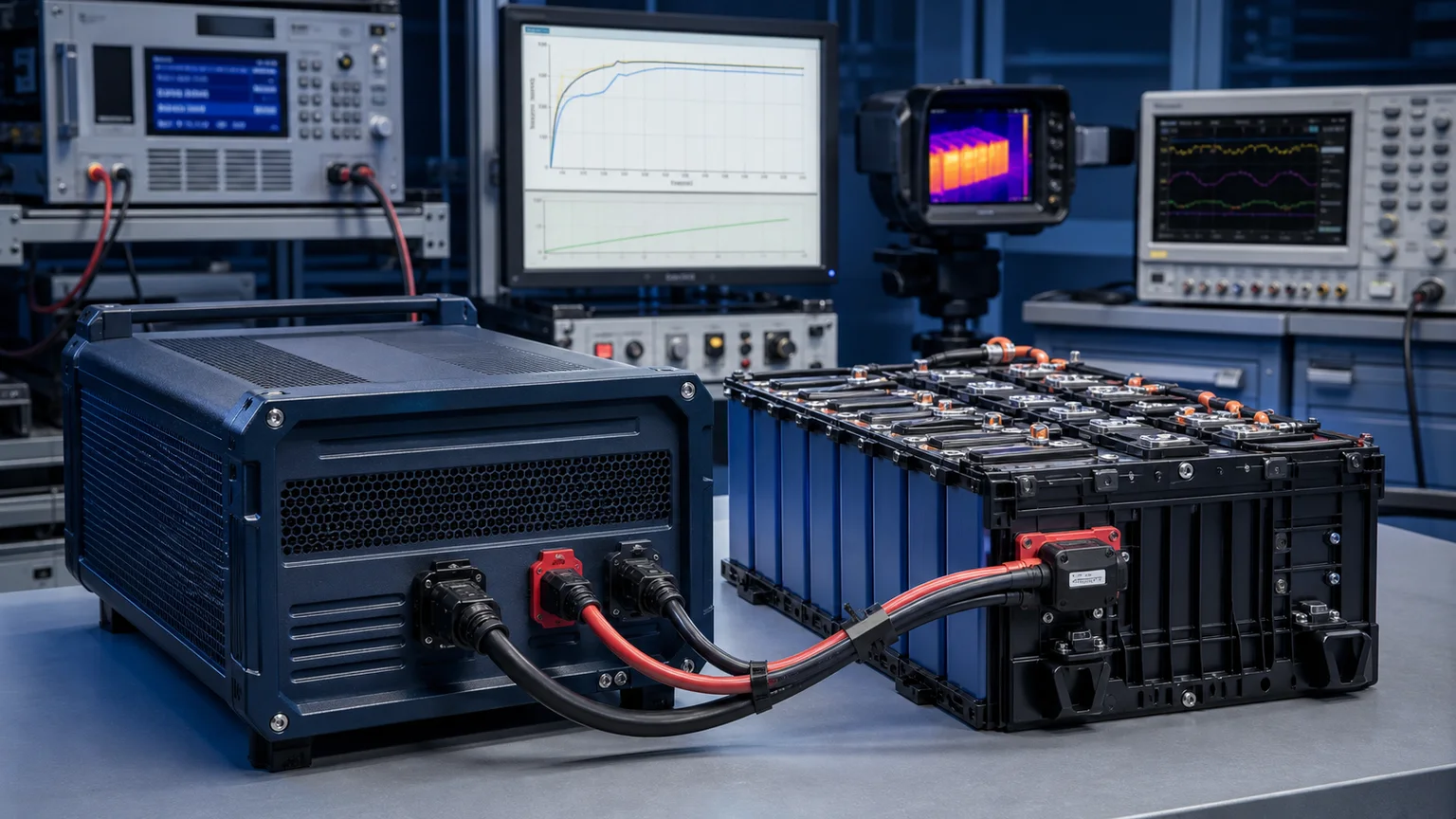

A pallet jack battery charger looks like the cheapest, simplest piece of gear on the warehouse floor — until a Crown PE 4500 quits halfway through a Black Friday backroom shift, or a $1,200 AGM pack on a Toyota 8HBW dies in fourteen months on a charger that the buyer thought was "the same as a forklift charger, just smaller." It is not the same. A pallet jack — Class III industrial truck in the OSHA / ANSI B56.1 sense, walkie or rider, single or double pallet — has its own duty cycle, its own pack-size band, and its own charger category. Treat it like a small forklift and you over-spend on bulk current the pack cannot accept; treat it like a golf cart and you under-charge a fleet that needs to be ready for the 5 a.m. delivery truck.
This guide covers 24V pallet jack battery charger selection in 2026 — the dominant voltage class for walkie and rider electric pallet trucks across Crown, Toyota, Raymond, Hyster/Yale, Jungheinrich, BT and Big Joe; how to pick between on-board and external chargers; how to spec for flooded, AGM, GEL or LiFePO4 packs; and how to size for single-shift retail, multi-shift 3PL and cold-storage operations.
Why Pallet Jack Chargers Are a Distinct Category
A walkie pallet jack is not a forklift in miniature. The duty cycle is fundamentally different. A Crown WP 3000 in a grocery backroom moves pallets from a receiving dock to a sales-floor staging area for an eight-hour shift, plugs in over the night cleaning window, and sits at 100% state of charge from 04:00 until 06:00 the next day when the first stocker grabs it. A counterbalanced forklift on the same property runs three shifts, opportunity-charges during breaks, and spends maybe four total hours a week unplugged in a fully-charged state.
That single-shift, long-rest profile drives the entire charger design. A pallet jack pack is typically 24V at 100–250 Ah — roughly one-third the capacity of a Class I rider forklift pack. The OEM-supplied charger is almost always sized for an overnight recharge from 30–40% state of charge, which means 15–25 A of bulk current on a 24V output. Anything higher is wasted hardware; anything lower will not finish a full equalization cycle before morning dispatch.
The other distinction is mechanical. Many pallet jacks ship with a built-in on-board charger mounted inside the chassis with a standard NEMA 5-15 cord that the operator plugs into any 120 V wall outlet. That choice — on-board vs external — has cascading consequences for cooling, serviceability and fleet operations that have no real equivalent on the forklift side.
For a deeper view of how charging chemistry rules differ between lead-acid and lithium packs in the same form factor, the LiFePO4 vs lead-acid battery charger selection guide walks through the algorithm differences in detail.
Step 1: Confirm It Is Really a 24V Pack
The first decision is forced by the truck, not chosen. The overwhelming majority of electric walkie pallet jacks and rider pallet trucks built since 2005 run 24V nominal packs — two 12 V batteries in series, or four 6 V batteries in series, or a single 24 V LiFePO4 module on a modern retrofit. Common OEM platforms and their pack specs:
| Pallet truck class | Typical models | Pack voltage | Typical capacity | Typical charger output |
|---|---|---|---|---|
| Walkie pallet, light retail | Crown PTH 50, Toyota 8HBW23, Big Joe PDW | 24V (2× 12 V) | 100–140 Ah | 24V / 15–20 A |
| Walkie pallet, 3PL / DC | Crown WP 3000/3045, Toyota 8HBW30, Raymond 8210, Hyster W45Z, Jungheinrich EJE 120 | 24V (4× 6 V flooded, or 2× 12 V AGM) | 130–210 Ah | 24V / 20–25 A |
| Rider pallet (end-control) | Crown WT/RT 4000, Raymond 8410, BT LWE 200, Yale MPB045 | 24V (4× 6 V, or 24V LFP retrofit) | 200–330 Ah | 24V / 25–30 A |
| Double pallet, long-fork rider | Crown PE 4500, Raymond 8510, Toyota 8HBE40 | 24V (4× 6 V or 8× 3 V flooded) | 280–375 Ah | 24V / 25–30 A |
A handful of legacy and specialty units run at other voltages — older Big Joe walkies at 12V, some heavy Crown RR series at 36V, large Jungheinrich ERE in 36V — but if you are buying a charger for a standard walkie or end-rider pallet jack manufactured in the last fifteen years, assume 24V until the nameplate proves otherwise. The single most common pallet-jack charger failure is a fleet buyer assuming "12V like a car battery" and ordering a charger that will not even initiate a charge cycle.
Confirm the pack voltage on the truck's data plate (usually under the cover behind the operator handle) and confirm the chemistry on the battery itself before specifying the charger.
Step 2: On-Board Charger vs External Charger
The second decision is operational, not technical. Pallet jack chargers come in two physical formats and the choice matters more than the brand on the case.
On-board chargers are mounted inside the truck chassis. The operator runs a captive AC cord (typically 120 V / 15 A NEMA 5-15) to any wall outlet at the end of the shift. There is no separate charger to lose, no charger cable to trip over, and no "which charger goes with which truck" inventory problem. The downside: the charger shares cooling air with the battery compartment, so high-ambient warehouses (un-airconditioned summer dock doors) thermally throttle the charger before it finishes absorption. And when the charger fails — and it will, after 8–12 years of vibration — the truck is parked until a service tech can swap the module.
External chargers sit on a shelf or cart and connect to the truck via an Anderson SB50 or SBX50 connector. They run cooler, last longer, and a single charger can rotate across multiple trucks in a small fleet. The downside: the operator has to remember to plug in (the most common cause of dead-pack mornings in retail), the SB50 contacts oxidize over time and need annual cleaning, and yard-loss of charger cables on multi-truck fleets is real.
The rule of thumb that holds up across most fleets:
- Single-shift retail / restaurant / small backroom (1–3 trucks) → on-board charger. Operators are not trained material-handling staff; the captive cord is the only reliable charging behavior.
- Multi-shift 3PL / distribution center (10+ trucks) → external chargers in a dedicated charging room. Battery-room discipline is part of the operation; thermal margin and serviceability matter.
- Cold-storage / freezer (any size) → external charger in the warm office or breakroom. On-board chargers do not start reliably at -20 °C and the truck spends its rest in a temperature that lead-acid packs refuse to fully charge in anyway.
The Sanyi external charger line — including the SY-C500W 24V/10A series for light walkies and the SY-C1000W 24V/25A series for rider and double-pallet trucks — is configured for the external-charging-room case, with SB50 output cables, IP54 enclosure and front-panel chemistry select.
Step 3: Match the Charger Algorithm to the Pack Chemistry
A 24V pallet jack pack is one of four chemistries, and the charger profile must match. There is no universal "smart charger" that handles all four correctly out of the box without configuration.
Flooded lead-acid (FLA) — still common on 3PL fleets running 24V/210 Ah packs because the chemistry is cheap and the watering schedule fits weekly maintenance routines. FLA needs an IUoU three-stage profile: constant-current bulk at 0.10–0.20 C, constant-voltage absorption at 29.0–29.4 V (held until current tapers to ~3% of capacity), float at 26.4 V, and a periodic equalization cycle at 31.2 V for 2–4 hours every 30–60 cycles to reverse stratification.
AGM (absorbed glass mat) — the retrofit-of-choice on indoor walkies in food-service, hospital and pharmacy applications where electrolyte spillage is unacceptable. AGM uses a similar IUoU profile but with tighter absorption (28.8–29.2 V) and no equalization — the sealed VRLA construction is destroyed by high-voltage equalization that a flooded pack tolerates.
GEL — used on cold-storage rider pallet jacks and outdoor yard units. Lower absorption (28.4–28.8 V), tighter current limit, and a critical float ceiling: GEL cannot tolerate the 27 V float that AGM/FLA accept.
LiFePO4 (LFP) — the fastest-growing segment of pallet-truck battery service since 2023. 24V/210 Ah LFP retrofits drop straight into a Crown WP 3045 or Raymond 8210 with no truck modification, and OEM lithium walkies from Crown (V-Force lithium) and Toyota are now widely shipped. LFP needs a fundamentally different algorithm: CC-CV (constant current to 29.2 V at 25 °C, then constant voltage hold until current tapers to 0.05 C), no float, no equalization, with BMS handshake to gate charging on cell-voltage and cell-temperature limits.
The takeaway: never mix chemistry and charger profile. A FLA-profile charger will gas an AGM pack. An AGM-profile charger will under-charge an FLA pack permanently. Any lead-acid profile will overcharge an LFP pack within hours of being plugged in. Specify the charger for the chemistry on the truck today, and ask for a chemistry-select switch on the front panel if the fleet plans an LFP migration over the next two years.

Step 4: Pick the Connector — SB50 Is Almost Always the Answer
Pallet jack connectors are dramatically more standardized than scissor lift or forklift connectors. Anderson SB50 (grey housing, 50 A continuous, 600 V working voltage) is the de facto standard on 24V walkie and rider pallet jacks across North America and most of Asia. Crown, Toyota, Raymond, Hyster, Yale, Big Joe and Jungheinrich-North-America all ship SB50 by default on 24V units.
SBX50 is a newer variant from Anderson with a finger-safe housing and slightly tighter detent. Some 2023+ OEM pallet jacks use SBX50 instead of SB50; the contacts are interchangeable but the housings are not. Confirm before ordering.
REMA / DIN 43589 appears on European-built pallet trucks (Jungheinrich EU spec, BT LWE for EU rental fleets, Linde T20). DIN 43589 is colour-keyed by voltage — the 24V housing is grey — and rated at 80 A. North American OEMs do not use DIN by default; if your fleet has a mix of US and EU-spec trucks, expect to stock both connector families.
Specify the connector at the same time as the charger output. A mismatch sounds harmless until a field tech with a crimp tool installs the wrong housing and shorts a 24V charger across the 0.001 Ω lead-acid pack internal resistance — a classic Monday-morning battery-room fire.
Step 5: Size for Recharge Time, Not for Pack Capacity
The sizing question is not "what current does the pack want" — every chemistry will accept 0.05–0.30 C bulk current without immediate damage. The real question is how many hours of wall time you have between drop-off and next dispatch.
Two operating cases dominate pallet-jack fleets:
- Single-shift retail / 3PL day-shift — truck returns at 17:00 at 35% SoC, plugs in overnight, dispatched at 05:00. That is 12 hours of wall time. A 210 Ah 24V pack needs to put back ~140 Ah of usable charge. At 20 A charger output that takes ~7 hours of constant-current bulk plus 2 hours of absorption = ~9 hours total. Comfortable margin. A 24V / 20 A charger fits the case cleanly.
- Two-shift 3PL with opportunity charging — truck returns at 22:00 at 30% SoC, must be dispatched at 05:30. That is 7.5 hours. A 280 Ah rider-pack at 20 A takes 10 hours bulk plus absorption — too slow. Step up to 25–30 A and the bulk drops to ~7 hours, leaving 30 minutes for absorption. The SY-C1000W series 24V / 25 A charger fits this two-shift case.
For walkie fleets the right answer is almost always the OEM-supplied size or one step up. Going two steps up (30 A on a 140 Ah walkie pack) buys nothing useful — the absorption stage is duration-limited by chemistry, not by available current, so you finish bulk faster but still wait the same absorption hours before the pack is truly full.
LFP retrofits flip this math. A 200 Ah LFP pack accepts 0.5 C continuously, so a 100 A charger finishes the same 140 Ah recharge in 90 minutes — making lunch-break opportunity charging a real option for the first time on a single-truck fleet.
Step 6: Certifications — UL 1564 and FCC Part 15 Are Not Optional
For any commercial deployment of a 24V pallet-jack charger in a US warehouse, two certifications are non-negotiable:
- UL 1564 (Industrial Battery Chargers) — the North American standard covering electrical isolation, abnormal-operation fault tolerance, enclosure construction and marking. OSHA-inspected workplaces require UL 1564 listing on any indoor industrial-traction charger. A charger without UL 1564 listing is not legal for commercial indoor charging in any major US 3PL.
- FCC Part 15 Class A or B — emissions compliance for the switching power stage. Most commercial chargers carry Class A; some on-board chargers used in retail (closer to a cashier and customer area) need Class B.
For EU deployments, EN 1175 (Industrial Trucks — Electrical/Electronic Requirements) and CE marking under LVD 2014/35/EU and EMC 2014/30/EU are the equivalents. Beyond the basics, ask the supplier for:
- IEC 60335-2-29 — safety of household and similar appliances – battery chargers, applies to portable plug-in on-board chargers.
- IP54 minimum for indoor charge-room mounting, IP65 for outdoor yard or dock-door use.
- Ambient rating of -10 °C to +40 °C standard, -20 °C to +40 °C for cold-storage deployments.
A charger that ships with only a CE self-declaration and no UL or EN test-house listing is a hobby unit with a label, not a commercial product.
Step 7: Sanyi Charger Product Map for Pallet Jack Fleets
Sanyi manufactures 24V industrial chargers across the power range that pallet-jack fleets need. Three product families cover the major use cases:
- SY-C260W 24V/5A series — right-sized for light retail walkies, seasonal-storage maintenance on off-shift units, and on-bench bench-test fixtures in service shops. Quiet convection-cooled design, no fan.
- SY-C500W 24V/10A series — the volume product for standard 24V walkie pallet jacks (Crown WP 3000, Toyota 8HBW23, Big Joe PDW). Configurable FLA / AGM / GEL / LFP via front-panel chemistry select. SB50 output cable as standard.
- SY-C1000W 24V/25A series — the workhorse for rider and double-pallet trucks (Crown PE 4500, Raymond 8410, BT LWE 200, Yale MPB045) and for two-shift 3PL opportunity-charging stations. Built for UL 1564 / EN 1175 listing on request, IP54/IP65 enclosure options.
For sizing a fleet, contact our team with the truck model, pack chemistry, target recharge window and operating environment. We size and certify chargers across the 24V pallet-truck range and ship globally. Browse the full Sanyi product catalog or contact our engineering team for a fleet-specific quotation.
FAQ
Can I use a 12V car battery charger on a 24V pallet jack?
No. A 12 V charger will not initiate a charge cycle on a 24 V pack — the absorption setpoint of 29 V is unreachable from a 12 V output stage. Even running two 12 V chargers in series on the two halves of a 24V pack is unsafe: the chargers do not coordinate, the two halves end up at different states of charge, and a flooded pack will accelerate stratification in months. Use a charger labelled 24 V at the bulk-current rating your pack capacity demands.
How long should a pallet jack battery charger last?
A commercial-grade external charger should last 10–15 years in a temperate warehouse — typically outlasting two pack replacements. On-board chargers run shorter, 6–10 years, because they share thermal envelope with the battery compartment and accumulate vibration stress from the truck chassis. The fan is the most common wear-out part; a fan-less convection-cooled design like the SY-C260W eliminates the dominant failure mode for low-power units.
Why does my Crown WP 3000 take 14 hours to charge overnight?
Three usual suspects. (1) The OEM on-board charger has aged and the absorption setpoint has drifted low — measure at the pack terminals; if absorption holds below 28.6 V on a 24V FLA pack, the charger needs service or replacement. (2) The pack has accumulated sulfation from being left at partial SoC over weekends — an equalization cycle (FLA only) will recover some capacity but a long-time-at-low-SoC pack is usually past saving. (3) The Anderson SB50 contacts have oxidized after 5+ years and add enough resistance that the charger sees end-of-charge prematurely; clean and re-tension annually.
Is it safe to leave a Toyota 8HBW on the charger over the weekend?
On flooded or AGM, yes — a charger with a proper float stage (26.4 V) is designed for indefinite float and the pack will sit at 100% SoC ready for Monday morning. On LFP, the picture is different: LFP does not need or want a float stage, and a charger that forces continuous current into an LFP pack at "float" voltage will accelerate cell ageing. A correct LFP charger terminates at end-of-charge and stays off until the pack drops below a reconnect threshold. Confirm the charger profile matches the chemistry before walking away on a Friday.
Can I retrofit a Raymond 8210 to LiFePO4 and reuse the OEM charger?
Almost never. The OEM charger on a Raymond 8210 ships configured for flooded lead-acid and is voltage-profile-locked at the factory. Pushing FLA absorption voltage (29.4 V held for 4 hours) into a 24V LFP pack will trip the BMS over-voltage protection within the first cycle and may permanently imbalance the pack. The LFP retrofit kit must include a chemistry-matched charger (CC-CV profile, BMS handshake) — budget the new charger as part of the retrofit, not an afterthought.
What's the difference between an SB50 and an SBX50 connector?
The contacts are interchangeable — both are 50 A rated Anderson Powerpole derivatives with the same current carrying parts. The difference is the housing: SB50 has open contact wells, SBX50 is finger-safe (IEC 61140 Class II touch-safe). Some 2023+ pallet trucks ship with SBX50 inlets for OSHA compliance with newer touch-safe rules. The two housings are not mate-compatible — you cannot plug an SB50 cable into an SBX50 inlet without an adapter or housing swap. Specify the connector body when ordering the charger cable, not just the contact rating.
For sizing, certification and cabling support on a specific pallet jack platform or fleet retrofit, contact the Sanyi engineering team with the truck model number, pack chemistry, target recharge window and operating environment. We size and certify 24V chargers across the pallet-truck range and ship UL 1564 / EN 1175 listed units globally.
.webp)