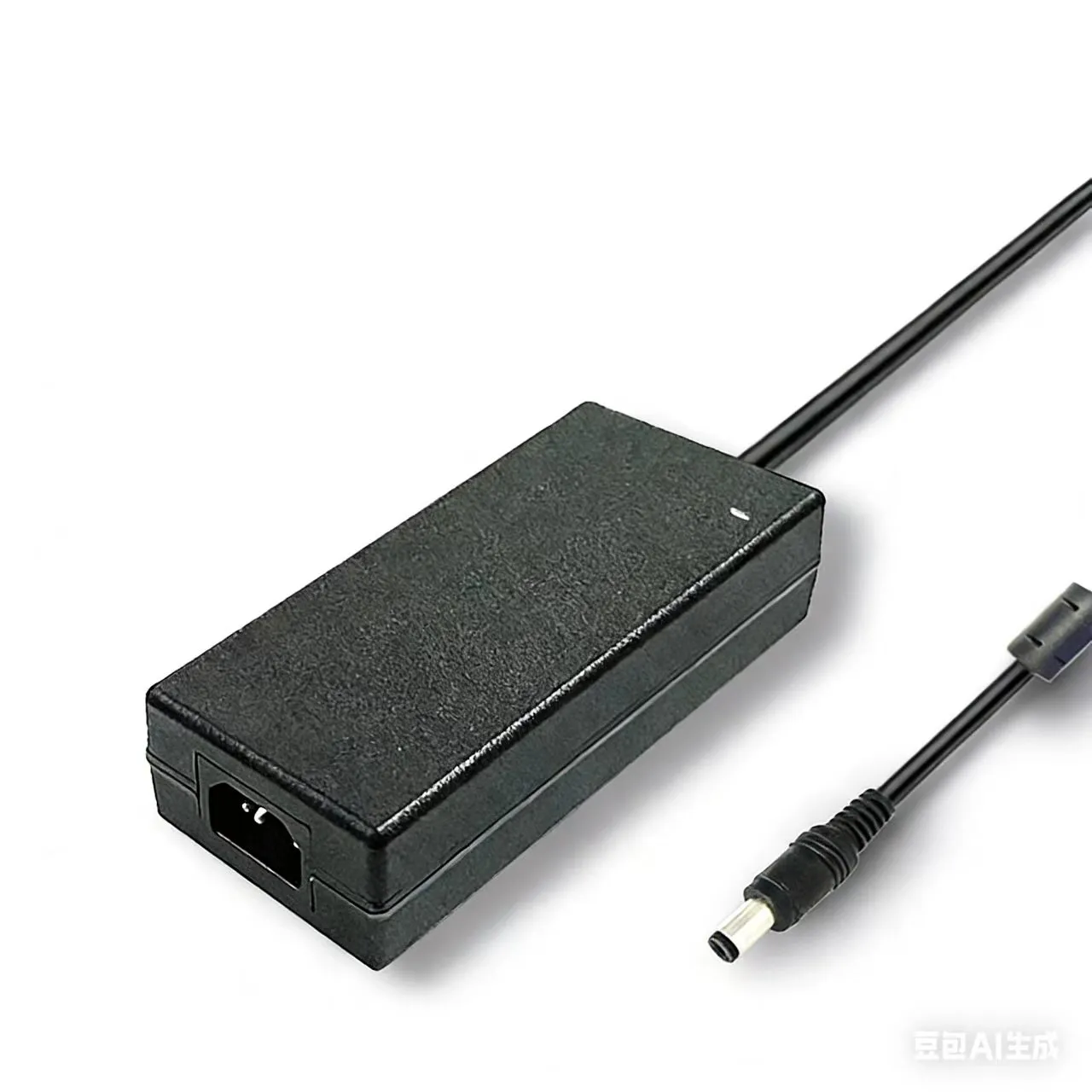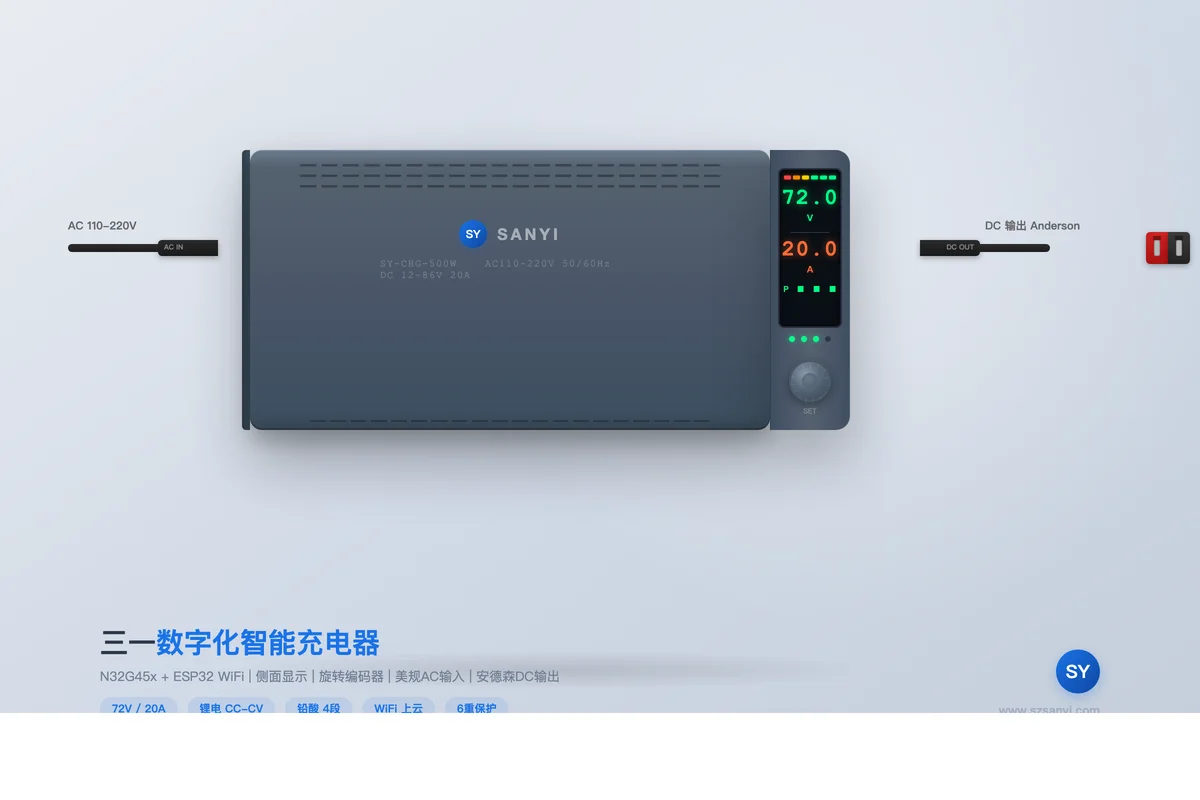

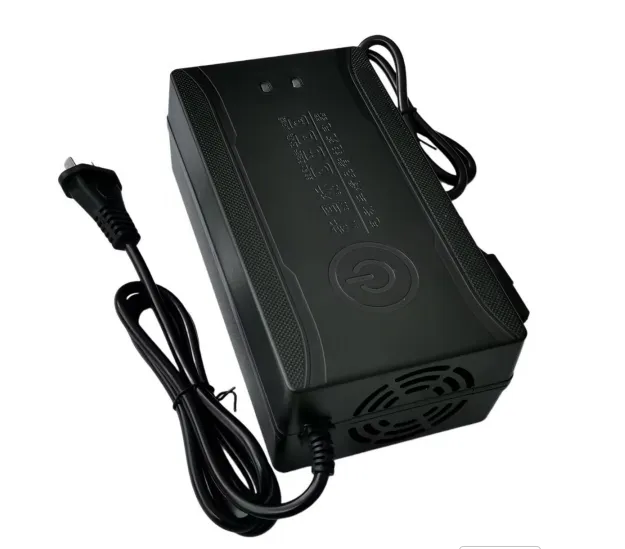
A battery charger built in 2010 had one job: deliver a fixed IUoU three-stage curve into whatever pack the operator plugged in. The pack chemistry was usually flooded lead-acid, the duty cycle was a forklift on an 8-hour shift, and the only feedback path was a thermistor glued to the side of the case. Fifteen years later the chargers being shipped onto AGV fleets, boom lifts, floor scrubbers and energy-storage cabinets are still — mostly — running that same fixed curve. The pack underneath is now LiFePO4 or NMC, the duty cycle is partial-state-of-charge opportunity charging, and the operator is a 24/7 fleet management platform that wants per-cell data back. The charger is the dumbest device in the loop.
Sanyi's cloud + edge AI adaptive charging architecture is built to close that gap. The on-charger edge model performs dynamic DC internal resistance (DC-IR) learning during every session, builds a real-time picture of each pack's electrical state, and adjusts current and voltage decisions cycle-by-cycle. The cloud layer aggregates that data across the entire deployed fleet, derives OEM-specific aging models, and pushes OTA charge-strategy updates back down to the edge. This article walks through the architecture, what the edge and cloud actually do, how it integrates with Sanyi's BMS and SCADA platform, and what the real-world payoff looks like in industrial battery service.
Why Static IUoU and CC-CV Profiles Are Running Out of Headroom
The two profiles that dominate today's industrial chargers — IUoU three-stage for lead-acid (constant current bulk → constant voltage absorption → float) and CC-CV for lithium chemistries (constant current to a cut-off voltage → constant voltage taper) — were both designed in an era when the charger could not assume any feedback beyond pack voltage and a single temperature point. They are static curves, parameterised once at the factory based on a brand-new reference cell, and then frozen in firmware.
Three failure modes follow from that.
Pack aging is invisible. A LiFePO4 cell at 1,500 cycles has 30–60% higher DC-IR than at cycle 1, but a static CC-CV charger applies the identical absorption voltage to both. The aged cell overshoots its real safe envelope, dissipates the excess as heat, and accelerates its own degradation — a self-reinforcing loop. The same problem on the lead-acid side: an FLA pack stratified after a year of partial-state-of-charge service needs a different absorption time than a fresh pack, but a fixed-profile charger gives it the same 4 hours regardless.
Temperature hysteresis is approximated, not measured. Most chargers apply a linear temperature compensation (–3 mV/°C/cell for lead-acid, a fixed offset for LFP) referenced to the case thermistor. But pack internal temperature lags case temperature by 10–30 minutes during a fast charge, and the lag is itself a function of pack age, cell balance and ambient airflow. A linear compensation cannot model that — it either undershoots at cold start (extending charge time) or overshoots at end-of-charge (gassing flooded packs, dendrite risk on lithium).
Cell-to-cell drift is ignored. A static profile sees only the pack-level terminal voltage. Two cells out of 16 drifting 50 mV out of balance look identical to the charger as two cells perfectly matched at the average. The first hint of trouble arrives when the BMS trips a high-cell-voltage protection mid-bulk and the charger surfaces only a fault code.
These three blind spots are precisely what the edge AI model is built to see.
What Dynamic Battery Impedance (DC-IR) Learning Actually Is
DC internal resistance is the slope of voltage-versus-current at the pack terminals over a short measurement window. It is the most informative single scalar the charger can derive from the pack in real time. Three things correlate strongly with DC-IR:
- State of charge (SoC) — most chemistries show a characteristic U-shaped DC-IR curve across SoC, with the minimum near 50% and the steepest rise below 10% and above 90%. This is why fast-charging an empty or nearly-full pack is intrinsically harder than fast-charging a half-full one.
- State of health (SoH) — the absolute DC-IR floor rises monotonically with cycle count and calendar age. A pack whose minimum DC-IR has doubled has lost most of its rate capability and roughly half its remaining useful life.
- Temperature — DC-IR roughly doubles for every 20 K drop below 25 °C on lead-acid and roughly triples on lithium chemistries below 10 °C. This is the single largest reason cold-weather fast charging fails.
A dynamic DC-IR learning system measures these continuously during a real charge session, not in a separate diagnostic mode. The technique conceptually relies on injecting small, controlled current perturbations during the bulk and absorption stages — small enough that the operator cannot perceive them, large enough that the resulting voltage response is well above measurement noise — and recovering the impedance from the response. The result is a live, per-session impedance fingerprint of the pack, refreshed many times per charge.
Sanyi treats this as the foundational sensor input that everything else in the AI charging stack is built on. The specific perturbation waveform, the recovery algorithm and the model that maps impedance to charge-decision parameters are Sanyi-proprietary R&D and are not exposed externally — what matters at the application level is that the resulting impedance estimate is accurate enough to drive cycle-by-cycle current and voltage adjustments without operator intervention.
Sanyi's Cloud + Edge AI Hybrid Architecture Overview
The architecture splits intelligence into two layers, each playing to the strengths of its compute environment.
The edge layer lives inside the charger. It is responsible for any decision that must happen within a single charging session — fast enough that round-tripping to the cloud is impossible. Its inputs are local: pack voltage, current, case temperature, the optional CAN/RS-485 telemetry from the pack BMS, and the live DC-IR estimate. Its outputs are the actual setpoints that the power stage acts on. Latency budget: milliseconds.
The cloud layer lives in Sanyi's deployment platform. It receives anonymised session logs from every connected charger in the field — impedance trajectories, temperature curves, fault events, OEM identifiers — and runs longer-horizon learning across the aggregate. Its outputs are parameters and models, not setpoints: refined battery-aging coefficients, OEM-specific charge profiles, new strategy bundles ready for OTA push. Latency budget: hours to days.
If you visualise it as a diagram, the picture is two stacked boxes with bidirectional arrows: the bottom box is the charger and its battery pack, the top box is the cloud, and the arrows in between carry session telemetry going up and updated strategy parameters coming down. The pack BMS and the customer's fleet SCADA system both hang off the side of the bottom box, exchanging real-time data with the edge but not directly with the cloud — keeping the customer network boundary clean.
The split matters because the two workloads have completely different latency and bandwidth profiles. You cannot ask the cloud to make every per-cycle current decision (network jitter alone would destroy charge quality), and you cannot ask the edge to derive a new aging model from hundreds of thousands of sessions (it does not have the data, the compute or the storage). Splitting them is what makes the system work in practice.
The Edge AI Model: What Runs Inside the Charger
The edge model is a compact decision engine. It does four things on every session.
Online impedance identification. The DC-IR estimate is refreshed many times per minute during bulk, less frequently during the lower-current absorption stage. The result is a live impedance vector that the rest of the edge logic consults instead of a fixed lookup table.
Adaptive current ceiling. Instead of running bulk at a single fixed C-rate baked in at the factory, the edge model derives the maximum safe current right now from the current impedance estimate, the measured pack temperature, the inferred SoC and any per-cell limits reported by the BMS. On a fresh, warm pack at moderate SoC, the ceiling is high and the charger runs fast. On an aged or cold pack, the ceiling is lower and the charger backs off automatically — without the operator changing any setting and without an explicit "cold-weather mode" toggle.
Adaptive stage transition criteria. The transition from bulk to absorption (or from CC to CV on lithium) is normally tied to a fixed voltage threshold. The edge model adjusts that threshold based on the live impedance — for an aged pack with elevated DC-IR, the apparent terminal voltage at the same internal state will be higher, and the static threshold would trigger transition too early. The edge model corrects for this so the pack gets the right amount of bulk for its current state of health.
Local safety supervision. All adaptive behaviour runs inside a hard safety envelope: absolute voltage and current limits, absolute pack and case temperature limits, BMS-reported per-cell limits, and a fault-state behaviour that always defaults to safe shutdown. The AI never adjusts outside this envelope. If it cannot satisfy a session within the envelope, it falls back to a conservative static profile and logs the reason — operations remain safe even with AI features fully disabled.
The Cloud AI Model: What Runs Above the Fleet
The cloud layer's role is to learn what the edge cannot.
Fleet-wide aggregation learning. A single charger sees the pack in front of it. The cloud sees thousands of packs of the same chemistry and capacity at different ages, in different climates, on different duty cycles. By aggregating the impedance and aging trajectories across the fleet, the cloud builds empirical aging models that no single-charger data set could ever derive. These models are then pushed back down to the edge as updated coefficients.
OEM battery pack fingerprint library. Many fleet operators run packs from multiple battery OEMs in parallel — a Genie boom lift pack, an Ecobat scrubber pack and a third-party LFP retrofit on the same yard. The cloud builds an OEM-tagged fingerprint library: characteristic impedance signatures, voltage curves and aging behaviour for each pack family. When a new charger is connected to a known OEM pack, the cloud-side classifier identifies the pack family from the first few minutes of session telemetry and downloads the corresponding tuned profile.
OTA charging-strategy delivery. The classical complaint about static chargers is that improving the algorithm requires recalling units or sending technicians with USB sticks. Sanyi's connected chargers receive new strategy bundles over the air on a controlled rollout cadence: a new profile is deployed first to a small pilot subset, fleet KPIs are monitored, and only after the pilot validates does the profile cascade to the wider deployment. Operators can also opt out of OTA updates entirely for regulated environments.
Anomaly and failing-pack detection. Patterns in the impedance trajectory often precede outright pack failure by weeks. The cloud flags packs whose impedance is drifting outside the fleet's normal envelope and surfaces those flags into the customer SCADA dashboard, giving maintenance teams a forward warning before an in-service failure.
Integration with Sanyi BMS and SCADA Platform
The cloud + edge AI charger is designed to fit into the broader Sanyi power-platform ecosystem rather than live in isolation.
On the BMS side, the charger exchanges real-time data with a connected Sanyi BMS over standard industrial buses (CAN and RS-485 are both supported), covering pack-level voltage and current, per-cell voltage and temperature, SoC and SoH estimates, and safety-state events. The edge model uses BMS-reported per-cell limits as a hard input to its current and voltage decisions — the AI never overrides a cell-level safety limit. When the connected pack is from a third-party BMS, the charger falls back to standard protocol profiles and operates conservatively on pack-level telemetry only.
On the SCADA / fleet side, the charger publishes per-session summaries (energy delivered, peak temperature, fault events, current SoH estimate) into the customer's existing fleet management platform using standard webhook and MQTT integrations. Customers running the full Sanyi platform get an additional fleet-wide dashboard view: SoH distribution across the fleet, packs flagged for maintenance, predicted remaining service life and charger utilisation. Specific message formats and field schemas are documented in the customer-facing integration guide and are not detailed here.
For the chemistry-side considerations that determine which adaptive features are available on a given pack — particularly the LiFePO4 vs lead-acid algorithm split — our LiFePO4 vs lead-acid battery charger selection guide is the long-form companion to this article. For the application-side perspective on opportunity charging and shift rotation, the forklift battery charger selection guide covers the operational context that adaptive charging is designed to optimise.
What This Actually Buys You: Real-World Benefits
Three benefit categories show up consistently in deployment.
Shorter average charge time at the same chemistry and capacity. Because the adaptive current ceiling allows the charger to push harder on packs that can take it (fresh, warm, mid-SoC) and back off only when the pack actually needs it, the average session is shorter than under a fixed-profile charger that has to assume worst-case conditions all the time. The improvement is largest on mid-life packs in moderate climates — the population where a static profile is most over-conservative — and smallest on brand-new packs or in extreme cold, where the ceiling is constrained by physics rather than by the algorithm.
Longer cycle life at the same usage pattern. Avoiding over-stress at end of charge is the single largest controllable lever on lithium pack life. The edge model's adaptive stage transition prevents the aged-pack overshoot that a static absorption threshold creates, and the cloud-side aging model continuously refines that behaviour as fleet evidence accumulates. The result is meaningfully more cycles before pack replacement, with the largest gains showing up on packs at the second half of their service life — exactly the population where pack replacement cost is most painful for operators.
Lower thermal-event risk. Because the current ceiling reacts to live impedance and live temperature rather than a static lookup, the charger is much less likely to drive an aged pack into thermal runaway territory. Combined with the cloud-side anomaly detection that flags packs trending toward failure, the overall thermal-event rate per million sessions drops sharply versus a static-profile baseline.
These benefits are not specific to one chemistry. Lead-acid packs benefit primarily from reduced gassing and more accurate equalisation timing; lithium packs benefit primarily from longer cycle life and lower thermal stress; mixed fleets benefit because the same charger handles both correctly without operator intervention.
Application Scenarios
The cloud + edge AI architecture is designed to drop into every major industrial battery service segment Sanyi covers.
Aerial work platforms (boom lifts and scissor lifts). Rental yards running mixed 48V/80V fleets of Genie Z/S, JLG 600S/800S and Skyjack SJ45/63 platforms get fleet-wide SoH visibility plus faster overnight recharge through the adaptive current ceiling. The Sanyi SY-C1000W ultra-high-power charger is the typical pairing.
Industrial floor scrubbers. Mid-size and large ride-on scrubbers (Tennant, Nilfisk, Kärcher industrial) running daily multi-shift duty cycles benefit from shorter opportunity charges and longer pack life — the most visible cost line on a commercial cleaning contract.
AGV / AMR fleets. Autonomous vehicles charging unattended at docking stations are the canonical use case for adaptive AI charging: there is no operator to push a "cold mode" button, the duty cycle is partial-state-of-charge by design, and the cost of a stranded vehicle on a production line is high. The cloud-side fleet view also doubles as a maintenance dashboard.
Electric forklifts. Lead-acid and LFP forklift packs both benefit, but the bigger payoff is on lead-acid: adaptive equalisation timing dramatically reduces stratification on packs that spend their working day in partial-state-of-charge service.
Electric golf carts and resort fleets. Seasonal-use packs that sit deeply discharged for weeks at a time benefit from cloud-side anomaly detection: the platform flags packs whose impedance has drifted during dormancy and recommends maintenance before the next active season.
Energy storage cabinets. Stationary commercial-and-industrial storage cabinets get the same per-pack SoH tracking and predictive-maintenance flagging, integrated into the customer's existing energy management system. The Sanyi SY-C500W series charger covers the lower-power end of the cabinet retrofit market.
For the full product map across all chemistries and voltage classes, see the Sanyi product catalogue.
Safety, Compliance and Data Handling
The cloud + edge AI architecture is designed to layer on top of, not replace, the existing certification and safety framework that Sanyi chargers ship with.
Hardware certifications. Sanyi chargers carry the certifications appropriate to their target market: UL 1564 for industrial battery chargers (North America), EN 1175 for industrial truck electrical equipment (EU), CE and FCC for general market access, and chemistry- or application-specific certifications where required by the application. Adding AI control does not change any of these requirements — the safety envelope inside which the AI operates is the same envelope the certified hardware enforces.
Data transmission security. Session telemetry from the edge to the cloud is encrypted in transit using industry-standard TLS, with mutual certificate authentication at the charger end. Telemetry payloads carry session-level operational data only; they do not carry any operator personal data or any customer-confidential identifiers beyond the asset tag the customer chooses to apply. Customers can opt for on-premise or regional-cloud deployment of the upstream platform where regulatory environments require it.
Local-mode operation. Every charger continues to operate fully in local mode if cloud connectivity is unavailable. The edge model uses the most recent strategy bundle it has cached, the safety envelope remains fully enforced, and the only feature lost is cloud-side model updates and fleet-view reporting. Local-mode operation can also be configured as the permanent posture for air-gapped or high-security customer sites.
FAQ
Is the cloud connection mandatory for the charger to work?
No. The charger operates fully on the edge model and the most recently cached strategy bundle. Cloud connectivity is required only to receive OTA strategy updates and to publish fleet-view telemetry. Customers can disable the cloud connection entirely and run permanently in local mode.
Does dynamic impedance learning damage the battery?
No. The small current perturbations the edge model uses to derive impedance are well below any chemistry-specific stress threshold — orders of magnitude smaller than the regular charging current itself. The system is designed to be electrically transparent to the pack.
How does the charger behave on a brand-new pack with no fleet history?
The edge model starts from the conservative default profile for the declared chemistry and capacity, derives its own DC-IR estimate from the first session and refines decisions session-by-session. Within a small number of sessions the model reaches a stable working point for that specific pack. Cloud-side OEM fingerprint classification, when the pack matches a known family, accelerates this further.
Can the AI override the battery BMS?
No. The BMS retains absolute authority over per-cell safety limits. The edge model treats BMS-reported limits as hard inputs and only optimises within the headroom the BMS allows. If the BMS issues a stop-charge command, the charger stops immediately.
Will this work on third-party (non-Sanyi) battery packs?
Yes. The edge model operates on pack-level voltage, current and temperature, which every battery exposes. When the pack also presents a standard CAN or RS-485 BMS interface, the model uses the per-cell data for additional refinement. OEM fingerprint classification works for any pack family the cloud has seen enough sessions to learn — Sanyi continuously expands the supported fingerprint library.
How much shorter is a typical charge session compared with a static-profile charger?
The improvement depends heavily on chemistry, climate and pack age. The largest gains are seen on mid-life lithium packs in moderate climates, where the static-profile baseline is the most over-conservative. The smallest gains are on brand-new packs or in extreme cold, where the rate is limited by chemistry rather than by the algorithm. Sanyi's application engineering team can size the expected benefit for a specific deployment as part of pre-sale evaluation.
Are OTA strategy updates rolled out instantly across the fleet?
No. Sanyi uses a staged rollout: a new strategy bundle is deployed first to a small pilot subset of chargers, fleet KPIs are monitored, and only after the pilot validates does the profile cascade to the wider deployment. Customers can also opt out of OTA updates entirely.
What certifications does the AI-enabled charger carry?
The same certifications as the underlying Sanyi charger platform — typically UL 1564 (industrial battery charger, North America), EN 1175 (EU industrial truck), CE and FCC. Adding the AI control layer does not change these requirements, because all adaptive behaviour runs inside the certified hardware safety envelope.
Talk to Sanyi About a Custom AI Adaptive Charging Solution
The cloud + edge AI architecture is available across Sanyi's industrial charger range, from the SY-C500W class for mid-power applications up to the SY-C1000W class for high-current boom-lift and energy-cabinet duty. Each deployment is sized to the customer's fleet profile, chemistry mix, climate and integration needs — there is no one-size-fits-all configuration.
If you are an OEM or a fleet operator evaluating next-generation adaptive charging for your platform, contact Sanyi to discuss a customised AI adaptive charging solution for your application. Our application engineering team can review your current static-profile baseline, model the expected benefit on your fleet, and propose a pilot deployment scoped to your operational risk tolerance.
.webp)