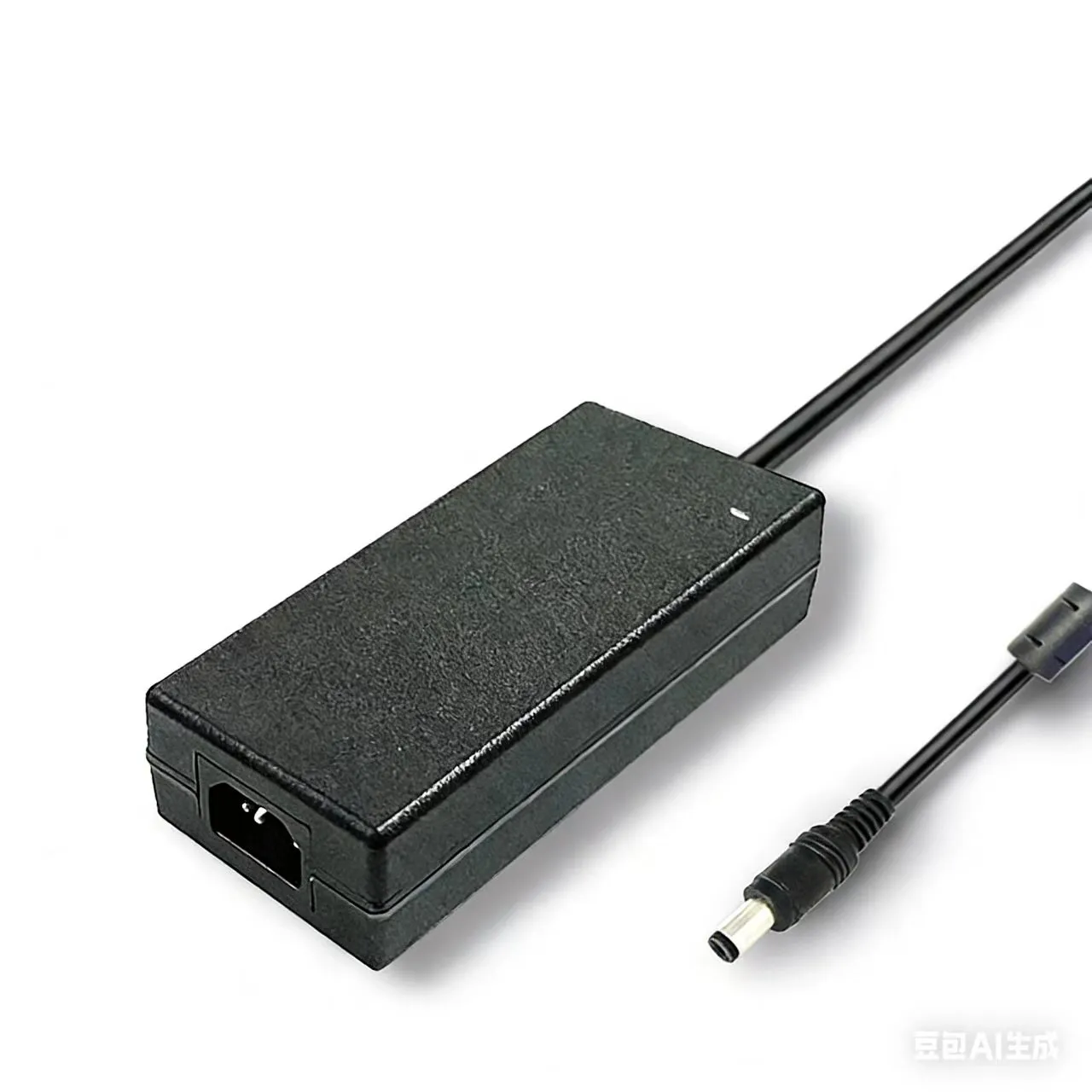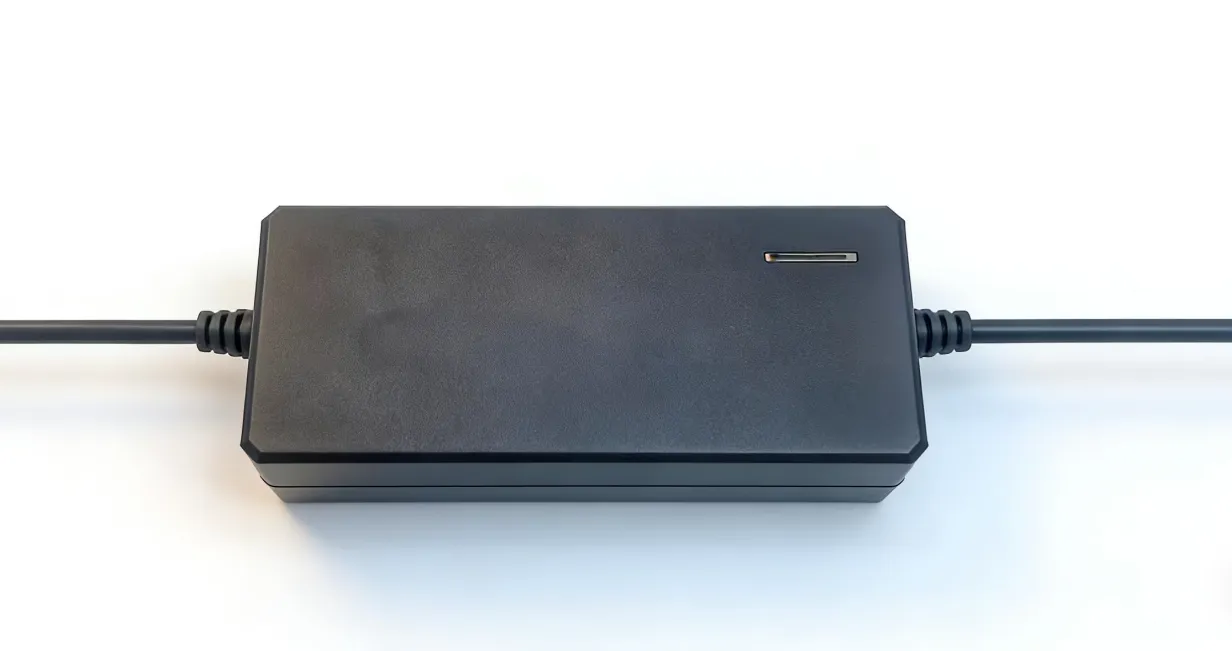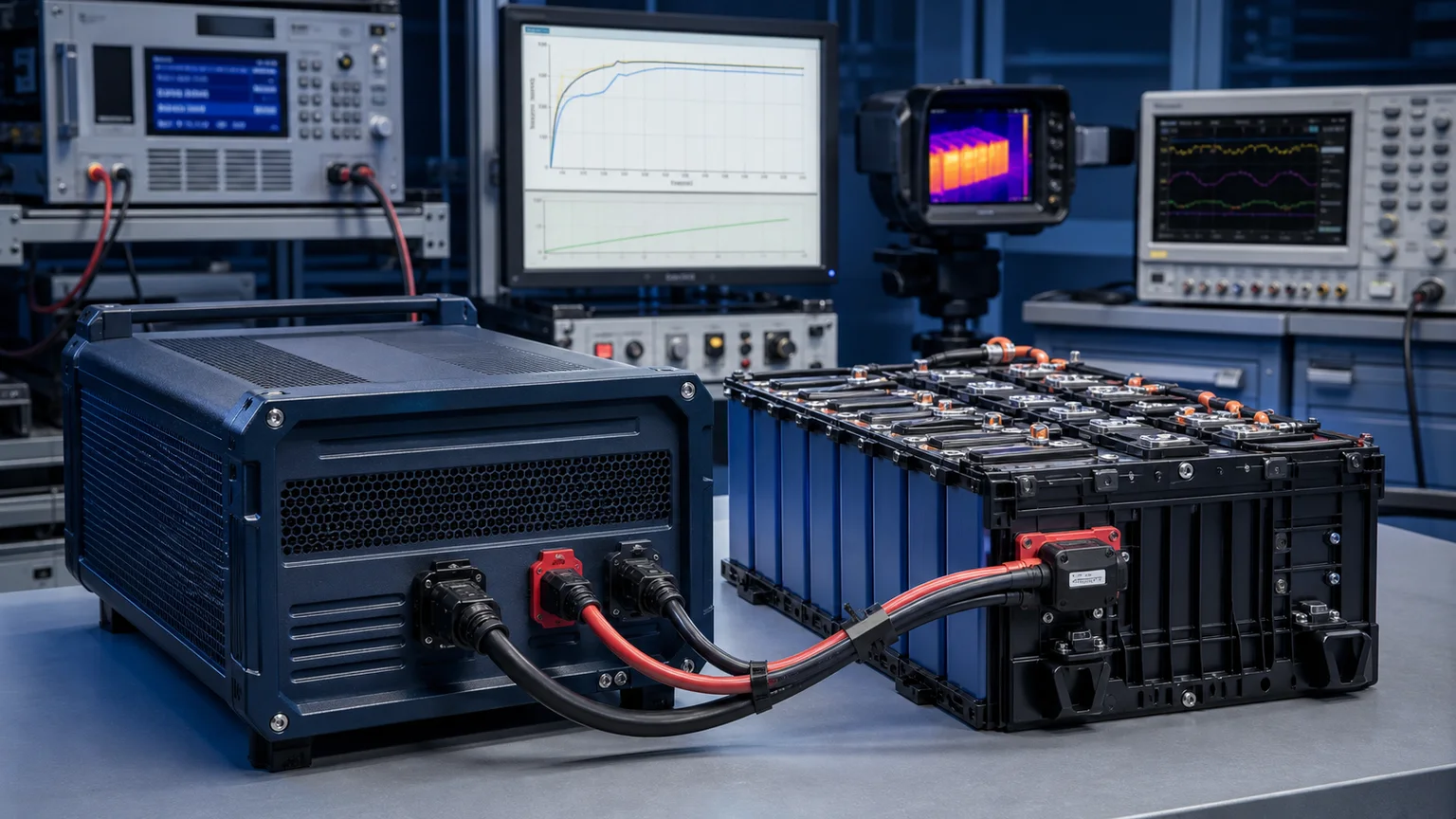

A scissor lift battery charger is the most overlooked safety-critical component on a rental yard. The lift itself is a $20,000–$60,000 asset that holds a worker thirty feet in the air; the battery pack is the heaviest single line item on the bill of materials; and the charger is the one part of the system that the operator interacts with every single shift. Get the charger wrong and a Genie GS-1930 starts a job at 76% state of charge instead of 100%, a JLG 2030ES quits at lunch on the third floor, or a $4,800 AGM pack gets cooked at 14.8 V absorption and degrades in eighteen months instead of five years.
This guide covers scissor lift battery charger selection in 2026 — how to match charger output to OEM lift platform (Genie, JLG, Skyjack, Haulotte, Snorkel), how to pick the right charge algorithm for flooded, AGM, gel or LiFePO4 chemistry, what UL 1564 and EN 1175 certification actually require for indoor MEWP charging, and how to design opportunity-charging schedules for rental fleets running two-shift or weekend turnover.
Why Scissor Lift Chargers Are Their Own Category
A scissor lift charger is not a forklift charger and not a golf cart charger. It sits between them. The pack capacity is typically 200–400 Ah on a 24V electric scissor lift and 200–315 Ah on a 48V rough-terrain unit — heavier than a golf cart, lighter than a Class I forklift truck. But the duty cycle is brutally different from either. A scissor lift sits at 100% SoC on a rental yard pad for five days, gets hauled to a job site Friday afternoon, runs at 30–60% depth of discharge for two full shifts, and comes back to the yard Sunday night for a 14-hour overnight recharge before the next job. Repeat 200 times a year.
That duty cycle drives three design choices that separate a real MEWP charger from a relabelled industrial supply. The charge algorithm must finish a full equalisation cycle in under 12 hours so the lift is ready for the morning truck. The enclosure must take indoor warehouse dust, occasional concrete-pad rain ingress, and the constant vibration of being mounted onto a chassis that bounces over expansion joints — which means at minimum IP54 for indoor-only carts and IP65 for rough-terrain units that get washed down between rentals. And the input must tolerate the worst shore power on earth: a 220 V single-phase outlet at a construction site, fed by a 100-foot extension cord, behind a contractor's generator with 4% THD on the waveform.
For a deeper look at how IP ratings translate into job-site survival, our waterproof power supply selection guide breaks down which IP digit actually protects against what.
Step 1: Identify Your Lift's Voltage Class
The first decision is forced by the lift, not chosen freely. Electric and hybrid scissor lifts run on two nominal pack voltages.
| Platform class | Typical models | Pack voltage | Typical pack capacity | Typical charger output |
|---|---|---|---|---|
| Compact electric, slab-only | Genie GS-1530, GS-1930; JLG 1930ES, 2030ES; Skyjack SJIII 3219 | 24V (4× 6V flooded series, or 2× 12V) | 200–245 Ah | 24V / 25–30 A |
| Mid-size electric, slab + light rough | Genie GS-2632, GS-3246; JLG 2632ES, 3246ES; Skyjack SJ3219, SJ3226 | 24V or 48V | 215–315 Ah | 24V/30A or 48V/25A |
| Rough-terrain electric / hybrid | Genie GS-3369 RT, GS-4069 RT; JLG 3369LE, 4069LE; Haulotte Compact 12 DX; Snorkel S3970RT | 48V (8× 6V flooded series) | 245–375 Ah | 48V / 25–30 A |
| Telescopic / large rough-terrain | Genie GS-5390 RT; JLG ES4046; Haulotte H15 SX | 48V or 80V (Europe) | 280–415 Ah | 48V / 30 A or 80V / 25 A |
The 24V slab scissor lift is the volume product of the rental industry — Genie GS-1930 and Skyjack SJIII 3219 alone account for tens of thousands of units in the North American rental fleet. Pack capacity is around 200–245 Ah at 24V, and the OEM-supplied charger is a 25 A or 30 A unit that finishes a recharge from 30% SoC in roughly 8–10 hours of overnight wall time.
A 48V rough-terrain scissor lift like the Genie GS-3369 RT or JLG 3369LE uses a heavier 245–375 Ah pack to support the four-wheel drive system and the additional mass of the rough-terrain chassis. The charger sized for those platforms — like the Sanyi SY-C1000W series ultra high-power charger (1000W / 1200W / 1600W, up to 25 A at 48V output) — is the right scale of hardware. Light-duty 10–15 A automotive chargers undersize badly at this pack size and will not finish equalisation overnight.
Step 2: Match the Charge Algorithm to the Chemistry
A scissor lift battery pack is one of four chemistries, and the charger must explicitly support that chemistry — there is no universal "smart charger" that handles all four correctly without configuration.
Flooded Lead Acid (FLA)
Still the volume chemistry on rental scissor lifts because the pack is cheap, the chemistry tolerates the abuse of mixed-operator rental service, and the watering schedule is acceptable on a yard with a maintenance crew. FLA needs a true IUoU three-stage charge profile: constant current bulk at 0.10–0.20 C up to absorption voltage (29.0–29.4 V for a 24V pack, 58.0–58.8 V for a 48V pack at 25°C), constant voltage absorption held until current tapers to ~3% of pack capacity, float at 26.4 V / 52.8 V indefinitely. A periodic equalisation cycle at 31.2 V / 62.4 V for 2–4 hours every 30–60 cycles is mandatory to reverse stratification and rebalance cells.
A charger that skips the equalisation stage — common on cheap rebranded supplies sold as "universal MEWP chargers" — will let a flooded pack stratify within a year of weekly use and drop to half its rated cycle life.
AGM (Absorbed Glass Mat)
The retrofit-of-choice on indoor-only construction scissor lifts and on units rented to airport, hospital and food-processing customers where electrolyte spillage is unacceptable. AGM uses a similar IUoU profile but with tighter absorption (28.8–29.2 V for 24V, 57.6–58.4 V for 48V) and no equalisation — the sealed VRLA construction is destroyed by the high-voltage equalisation cycle that a flooded pack tolerates. A charger configured for FLA will gas an AGM pack and shorten its life dramatically.
Gel
Less common on scissor lifts but used in temperature-sensitive applications (cold-storage warehouses, outdoor northern fleets). Absorption voltage is lower again (28.4–28.8 V / 56.8–57.6 V) and current limit must be capped tighter to avoid the gas-recombination overload that destroys gel cells. Float is critical — gel cannot tolerate the higher AGM/FLA float of 27 V.
LiFePO4
The fastest-growing segment of MEWP battery service since 2023. LFP retrofits on Genie GS-1930 and JLG 2030ES are widely available at 24V/210 Ah; OEM lithium offerings from JLG (DaVinci AE) and Skyjack (SJ12 E) are pure 48V LFP platforms. LFP needs a fundamentally different algorithm: CC-CV (constant current to 29.2 V or 58.4 V at 25°C, then constant voltage hold until current tapers to 0.05 C), no float, no equalisation. The charger must communicate with the pack BMS to gate charging on cell-voltage / cell-temperature limits — pure voltage-based charging without BMS feedback risks cell-imbalance failures.
For a side-by-side comparison of LFP vs lead-acid charger requirements and the retrofit considerations on industrial equipment, our LiFePO4 vs lead-acid battery charger selection guide walks through the algorithm differences in detail.
The takeaway: never mix chemistry and charger profile. A FLA-profile charger will gas an AGM pack; an AGM-profile charger will under-charge a FLA pack; a lead-acid charger of any flavour will overcharge an LFP pack within hours. The charger must be either chemistry-specific or have a clearly documented chemistry-select switch on the front panel.
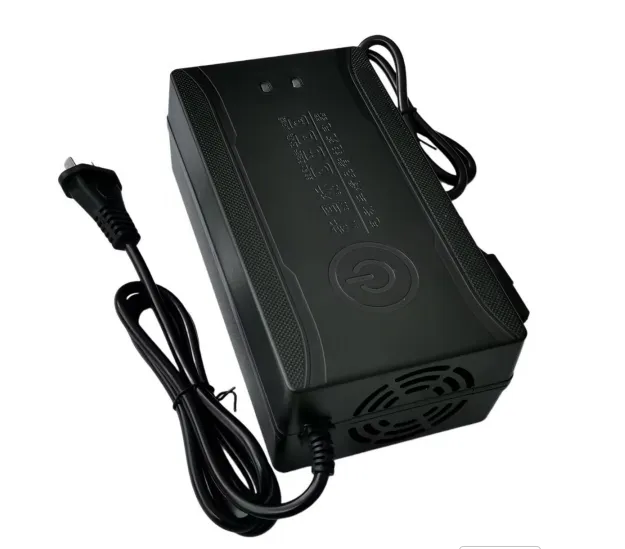
Step 3: Pick the Connector — SB50, DIN 43589, or OEM Crowfoot
Scissor lift OEMs are less standardised than golf cart OEMs on the connector side, but three families dominate.
Anderson SB50 (grey, red, or blue housing): the de facto rental-industry standard on North American scissor lifts. Used on most Genie and Skyjack 24V slab platforms and on aftermarket retrofit chargers across all five OEMs. Rated 50 A continuous, 120 V working voltage, 10,000 mating cycles. Colour-keyed housing prevents cross-connecting different voltages on a multi-platform rental yard.
Anderson SB175 / SB350: stepped up for higher-current rough-terrain platforms (Genie GS-3369 RT, JLG 4069LE) and for opportunity-charging stations that need to deliver 60–100 A bulk current to a 375 Ah 48V pack in a 4-hour window.
DIN 43589 (REMA / Schaltbau): the European MEWP standard, used on Haulotte, Snorkel UK-built units, and any platform built for EU-market rental. The DIN connector is colour-keyed by voltage (24V, 48V, 80V) and rated for 80 A or 160 A depending on housing size. North American OEMs do not use DIN by default — if you are sourcing a charger for a Genie or JLG unit built for the EU market, check the connector on the lift itself, not the OEM nameplate.
OEM crowfoot / proprietary plugs: a few older Skyjack and Snorkel units use proprietary 2-pin DC connectors. These are sometimes specified for legacy compliance reasons; replacement units are usually adapted to SB50 at the next charger swap.
The connector is not a trivial choice. A mismatch between the lift inlet and the charger output cable means a field technician with a crimp tool and the wrong connector body, which is how a 24V charger ends up on a 48V lift inlet and a $4,800 pack goes pop on a Monday morning. Specify the connector at the same time as the charger output spec; do not assume.
Step 4: Size for Recharge Time, Not for Pack Capacity
The sizing question is not "what current does the pack want" — every chemistry will accept anywhere from 0.05 C to 0.30 C bulk current without immediate damage. The real question is how many hours of wall time the rental yard has between rental drop-off and the next dispatch.
The two operating cases:
Overnight recharge (rental yard standard): lift returns at 18:00 at 30% SoC, dispatched again at 06:00 the next morning. That is 12 hours of wall time. A 200 Ah 24V pack needs to put back 140 Ah of usable charge; at 25 A charger output that takes 5.6 hours of constant-current bulk plus 2–3 hours of absorption = ~8 hours total. Comfortable margin. A 25–30 A charger on a 24V slab lift fits this case.
Opportunity charging (two-shift rental, weekend turnover): lift returns at 22:00 at 30% SoC, must be dispatched at 06:00 — 8 hours of wall time. A 315 Ah 48V pack needs 220 Ah at 25 A = 8.8 hours bulk. Too slow. Step up to a 40–50 A charger and the bulk drops to 4.4–5.5 hours, leaving room for absorption. The SY-C1000W high-power charger fits this opportunity-charging case at 48V.
For rental-fleet operators the right sizing answer is almost always one step heavier than the OEM charger — OEM chargers are sized to the cheapest viable overnight case, not to the operational reality of weekend turnover. The lithium retrofit case is even more aggressive: LFP tolerates 0.5 C bulk happily, so a 200 Ah LFP pack can charge in under 2 hours with a properly sized 100 A charger.
Step 5: Certification — UL 1564 and EN 1175 Are Not Optional
Two certification standards apply to MEWP chargers and both are non-negotiable for any commercial deployment.
UL 1564 (Industrial Battery Chargers) is the North American standard for chargers feeding industrial traction batteries. UL 1564 covers electrical isolation, abnormal-operation fault tolerance, enclosure construction, and the marking requirements that let an OSHA-inspected job site accept the charger. A charger without UL 1564 listing is not legal for indoor commercial charging in any major US rental chain.
EN 1175 (Industrial Trucks - Electrical/Electronic Requirements, formerly EN 1175-1/2/3) is the European equivalent and is required for any MEWP charger sold into EU rental fleets. EN 1175 covers similar ground to UL 1564 but with EU-specific EMC limits (EN 12895), low-voltage directive compliance (LVD 2014/35/EU), and CE marking.
Beyond those two, ask for:
- IEC 60335-2-29 (safety of household and similar appliances - battery chargers) — applies to portable plug-in chargers used outside of dedicated charging rooms.
- IEC 61000-6-2 / -6-4 EMC immunity / emission for industrial environments.
- IP54 minimum for indoor charge-room mounting, IP65 for outdoor rental-yard pad or job-site use.
A charger that ships with only a CE self-declaration and no UL or EN test-house listing is not a commercial product — it is a hobby charger with a label.
Step 6: Rental Fleet Operations — Rotation, Cycle Counting, and Fleet Telematics
A scissor lift charger in a rental yard is not a one-off purchase; it is a fleet-management tool. Three operating practices materially extend pack life and cut warranty exposure.
Rotation: rotate lifts through the rental dispatch queue based on cycle count, not on last-rental date. A Genie GS-1930 with 240 deep cycles on its FLA pack should rotate to lighter duty before it goes back out to a contractor running it twice a day. Modern chargers with onboard cycle counters (or a simple log on the wall) let the yard manager track this without telematics.
Opportunity charging: top up between shifts at 15-minute breaks. A flooded pack does not like opportunity charging — it accelerates positive-plate corrosion. An AGM pack tolerates it occasionally. An LFP pack thrives on it: partial-state-of-charge operation is the LFP optimum. Match the fleet operating model to the chemistry, not the other way around.
Telematics: 2024+ Genie, JLG and Skyjack platforms ship with optional fleet-telematics modules that report pack voltage and charge cycles back to the rental yard. A charger with a closed-protocol pairing to those telematics modules (often via CAN bus or short-range RF) lets the yard see "lift 047 finished charge at 04:12, ready for 06:00 dispatch" without a yard walk. For yards moving in this direction, the Sanyi SY-C260W and SY-C500W series chargers include the digital control hooks needed to integrate at the fleet-management layer.
Step 7: Sanyi Charger Product Map for Scissor Lift Service
Sanyi manufactures industrial battery chargers across the full voltage and power range that scissor lift fleets need. Three product families cover the major use cases.
- SY-C260W series (260W, 5 A): right-sized for 12V auxiliary banks on hybrid scissor lifts, small slab-only 24V/100 Ah light-duty units, and as a maintenance / desulfation float charger for off-rental units sitting in long-term yard storage.
- SY-C500W series (500W, 10 A): the volume product for 24V slab scissor lifts in the Genie GS-1530 / GS-1930 and Skyjack SJIII 3219 class. Configurable for FLA / AGM / gel / LFP via front-panel chemistry select.
- SY-C1000W series (1000W / 1200W / 1600W, up to 25 A): the rough-terrain workhorse for 48V Genie GS-3369 RT, JLG 3369LE / 4069LE, Haulotte Compact 12 DX and Snorkel S3970RT platforms. Also fits opportunity-charging stations on two-shift rental yards.
All Sanyi MEWP chargers are built for UL 1564 / EN 1175 listing on request, IP54 / IP65 enclosure options, and IUoU three-stage / CC-CV configurable charge algorithms. For a full product line walkthrough or to discuss a fleet-specific OEM pairing, see the Sanyi product catalog or contact our engineering team.
FAQ
How long should a scissor lift battery charger last?
A correctly sized commercial-grade charger should outlast two pack replacements — typically 8–12 years of rental-yard service or 15+ years on a captive-fleet construction-company unit charged five days a week. Lifespan is dominated by the input capacitor bank and the cooling fan; a fan-less convection-cooled design like the SY-C500W series eliminates the most common wear-out failure mode.
Can I use a forklift charger on a scissor lift?
Sometimes — a 24V/30A or 48V/30A forklift charger will physically charge a scissor lift pack if voltage and connector match. But forklift chargers are typically sized for 600–1000 Ah Class I traction packs and will run for 3–4 hours of bulk on a 200 Ah scissor lift pack before tapering, putting unnecessary thermal stress on the pack. Use a charger sized for the pack capacity, not for the next-larger industrial truck class.
Why does my Genie GS-1930 only charge to 80%?
Three common causes. (1) The OEM charger has aged and the absorption voltage has drifted low — measure absorption at the pack terminals; if below 28.8 V on a 24V FLA pack, the charger needs service. (2) One or more cells in the FLA pack is sulfated and refusing to take full charge — equalise once, then check specific gravity on individual cells. (3) The charge cable has corroded at the connector — Anderson SB50 contacts oxidise after 5+ years in a humid yard and add resistance that the charger interprets as a charged pack.
Is it safe to leave a JLG 2030ES on the charger all weekend?
On flooded or AGM, yes — a charger with a proper float stage (26.4 V on 24V, 52.8 V on 48V) is designed for indefinite float. On LFP, the picture is different: LFP does not need or want a float stage. A correct LFP charger terminates current at end-of-charge and stays off until pack voltage drops below a reconnect threshold. If the charger is forcing continuous current into an LFP pack at "float" voltage, switch to a charger with a proper LFP profile.
What's the difference between a Skyjack OEM charger and an aftermarket replacement?
The OEM charger ships with the lift, carries OEM warranty support for the charger-and-pack system, and is matched to the OEM's pack chemistry at delivery. The downside: OEM chargers are typically not field-configurable for chemistry, so the lift cannot be retrofitted to LFP without replacing the charger. Aftermarket commercial chargers (Sanyi, Quick Charge, Schauer, Lester) cost less, support multiple chemistries, and are repairable rather than throw-away — but you take on the responsibility of matching profile to pack. For a 200+ unit rental fleet doing LFP retrofits, the aftermarket route usually wins on TCO.
How do I tell if my Haulotte Compact 12 DX needs the European DIN 43589 charger or the US Anderson SB50?
Look at the inlet on the lift, not the OEM nameplate. A Haulotte Compact 12 DX built for the EU rental market typically ships with DIN 43589; a unit imported into North America and re-marketed by a US distributor often has the inlet swapped to Anderson SB50 at port. If the inlet is square-bodied with two large pins, that is DIN; if it is rectangular grey-bodied with two flat blades, that is SB50. When in doubt, the lift serial-number plate carries a build-spec code that identifies the original-market configuration.
Can the same charger handle a Snorkel S3970RT and a JLG 4069LE?
Yes if both are 48V and both run the same battery chemistry — and most rental yards run them on flooded packs of similar capacity (245–375 Ah). The SY-C1000W series at 48V/25A covers both platforms with the same SKU, which simplifies rental-yard spares inventory. Connector spec on the charger cable may need a one-step swap (the SB50 housing is identical; the cable length and lug may differ between OEM cable harnesses), but the charger body is the same unit.
What happens if I charge a 48V LFP pack with a 48V flooded-lead-acid charger by mistake?
Within the first 30 minutes: nothing visible, because both algorithms start at constant current. As the pack reaches 58 V the FLA charger continues pushing into the absorption stage at 58.8 V and holds there for hours. The LFP cells will continue accepting current past their safe top voltage, the pack BMS will trigger over-voltage protection on individual cells and disconnect the pack from the charger, and depending on the BMS design the pack may or may not be recoverable. Best case: hard reset of the BMS. Worst case: permanent imbalance across cells and a pack replacement. Always confirm the charger profile before plugging in to a retrofit lift.
For sizing and certification support on a specific scissor lift platform or rental-fleet retrofit, contact the Sanyi engineering team with the lift model number, pack chemistry, target recharge window, and operating environment. We size and certify chargers across the full 24V–80V MEWP range and ship UL 1564 / EN 1175 listed units globally.
.webp)