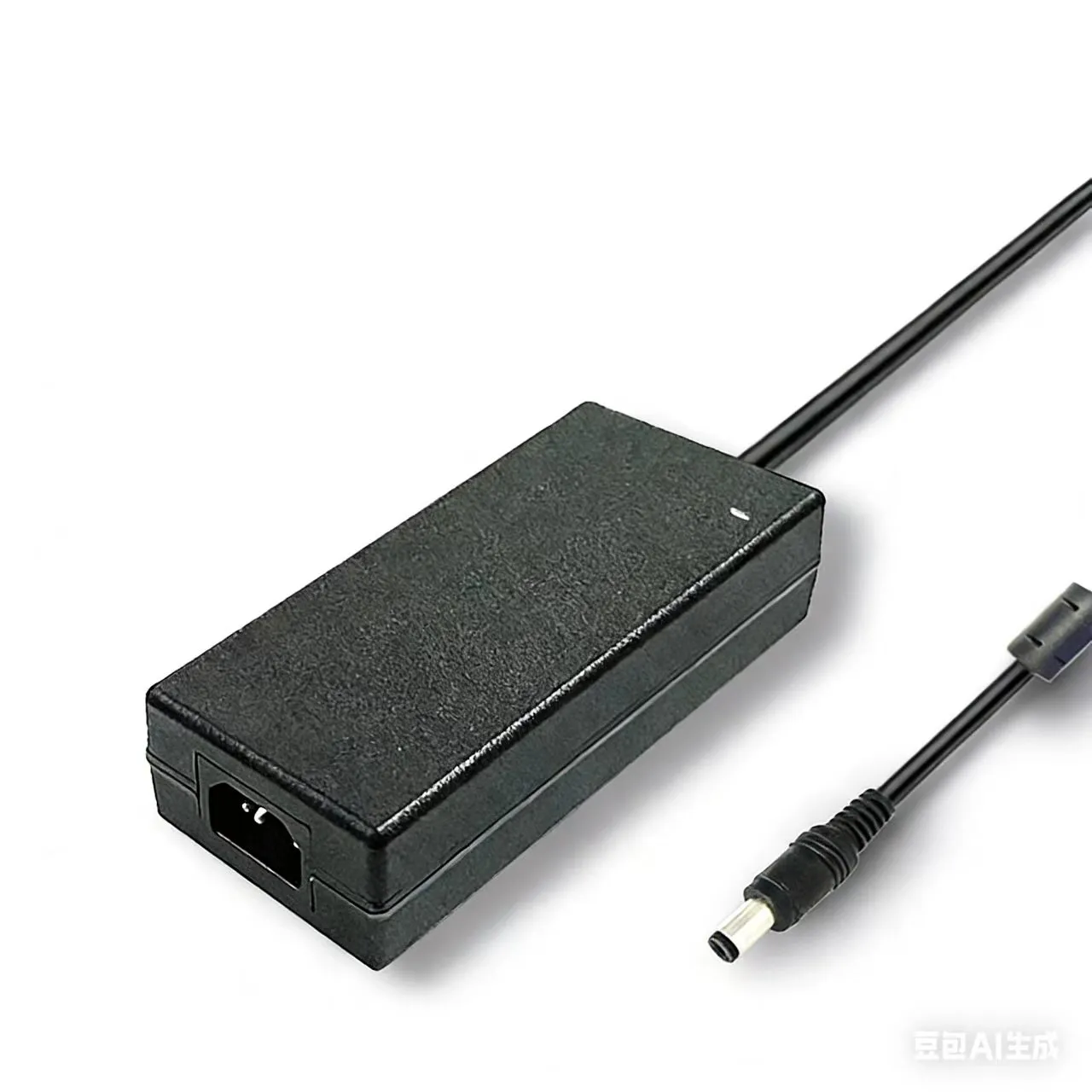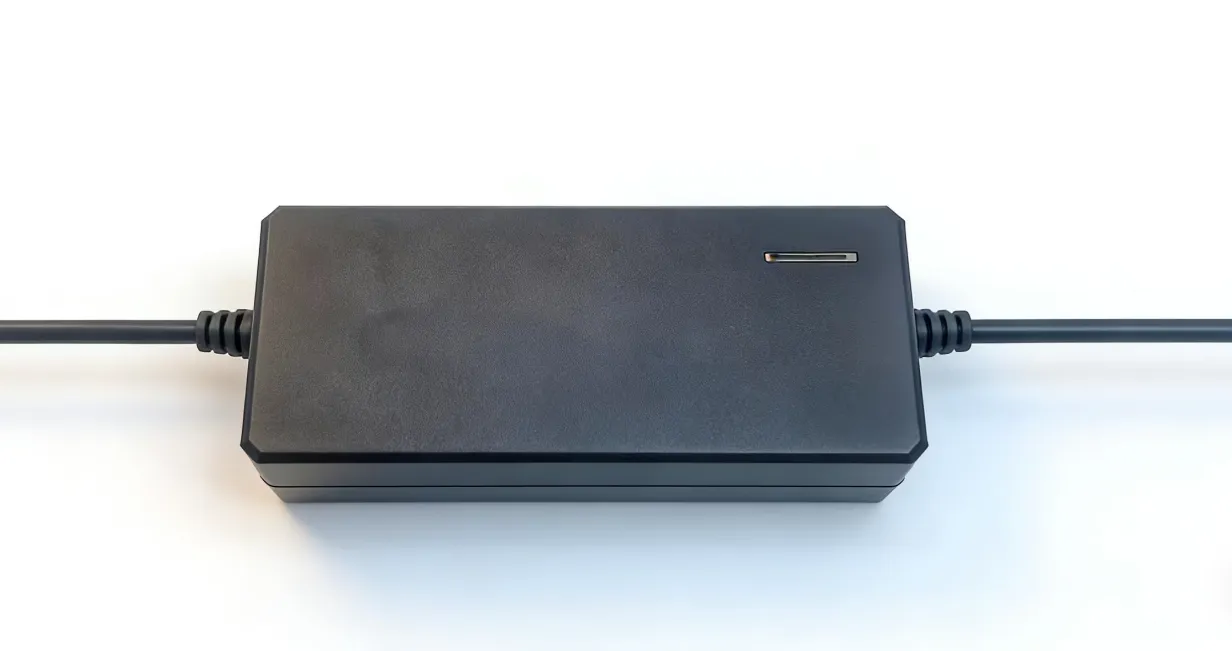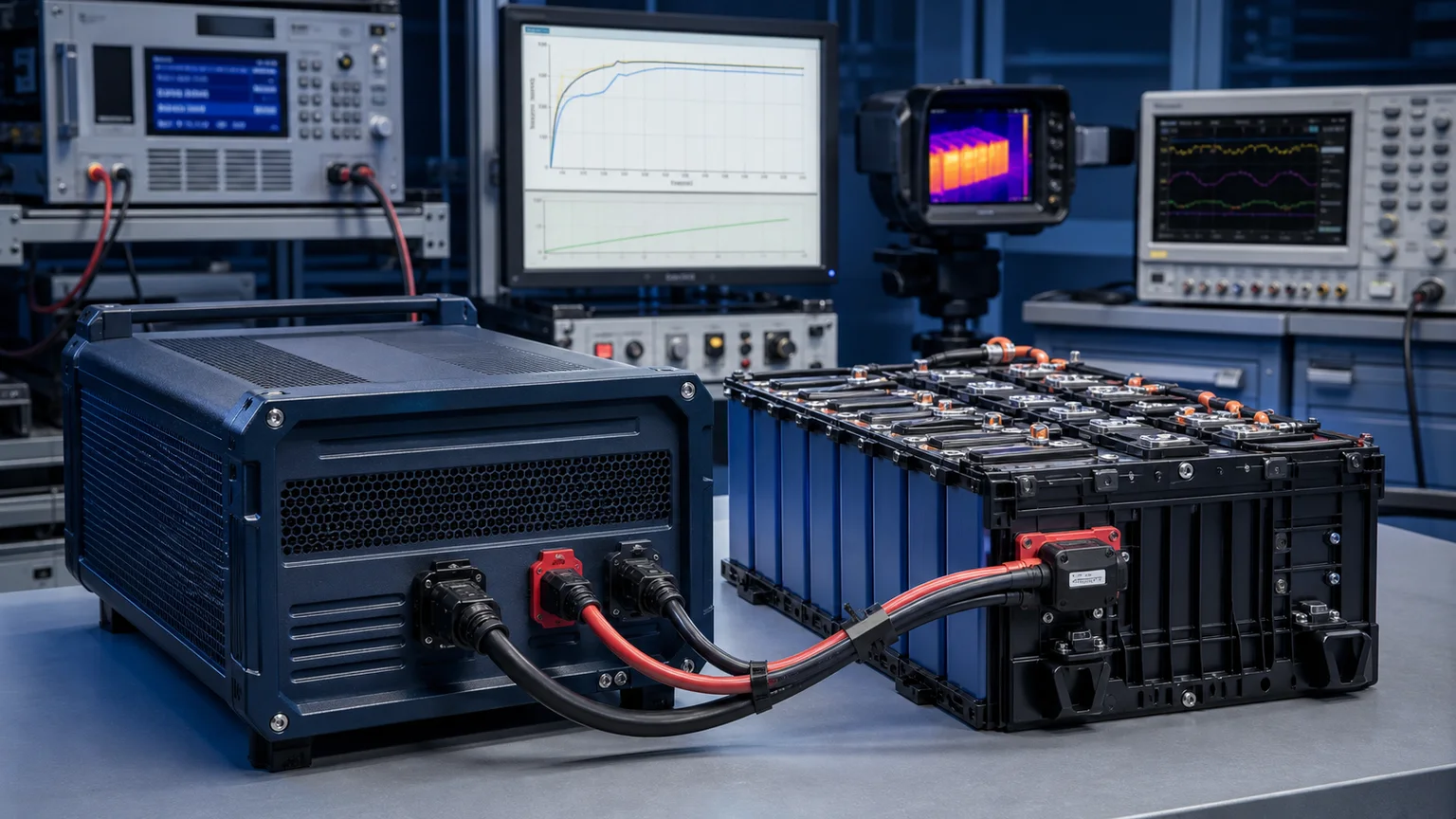

An RV converter charger is the single most misunderstood box on the rig. It looks like a generic 12 V power supply, it lives in a louvered cabinet next to the breaker panel, and most owners do not think about it until the morning the house lights dim, the propane detector squeals at 10.4 V, and a $1,800 LiFePO4 retrofit refuses to come off 60% state of charge after a full night on shore power. Treat the converter charger as "just a 12 V supply" and you over-pay for capacity the rig cannot use; treat it as a marine charger and you starve the house bank of equalization the flooded pack actually needs.
This guide covers 12V RV converter charger selection in 2026 — for motorhomes (Class A / B / C), travel trailers, fifth wheels and camper vans across the North American 30 A / 50 A shore power ecosystem; how to pick between single-stage and 4-stage IUoU smart algorithms; how to spec for AGM, GEL, flooded or LiFePO4 house banks; and the practical replacement map for Magnetek, Parallax, Progressive Dynamics, WFCO, IOTA and Xantrex OEM converters.
Why RV Converter Chargers Are a Distinct Category
An RV converter charger is not a marine charger with a different label, and it is not a forklift charger scaled down. It sits at a unique intersection of three constraints that no other 12 V charger category has to satisfy simultaneously: North American RV shore power, dual-bus house/chassis battery separation, and distribution-panel co-location with DC loads running while charging.
North American RVs run on either a 30 A / 120 V single-phase shore connection (TT-30 inlet, common on travel trailers and Class C motorhomes up to ~32 ft) or a 50 A / 120-240 V split-phase connection (NEMA 14-50 inlet, standard on Class A diesel pushers, large fifth wheels and toy haulers). The converter charger lives downstream of the main breaker panel, fed by a dedicated 15 A or 20 A AC branch, and its 12 V DC output feeds the house battery while simultaneously powering interior lighting, water pump, slide-out motors, propane refrigerator control board, CO/LP detectors and the entertainment system.
The chassis battery — the one that cranks the engine on a motorhome — is a completely separate bus, isolated by a battery-disconnect relay or a battery-isolation manager (BIM) and charged either by the engine alternator on the road or trickled by a battery maintainer when parked. The converter charger does not normally charge the chassis battery. This is the single most important point new RV owners miss, and the source of most "my chassis battery dies after a week on shore power" complaints.
The RV industry codifies the combination of constraints in RVIA / NFPA 1192 (RV Standards) and NEC Article 551 (RVs and RV parks), and the converter charger has to comply with both — UL 458 listing (Power Converters Used in Recreation Vehicles) is the de-facto credential, distinct from UL 1564 industrial chargers or UL 1236 portable consumer chargers.
For owners coming from boats, the marine battery charger selection guide covers what carries over (multi-bank charging, ABYC safety thinking) and what does not (galvanic isolation, salt-water IP ratings) versus the RV case.
Single-Stage vs Multi-Stage Smart Chargers — The 4-Stage Algorithm
A converter charger from 1990 was a single-stage unit: a 60 Hz transformer dropping line voltage to roughly 13.8 V DC, ferro-resonant or magnetic-amplifier regulated, and that voltage was applied continuously to the house bank whenever shore power was present. Simple, indestructible, and quietly murderous to any modern battery.
Single-stage at a fixed 13.8 V does three bad things at once. It never completes a full bulk charge — a flooded pack returning to 100% needs to see ~14.4 V during absorption, and 13.8 V leaves it permanently at ~85% SoC. It boils electrolyte on long shore-power sits — at 13.8 V continuously, an FLA pack at full charge gases steadily, dropping electrolyte level and stratifying acid. And it damages LiFePO4 retrofits in a different mode — LFP cells will accept 13.8 V indefinitely without complaint but never reach the 14.2–14.4 V absorption knee that BMS-balancing logic expects, so cell drift accumulates.
The modern answer is a 4-stage smart converter charger running an IUoU algorithm with an added equalization stage:
- Bulk — constant current at the charger's rated output (45 A, 55 A, 75 A, 100 A depending on the model), driving the pack from 50–80% SoC toward the absorption voltage knee. The current is limited by the charger; the pack accepts whatever it can.
- Absorption — constant voltage at 14.2–14.6 V (chemistry-dependent), held until the accepted current tapers to ~2–4% of pack capacity. This is the stage that actually completes the charge.
- Float — drop to 13.2–13.6 V (chemistry-dependent) and hold indefinitely while shore power is connected, replacing self-discharge and powering DC loads without gassing the pack.
- Equalization — periodic excursion to 15.3–15.5 V for 2–4 hours every 30–60 cycles, flooded lead-acid only, to reverse stratification and de-sulfate plates. Modern smart converters either run this automatically on a timer or expose a front-panel button.
Progressive Dynamics calls this "Charge Wizard." Parallax calls it "TempAssure." WFCO calls it "Auto-Detect 4-Stage." The vendor names differ but the underlying algorithm is the same IUoU+equalize behavior, and it is the floor for any modern RV charger spec.
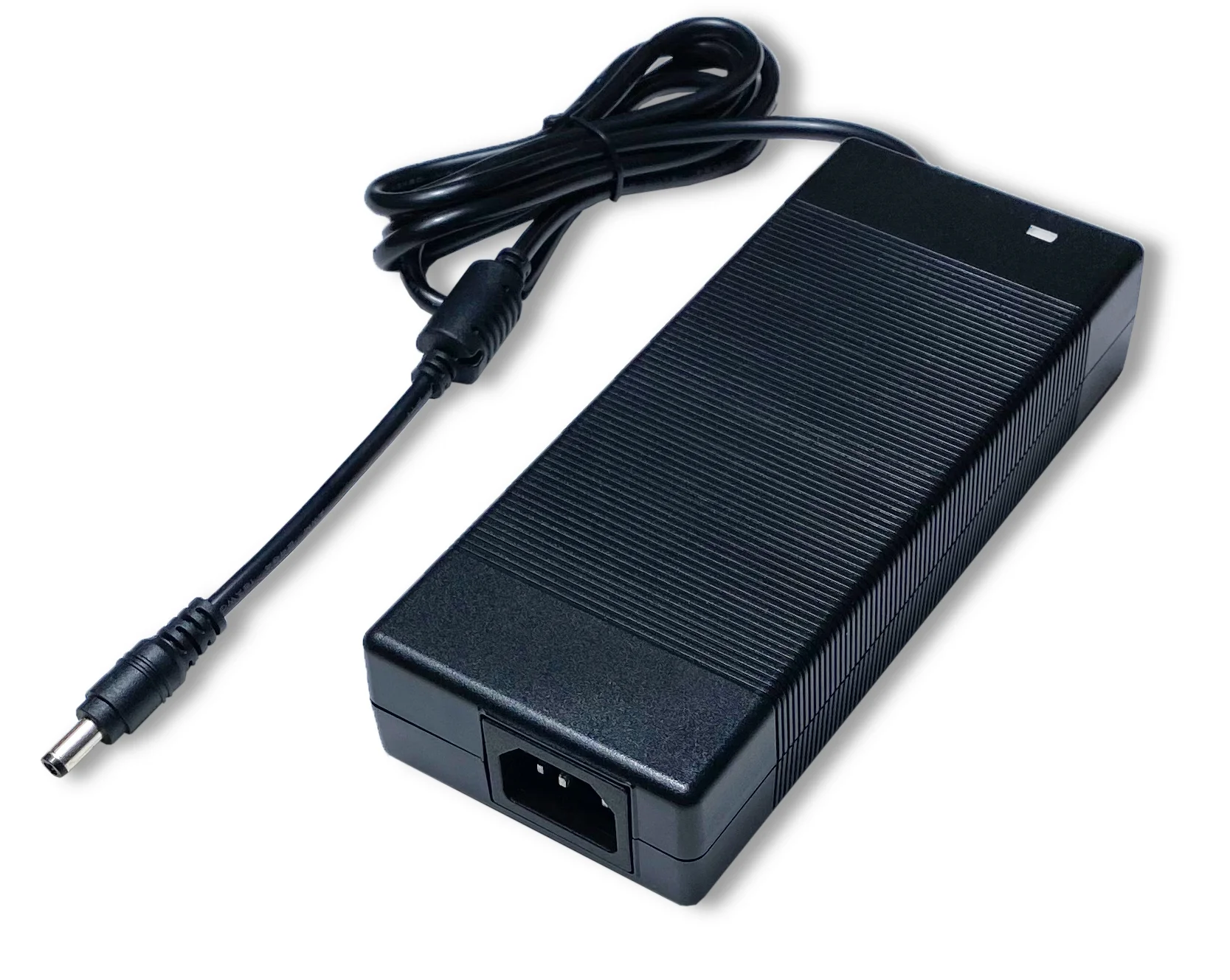
12V Output Sizing — 30A / 45A / 55A / 75A / 100A Converter Selection
RV converter chargers cluster around a small set of output current bands, and the right size is driven by the house bank capacity and the DC load running while charging, not by the rig's overall AC service:
| Rig class | Typical house bank | Recommended converter output | Notes |
|---|---|---|---|
| Pop-up trailer, small teardrop, truck camper | 1× 12 V, 80–100 Ah | 12V / 30 A | Single-stage acceptable here; 4-stage preferred |
| Small travel trailer (under 24 ft) | 1× 12 V or 2× 6 V series, 100–230 Ah | 12V / 45 A | 4-stage required for AGM or LFP |
| Mid-size travel trailer / Class C motorhome | 2× 6 V or 2× 12 V parallel, 200–400 Ah | 12V / 55 A | Most common WFCO / Progressive Dynamics size |
| Large fifth wheel / Class A gas | 4× 6 V or 200–400 Ah LFP | 12V / 75 A | LFP retrofit usually demands this step |
| Class A diesel pusher / luxury toy hauler | 400–600 Ah LFP, 12 V or 24 V bank | 12V / 100 A | Often inverter/charger combo, not standalone |
The DC-loads-while-charging caveat: on shore power with the converter running, every interior LED, the propane refrigerator control board, the slide-out controllers and the entertainment stack pull from the converter's 12 V bus before any surplus current flows into the battery. A typical 32 ft travel trailer parked at a campground with lights, fridge and a TV running draws 18–25 A continuously off the 12 V bus. If your converter is rated 45 A and the rig is pulling 20 A in steady-state loads, you have only 25 A available for actual battery charging — and a deeply-discharged 200 Ah AGM pack will refuse to absorb at the 0.10 C minimum bulk rate.
Size the converter so that rated output minus continuous DC load is at least 0.10 C of the house bank capacity. A 300 Ah AGM bank with 25 A of steady DC loads needs at least a 55 A converter to get a real 30 A into the pack — and 75 A if the owner wants overnight recovery from 30% SoC.
LFP changes the calculation in the owner's favor. A 300 Ah LFP pack accepts 0.5 C continuously, so a 75 A converter never sees a current-limited regime; the limit is the converter, not the chemistry. This is why the SD-500W high-power switching power supply sees increasing use as an upstream 12 V source in custom Class B camper van builds — the 12 V / 41 A rail is exactly the size of a Progressive Dynamics PD9145, but with the modular packaging and remote-mount flexibility custom builders need.
AGM / GEL / Flooded vs LiFePO4 — Charge Profile Differences in RV Service
The four chemistries that share the RV market each need a different charge profile, and the converter charger must be configured (chemistry-select switch on the front panel, or model-level configuration) to match.
Flooded lead-acid (FLA) — still the cheapest house bank per amp-hour and still common on owner-installed retrofits using golf-cart 6 V batteries in series-parallel. FLA needs the full IUoU+equalize profile: bulk to 14.6 V absorption knee at 25 °C, hold absorption ~2 hours, drop to 13.6 V float, equalize at 15.5 V every 30–60 cycles for 2–4 hours. Electrolyte level needs monthly inspection regardless of charger.
AGM (absorbed glass mat) — the volume retrofit chemistry on travel trailers since 2015. AGM uses a tighter IUoU profile: bulk to 14.4 V absorption, hold ~90 minutes, drop to 13.4 V float. No equalization — AGM is a sealed VRLA design and the high-voltage equalization stage that flooded packs tolerate will dry an AGM pack out and kill it. A converter charger forced into equalization on an AGM bank is the dominant failure mode for "my new batteries only lasted two years."
GEL — uncommon on RVs but appears on some EU-import camper vans and high-end Class B builds. Lower absorption (14.1 V), tighter current limit, critical float ceiling at 13.5 V. GEL cannot tolerate the 13.8 V float that AGM and FLA accept and will dry out within months on a charger configured for the wrong chemistry.
LiFePO4 (LFP) — the fastest-growing RV house bank chemistry since 2023, driven by Battle Born, Renogy, Victron, Will Prowse-style DIY builds and OEM Lithionics installations on luxury Class A diesel pushers. LFP needs a fundamentally different algorithm: CC-CV (constant current to 14.2–14.4 V at 25 °C, then constant voltage hold until current tapers to 0.05 C), no float, no equalization, with BMS handshake to gate charging on cell-voltage and cell-temperature limits. Critically, LFP must not be charged below 0 °C — the converter charger or upstream BMS has to interlock against low-temperature charging, or the cells plate lithium and degrade permanently.
The takeaway: never assume the OEM converter handles LFP correctly out of the box. A 1998 Magnetek 6300A in float mode will park an LFP pack at 13.8 V indefinitely — the cells will survive but never balance. A 2015 WFCO WF-8945 in equalization mode will trip the BMS over-voltage protection within the first cycle. Specify a 4-stage smart converter with explicit LFP profile select, or budget a separate LFP-compatible charger in parallel with the legacy converter, before the retrofit.
For a deeper view of the algorithm difference between lead-acid and lithium, the LiFePO4 vs lead-acid battery charger selection guide walks the chemistry behavior in detail.
OEM Replacement Map — Magnetek / Parallax / Progressive Dynamics / WFCO / IOTA / Xantrex
Most RV converter charger purchases in 2026 are replacements, not new installs. The OEM brand on the box behind the panel narrows the upgrade path considerably:
- Magnetek 6300 / 6400 series — 1980s–1990s ferro-resonant single-stage units common on Winnebago, Fleetwood and Coachmen rigs. Drop-in replacement is the Progressive Dynamics PD4600 series with the same chassis dimensions but a 4-stage Charge Wizard algorithm.
- Parallax 7300 / 7400 / 8300 series — common OEM on Forest River, Jayco and Keystone trailers from ~2000–2015. Replacement either with newer Parallax 8300A (factory-upgraded with TempAssure 4-stage) or with a Progressive Dynamics PD9100 series in the same mounting footprint.
- Progressive Dynamics PD9100 / PD9200 series — already 4-stage; if the existing unit is still running, no replacement needed. If it has failed, drop-in within the same series.
- WFCO WF-8900 series — the dominant OEM converter on 2015+ travel trailers from Forest River, Heartland, Grand Design and Keystone. The factory algorithm is auto-detect 4-stage but has been known to skip the absorption stage on AGM packs — a known issue. Replace with a WFCO WF-8900-AD (the Auto-Detect refresh) or step up to a Progressive Dynamics PD9145C for the same physical footprint with a more aggressive absorption profile.
- IOTA DLS series — the standalone replacement of choice for installers who want a converter not married to a distribution panel. DLS-30, DLS-45, DLS-55, DLS-75 sizes map directly to the output bands above; pair with the IOTA IQ4 smart controller to add 4-stage to a DLS otherwise running single-stage at 13.6 V.
- Xantrex TrueCharge2 / Freedom series — used on higher-end Class B and Class A diesel pushers as inverter/charger combos. Replacement is in-family: TrueCharge2 to TrueCharge2 Plus, or step up to Freedom XC Pro for inverter+charger consolidation.
The mechanical-fit dimension matters as much as the electrical spec. Travel-trailer distribution panels are dimensioned for a specific converter footprint, and a replacement that is half an inch too tall will not fit the cabinet. Confirm overall dimensions and AC/DC terminal positions against the existing unit before ordering — the chassis is often more constraining than the model number.
Inverter/Charger Combo vs Standalone Converter Charger
Two architectures dominate the modern RV market:
Standalone converter charger — the converter is a one-way 12 V DC supply downstream of an AC distribution panel. When the owner wants 120 V AC from the house bank (running a microwave or a TV while boondocking), a separate inverter handles the DC-to-AC direction. This is the architecture on most travel trailers under 40 ft and most Class C motorhomes — simple, replaceable in parts, cheaper.
Inverter/charger combo — a single bi-directional unit that runs as a charger when shore power is present and as an inverter when shore power is removed. Common on Class A diesel pushers, large fifth wheels with residential refrigerators, and most Class B camper van builds. The Magnum MS / MSH series, Xantrex Freedom series, Victron MultiPlus and Magnum MS-PAE are the dominant brands. The combo unit handles transfer switching automatically (typically a 20–25 ms changeover) so refrigerator compressors and CPAP machines see no interruption.
The combo architecture costs more upfront but consolidates: one box, one set of DC cables, one BMS handshake. For LFP retrofits on Class A coaches, the combo path is usually cheaper end-to-end than retrofitting both a new converter and a new inverter. For travel-trailer owners adding LFP, the standalone path is almost always right — the inverter is rarely used and a low-cost converter swap is the lowest-risk path.
Boondocking & Solar Integration — Converter Charger + MPPT
Off-grid camping (boondocking) inverts the design problem. There is no shore power, the converter charger is dormant, and the only inbound energy is solar through an MPPT controller (and occasionally engine alternator on a motorhome with a battery isolation manager).
Two integration patterns work in 2026:
Parallel architecture — the MPPT solar controller and the converter charger both connect to the house bank in parallel. When shore power is present, the converter dominates and the MPPT idles (because its open-circuit setpoint sits above the converter's float voltage). When shore power is removed, the MPPT alone handles the bank. This is the simplest pattern, requires no coordination, and works on any RV regardless of converter brand. The downside: the converter has no awareness of solar contribution and may keep its absorption stage running longer than needed when both sources are active.
Coordinated architecture — used on Victron-ecosystem builds with VE.Bus and VE.Direct linking the MPPT, inverter/charger, BMS and battery monitor. The system runs a single absorption window across all sources, and when the MPPT contribution alone is enough to hold absorption, the converter stage backs off automatically. Significantly more efficient on long boondocking weekends with intermittent shore visits, significantly more expensive and brand-locked.
The mid-power desktop adapter line — including the APN Series 48W-144W desktop adapter and the SUN Series 48W-144W desktop adapter — sees use in compact camper van builds as auxiliary 12 V sources for accessory subsystems (lighting circuits, USB hub power, MPPT controller bench power), separate from the main converter charger but supporting the boondocking electrical architecture.
Buying Checklist
Before ordering a replacement or upgrade, confirm all of the following:
- Shore power class — 30 A / 120 V (TT-30) or 50 A / 120-240 V (NEMA 14-50). Determines available AC headroom for the converter's branch circuit.
- House bank chemistry — FLA, AGM, GEL or LFP. Drives the algorithm spec.
- House bank capacity — Ah at C20 (lead-acid) or nameplate Ah (LFP). Drives the converter output sizing per the table above.
- Continuous DC load while charging — 12 V refrigerator, lighting, vent fans, slide-out parking-rest loads. Subtract from converter output to size for actual charge current.
- Mechanical footprint — width, depth, height of existing unit and AC/DC terminal positions. Mechanical fit constrains the model list more than the electrical spec usually does.
- UL 458 listing — non-negotiable for any unit installed inside the RV envelope behind the distribution panel.
- Chemistry-select switch or model variant — explicit support for the house bank chemistry, with LFP profile that does not float and that respects low-temperature charge interlock.
- Equalization control — front-panel button or timer-based, FLA only.
A converter that ships with only a CE self-declaration and no UL 458 is not a legal install for a US/Canadian RV — it cannot be plugged into a distribution panel that has been listed under NFPA 1192 / NEC 551, and an insurance investigation after a fire will note the non-compliance.
Sanyi Product Map for RV House Battery Systems
Sanyi manufactures 12 V power supplies and adapters across the power range that RV builders and aftermarket retrofitters need. Three product families cover the major use cases for custom Class B camper van builds, travel trailer upgrades and accessory subsystems:
- HP Series 120W-480W high-power 12V adapter — the upstream 12 V source for custom converter charger builds, Class B camper van DC distribution, and high-load auxiliary circuits. 12 V / 10 A through 12 V / 40 A configurations available, with the 240 W / 20 A and 480 W / 40 A units sized to match the bulk-stage demand of a 100–200 Ah AGM or LFP house bank.
- APN Series 48W-144W desktop adapter — the mid-power workhorse for compact camper van and truck camper accessory loads — secondary lighting circuits, USB charging hubs, refrigerator control board power, MPPT controller bench supplies.
- SUN Series 48W-144W desktop adapter — backup and secondary 12 V supply for camper van builds where the main converter is used for house bank charging and the SUN unit supplies isolated accessory subsystems.
- SD-500W high-power switching power supply — the modular bench-mount 12 V / 41 A rail used as the primary DC bus in custom Class B builds and high-current converter charger replacement projects. Suitable for builders working outside the OEM footprint who want a clean, replaceable 12 V source matched to a separate smart charge controller for the house bank.
For sizing a converter charger replacement or designing a custom RV electrical system, contact our team with the rig class, shore power class, house bank chemistry, capacity and continuous DC load. We size and certify 12 V power supplies and adapters across the RV power range and ship globally. Browse the full Sanyi product catalog or contact our engineering team for a build-specific quotation.
FAQ
Will a 4-stage smart converter charge my chassis battery while I'm parked on shore power?
Almost never, without an added relay. The converter charger is wired to the house bus, isolated from the chassis bus by a battery-disconnect or BIM. Some Class A motorhomes ship with a "Trik-L-Start" or "Echo Charger" relay that bleeds a few amps from the house bus to the chassis bus when the house bus is above 13.4 V — that is what keeps the chassis battery alive on shore power. If your motorhome does not have that relay, the chassis battery will discharge over weeks of shore-power storage regardless of how good the converter is. Verify the trickle path before blaming the converter for a dead chassis battery on Monday morning.
My new LiFePO4 house bank only reaches 90% on my WFCO WF-8945 — is the converter broken?
The converter is not broken; it is configured for lead-acid. WFCO WF-8945 in lead-acid mode targets a 14.4 V absorption knee, but holds it for only a fixed time window before dropping to 13.6 V float. An LFP pack accepts current at the absorption voltage until cells balance — which can take several hours longer than the WFCO timer allows. Either replace with a converter that has an explicit LFP profile (CC-CV with current-taper termination, no float), or add a separate LFP-compatible charge controller in parallel with the WFCO and let the LFP unit finish what the WFCO starts.
Can I leave my travel trailer plugged in at home for the winter with a 4-stage converter?
On AGM or FLA, yes — a 4-stage converter in float mode at 13.4–13.6 V is exactly what an indefinite-storage AGM or flooded pack wants. The chemistry self-discharges 2–5% per month and the converter replaces that drift cleanly. On LFP, the picture is different: LFP self-discharge is under 2% per month and a converter holding LFP at 13.6 V indefinitely will accelerate cell ageing slightly. The right answer for LFP winter storage is to charge to 80% SoC, disconnect from shore power, and check monthly — or use a converter with an explicit "LFP storage mode" that drops to 13.0 V float.
What size converter do I need to retrofit a 400 Ah LiFePO4 house bank?
A 75 A 4-stage smart converter with explicit LFP profile is the right starting point for a 400 Ah LFP retrofit on a travel trailer or Class C motorhome. LFP accepts 0.5 C continuously so the pack will absorb 75 A indefinitely without protest, and a 400 Ah pack discharged to 30% SoC will recover in ~3–4 hours of bulk plus another 60–90 minutes of absorption. Going larger to 100 A buys faster bulk but stresses the AC branch circuit on a 30 A shore connection — a 100 A converter at full output draws ~12–14 A on the 120 V side, eating most of a 15 A branch breaker.
Why does my Magnetek 6300A boil my flooded house batteries dry every summer?
Because it is a ferro-resonant single-stage unit running at 13.8 V continuously, and flooded batteries at 25 °C ambient gas mildly at 13.8 V, accelerating to visible bubbling at 35 °C summer temperatures. The Magnetek 6300A has no temperature compensation and no float stage to drop the voltage after the pack is full. The fix is a Progressive Dynamics PD4600 series drop-in replacement with Charge Wizard 4-stage and temperature compensation — same chassis footprint, same AC and DC terminal positions, and the gassing problem disappears on the next shore-power cycle.
Is an inverter/charger combo worth the extra cost on a 32 ft travel trailer?
Usually no. A 32 ft travel trailer with a residential-fridge-free electrical system rarely draws 120 V AC from the house bank — the microwave, hair dryer and coffee maker are shore-power-only by design. A standalone 55 A converter charger plus a small 1000 W modified-sine inverter on a single accessory circuit (for laptop and CPAP use during boondocking) costs less than half the combo path and is easier to service. The combo math flips on Class A diesel pushers with residential refrigerators and on Class B van builds where the inverter sees daily use — then the combo is the right architecture.
For sizing, replacement and cabling support on a specific RV converter charger upgrade or custom Class B build, contact the Sanyi engineering team with the rig class, shore power class, OEM converter brand and model, house bank chemistry and capacity. We size and certify 12 V power supplies and adapters across the RV power range and ship globally.
.webp)