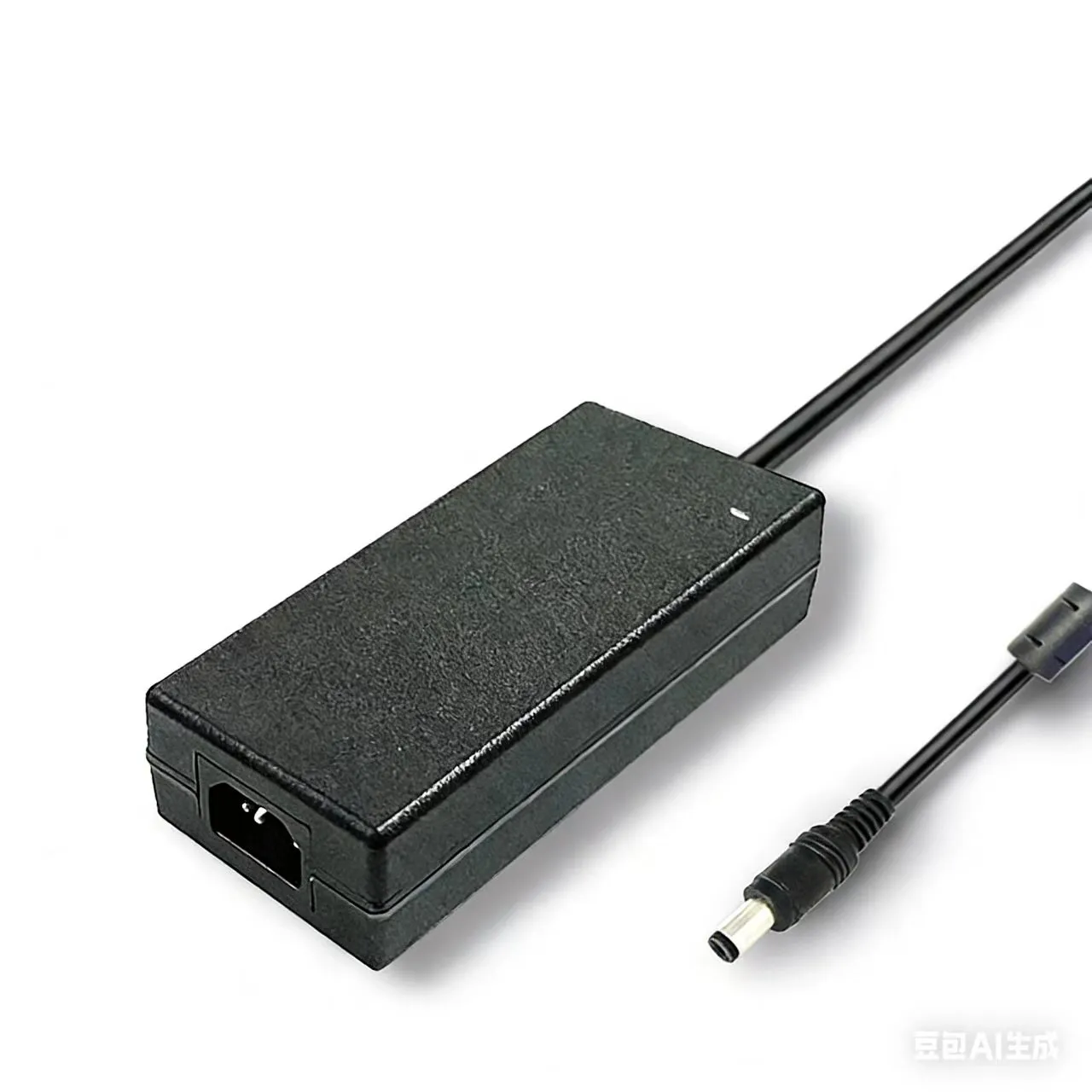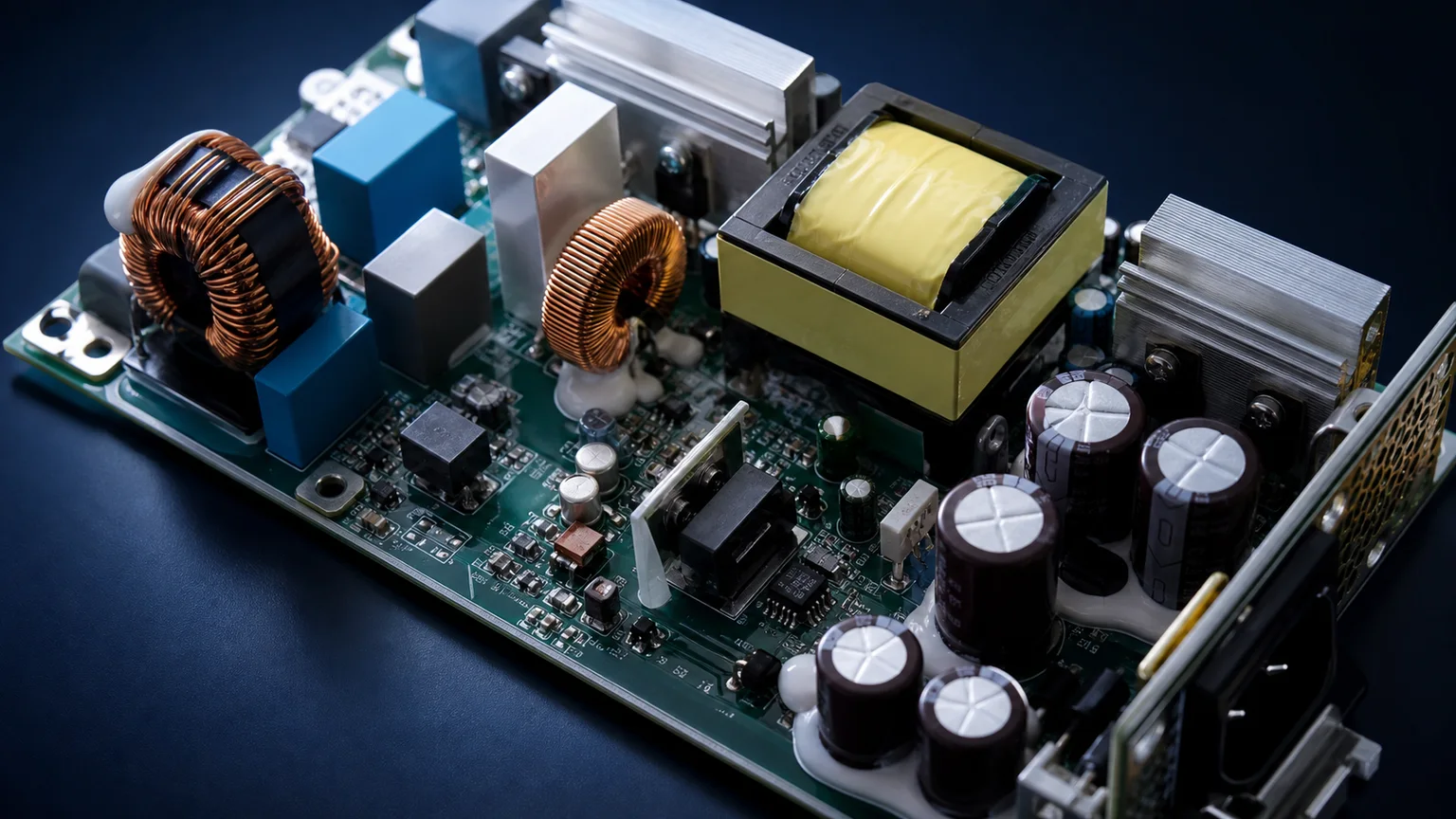

A buyer at a Middle-Eastern infrastructure integrator approves a "500W" industrial DC supply for a roadside surveillance cabinet. Six months later, the cabinet shuts down every afternoon. After two engineers fly out, the answer is embarrassingly basic: the cabinet sits at 50°C internal ambient under summer sun, the PSU is rated 500W only at 25°C, and at 50°C the same supply is allowed to deliver around 350W. The unit is not faulty. It was simply never a 500W supply in the conditions it was deployed.
This is the most common — and most expensive — sizing mistake in industrial power procurement. The fix is not better hardware. It is reading the derating curve that every reputable manufacturer publishes and most buyers ignore.
Why "Rated Power" on the Datasheet Is Almost Always a Lie
The number printed in 24-point bold on the front of a datasheet — "500W", "240W", "120W" — is the maximum continuous output under reference conditions: typically 25°C ambient, sea level, free convection, nominal input voltage, and a clean resistive load. Almost no real industrial deployment matches all five.
Move the same supply into a sealed 55°C cabinet at 3000m altitude with a pulsing motor load on a brownout-prone grid, and the maximum continuous output it can sustain drops dramatically. Push past that limit and one of three things happens: over-temperature protection trips and the load drops out, electrolytic capacitor life collapses (every 10°C above their rated temperature roughly halves life), or the supply ages into instability and starts producing intermittent faults that look like load problems.
Datasheet "rated power" is not a lie — manufacturers test and verify it under stated conditions. But for any buyer specifying for hot enclosures, high altitude, or natural-convection cabinets, the printed number is the starting point of a calculation, not the answer.
What Is a Power Supply Derating Curve?
A derating curve is a graph the manufacturer publishes alongside the headline rating, showing how the maximum allowed continuous output changes with environmental conditions. The two universal axes are ambient temperature and altitude. Better datasheets also publish derating for input voltage (low-line operation forces higher input current and more heat) and mounting orientation (a vertical mount cools differently than a flat one).
The Anatomy of a Typical Derating Chart
The classic temperature derating curve is L-shaped. From the lower temperature limit (often −20°C or −40°C for industrial parts) up to a knee point — typically 40°C, 50°C, or 55°C depending on the design — the supply can deliver 100% of its rated output. Above the knee, output capability drops linearly to zero at the upper temperature limit (often 70°C or 80°C). The slope of that line is what determines whether your PSU is over-spec'd or just barely surviving in your cabinet.
A typical industrial switching supply rated at 50°C might allow 100% output up to 50°C, then derate by 2.5% per °C above the knee, reaching 50% output at 70°C. A premium industrial supply with a higher knee (60°C or 65°C) and a shallower slope is what real harsh-environment deployments want — but they cost more, and they are exactly the supplies where the derating curve is most worth reading carefully.
Why Manufacturers Publish It (and Why Most Buyers Ignore It)
Reputable safety standards — IEC 62368-1, UL 60950-1, EN 50155 for railway, IEC 61204 for low-voltage DC — all expect manufacturers to specify a useful operating envelope, not just a peak number. The derating curve is how that envelope is communicated.
Buyers ignore it because RFQ spreadsheets only have a column for "Power (W)". An overspec'd-at-25°C supply and a properly-rated-at-55°C supply look identical in column B even though the second one is built better and costs more. The buyer who reads only the headline number rewards the worse design. The buyer who reads the derating curve discovers the cheaper supply, derated to deployment conditions, is no longer cheaper per real watt delivered.
Temperature Derating — The Most Common Pitfall
Of every derating axis, ambient temperature bites first and bites hardest. Internal cabinets in solar farms, roadside telecom shelters, factory mezzanines, signage cavities, and EV charging pillars routinely sit 15–25°C above outdoor ambient because of solar gain and load self-heating. A "30°C summer day" outside often means a 55°C interior at 3pm.
The "Knee Point" Explained
The knee point is the highest ambient temperature at which a supply still delivers 100% rated output. It is determined by the thermal design: heatsink area, internal airflow, capacitor ratings, transformer insulation class. A knee at 40°C says the engineering team budgeted for office environments. A knee at 55°C or 60°C says they budgeted for industrial cabinets. A knee at 70°C is rare and almost always implies forced-air cooling and high-grade components.
The right question at procurement is not "what's the rated power?" but "what's the rated power at my worst-case ambient?". A pragmatic rule of thumb: pick a supply whose derated output at your worst-case ambient is at least 1.3× your peak load. That margin absorbs grid sag, capacitor aging, and load creep over the service life.
Convection vs Forced-Air Cooling
Two supplies with identical labels can have radically different derating curves depending on whether they rely on natural convection (no fan) or forced-air cooling (internal fan, or external airflow over a fanless heatsink). A fanless supply cools by gravity-driven hot-air rise; cram it into a sealed cabinet with no breathing holes and the knee point effectively collapses by 10–15°C from the datasheet figure. A fan-cooled supply maintains its rated curve only as long as the fan works and the intake stays unblocked — which means dust filters, fan-failure detection, and predictable replacement schedules become part of the real cost of ownership. Picking between fanless and forced-air is a thermal-design decision dressed up as a procurement choice. Read the cabinet first, then read the curve.
For deployments that depend on long fanless service life in moderate ambient temperatures, browse our enclosed industrial switching power supply line, which is designed around natural convection and metal housings sized for the specified knee temperature.
Altitude Derating — The One Buyers Forget Until Field Failure
Altitude derating does not show up on most procurement checklists because most buyers in coastal cities never encounter it. But Tibetan Plateau telecom, Andean mining, Bolivian highway tolling, Ethiopian cell sites, and even some Rocky Mountain ski-resort installations sit above 3000m. Send a sea-level-rated supply to those sites and it will fail in two specific, related ways.
Why Air Density Matters
Higher altitude means lower air density. Lower density means less mass of air carrying heat away from internal heatsinks per cubic meter, so the same fan speed cools less effectively. Lower density also means lower dielectric strength of internal air gaps — a clearance that comfortably withstands 1500 V at sea level may flash over at the same voltage at 5000m.
So a high-altitude PSU has to derate thermally (cooling is less effective) and electrically (high-voltage isolation margin is reduced). Some vendors publish only the thermal half; the most honest publish both, plus a maximum-altitude limit beyond which the supply is not certified to operate at all.
Typical Derating Above 2000m / 3000m / 5000m
Industry rules of thumb for general-purpose industrial supplies (always confirm against your specific datasheet):
- Below 2000m: typically no derating; rated output applies as-is.
- 2000–3000m: derate output power by ~5–10%, and reduce the rated maximum operating temperature by ~5°C.
- 3000–4000m: derate output by ~15–20%, derate temperature by another ~5–10°C.
- 4000–5000m: derate output by 25–30% or more; many supplies are simply not rated above 5000m.
- Above 5000m: requires a high-altitude purpose-built supply; standard industrial supplies should not be specified.
These are typical industry numbers for general switching supplies — the actual derating for any specific model must come from that vendor's published curve. For the >300W cabinet-mount range that gets deployed into hot, high-altitude infrastructure cabinets, our industrial cabinet-mount 240W–480W switching supplies ship with the published derating, ventilation, and certifications appropriate for that envelope.
Real-World Sizing Example: 500W Application at 55°C, 3000m
Suppose you have a real continuous load of 380W and a sealed cabinet at 3000m altitude in a desert region where worst-case internal ambient hits 55°C in summer afternoon sun. A naïve buyer picks a 500W supply because 500W > 380W. Run the actual numbers.
Take a typical industrial 500W supply with a 50°C knee and a 2.5% / °C slope. At 55°C ambient, temperature derating allows 87.5% × 500W ≈ 438W. Apply altitude derating of ~10% at 3000m and you reach ~394W. That is 14W of margin against a 380W load — under 4%. Any grid sag, capacitor aging, or load creep, and the supply spends hot afternoons clipping on overload protection or thermally shutting down.
The correct spec is a 750W supply with a 60°C knee, or a 500W supply with a 65°C knee, or two 500W supplies in parallel redundancy. The point is not the specific answer — it is that the answer is invisible if you stop reading at "500W".
How to Cross-Check a Vendor's Derating Claims
A few practical sanity checks separate honest derating curves from marketing decoration:
- Look for a published knee temperature, not just a rated range. "Operating temperature −10°C to +60°C" without a derating curve usually means full output only at the low end of that range.
- Check that altitude is mentioned at all. Datasheets that don't reference altitude beyond "0–2000m" implicitly disclaim everything above 2000m.
- Cross-reference with certification marks. Many safety certifications fix the test ambient at 40°C; a supply marketed as "60°C rated" but only certified at 40°C is making a marketing claim, not a test claim.
- Check the capacitor temperature rating. A supply rated for 60°C ambient that uses 85°C-rated electrolytics has a hidden short lifetime ceiling no derating curve will reveal directly.
Procurement Checklist: 6 Questions Before You Approve a PSU Spec
Before signing off on any industrial power supply for a real deployment, walk through these six questions:
- What is the worst-case ambient temperature inside my enclosure (not outside the building) at the hottest hour of the hottest day, including solar gain and load self-heating?
- What is the deployment altitude, and does the chosen PSU have a published derating curve covering that altitude?
- At my worst-case ambient and altitude combined, what is the actual continuous output the datasheet allows me to draw?
- Is that derated number at least 1.3× my peak continuous load, with additional margin for grid sag and aging?
- Is the cooling assumption in the curve (free convection vs forced-air, vertical vs horizontal mount) the same as my actual installation?
- What is the lifetime expectation (MTBF, capacitor hours) at the temperature I am actually running, not at 25°C?
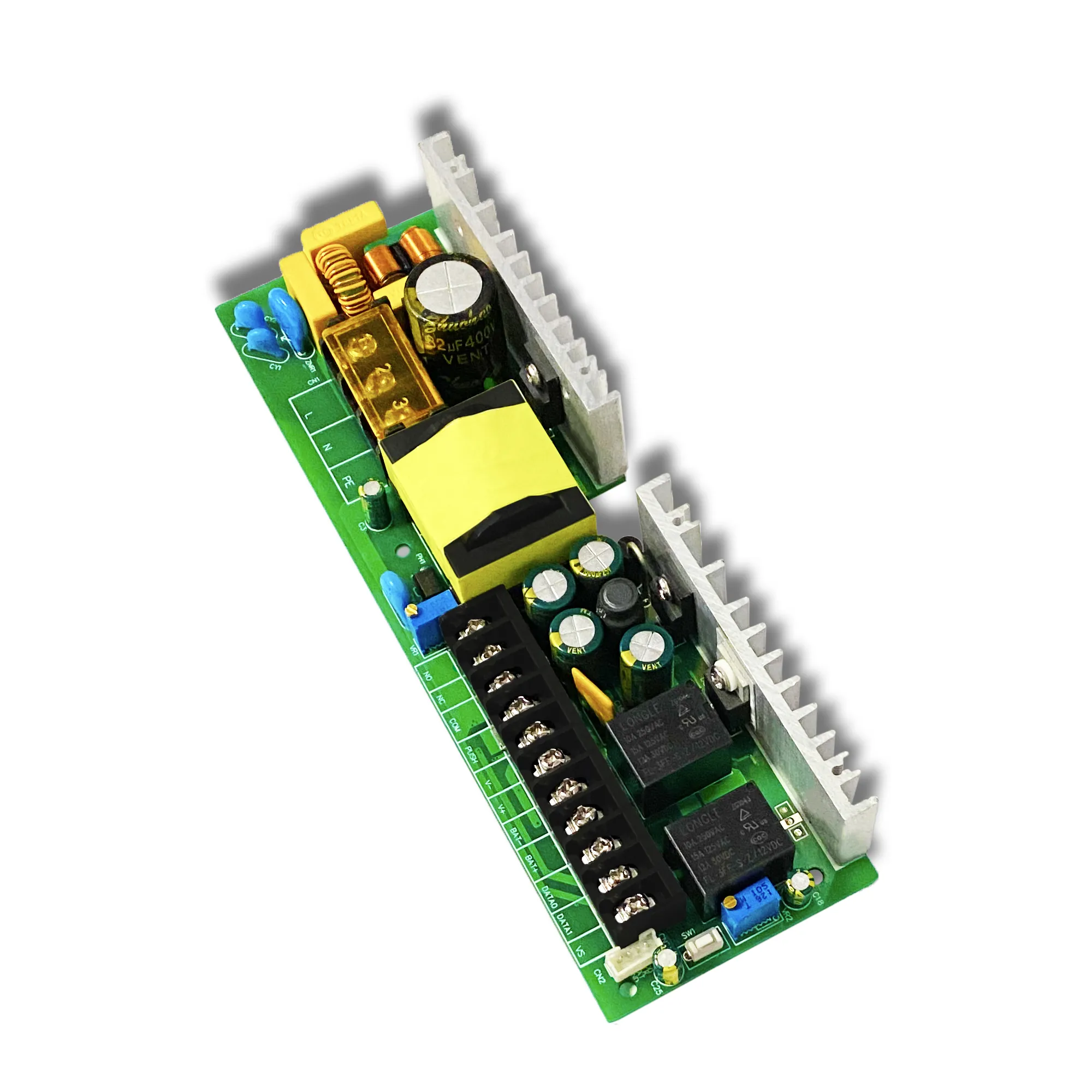
If you cannot get a clean answer to any of these from the datasheet alone, push back to the vendor before procurement closes. Open-frame and embedded-board supplies — like our compact open-frame board-mount line — also have derating curves; the questions don't change just because the form factor does.
For project-specific derating analysis, custom derating curves on tailored designs, or sourcing options for high-altitude and high-temperature deployments, contact the Sanyi engineering team and share your enclosure profile, altitude, and continuous load — we'll work the calculation with you before you place the PO.
FAQ
Q1: If a PSU is rated 500W, why can't I just use it at 500W?
You can — at 25°C, sea level, with proper airflow, on a clean resistive load. The rated power is the test-condition maximum. Any deviation reduces the output you can safely draw without overheating internals, accelerating capacitor aging, or tripping protection. The derating curve quantifies how much you lose for each environmental factor.
Q2: Does forced-air cooling eliminate temperature derating entirely?
No. Forced-air raises the knee point and shallows the slope, but every supply still has a temperature beyond which output must be reduced. Forced-air also introduces a single point of failure: a fan-cooled supply running with a clogged filter or stalled fan derates to its convection-only curve, which is usually steeper and lower than buyers expect.
Q3: How much output do I lose at 4000m altitude on a typical industrial PSU?
Typically 15–25% of rated output, plus a 5–15°C reduction in maximum operating temperature, depending on design. Always verify against the vendor's published altitude curve. Many supplies are not rated above 5000m at all — operating outside the stated altitude range voids both the warranty and the safety certification.
Q4: Can I run two derated PSUs in parallel to recover lost capacity?
Yes, with caveats. Parallel redundancy with active current sharing is a standard technique for high-availability industrial systems. Two supplies derated to 70% each deliver 140% of single-unit derated output, usually enough to cover the load with redundancy margin. But parallelism only works with supplies designed for it — verify the datasheet supports current sharing, and remember each unit still ages independently against its own curve.
.webp)