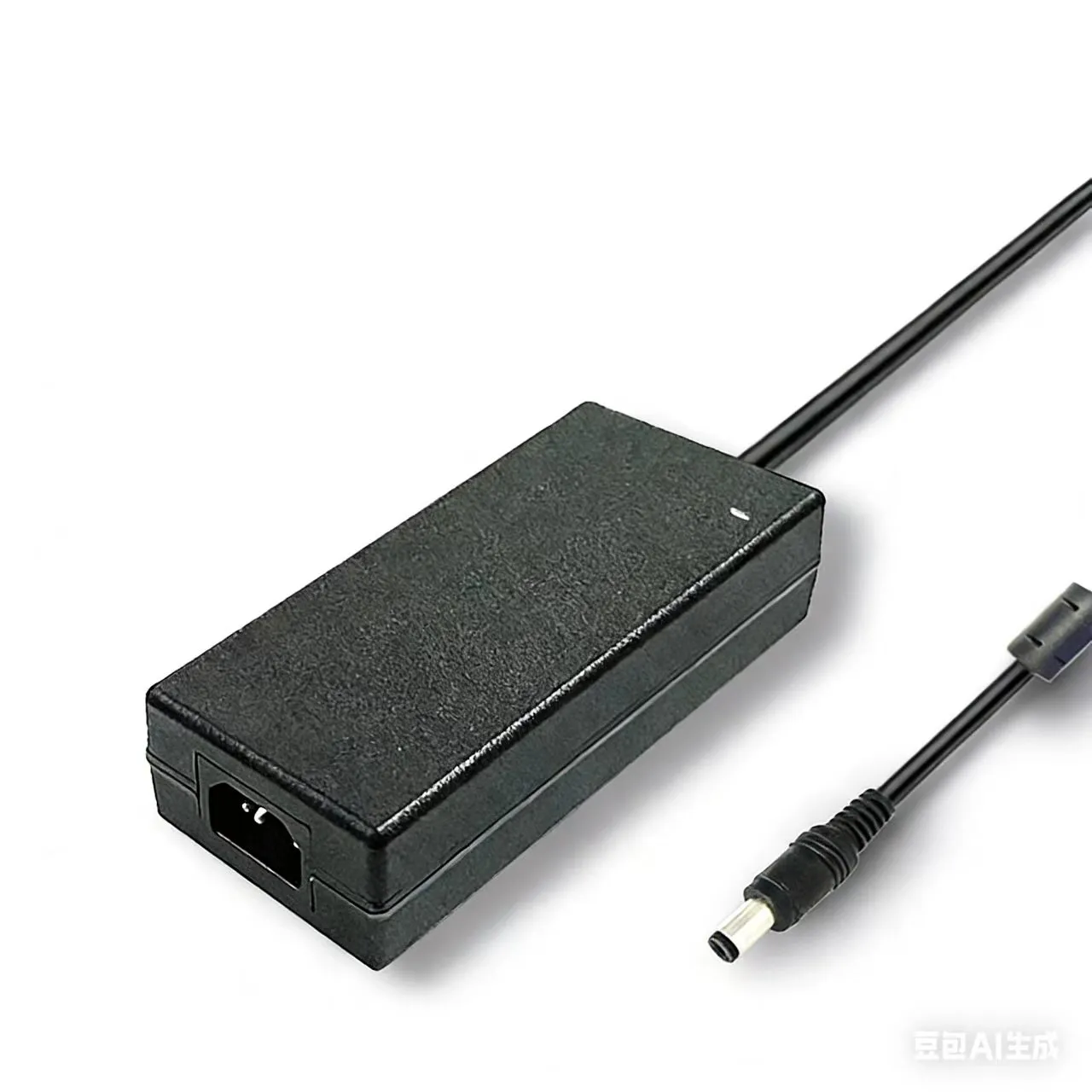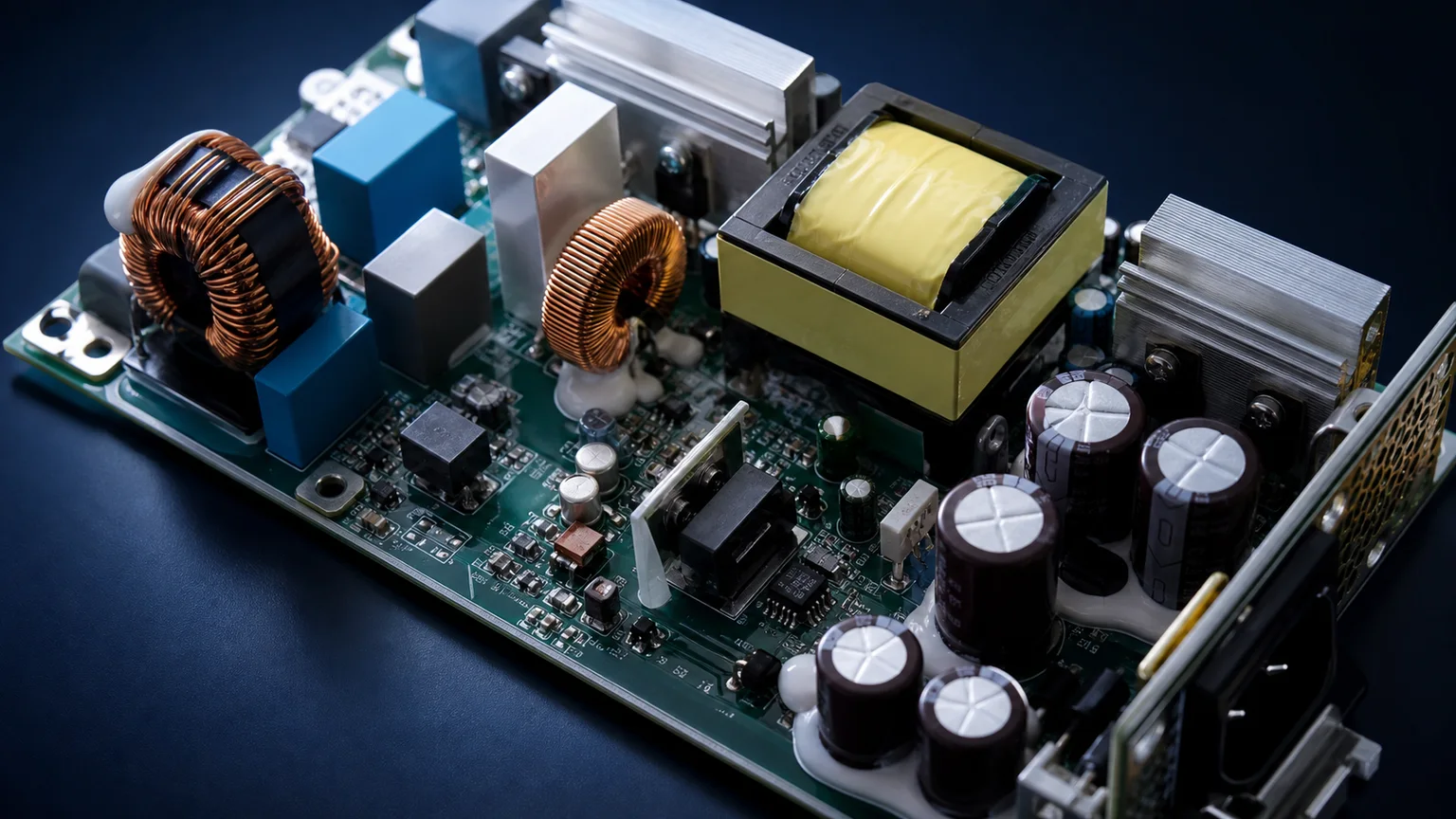

Two power supplies can hit the same 500W output, pass the same load test, and carry the same enclosure — yet one runs at 90% efficiency and the other at 96%, with half the EMI and a third less filtering. The difference usually isn't the semiconductor or the PFC stage. It's the DC-DC topology: whether the supply uses a classic hard-switched converter (flyback, forward, half-bridge, phase-shift full-bridge) or a LLC resonant half-bridge that switches softly.
This is the third layer of the switch-mode stack. The device level decides the raw switch (we cover that in our GaN vs silicon power adapter selection guide); the PFC stage decides how the supply behaves on the mains (see our active PFC vs passive PFC 80 PLUS guide); and the DC-DC topology decides how efficiently that bus voltage becomes a regulated output. This guide covers LLC resonant vs hard switching power supply topology selection — the engine room of every 80 PLUS Titanium PSU and every high-density adapter.
What Is Hard Switching — Traditional PWM Power Supply Topologies
In a hard-switched converter, the MOSFET turns on and off while it is simultaneously carrying current and blocking voltage. During each transition the voltage across the device and the current through it overlap for a few tens of nanoseconds, and the product of the two is instantaneous power dissipated as heat. This switching loss happens on every cycle, twice per switch, and it scales directly with frequency — which is exactly why hard-switched designs hesitate to push their switching frequency very high.
Hard switching is controlled by pulse-width modulation (PWM): a fixed-frequency clock with a duty cycle that widens or narrows to regulate the output. The approach is mature, cheap, and robust — the classic PWM controller architectures of the 1980s and 90s still ship by the billion. Its weaknesses are equally well known: those abrupt voltage and current edges (high dv/dt and di/dt) radiate strong EMI, and the per-cycle switching loss caps practical efficiency at roughly 88–92%.
Flyback, Forward, Half-Bridge, Phase-Shift Full-Bridge — Hard-Switched Topology Tour
The hard-switched family spans the whole power range, each member suited to a band:
- Flyback (< 75W) — The workhorse of small adapters and standby supplies. A single switch and a coupled inductor (acting as transformer plus energy store). Minimal parts, lowest cost, isolated — but ripple and EMI rise quickly with power, so it fades out above ~75W.
- Forward (75–200W) — Adds a true transformer and an output choke for cleaner energy transfer. Good for mid-power industrial rails.
- Push-pull (100–500W) — Two switches drive the transformer alternately, using the core more fully. Higher power density than forward, but sensitive to flux imbalance.
- Half-bridge (200–1000W) — Two switches across the bus halve the voltage stress on each device; a staple of mid-to-high-power supplies.
- Phase-shift full-bridge (1–5kW) — Four switches with phase-shift control achieve partial soft switching and handle kilowatt-class power. It's the high-power hard-switched ceiling, and the natural rival to LLC at the top end.
All of these are reliable and well-understood, and all of them pay the hard-switching tax: switching loss that limits efficiency and sharp edges that demand heavy input/output filtering.
What Is LLC Resonant Topology — ZVS, ZCS, and the Resonant Tank
The LLC resonant half-bridge attacks the problem at its root. Instead of forcing the switch to commutate under load, it inserts a resonant tank — a resonant inductor (Lr), a resonant capacitor (Cr), and the transformer's magnetizing inductance (Lm) — between the half-bridge and the transformer. The tank shapes the current into a near-sinusoidal waveform and, crucially, arranges the timing so that:
- the primary MOSFETs turn on at zero voltage (ZVS — zero-voltage switching), because the tank current has already driven the switch node to the opposite rail before the gate fires, and
- the secondary rectifiers turn off at zero current (ZCS — zero-current switching), eliminating reverse-recovery losses.
With voltage and current no longer overlapping during transitions, the dominant switching loss simply disappears. The LLC achieves this across the full load range, not just at one operating point. The output is regulated not by duty cycle but by frequency modulation — sliding the switching frequency along the tank's gain curve to set the output voltage.
Why LLC Achieves 94–97% Efficiency Across the Load Range
Removing switching loss is worth several efficiency points outright: where good hard-switched designs top out around 88–92%, a well-designed LLC reaches 94–97%. The gap is widest exactly where it matters most for certification — at light load. The 80 PLUS Titanium tier demands ≥90% efficiency at just 10% load, a target almost impossible to hit while paying per-cycle hard-switching losses, but natural for an LLC whose losses scale with the (now soft) transitions. That single fact is why nearly every Titanium-class server PSU runs an LLC back end.
EMI Comparison — Hard-Switched Edges vs LLC Quasi-Sinusoidal Waveforms
EMI is born of fast edges. A hard-switched converter slams its switch node between rails in nanoseconds, and the resulting steep dv/dt and di/dt broadcast broadband noise that must be tamed with bulky common-mode chokes, X/Y capacitors and shielding. The LLC's resonant tank, by contrast, produces quasi-sinusoidal current waveforms with gentle transitions and inherently lower harmonic content. The practical payoff is a 30–50% lighter EMI filter for the same compliance margin — less copper, fewer capacitors, smaller enclosure.
Power Density Gains — LLC + GaN/SiC + High Frequency
Because the LLC switches softly, it can run at high frequency (200–500 kHz) without the switching loss exploding the way a hard-switched design would. Higher frequency shrinks the transformer and the resonant magnetics, lifting power density. Pair that with wide-bandgap devices — GaN and SiC, which switch faster and cleaner than silicon — and the compounding effect delivers a 30–50% power-density improvement. This is why the densest modern adapters and server PSUs almost always combine an LLC back end with GaN or SiC switches; the device choice and the topology choice reinforce each other.
Control Complexity — PWM vs Frequency Modulation, Startup, Short-Circuit Behavior
The LLC's efficiency comes at a cost: control is genuinely harder. Hard-switched PWM is conceptually simple — fixed frequency, variable duty, a well-trodden compensation problem. The LLC instead regulates by frequency modulation along a non-linear gain curve, which complicates the loop design. It also behaves awkwardly at the edges: startup must charge the tank without over-stressing the switches, and short-circuit / overload protection is tricky because the resonant tank's behavior changes dramatically away from its design operating point. These cases need a dedicated resonant controller and careful protection design — the reason LLC stays out of the cheapest, simplest products.
Power Supply Application Selection — Server PSU, Telecom, LED Driver, Laptop Adapter, EV Charger, Industrial, Medical
- Server / data-center PSU — Any unit chasing 80 PLUS Platinum or Titanium runs an LLC back end; it's effectively mandatory at those tiers.
- Telecom rectifiers — High-efficiency, high-density requirements push these firmly into LLC territory.
- High-power LED drivers — Constant-current LLC variants deliver efficient, low-EMI drive for large luminaires.
- Laptop / desktop adapters — Above ~65W, the compact GaN era favors LLC. Sanyi's HP-series high-power desktop adapters (120W–480W) target exactly this high-power desktop band, and the mid-power APN-series desktop adapters (48W–144W) cover the fast-charge tier where the topology choice starts to matter.
- EV / DC fast charging — Kilowatt-class chargers lean on LLC and phase-shift full-bridge for efficiency at scale.
- High-density industrial supplies — Where size and heat budgets are tight, LLC earns its complexity.
- Medical PSU — High efficiency plus low leakage and EMI make LLC a frequent choice for IEC 60601 designs.
For engineers and field teams juggling several devices, multi-output chargers such as the SY-C260W smart charger and the higher-power SY-C500W charger pair an efficient resonant or GaN back end with practical multi-port output.
When Hard Switching Still Wins — Sub-65W Adapters, Wide-Input Designs, Cost-Sensitive Bulk
Hard switching is far from obsolete:
- Sub-65W adapters — Flyback's part count and cost are unbeatable here; an LLC's extra components and controller can't be justified.
- Low-cost LED drivers — Where the efficiency premium doesn't pay back, simple hard-switched stages dominate.
- Wide-input designs (90–264 VAC universal) — A wide input forces the LLC across a broad frequency range, dragging it off its efficient resonant point; hard-switched topologies handle universal input more gracefully.
- Tight dynamic-response requirements — PWM's direct duty-cycle control reacts faster to load steps than frequency modulation along a gain curve.
80 PLUS Efficiency Tiers and Topology Mapping
The efficiency tiers map cleanly onto topology choices:
- 80 PLUS Bronze / Silver — Achievable with good hard-switched designs (forward, half-bridge).
- 80 PLUS Gold — The crossover band; high-end hard-switched or entry LLC.
- 80 PLUS Platinum / Titanium — Practically LLC-only, especially Titanium's brutal 10%-load efficiency target. If a spec sheet promises Titanium, there's an LLC resonant tank inside.
Common Selection Pitfalls
- "LLC is always better." Below 65W, flyback's cost and ruggedness advantage overwhelms the LLC's efficiency edge — the resonant tank simply doesn't pay back.
- "LLC guarantees high efficiency." Only near its design resonant point. Operate it off-resonance — as a wide-input range forces — and efficiency can actually fall below a well-tuned hard-switched design.
- "LLC costs far more than hard switching." At server-PSU volumes, LLC is fully industrialized; the BOM delta is modest once scaled. The premium is real mainly at low volume.
- "LLC suits any input voltage." A wide-input LLC needs a complex frequency range and gain-curve design; it's happiest with a tightly regulated bus (which is exactly why a PFC pre-regulator usually feeds it).
- "Hard switching is outdated." In adapters and low-power supplies, flyback still holds the overwhelming majority of the market — and will for the foreseeable future.
Sanyi Power Supply Ecosystem for LLC and Hard-Switched Designs
Sanyi builds across both worlds, so you can match the topology to the application rather than the other way around:
- HP-series high-power desktop adapters (120W–480W) — high-power desktop and workstation supplies for the efficiency-critical band where resonant back ends earn their keep.
- APN-series desktop adapters (48W–144W) — mid-power desktop reference covering the fast-charge tier.
- SY-C260W smart charger — multi-device charging for engineers and travelers, pairing an efficient back end with GaN-class output.
- SY-C500W charger — high-power charging for multi-screen workstations and field use.
Every unit ships with CE / UL / FCC compliance as applicable, plus over-voltage, over-current, short-circuit and over-temperature protection. Contact Sanyi for topology and efficiency-tier recommendations and OEM/ODM options across adapter, industrial and server-class lineups. For the full switch-mode picture, read our companion guides on active vs passive PFC and GaN vs silicon devices.
FAQ
Is LLC always more efficient than a hard-switched supply? Across most of the load range, yes — an LLC typically runs 94–97% versus 88–92% for hard switching, and the gap is biggest at light load. But the advantage assumes the LLC operates near its resonant design point. Push it across a wide input range, or run it well off-resonance, and a well-tuned hard-switched design can match or beat it. For sub-65W adapters, flyback usually wins outright on cost.
Why do all 80 PLUS Titanium server PSUs use LLC? Titanium requires ≥90% efficiency at just 10% load. A hard-switched converter pays per-cycle switching losses that dominate at light load, making that target nearly impossible. The LLC's ZVS/ZCS soft switching keeps losses low even at light load, so it's effectively the only topology that clears Titanium. A PFC front end plus an LLC back end is the standard Titanium recipe.
Do I need LLC for a 65W laptop adapter? Not necessarily. Around 65W is the crossover: a hard-switched flyback can be perfectly adequate and cheaper, while a GaN-based LLC delivers smaller size and higher efficiency. The decision turns on how much you value compactness and efficiency versus cost. Above ~100W, the balance tilts firmly toward resonant/GaN designs; well below 65W, flyback dominates.
.webp)