
What is the most common cause of rework in lighting projects? It's not poor strip quality or bad installation — it's choosing the wrong power supply.
Typical failures caused by wrong power supply selection
- Strip visibly dimmer at the far end while the end near the power supply looks fine — voltage drop
- RGB strip shows color shift at the tail, set to white but appears yellowish — voltage drop + insufficient power
- Power supply runs hot after 30 minutes, burning smell — no wattage headroom, chronic full-load overheating
- Outdoor strip dies after six months, open the PSU and it's full of water — IP rating too low
- Strip flickers when used with a dimmer — power supply incompatible with PWM dimming
All of these problems trace back to one thing: no power supply sizing calculation was done before installation. This guide walks you through a 3-step calculation method — from LED chip wattage and voltage system selection to IP protection ratings — everything in one place.
How Much Power Do Different LED Strips Actually Consume?
The first step in choosing a power supply is knowing your strip's power consumption. LED strip wattage is determined by three factors: chip model, LED density per meter, and whether it's single-color or RGB.
Here are the measured power consumption figures for mainstream chips at standard density (60 LEDs/m) and high density (120 LEDs/m):
| Chip Model | Per-LED Wattage | 60 LEDs/m | 120 LEDs/m | Primary Use |
|---|---|---|---|---|
| SMD 3528 | 0.06W | 4.8 W/m | 9.6 W/m | Ambient lighting, contour accents |
| SMD 2835 | 0.1–0.2W | 12 W/m | 24 W/m | General illumination, light boxes, commercial spaces |
| SMD 5050 | 0.2–0.3W | 14.4 W/m | 28.8 W/m | RGB color-changing strips |
| SMD 5630 | 0.5–1.0W | 30 W/m | 60 W/m | High-brightness commercial lighting |
| COB | — | 10–15 W/m | 15–20 W/m | Dot-free uniform illumination |
Sources: AD LED Lights, 2024; InStyle LED, 2024; ZBL Lighting, 2024
RGB / RGBW Strips: Higher Power Than You Might Think
Single-color strips have a fixed power draw, but RGB and RGBW strip consumption depends on the color currently being displayed:
| Strip Type | Single-Color Mode | Full-Channel Max Power | Notes |
|---|---|---|---|
| RGB 5050 (60/m) | ~5 W/m | 14.4 W/m | White = R+G+B all on, maximum power draw |
| RGBW 5050 (60/m) | ~5 W/m | 15–18 W/m | All 4 channels on, ~20% higher than RGB |
Sources: HitLights, 2024; Hi-Line Lighting, 2024
The #1 RGB Sizing Mistake
Many people size the power supply based on "I usually only use warm white," so they spec the PSU for just 8W/m. The problem: the moment the user switches to white, all 3 channels turn on and power consumption instantly spikes to 14.4W/m. The power supply trips on overload protection and every light goes out. RGB/RGBW power supplies must be sized for full-channel maximum power consumption.
12V, 24V, or 48V? How to Choose the Right Voltage
LED strips come in three mainstream voltage systems. Choosing the wrong voltage won't burn the strip, but it will cause the far end to go dim — because of voltage drop.
What Is Voltage Drop?
An LED strip is essentially a thin copper-foil conductor with inherent resistance. As current flows through, voltage drops across the copper trace — the farther from the power supply, the lower the voltage and the dimmer the LEDs. When voltage drop exceeds 5%, the brightness difference becomes visible to the naked eye; beyond 10%, the dimming is obvious, and RGB strips will also exhibit color shift at the tail (Waveform Lighting, 2024).
| Voltage | 5m Drop | 10m Drop | Recommended Max Single-Feed Length | Typical Application |
|---|---|---|---|---|
| 12V | ~15% | >30% | 5m | Display cases, short residential runs |
| 24V | ~5% | ~10% | 10m | Commercial lighting, industry standard |
| 48V | ~2.7% | ~5% | 15–20m | Large commercial, building facades |
Sources: MyLEDy, 2024; SignliteLED, 2025; Flexfire LEDs, 2024
Selection Guidelines:
- Under 5 meters: Either 12V or 24V works; 12V strips offer more variety and lower cost
- 5–10 meters for commercial projects: 24V is preferred — the current industry standard
- Over 10 meters for large installations: Go with 48V, or use 24V with multi-point parallel power injection
3 Ways to Mitigate Voltage Drop: (1) Feed power from both ends of the strip (dual-end injection); (2) Run independent power feeds every 5m; (3) Use strips with thicker copper foil (2oz copper or greater). Regardless of the method, the power supply voltage must exactly match the strip voltage.
3-Step LED Strip Power Supply Calculation
The method is even simpler than PoE switch sizing — just 3 steps.
Step 1: Calculate Total Strip Power Consumption
Total Power = Per-Meter Wattage (W/m) x Total Strip Length (m)
Look up the per-meter wattage from the strip's datasheet, or reference the chip power table above. For RGB/RGBW strips, always use the full-channel maximum power consumption.
Step 2: Multiply by 1.25 (The 80% Headroom Rule)
Required PSU Wattage = Total Power x 1.25
Why should you never run a power supply at full load?
- Thermal management — A fully loaded PSU generates significant heat; for every 10°C rise in ambient temperature, PSU lifespan is cut in half (aspectLED, 2024)
- Inrush current — LED strips draw higher current at power-on than in steady state
- Expansion headroom — Adding more strip later won't require a PSU swap
- High-temperature derating — Summer temperatures inside mounting channels can exceed 50°C, reducing actual PSU output capacity
Step 3: Match the Voltage and IP Rating
The voltage must match the strip (12V strip requires 12V PSU, 24V requires 24V) — never mix them. Choose the IP rating based on the installation environment (see below).
Worked Example: 10m COB Strip + 5m RGB Strip
A commercial showroom lighting project requires two sets of strips:
| Zone | Strip Type | Length | Per-Meter Wattage | Subtotal |
|---|---|---|---|---|
| Display lighting | 24V COB strip | 10m | 14 W/m | 140W |
| Ambient lighting | 24V RGBW 5050 (60/m) | 5m | 18 W/m (full channel) | 90W |
| Total | 230W |
Calculation:
- Step 1: Total power = 140 + 90 = 230W
- Step 2: 230 x 1.25 = 287.5W
- Step 3: Need a 24V output, 288W+ rated, indoor IP20 power supply
In this case, a 200W power supply would not even cover the strip load alone (230W already exceeds it) — guaranteed failure. Choosing an SL-300W ultra-slim PSU puts utilization at 76.7%, leaving ample headroom — even adding 3–4 more meters of strip later is no problem.
Alternatively, you can run the COB and RGBW on separate power supplies: COB on an SL-180W (78% utilization), RGBW on an SK-120W (75% utilization). The advantage of independent power feeds is that a failure in one group doesn't affect the other.
How to Choose the Right IP Protection Rating
A power supply's IP rating determines the environments where it can safely operate. Go too low and water ingress will destroy it; go too high and you're overpaying.
| IP Rating | Protection Level | Suitable Environments | Sanyi Product Line |
|---|---|---|---|
| IP20 | Protected against finger contact, not waterproof | Dry indoor: bedrooms, living rooms, offices, showrooms | SL Ultra-Slim Series, SK Ultra-Slim Series, SC Compact Series |
| IP44 | Splash-proof | Semi-outdoor with cover: balconies, covered patios, kitchens | — |
| IP65 | Jet-proof | Sheltered outdoor: porches, covered walkways, building facades | SNT Rainproof Series |
| IP67 | Temporary submersion | Exposed outdoor: landscape lighting, courtyards, parking lots, signage | SYG Waterproof Series, 1703 Aluminum Waterproof |
| IP68 | Continuous submersion | Underwater: swimming pools, fountains, water features | Contact us for custom solutions |
The Most Common Outdoor Installation Mistake
Outdoor projects often use an IP20 power supply placed inside a "waterproof junction box," assuming the box provides sufficient protection. In reality, junction box seals degrade over time and water ingress through cable entries is inevitable. Outdoor installations require the power supply itself to be rated IP65 or higher — you cannot rely on an external enclosure as a substitute. Regions with heavy rainfall and high humidity demand even stricter protection.
The 5 Most Common Mistakes Beginners Make
Mistake 1: Sizing an RGB PSU Based on Single-Color Power Draw
An RGB strip running only red may draw just 5W/m, but the moment the user switches to white (R+G+B all on), consumption instantly jumps to 14.4W/m. The power supply must be sized for full-channel maximum power — otherwise it trips on overload protection the moment someone selects white.
Mistake 2: Installing the PSU in an Enclosed Channel Without Ventilation
Squeezing a slim PSU into a 5cm-tall mounting channel and sealing it shut creates a miniature oven. For every 10°C rise in ambient temperature, PSU lifespan is cut in half (aspectLED, 2024). Solution: leave ventilation openings, or mount the PSU outside the channel and run extension cables.
Mistake 3: Correct Total Wattage But Dim Far Ends on Long Runs
The total wattage may be sufficient, but a 10m strip fed from one end will have more than 10% voltage drop at the far end. The correct approach: run independent return lines every 5 meters, or feed the strip from both ends in parallel.
Mistake 4: Mixing Up 12V and 24V Power Supplies
Connecting a 12V strip to a 24V PSU = instant LED burnout. Connecting a 24V strip to a 12V PSU = won't light up or extremely dim. The PSU voltage must exactly match the strip's rated voltage. It seems like a basic mistake, but on large job sites with multiple crews, miswiring genuinely happens more often than you'd think.
Mistake 5: Looking Only at Total Wattage, Ignoring PSU Quality
Two power supplies both rated at 200W can be vastly different — a cheap no-name unit may only sustain 150W continuous output, with high ripple, low efficiency, and excessive temperature rise. When selecting a power supply, look for:
- Continuous output power (not peak power)
- Conversion efficiency of 85% or higher (low efficiency means more waste heat)
- Protection features: over-current, over-voltage, and short-circuit protection are all essential
- Certifications: CE and RoHS at minimum; UL and FCC for export projects
Quick Reference: Strip Length → PSU Wattage → Recommended Model
Using the most common 24V strips as the example (1.25x headroom already included):
Indoor Applications (IP20)
| Strip Type | Length | Strip Power | Required PSU Wattage | Recommended Model |
|---|---|---|---|---|
| 2835 (60/m, 12W/m) | 2m | 24W | ≥30W | SR-32W / SYR-36W |
| 2835 (60/m, 12W/m) | 5m | 60W | ≥75W | SP-72W / SK-120W |
| COB (14W/m) | 5m | 70W | ≥88W | SK-120W |
| COB (14W/m) | 10m | 140W | ≥175W | SL-180W / SL-200W |
| RGB 5050 (60/m, 14.4W/m) | 5m | 72W | ≥90W | SK-120W |
| RGBW 5050 (60/m, 18W/m) | 5m | 90W | ≥113W | SL-120W |
| 5630 High-Brightness (60/m, 30W/m) | 5m | 150W | ≥188W | SL-200W |
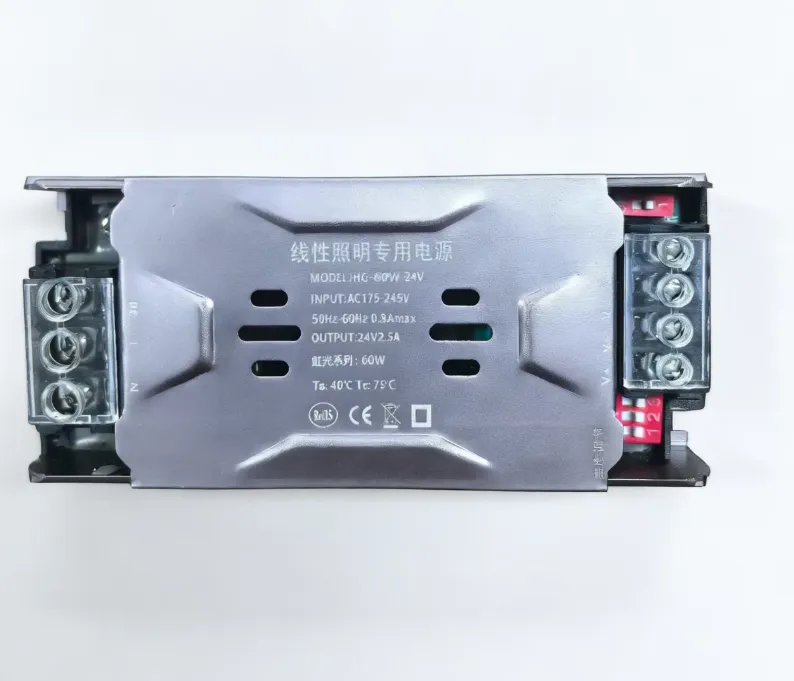
Sanyi's ultra-slim series power supplies are just 30mm thick, purpose-built for mounting channels and slim light boxes. Honeycomb ventilation holes ensure effective thermal management even in tight spaces. Available in both 12V and 24V versions, with over-current, over-voltage, and short-circuit protection standard across the entire lineup.
Outdoor Applications (IP65–IP67)
| Strip Type | Length | Strip Power | Required PSU Wattage | Recommended Model |
|---|---|---|---|---|
| Outdoor 2835 (12W/m) | 3m | 36W | ≥45W | SNT-48W / SYG-48W |
| Outdoor 2835 (12W/m) | 5m | 60W | ≥75W | SNT-96W / SYG-72W |
| Landscape COB (14W/m) | 5m | 70W | ≥88W | SNT-96W |
| Large-Scale Installations | Multiple segments | >100W | Calculate per segment | 1703 Aluminum Waterproof |
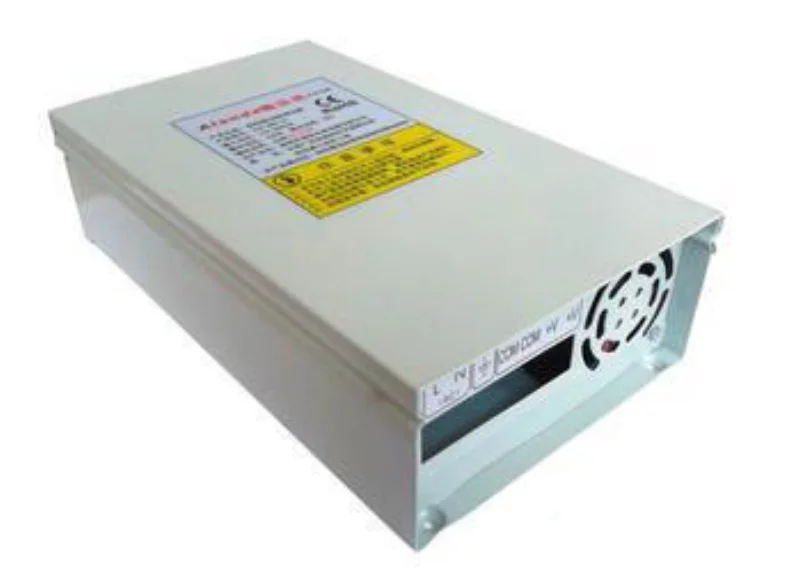
The SNT Rainproof Series is ideal for semi-outdoor covered environments, with an operating temperature range of -30°C to +60°C. The SYG Waterproof Series features IP67 full-seal construction with a corrosion-resistant enclosure, suitable for demanding environments such as fountains and in-ground fixtures. The 1703 Aluminum Waterproof Series delivers the best thermal dissipation performance, making it the top choice for large-scale outdoor lighting projects.
Constant Voltage vs. Constant Current: Two Types of LED Drivers
LED power supplies fall into two categories: Constant Voltage (CV) and Constant Current (CC). Choose the wrong type, and the strip either won't light up or will burn out.
| Constant Voltage (CV) | Constant Current (CC) | |
|---|---|---|
| Output | Fixed voltage (12V/24V/48V), current varies with load | Fixed current (350mA/700mA, etc.), voltage varies with load |
| Used For | LED strips (strips have built-in current-limiting resistors) | LED modules, high-power spotlights, panel lights |
| Which for strips? | Strips require Constant Voltage (CV). Each LED segment on the strip PCB has series current-limiting resistors — it only needs a stable voltage input. |
Simple rule: Strips = Constant Voltage; Modules / Spotlights = Constant Current. All Sanyi ultra-slim and waterproof power supplies are constant-voltage output, purpose-designed for LED strips and light boxes.
Why LED Strip Power Supply Selection Matters More Than Ever
Three industry trends are raising the bar for power supply quality:
- COB strips going mainstream — COB strips eliminate visible LED dots and deliver perfectly uniform light output, rapidly replacing traditional SMD strips. But COB strips consume 10–20W/m — 2 to 4 times the 4.8W/m of SMD 3528 — doubling or quadrupling power supply requirements.
- Commercial lighting upgrades — The global LED strip market reached $9.7 billion in 2025 and is projected to grow to $16.5 billion by 2032 (CAGR 7.8%, Stats Market Research, 2025). Commercial spaces demand far higher lighting quality and reliability than residential installations.
- Smart dimming — Tunable White and Human-Centric Lighting are major trends in 2026 (AD LED Lights, 2025). Smart strips require power supplies compatible with PWM/DALI/0-10V dimming protocols, placing higher demands on ripple performance and protocol compatibility.
For lighting contractors and LED product OEMs, the power supply is no longer a "just make it work" accessory — it's the critical component that determines project quality and warranty callback rates.
Frequently Asked Questions
Q: Can one power supply drive both single-color and RGB strips simultaneously?
Yes, as long as the voltage matches (both 24V) and the total power consumption stays within 80% of the PSU's rated capacity. Simply connect the single-color and RGB strips to separate output runs. That said, separate power supplies are recommended — the RGB dimming signal can feed back through a shared PSU to the single-color strip, causing subtle flickering.
Q: Is there any problem with choosing a power supply that's too large?
No. A power supply only delivers the current the strip demands — it won't force-feed extra power. A 200W strip connected to a 300W PSU will only draw 200W. However, avoid going excessively large (more than 2x), as some dimmable power supplies may flicker at very low loads (aspectLED, 2024). The recommended PSU utilization range is 60%–80%.
Q: I have a 12V power supply — can I use it with 24V strips?
Absolutely not. A 24V strip on a 12V PSU will be extremely dim or won't light at all. A 12V strip on a 24V PSU will burn out instantly. Voltage must match exactly — there is no workaround.
Q: How do I know if my existing power supply can handle the load?
Check the nameplate for "Rated Output Power" (in watts) or "Rated Output Current" (in amps). Divide the total strip power consumption by the voltage to get the current requirement. For example: a 24V, 140W strip load requires 140 / 24 = 5.83A. If the PSU nameplate shows a rated output of 6.25A (150W), that's 93% utilization — too high. Upgrade to a larger unit.
Q: How do I safely wire an outdoor LED strip power supply?
IP67 power supplies come with pre-attached waterproof input and output cables — no need to open the enclosure for wiring. The critical point is that cable connection points must also be waterproofed — use waterproof wire connectors or heat-shrink tubing with waterproof adhesive. Electrical tape alone is not sufficient.
Summary
LED strip power supply selection comes down to three things: calculate the wattage (strip consumption x 1.25), match the voltage (must equal the strip voltage), and choose the protection rating (IP rating based on installation environment). The most common failures aren't due to inability to calculate — they happen because RGB power consumption was underestimated, voltage drop wasn't considered, or the IP rating was downgraded to save money.
Next Steps
- LED Power Supply Product Center — Ultra-slim / Rainproof / Waterproof full range, 12W to 200W
- Contact Us — Need custom wattage, dimensions, or connectors? OEM/ODM solutions available
- Further Reading: PoE Power Budget Calculator & Switch Sizing Guide — Useful for low-voltage network engineers as well
正面.webp)