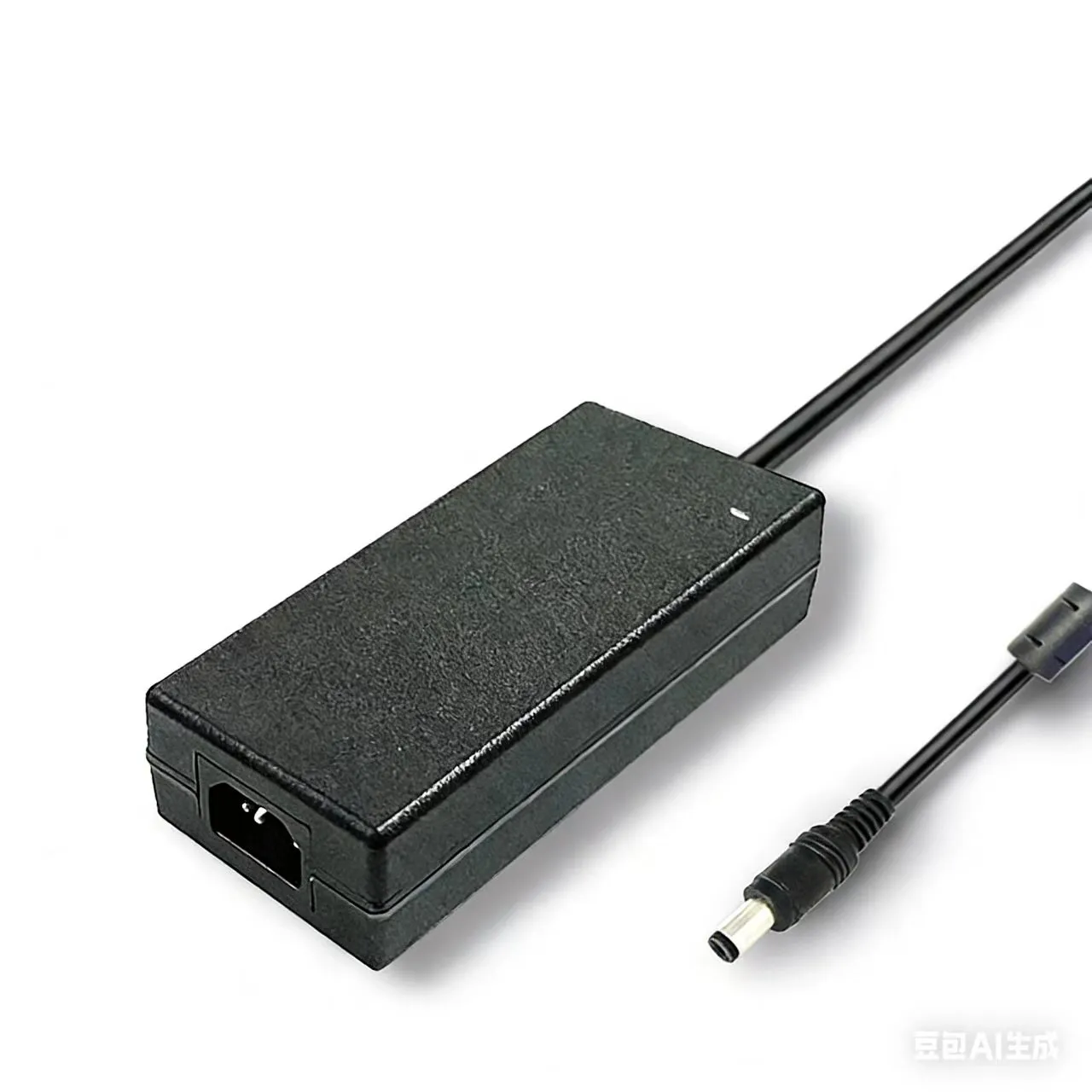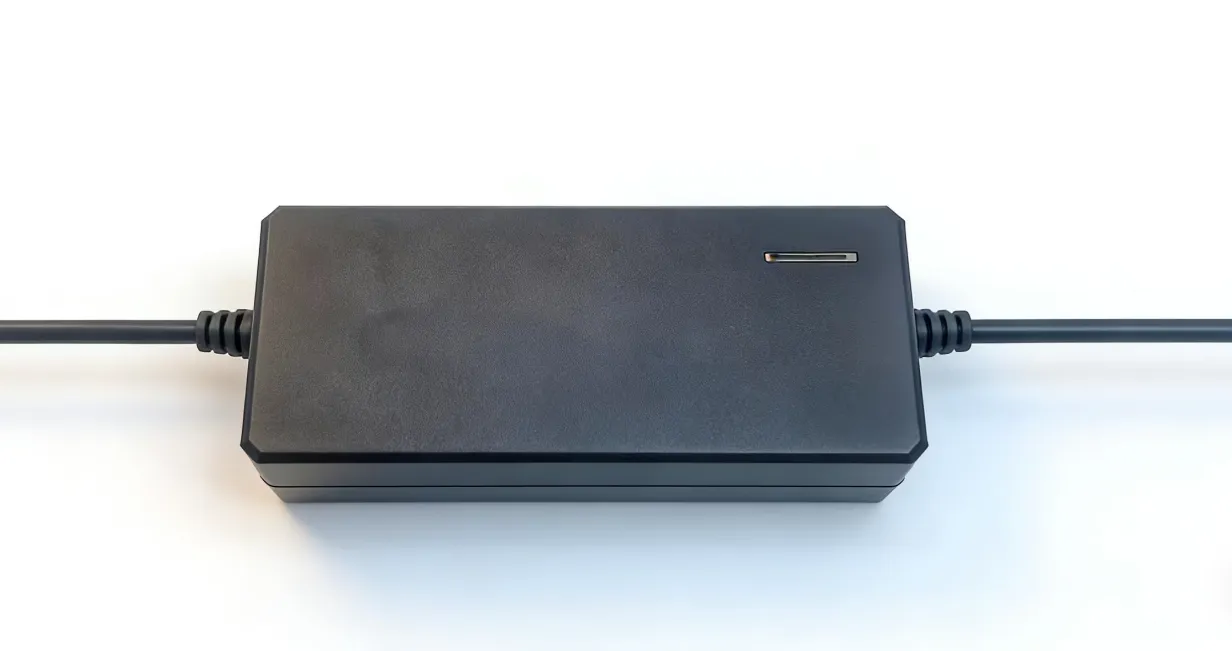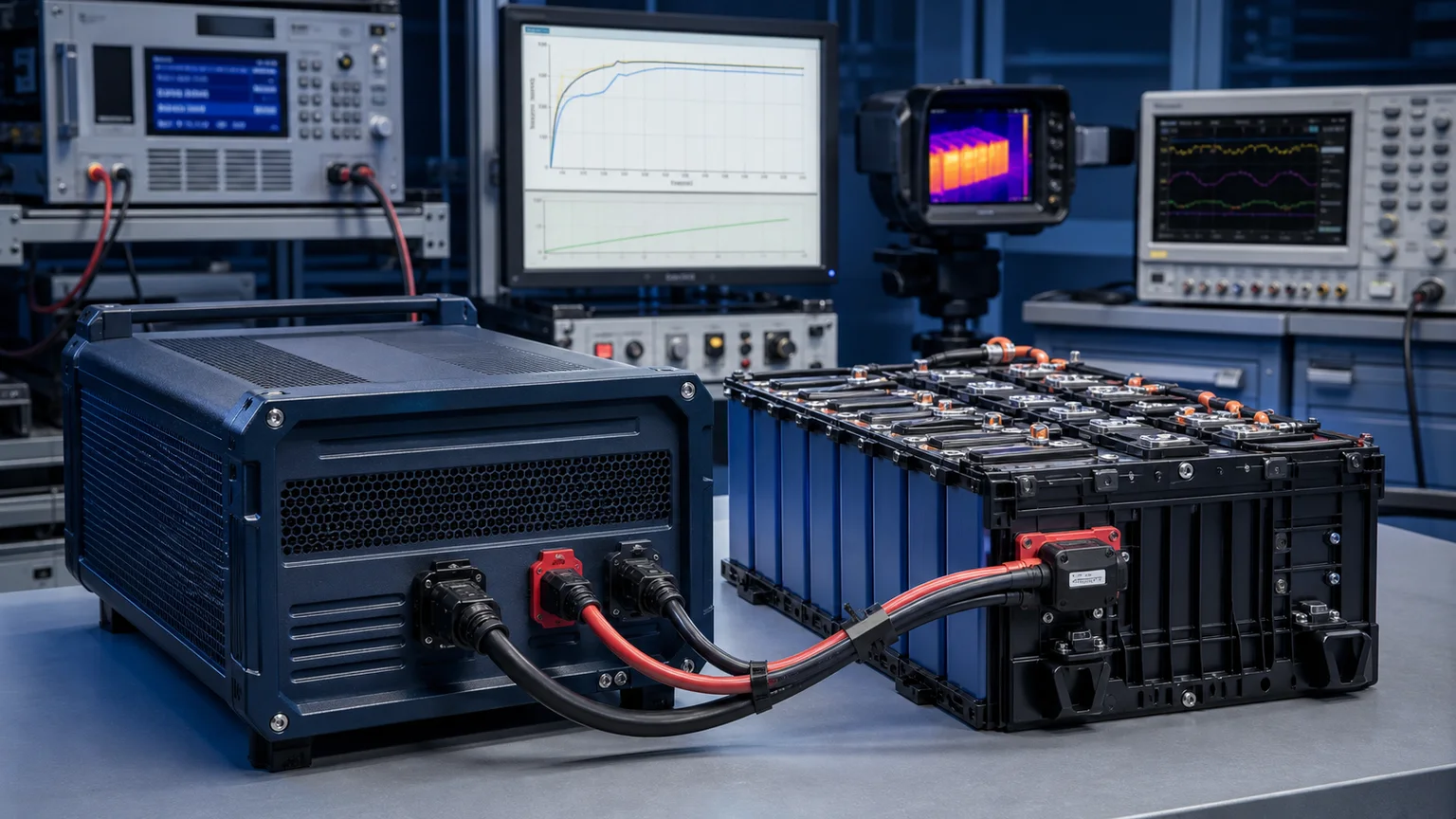

A golf cart charger is the single most replaced electrical component on a private cart, and the single most under-specified line item on a fleet purchase order. The cart itself lasts twenty years; the original OEM charger lasts six to eight; the battery pack lasts four to seven on lead-acid and ten or more on LiFePO4 — and any time the charger is mismatched to the pack, the pack ages on the wrong end of those ranges. A correctly chosen 36V or 48V charger is the cheapest insurance the cart will ever buy.
This guide covers golf cart battery charger selection in 2026 — how to identify your cart's voltage, OEM connector, and onboard-vs-external architecture; how to size charge current to the bank you actually have; how to pick a profile that respects flooded, AGM, gel, or LiFePO4 chemistry; and what UL, cUL, and IP ratings actually buy on a cart that lives outdoors year-round.
Why Golf Cart Chargers Are Their Own Category
A golf cart charger is not an automotive charger and not a marine charger. It sits between the two in duty cycle but has its own constraints. Carts spend most of their life in shaded sheds, but they get charged outside in 95°F humidity behind a clubhouse, in a 5°F barn in February, and on a fairway maintenance shed floor that floods twice a year. The cord gets stepped on, the connector gets dropped on concrete, and the cart owner expects to plug in the cord, walk away, and find a fully charged pack the next morning — for 8 to 12 years.
That duty cycle drives three design choices that distinguish a real golf cart charger from a relabelled industrial supply. The output connector must match an OEM-specific plug body that carries multi-amp DC current and survives ten thousand mating cycles. The charge profile must run unattended overnight without overcooking the pack on the last 5%. And the enclosure must take outdoor humidity cycling and the occasional hose-down during cart wash, which means at minimum IP54 for indoor-shed mounting and IP65 for any cart that gets washed on the bagroom apron.
For a deeper look at how IP ratings translate into outdoor survival and where the marketing claims fall apart, our waterproof power supply selection guide breaks down what each IP digit really protects against.
Step 1: Identify Your Cart's Voltage and Architecture
The first decision is forced by the cart, not chosen freely. Modern golf carts run on one of two nominal pack voltages, with two distinct architectures.
| Cart platform | Years | Pack voltage | Pack architecture (lead-acid stock) | Charger architecture |
|---|---|---|---|---|
| Club Car DS / Precedent (electric) | 1995–2014 | 48V | 6 × 8V or 4 × 12V | External cord-and-plug |
| Club Car Onward / Tempo / Villager | 2015–present | 48V | 4 × 12V or LiFePO4 | On-board (OBC) standard |
| EZGO TXT / Marathon | 1989–2008 | 36V | 6 × 6V | External, Powerwise D plug |
| EZGO RXV / TXT 48V / Express / Liberty | 2008–present | 48V | 4 × 12V or 6 × 8V | External, Powerwise QE / Delta-Q OBC |
| Yamaha G14 / G16 / G19 | 1995–2002 | 36V | 6 × 6V | External, Yamaha 2-pin |
| Yamaha G22 / Drive / Drive2 | 2003–present | 48V | 4 × 12V or 6 × 8V | External, Yamaha 2-pin |
| ICON / Bintelli / Evolution / Advanced EV | 2018–present | 48V (some 72V LSV) | 6 × 8V AGM stock or LiFePO4 OEM | External, SB50 Anderson |
| Cushman Hauler / Shuttle | 1995–present | 36V or 48V | Mixed | External, Powerwise or SB50 |
Three points are worth highlighting because they trip up most buyers.
First, "36V vs 48V" is not always obvious from the model badge. A 1998 EZGO TXT and a 2010 EZGO TXT look identical from the curb but one is 36V and the other is 48V. Count the battery posts: six 6V batteries means 36V, four 12V or six 8V means 48V. Never assume from model year alone.
Second, on-board chargers (OBCs) — common on Club Car Onward, EZGO RXV, and most lithium-OEM ICON / Bintelli / Evolution carts — talk to the cart's controller over a CAN bus or single-wire signal line. The cart will not roll until the charger reports completion and disengages. Replacing an OBC with a generic external charger requires either re-wiring around the controller interlock or installing a full conversion kit — it is not a plug-and-play swap.
Third, the connector body is part of the spec, not a generic accessory. A wrong connector that "fits" by force will arc, melt, or back-feed on the pack-positive line. The next section covers connectors specifically because connector mismatch is the #1 cause of charger failure on the bench return rate.
Step 2: Match the Charger Connector to the OEM Plug
Five connector families cover roughly 95% of the installed cart base in North America. Get this wrong and nothing else matters.
Anderson SB50 (gray housing on 48V, red on 36V) — the open-standard connector used by ICON, Bintelli, Evolution, Advanced EV, most lithium retrofit kits, and many Cushman utility carts. Two flat contacts rated 50 A continuous, latching housing, color-keyed by voltage to prevent cross-mating. The most repairable of all golf cart connectors — a damaged housing is a $6 part and a five-minute crimp.
EZGO Powerwise D (round 3-pin, white) — the OEM connector on EZGO TXT 48V, Marathon, and Medalist carts up through about 2008. The three pins are pack-positive, pack-negative, and a thermistor / interlock signal that the OEM Powerwise charger reads to confirm the pack is connected. A non-OEM charger that ignores the third pin works electrically but loses the pack-temperature safety loop.
EZGO Powerwise QE / Delta-Q OBC connector — the on-board charger interface on EZGO RXV and newer Express models. Hardwired to the cart, no external plug body. Replacement requires the matching Delta-Q QuiQ or equivalent OBC, not an external charger.
Yamaha 2-pin (round, black) — the OEM connector on Yamaha G14 through Drive2. Two heavy DC contacts in a round threaded shell. Reliable but proprietary — aftermarket chargers either ship with a Yamaha-specific cordset or include an SB50 adapter pigtail.
Crowfoot (3-prong triangular, black) — the original Club Car DS and Precedent connector before the OBC era. Three round pins in a triangular layout, often confused with a three-phase electrical plug. Still seen on tens of thousands of pre-2014 Club Car DS / Precedent carts in service.
A general-purpose 36V or 48V charger like the SY-C500W-10A high-power charger ships with an SB50 cordset by default and accepts swap-in pigtails for Powerwise D, Yamaha 2-pin, or Crowfoot — which lets a single SKU cover an entire mixed fleet of EZGO, Yamaha, and Club Car carts at a country club or resort.
Step 3: Size the Charge Current to Your Pack
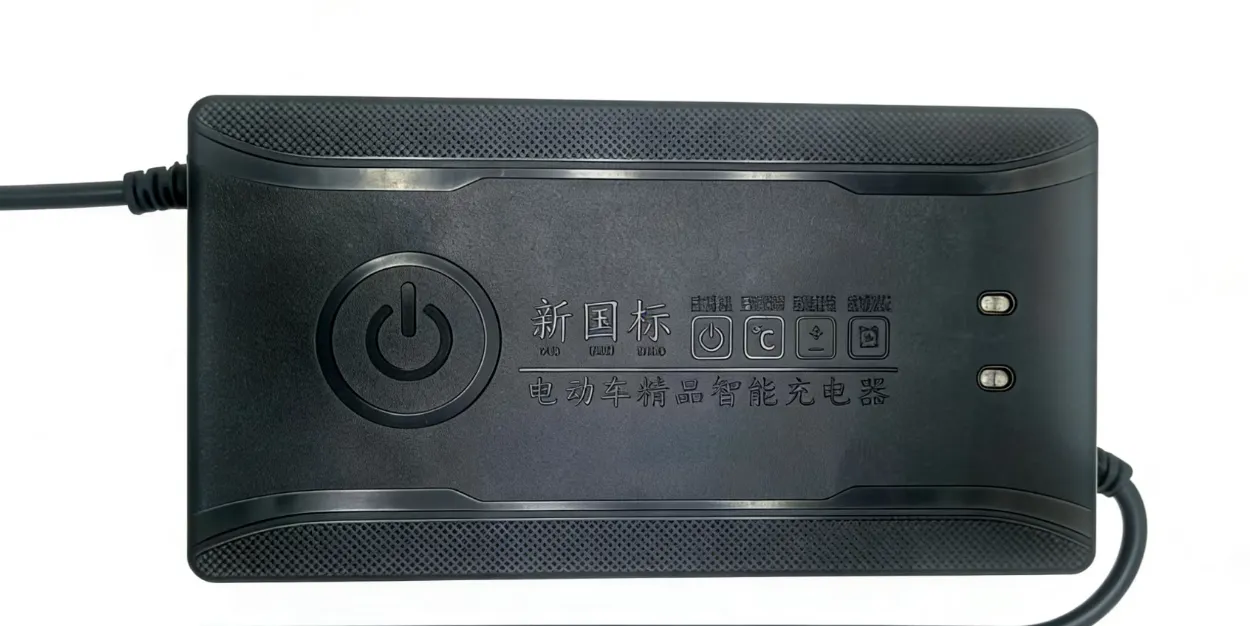
Charger sizing for golf carts follows the same rule as marine and forklift sizing: 10% to 25% of pack capacity in amps. A 48V pack built from four 100 Ah 12V batteries is a 100 Ah pack at 48V — it wants 10–25 A on the charger output.
| Pack voltage | Pack capacity (typical) | Charger output current | Overnight charge time (50% DoD) |
|---|---|---|---|
| 36V (six 6V × 220 Ah) | 220 Ah | 15–25 A | 6–9 hours |
| 48V (four 12V × 100 Ah lead-acid) | 100 Ah | 10–20 A | 4–6 hours |
| 48V (six 8V × 170 Ah) | 170 Ah | 15–25 A | 6–8 hours |
| 48V LiFePO4 (105 Ah retrofit) | 105 Ah | 15–25 A (up to 50 A on lithium) | 3–5 hours |
| 48V LiFePO4 (160 Ah deep-cycle retrofit) | 160 Ah | 20–40 A (up to 80 A on lithium) | 3–5 hours |
Below 10% of capacity, the charge time is unacceptable for daily use — a 6-amp trickle charger on a 220 Ah lead-acid pack takes 30+ hours to recover from a deep round of golf. Above 25%, lead-acid plates start to overheat and gas excessively, and on flooded packs the electrolyte boils off faster than the cart owner refills it.
LiFePO4 packs tolerate much higher charge rates — a 105 Ah lithium pack can comfortably take 50 A (0.5 C) — but the on-board BMS will limit current to whatever it is rated for, regardless of what the charger can deliver. Oversizing the charger past the BMS limit just means the BMS throttles and the charger runs at reduced output. There is no benefit to specifying a 60 A charger on a pack whose BMS caps at 30 A.
For mixed fleets running 36V Yamaha G19 carts alongside 48V EZGO RXV and lithium-converted ICON carts, the SY-C260W-5A high-power charger sized for 36V daily-driver duty paired with the SY-C500W-10A for the 48V lithium carts is a clean two-SKU architecture that covers most country-club fleets without overspending on either end.
Step 4: Pick a Charge Profile for the Chemistry on Board
Golf cart fleets are mixed. A 2008 EZGO TXT still on its original flooded T-105s, a 2018 Club Car Onward on AGM, and a 2024 ICON i40L OEM-fitted with LiFePO4 may all be sharing the same charging shed. A chargers that runs the wrong profile on a pack quietly destroys it — the symptoms (range loss, won't hold a charge, "battery is dead") look like battery failure, not charger failure, so the misdiagnosis is common.
Flooded Lead-Acid (T-105, T-145, US-2200) — 3-stage + monthly EQ
The classic flooded pack accepts a bulk → absorption → float profile. Bulk pushes rated current until pack voltage hits ~2.45 V/cell (44.1 V on a 36V pack, 58.8 V on a 48V pack). Absorption holds that voltage while current tapers. Float drops to ~2.27 V/cell (40.9 V on 36V, 54.5 V on 48V) for indefinite top-up. Monthly equalization at ~2.55 V/cell remixes stratified electrolyte and dissolves sulfate — flooded packs that never see EQ will sulfate within two seasons, regardless of charger quality.
Watering matters as much as charging. A flooded pack that runs dry above the plates loses capacity permanently in a single discharge cycle. Owners switching from flooded to AGM or LiFePO4 cite "no more watering" as the number-one quality-of-life upgrade.
AGM (Trojan T-1275 AGM, US AGM 31) — 3-stage, EQ disabled
AGM accepts the same bulk → absorption → float profile but at slightly lower setpoints (typically 14.4 V absorption / 13.5 V float per 12V battery). EQ is prohibited on AGM — there is no liquid electrolyte to remix, and forcing EQ voltages onto a sealed AGM cell vents and dries it permanently. A charger that auto-applies EQ "for battery health" without a per-output disable will quietly destroy a $1,200 AGM pack inside a year.
LiFePO4 (Eco Battery, RoyPow, Allied, Dakota) — CC/CV, no float, no EQ
LiFePO4 packs use straight CC/CV: bulk at rated current to ~3.55–3.65 V/cell (~57.6–58.4 V on a 48V 16-cell pack), CV taper to a cutoff threshold, then idle. No float, no EQ, no maintenance current. After termination the charger waits for pack voltage to drop below a re-bulk threshold before kicking in again.
The trickier part is BMS coordination. A serious lithium golf cart pack carries its own BMS, and a charger that ignores BMS-asserted current limits or low-temperature charge inhibit will either trip the pack contactor mid-cycle (the operator sees "charger keeps clicking on and off") or push current into a sub-freezing pack and plate lithium onto the anode, killing capacity within weeks. A charger built for golf cart LFP service should support a CAN or RS-485 BMS handshake, or at minimum honor a low-temperature charge inhibit signal.
For a deeper dive into the chemistry-specific differences and how to spot a charger that will quietly kill the wrong pack, the LiFePO4 vs lead acid battery charger selection guide is the reference companion to this section, and the NOCO vs CTEK vs Victron LiFePO4 charger comparison covers the consumer-brand trade-offs at the small-pack end of the market.
Step 5: On-Board Charger (OBC) vs External Charger
A growing share of new carts ship with an on-board charger wired permanently into the cart and controlled by the vehicle CAN bus. The owner plugs an AC cord into a receptacle on the body and the cart handles the rest. OBCs dominate Club Car Onward, EZGO RXV / Express, and most lithium-OEM ICON, Bintelli, and Evolution platforms.
OBCs have real advantages on a single-cart owner:
- One cord (AC, not DC) makes it impossible to mismate the connector.
- The cart enforces a charge-completion interlock — you cannot drive away mid-charge.
- Pack temperature, BMS state, and charge curve are visible on the cart dashboard or app.
OBCs have real disadvantages on a fleet:
- One bad OBC takes one cart out of service until a same-model replacement arrives.
- OEM OBC pricing is 2–3× the cost of a comparable external charger.
- A fleet running mixed Club Car / EZGO / Yamaha / ICON cannot share OBCs across models.
For a country-club fleet of 60 carts split across three OEMs, the standard architecture is to strip non-functional OEM OBCs and standardise on external chargers with SB50 cordsets and per-cart adapter pigtails. One charger SKU, four cordset SKUs, and any charger fits any cart. A Sanyi SY-C500W or SY-C1000W series charger sized to the 48V LFP pack handles a full overnight charge for the largest packs in the fleet, and the same charger covers the smaller AGM packs at reduced bulk current.
Step 6: Outdoor Survival — IP54, IP65, and the Charge Shed Reality
Golf cart chargers live in a wet environment. The cart gets washed, the charge shed floods, the apron behind the bagroom is hosed down twice a day, and the cordset gets dropped on wet concrete. IP rating matters and the right rating depends on where the charger lives.
IP54 — Dust-protected (limited ingress, no harmful effect), splash-protected from any direction. The minimum acceptable rating for a charger that lives indoors in a shed but might see incidental splash from cart wash or a leaky roof.
IP65 — Dust-tight, protected against low-pressure water jets from any direction. The right rating for a charger mounted on the cart-wash apron, in a maintenance bay floor, or anywhere the unit might get hosed down during cart cleaning.
IP66 / IP67 — Dust-tight, protected against high-pressure jets (IP66) or temporary immersion (IP67). Overkill for most golf-cart use except a fully outdoor charging station mounted on a fairway maintenance hut.
What the IP rating does not test for is humidity cycling — and the charge shed in Florida or coastal Carolina cycles between 60% and 95% RH twice a day, every day. A charger that publishes IP65 with no humidity-cycling spec will pass a hose test on day one and corrode internally within two seasons. Look for IEC 60068-2-30 damp-heat cycling on the test report alongside the IP claim.
Step 7: UL, cUL, and the Certifications That Matter
A golf cart charger plugged into a 120V or 240V wall outlet is a regulated product in North America. The certifications that matter on the actual product label:
- UL 1564 — Industrial battery chargers — the primary US safety standard for traction-battery chargers above 100 W. Required for any charger sold to a commercial fleet.
- UL 2202 / UL 2231 — EV and lithium-charger safety supplements; relevant for LiFePO4-rated golf cart chargers.
- cUL (Canadian UL) — same standards, Canadian listing — required for any cart deployed at a Canadian course or resort.
- FCC Part 15B — emissions limits to prevent the charger from blanketing a clubhouse Wi-Fi or cart-tracking GPS.
- Energy Star (optional) — efficiency benchmark; useful for LEED-certified clubhouses and corporate sustainability reporting.
For carts exported to or operated in Europe, CE marking with EN 60335-2-29 (battery charger safety, harmonised under the EU Low Voltage Directive) and EN 55014 (EMC) replace the UL/cUL stack.
A charger sold without a UL or cUL listing is not an industrial-grade fleet charger regardless of how the listing reads. Ask for the test report, not the marketing copy. You can browse the full Sanyi charger range from the products listing, or request a fleet-sizing recommendation from our engineering team.
FAQ
How do I tell if my golf cart is 36V or 48V?
Open the battery compartment and count the batteries, then read the voltage marked on each battery case. Six 6-volt batteries in series = 36V. Six 8-volt batteries or four 12-volt batteries in series = 48V. Do not rely on the model badge — a 1998 EZGO TXT is 36V and a 2010 EZGO TXT is 48V despite identical bodywork. If the cart has a lithium retrofit, the pack will be a single sealed enclosure with a label specifying nominal voltage (typically 48V, occasionally 36V or 72V).
Can one charger handle both my 36V Yamaha and my 48V Club Car?
A single charger SKU with a configurable output voltage and swap-in cordsets can — and that is the standard fleet architecture for country clubs running mixed OEMs. A multi-voltage charger detects pack voltage on connection and runs the matching profile. A fixed-voltage 36V-only or 48V-only charger cannot — connecting it to the wrong pack either does nothing (under-volted) or risks overcharge (over-volted). Always verify multi-voltage capability on the spec sheet, never assume it from the marketing copy.
Why does my golf cart charger keep clicking on and off?
Three common causes. (1) On a lithium pack, the BMS is asserting an over-voltage or low-temperature inhibit and the charger is honoring it — check the pack's Bluetooth app for fault codes. (2) On a lead-acid pack, one battery in the series string is failed open, and the charger sees pack voltage cycle as the failed cell fluctuates — load-test each individual battery. (3) On an OBC, the cart's CAN bus interlock is asserting a charge-disable while the cart is in any state other than "park" — confirm the cart is in tow / maintenance mode for charging.
Can I leave my golf cart on the charger all winter?
For a lead-acid pack with a real 3-stage charger, yes — the float stage maintains the pack indefinitely without overcharging. For a LiFePO4 pack, no — the charger should be unplugged once the pack hits 100% and the BMS should keep the pack at storage SOC (typically 50–80%) for long-term storage. Leaving a LFP pack at 100% for months accelerates calendar aging significantly. For lead-acid in cold storage, also keep the pack above 50% SOC — a discharged lead-acid pack freezes at much higher temperatures and the freeze damage is permanent.
What's the difference between an OEM charger and an aftermarket charger?
An OEM charger is the unit that shipped with the cart from Club Car, EZGO, Yamaha, or ICON — usually a Delta-Q QuiQ, Lester Summit, Powerwise, or similar. It carries the cart maker's branding, is profile-locked to the OEM-spec pack chemistry, and is priced at a 2–3× premium. An aftermarket charger from a charger-focused vendor offers configurable profiles (so it works on the same cart after a lithium retrofit), broader voltage range (one SKU covers 36V and 48V), and lower per-unit cost — at the trade-off of being a separate non-OEM line item that fleet managers track and stock independently.
How long should a golf cart charger last?
A reputable industrial-grade golf cart charger should last 8 to 12 years in normal fleet duty — meaning roughly 2,000 to 3,500 charge cycles depending on cart utilisation. Failure modes are usually input-side (capacitor aging from grid surges) or connector-side (crimp fatigue from daily mating) rather than core electronics. A charger that fails inside 3 years is almost always a sign of either a wrong-chemistry profile (the unit is overworking) or an undersized output (the charger is running flat-out every cycle), not a defective unit.
Conclusion
Golf cart charger selection is a five-decision problem: voltage class (set by the cart, count the batteries, do not trust the badge), connector body (SB50 / Powerwise D / Yamaha 2-pin / Crowfoot — match the OEM plug), charge current (10–25% of pack capacity, with LFP allowing up to 50%), chemistry profile (flooded with EQ, AGM without EQ, LFP with BMS handshake), and enclosure / certification (IP54 indoor / IP65 outdoor, UL 1564 for any commercial fleet). Get the order right and the hardware decision is straightforward — Sanyi's high-power charger line, from the SY-C260W single-cart auxiliary chargers up through the SY-C500W mid-pack units and the SY-C1000W ultra-high-power class for large 48V LFP retrofits, covers private cart owners through full country-club and resort fleets.
If you are running a mixed-OEM country club fleet, converting a Club Car Precedent or EZGO TXT to lithium, building out a LSV / NEV dealer charging bay, or specifying chargers for an industrial Cushman utility fleet, talk to our engineering team with the cart count, OEM mix, pack voltages, pack chemistries, and the charging shed environment — and we will come back with a charger spec, a cordset matrix, and an install layout that survives the actual duty cycle.
.webp)