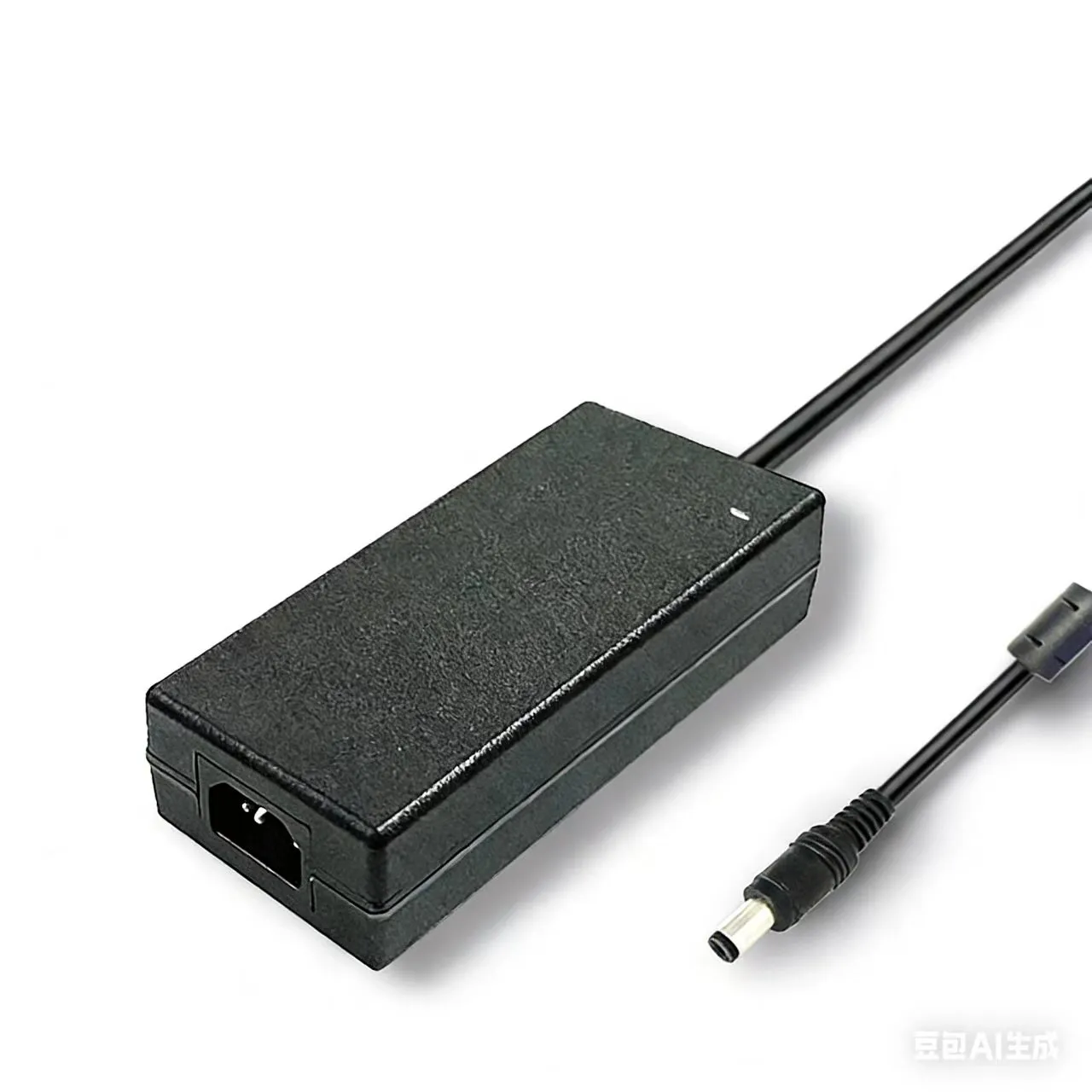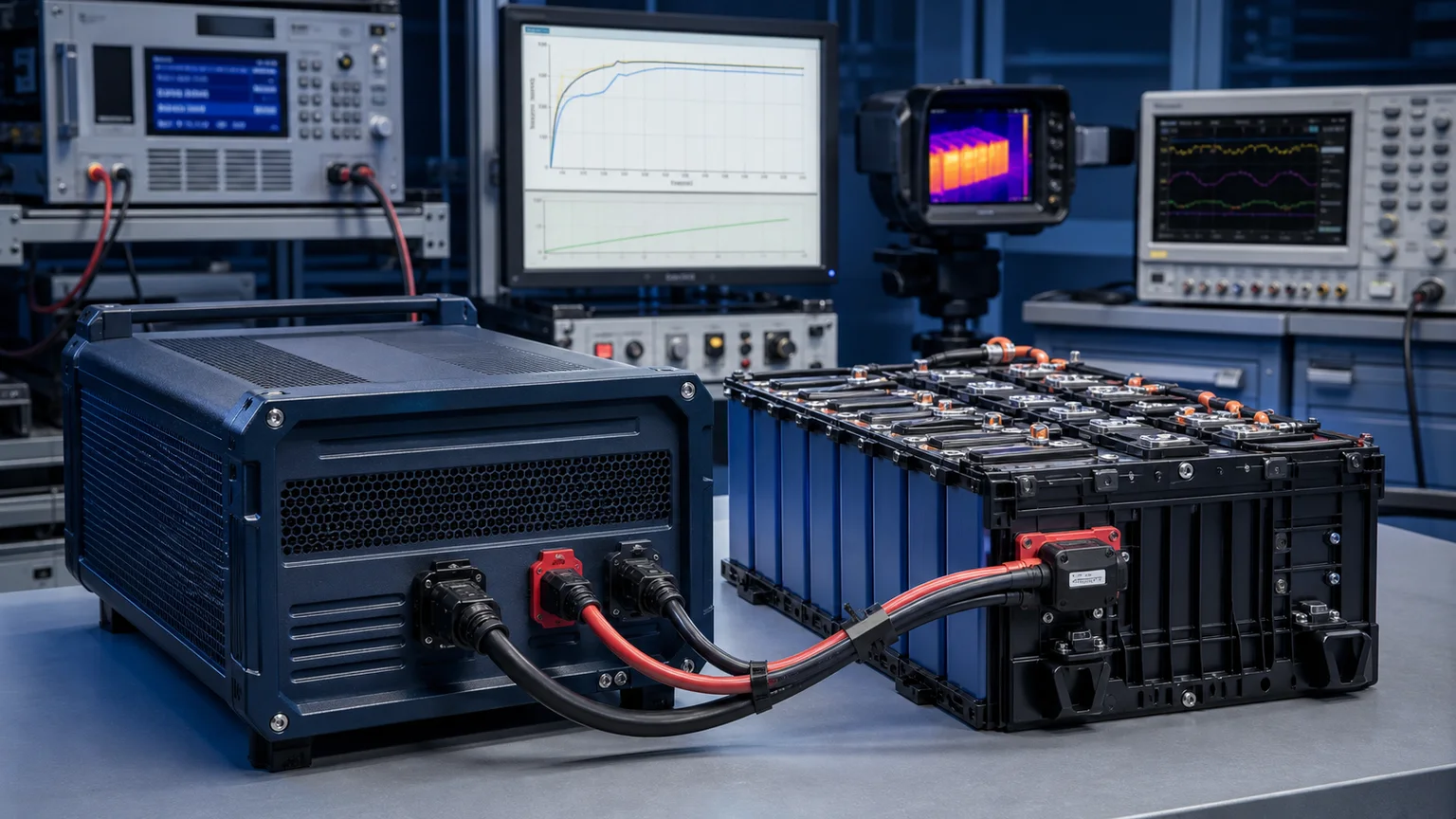

A forklift battery charger is not the same kind of equipment as a benchtop or RV charger, even when the nominal pack voltage looks similar. A warehouse forklift cycles a 24V, 36V, or 48V traction pack hard — often two shifts a day, sometimes three — in an environment that mixes 5°C cold-storage rooms with +45°C summer dock doors, concrete dust, vibration from pallet drops, and a maintenance window of "whatever fits between the morning safety briefing and the first picking wave." Spec the charger wrong and you don't lose a hobby battery: you lose a shift.
This guide covers forklift battery charger selection in 2026 — voltage class sizing, charge-current and runtime math, the difference between a flooded lead-acid EQ profile and a LiFePO4 CC/CV profile on the same forklift, what UL 2202, UL 2849, and OSHA expect from the install, and how Sanyi's high-power charger line maps onto each duty cycle.
Step 1: Match the Charger Voltage Class to the Truck
Forklift packs are nominal 24V, 36V, or 48V, with a few 72V/80V Class I electric riders at the heavy end. The voltage class is dictated by the truck OEM and the lift capacity — you do not get to pick it. What you pick is a charger whose output voltage range is built for that class.
| Truck class | Typical pack | Typical capacity | Typical charger output range |
|---|---|---|---|
| Class III walkie / pallet jack | 24V | 150–375 Ah | 28.8–29.4 V (lead acid) / 28.4–29.2 V (LFP) |
| Class II reach truck, light Class I rider | 36V | 500–800 Ah | 43.2–44.1 V / 42.6–43.8 V |
| Class I counterbalanced rider | 48V | 600–1000 Ah | 57.6–58.8 V / 56.8–58.4 V |
| Heavy Class I, container handler | 80V | 800–1200 Ah | 96.0–98.0 V (lead acid traction) |
A 48V charger on a 36V pack will refuse to terminate (the pack never reaches the bulk setpoint). A 36V charger on a 48V pack will undercharge it permanently and silently kill capacity month over month. Always confirm the charger's labeled output voltage range covers the pack's float and absorption setpoints with margin — not just the nominal voltage.
For mixed-voltage fleets, do not buy "universal" chargers that try to cover all three classes from one unit. The current capability collapses at the high-voltage end and the protection hardware ends up oversized for the small packs. A two-charger or three-charger solution per dock is almost always cheaper over five years of cycle life.
Step 2: Calculate the Charge Current Honestly
The traditional rule of thumb for flooded lead-acid traction batteries is C/8 for an overnight charge — i.e., a 600 Ah pack wants ~75 A. That math is for conventional charging: one full discharge per shift, eight hours plugged in, equalize once a week. Step outside that pattern and the math changes:
- Conventional / overnight charging — C/8 to C/10. 600 Ah pack → 60–75 A. 8 hours bulk + absorption + cool-down.
- Opportunity charging (lead-acid) — C/4 to C/3 during breaks. 600 Ah pack → 150–200 A. 15–20 minute bursts, no equalize during the day.
- Fast charging (LiFePO4) — up to C/2 sustained, briefly 1C. 600 Ah LFP pack → 300 A bulk. 90-minute full recharge during a long lunch.
A 600 Ah pack on a 36V Class II reach truck running two shifts is therefore not "a 48V/100A charger" — it might need a 48V/200A station for opportunity charging, or a 48V/75A unit for overnight. The charger's max current spec must comfortably exceed your chosen rate, with a 20–30% derate margin for high cabinet ambient.
When packing multiple smaller modules in parallel — a setup common with 48V LiFePO4 forklift retrofits — a multi-output charger like the SY-C1000W / 1200W / 1600W ultra high-power charger range can handle a 48V/25A line per output and stack to deliver the burst current opportunity charging demands without thermal throttling.
Step 3: Pick the Right Charging Profile
This is where the chemistry matters more than the voltage.
Flooded Lead-Acid Forklift Batteries: 3-Stage + Equalize
Flooded traction batteries have been the workhorse of warehouse fleets since the 1960s for a reason — they tolerate abuse, they accept water topping, and a bad charger only kills them slowly. They want a four-step profile:
- Bulk — constant current at C/8 to C/10 until the pack reaches absorption voltage (2.4–2.45 V/cell, i.e. ~57.6–58.8 V on a 48V pack).
- Absorption — hold absorption voltage, let current taper to ~C/50.
- Float — drop to 2.25–2.27 V/cell (~54.0–54.5 V on a 48V pack), hold indefinitely, suppresses sulfation while the truck sits idle overnight.
- Equalization (EQ) — every 5–10 cycles, raise to 2.55–2.65 V/cell (~61–64 V on a 48V pack) for 2–4 hours, deliberately gas the electrolyte to remix stratified specific gravity.
The EQ stage is non-negotiable on flooded packs. Skip it for six months and stratification kills the bottom plates; the battery keeps reading "ok" on the pilot lights and quietly loses 30% of its capacity. EQ is prohibited on AGM, gel, and LiFePO4 — it boils sealed cells dry and trips a lithium BMS overvoltage shutdown.
LiFePO4 Forklift Batteries: CC/CV, No Float, No EQ
LFP forklift retrofits — increasingly the default for new orders since 2024 — use CC/CV charging:
- CC — push rated current (often 0.5C, briefly 1C) until pack reaches 3.55–3.65 V/cell (~56.8–58.4 V on a 48V pack).
- CV — hold that voltage and taper current to a cutoff (typically C/20 to C/50).
- Terminate — hard stop. No float. No EQ. Re-bulk only if pack voltage falls below a threshold.
A LiFePO4 forklift charger must also respect the pack's BMS:
- A CAN 2.0B or RS-485 link from the BMS often sets a dynamic charge-current limit — the charger needs to honor it or the BMS will trip the contactor mid-cycle, and the operator will complain that "the charger keeps cycling."
- A low-temperature charge cutoff (typically below 0°C) is mandatory — a charger that ignores it will plate lithium dendrites onto the anode in a cold-storage warehouse and permanently kill capacity within weeks.
The midrange SY-C500W-10A high-power charger covers single-line 24V and 36V LFP forklift packs up to ~250 Ah with a CC/CV profile and OCP/OVP/SCP/OTP protection layered on. For the higher-capacity 48V packs, step up to the SY-C1000W series.
Step 4: Opportunity Charging vs. Conventional — Which Pattern Fits the Fleet?
Opportunity charging — short, high-current top-ups during breaks — is the single biggest operational lever for fleets that want to drop the spare battery and the dedicated battery-change room. The trade-offs:
| Conventional (overnight) | Opportunity charging | |
|---|---|---|
| Cycles per day | 1 deep cycle | 4–8 partial cycles |
| Charge rate | C/8–C/10 | C/4–C/3 (lead acid) / up to C/2 (LFP) |
| Battery temperature rise | 5–10 °C | 15–25 °C (needs forced cooling on lead acid) |
| Spare battery required | Yes, for 2- and 3-shift ops | No — same battery cycles all day |
| Capacity loss per year | ~5% on lead acid | ~8–12% on lead acid, ~3–5% on LFP |
| Best fit chemistry | Flooded lead-acid | LiFePO4 |
The numbers say what the operations director already feels: opportunity charging on flooded lead acid is a 30% shorter battery life trade for one less spare battery and one freed-up battery-change room. On LiFePO4, opportunity charging is essentially free — LFP cycle life barely cares about partial-state-of-charge cycling. That asymmetry is the single most important reason warehouses with two shifts or more are converting their fleets to lithium.
If you're running mixed chemistries during a transition, pick a charger with a switchable profile so the same dock can serve both. This is a sweet-spot use case for the SY-C1000W series, which offers selectable lithium and lead-acid curves for fleet migration.
Step 5: Workplace Safety, Certifications, and the Install
The forklift charger is not just a power supply — it is a piece of permanent workplace electrical equipment, and that triggers code requirements that a benchtop charger never sees.
UL 2202 — Electric Vehicle (EV) Charging System Equipment. The dominant North American safety standard for forklift chargers, covering insulation, output current limit, ground-fault detection, and abnormal-condition behavior. A charger sold in the US for material-handling duty must carry UL 2202 or an equivalent.
UL 2849 — Light Electric Vehicle (LEV) Power Trains. Increasingly cited for the lithium-pack side of the system; relevant when the charger is sold bundled with an LFP battery as a single SKU.
OSHA 29 CFR 1910.178(g) — Powered industrial truck batteries and chargers. Specifies the install: dedicated charging area, eye-wash station within 25 feet for flooded lead-acid (electrolyte splash hazard), no smoking, adequate ventilation to dissipate hydrogen during EQ, and a designated method to change/service batteries. LiFePO4 retrofits do not eliminate all of these — ventilation requirements relax, but fire-blanket and dry-chemical extinguisher requirements appear instead.
ANSI/ITSDF B56.1 — Safety standard for low- and high-lift trucks. Indirectly governs the charger via truck-side connector and lockout requirements.
For the cabinet itself, look for:
- IP rating — IP20 is the floor for an indoor charging room; IP54 or higher if the charger sits out on the warehouse floor exposed to dust and washdown overspray.
- Operating ambient — a charger labeled 0–40 °C will throttle every August. Look for −10 to +50 °C with 80% RH non-condensing.
- Forced-air cooling with filtered intake — concrete and pallet dust ingest into unfiltered fans and kill the charger in a year.
- Surge withstand — IEC 61000-4-5 Class 3 minimum (2 kV line-line, 4 kV line-ground).
- Galvanic isolation between input AC and output DC, audited via the UL 2202 file.
The light-duty SY-C260W-5A high-power charger is designed for 24V auxiliary packs on Class III walkies and pallet jacks where the duty cycle is lighter, in an aluminum-alloy housing with OCP/OVP/SCP protection. For Class II and Class I heavy duty, the SY-C500W and SY-C1000W series step up the current rating, the cabinet, and the cooling.
You can browse the full Sanyi forklift and industrial charger range from the products listing, or request a sizing recommendation from our engineering team.
FAQ
How do I know if my forklift battery is 24V, 36V, or 48V?
Check the cell count on the battery nameplate. Flooded lead-acid traction cells are 2 V nominal — 12 cells = 24 V, 18 cells = 36 V, 24 cells = 48 V. LiFePO4 forklift packs are usually built from 3.2 V cells in series — 8 cells = 24 V, 12 cells = 36 V, 16 cells = 48 V. The truck OEM nameplate inside the operator compartment is the authoritative source; the charger and battery must both match it.
Can I use one charger for both lead-acid and LiFePO4 forklift batteries?
Only if the charger explicitly lists both profiles and lets you select between them at the panel or via communication. The voltage targets, termination criteria, and standby behavior are different enough that running one chemistry's profile on the other's pack will either undercharge the pack (LFP profile on lead acid → sulfation) or trip the BMS (lead-acid profile with EQ on LFP → contactor disconnect, charger oscillation). Sanyi's SY-C1000W series carries selectable lithium and lead-acid modes for fleets mid-migration.
Is opportunity charging really worth it?
For a single-shift operation, no — the operational savings don't justify the battery life hit on lead acid. For a two-shift or three-shift operation, opportunity charging eliminates the spare battery, frees up the battery-change room, and removes a forklift swap from the shift change. On LiFePO4 it's almost a free win because LFP cycle life is largely insensitive to partial-state-of-charge cycling. On flooded lead acid it's a roughly 25–30% reduction in calendar life that you trade for the operational gain.
Why does my 48V forklift charger keep cycling on and off?
Most common cause on a LiFePO4 retrofit: the charger doesn't honor the pack BMS's dynamic current-limit signal. The BMS asks for derated current (cell imbalance, high cell temperature, low ambient temperature), the charger ignores it and pushes rated current, the BMS trips the charge contactor, the charger sees a disconnect, restarts, and the cycle repeats. Fix: use a charger with CAN 2.0B or RS-485 BMS handshake, or — on simpler packs — a charger whose voltage and current are tuned conservatively (CV target slightly below 3.55 V/cell, CC limit at 80% of pack BMS spec). On a flooded lead-acid pack the same symptom usually means the float voltage is set too high and tripping a battery low-electrolyte alarm.
What certifications should I require on a forklift charger sold into the US?
UL 2202 is the primary safety standard for the charger itself. UL 2849 increasingly applies when the charger is bundled with a lithium pack. The install must comply with OSHA 29 CFR 1910.178(g) — dedicated charging area, ventilation, eye-wash station for flooded packs, fire-suppression provisions for lithium. The truck-side connector and lockout follow ANSI/ITSDF B56.1. Outside the US, look for IEC 61851 family compliance for the charger and IEC 62619 / UN 38.3 for the lithium pack.
Conclusion
Forklift charger selection comes down to four decisions made in order: voltage class (set by the truck), charge rate (set by the duty cycle and chemistry), profile (set by lead acid vs. LiFePO4), and install / certification (set by the workplace and the local code). Get the order right and the hardware decision is straightforward — Sanyi's high-power charger line spans the full envelope from 24V Class III walkies up to 48V Class I counterbalanced riders.
If you're sizing a fleet — single-shift to three-shift, mixed chemistry mid-migration, or a greenfield LFP install — talk to our engineering team with the truck class, pack capacity, daily cycle count, and warehouse ambient profile, and we'll come back with a charger spec and a dock layout recommendation tailored to the actual duty cycle.
.webp)