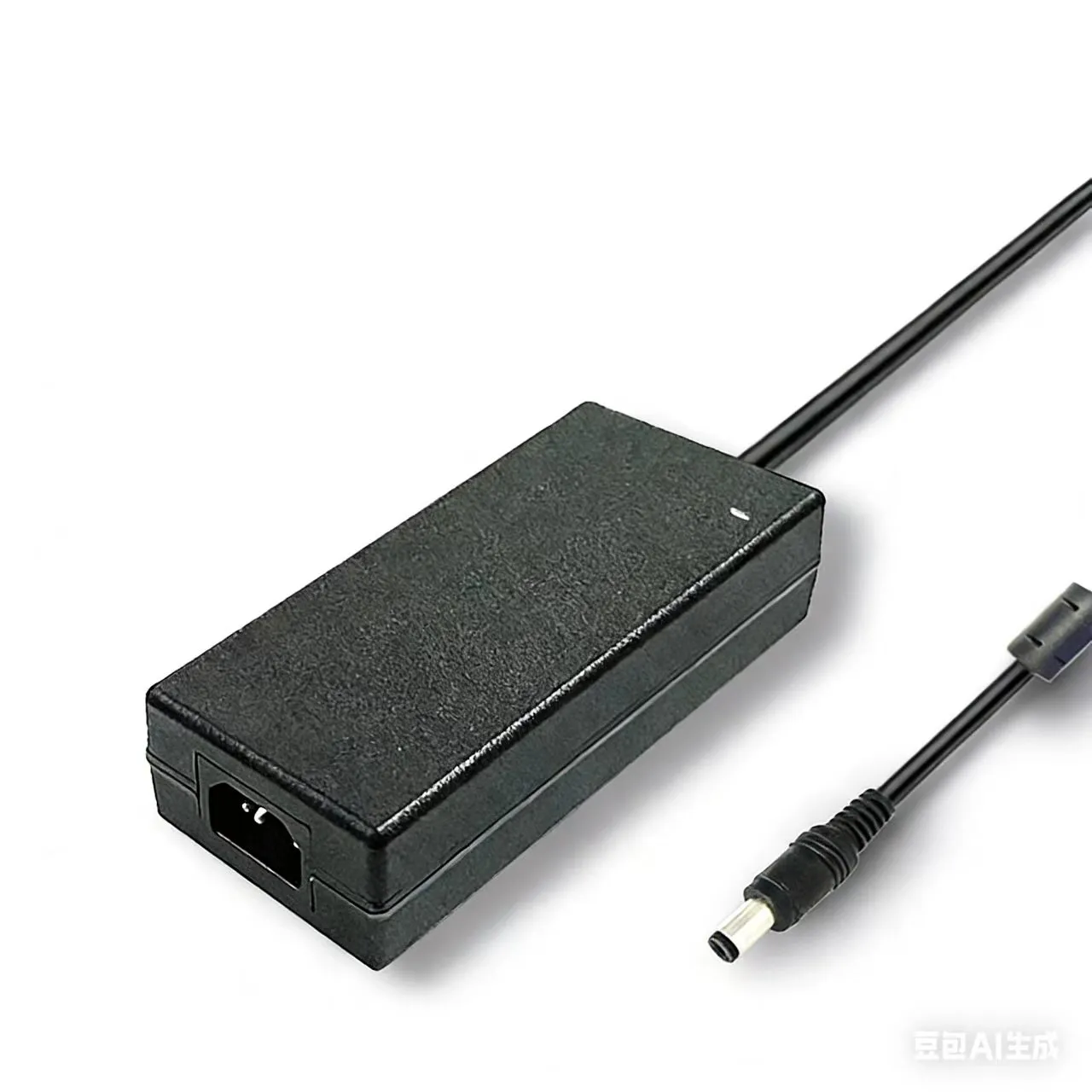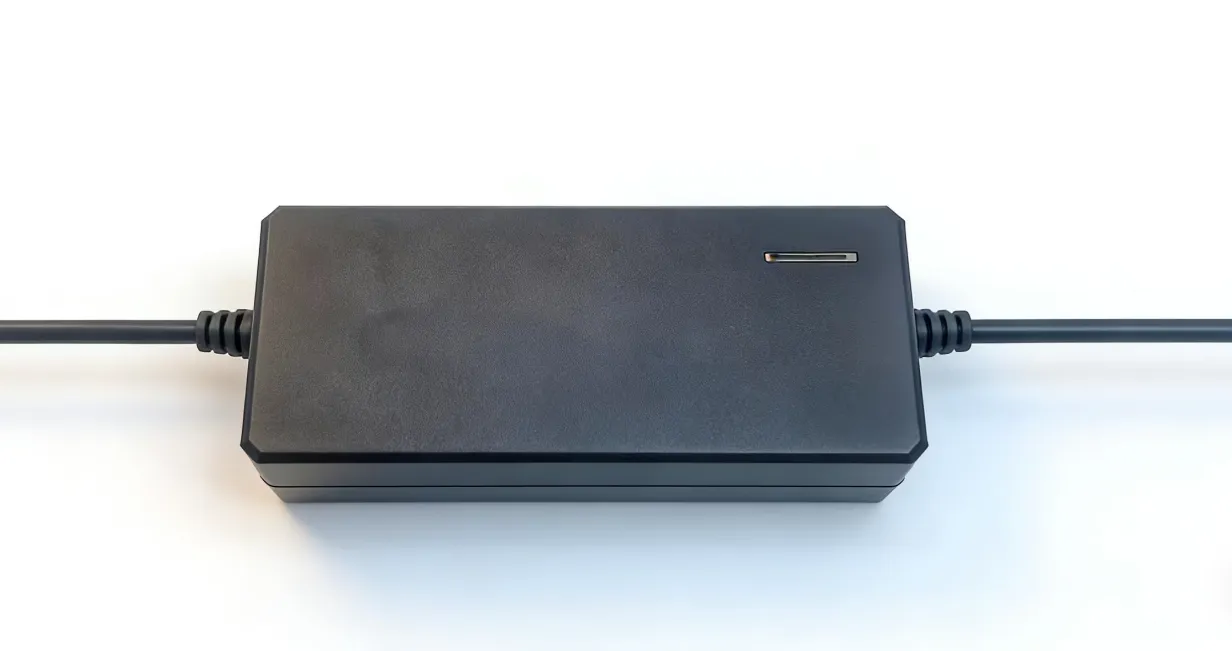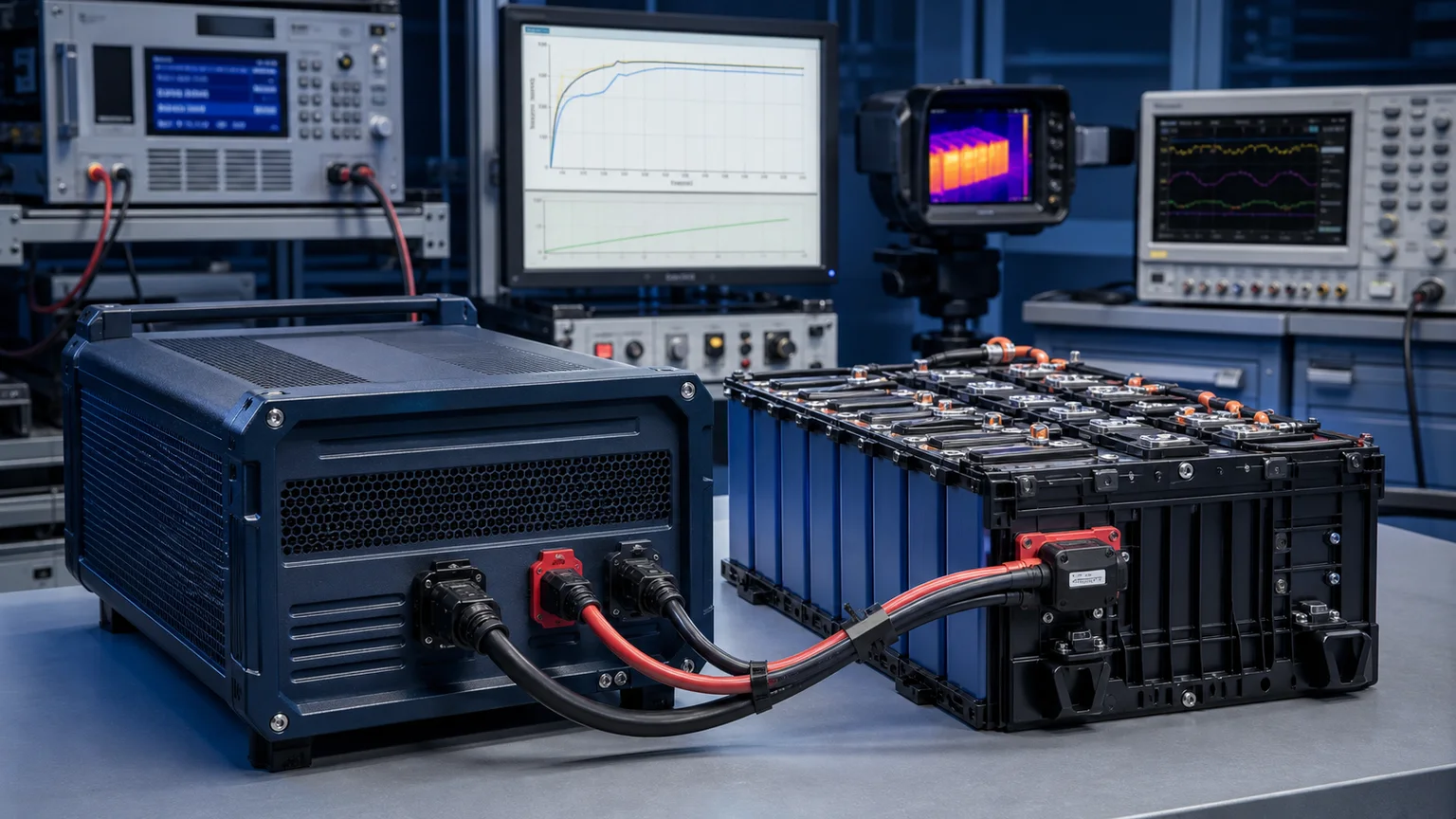

A floor scrubber battery charger is the single component that decides whether a $7,000 walk-behind or a $32,000 ride-on auto scrubber actually shows up to the next shift. The machine itself is engineered for thousands of running hours; the battery pack is the heaviest line item on the parts list and the one that gets replaced on a service interval; and the charger is the part that the night cleaner plugs in at 02:00 and walks away from. Pick the wrong charger and a Tennant T500 starts the morning shift at 71% state of charge, a Kärcher BD 50/70 R Bp cuts out halfway through a hospital corridor, or a $1,800 AGM pack on a Nilfisk SC1500 cooks itself in fourteen months instead of the four years the spec sheet promised.
This guide covers floor scrubber battery charger selection in 2026 — how to match charger output to the OEM machine (Tennant, Kärcher, Nilfisk, Hako, Comac, Numatic, IPC Eagle, Viper, Advance), how to pick the right charge algorithm for flooded, AGM, gel or LiFePO4 chemistry, what UL 1564, EN 1175 and IEC 60335-2-29 certification actually require for indoor commercial cleaning, and how to design opportunity-charging schedules for 24/7 contract cleaning fleets running three shifts a day across malls, warehouses, hospitals and airport terminals.
Why Floor Scrubber Chargers Are Their Own Category
A floor scrubber charger sits in a strange operational niche. The pack capacity is typically 80–105 Ah on a 24V walk-behind, 140–240 Ah on a 24V ride-on, and 240–415 Ah on a 36V large ride-on — heavier than a robotic vacuum, lighter than a forklift, comparable to a small scissor lift but with a fundamentally different duty cycle. A scrubber doesn't sit on a yard pad for five days; it runs every single night, sometimes twice a day on contract-cleaning sites, and the operator wants it ready in the morning without thinking about it.
Three factors separate a real commercial scrubber charger from a relabelled industrial supply.
First, the load profile is mixed and brutal. Unlike a forklift that draws a steady traction current, a scrubber's load is brush motor + vacuum motor + drive motor + solenoid valve + onboard pump, all switching on and off as the operator releases the squeegee, lifts the brush deck, or stops to empty the recovery tank. The pack sees ~50 A continuous traction current with frequent 80–120 A spikes from the brush motor inrush. The charger must put that energy back without forcing the pack into the high-current absorption stress that shortens AGM life.
Second, the environment is wet. A floor scrubber is, by definition, a machine that sprays clean water and recovers dirty water. The charger lives on the machine, behind a splash guard, sometimes with the operator hosing down the brush deck two feet away. IP54 is the minimum for any onboard charger; IP65 is correct for any unit that gets washed down between shifts. A charger that ships at IP20 because it was originally designed for an indoor server rack will fail at the connector terminals within eighteen months of scrubber service.
Third, the operator is not a battery technician. The night cleaner plugs in, walks away, and trusts the charger to do the right thing. There is no maintenance crew checking electrolyte levels weekly. That puts the entire pack-protection burden on the charger: correct chemistry profile, automatic equalisation scheduling for flooded packs, automatic temperature compensation, automatic shutoff on pack disconnect. A charger without those automatic behaviours is a warranty claim waiting to happen.
For a deeper look at how IP ratings translate into actual ingress survival, our IP65 / IP67 / IP68 waterproof power supply selection guide breaks down which IP digit protects against what.
Step 1: Identify Your Scrubber's Voltage Class and Pack Size
The first decision is forced by the machine, not chosen freely. Commercial floor scrubbers cluster on two nominal pack voltages, with pack capacity varying widely by machine class.
| Machine class | Typical OEM models | Pack voltage | Typical pack capacity | Typical charger output |
|---|---|---|---|---|
| Walk-behind, small (17–20") | Tennant T300, T350; Kärcher BD 50/50 C Bp; Nilfisk SC500; Viper AS510B; IPC Eagle CT15 | 24V (2× 12V or 4× 6V) | 80–105 Ah | 24V / 12–15 A |
| Walk-behind, mid (24–28") | Tennant T500; Kärcher BD 50/70 R Bp; Nilfisk SC450; Hako Scrubmaster B45; Advance SC450 | 24V | 105–140 Ah | 24V / 15–20 A |
| Ride-on, compact (28–32") | Tennant T7, T7AMR; Kärcher B 90 R; Nilfisk SC1500; Comac Innova 55B; Numatic TGB 6055 | 24V (4× 6V) | 175–240 Ah | 24V / 25–30 A |
| Ride-on, large (32–40") | Tennant T16, T17; Kärcher B 150 R; Nilfisk SC6500; Hako Scrubmaster B175 R; Comac Optima 100 BS | 36V (6× 6V) | 240–415 Ah | 36V / 25–30 A |
The 24V walk-behind is the volume product of the commercial cleaning industry — Tennant T500, Kärcher BD 50/70 R Bp and Nilfisk SC450 alone account for hundreds of thousands of units across mall, hospital, warehouse and education contracts. Pack capacity is around 105–140 Ah at 24V, and the OEM-supplied onboard charger is typically a 15–20 A unit that finishes a recharge from 30% SoC in roughly 6–8 hours of overnight wall time.
A 36V large ride-on like the Tennant T16 or Kärcher B 150 R uses a heavier 240–415 Ah pack to support the larger brush deck, the deeper squeegee suction, and the cabin solenoid valves. The charger sized for those platforms — like the Sanyi SY-C1000W series ultra high-power charger (1000W / 1200W / 1600W, up to 30 A at 36V output) — is the right scale of hardware. Light-duty 8–12 A automotive-style chargers undersize badly at this pack size and will not finish overnight in a single-shift contract; in a 24/7 three-shift contract they cannot keep up at all.
Step 2: Match the Charge Algorithm to the Chemistry
A floor scrubber battery pack is one of four chemistries, and the charger must explicitly support that chemistry — there is no "universal smart charger" that handles all four correctly without configuration.
Flooded Lead Acid (FLA)
Still common on ride-on scrubbers operated by in-house facilities teams (hospitals, universities, large factories) where a weekly watering schedule is acceptable. FLA needs a true IUoU three-stage charge profile: constant current bulk at 0.10–0.20 C up to absorption voltage (29.0–29.4 V for a 24V pack, 43.5–44.1 V for a 36V pack at 25°C), constant voltage absorption held until current tapers to ~3% of pack capacity, float at 26.4 V / 39.6 V indefinitely. A periodic equalisation cycle at 31.2 V / 46.8 V for 2–4 hours every 30–60 cycles is mandatory to reverse stratification and rebalance cells. A charger that skips equalisation will let a flooded pack stratify within twelve months and drop to half its rated cycle life.
AGM (Absorbed Glass Mat)
The mainstream chemistry on commercial scrubbers since 2015. AGM dominates Tennant, Kärcher and Nilfisk product lines because it eliminates the watering requirement, tolerates the partial-state-of-charge operation of contract cleaning, and survives the bumpy ride on uneven warehouse floors without electrolyte sloshing. AGM uses a similar IUoU profile but with tighter absorption (28.8–29.2 V for 24V, 43.2–43.8 V for 36V) and no equalisation — the sealed VRLA construction is destroyed by the high-voltage equalisation cycle that a flooded pack tolerates. A charger configured for FLA will gas an AGM pack and shorten its life dramatically.
AGM is still the largest installed base on scrubbers, and Sanyi expects it to remain the volume chemistry through at least 2028. Lithium penetration is rising fast — most OEMs now ship a lithium variant alongside the AGM SKU — but AGM still wins on upfront cost, on cold-weather behaviour, and on the well-understood replacement process that facilities teams already trust.
Gel
Less common on scrubbers than on golf carts but used in temperature-sensitive applications (cold-storage warehouses, outdoor cleaning equipment, deep-discharge contract sites). Absorption voltage is lower again (28.4–28.8 V / 42.6–43.2 V) and current limit must be capped tighter to avoid the gas-recombination overload that destroys gel cells. Float is critical — gel cannot tolerate the higher AGM/FLA float of 27 V / 40.5 V.
LiFePO4
The fastest-growing segment of commercial scrubber service since 2024. LFP retrofits on Tennant T500 and Kärcher BD 50/70 R Bp are widely available at 24V/105 Ah; OEM lithium offerings on Tennant T7AMR (the autonomous variant) and Nilfisk SC500 Li are factory-fit LFP. LFP needs a fundamentally different algorithm: CC-CV (constant current to 29.2 V or 43.8 V at 25°C, then constant voltage hold until current tapers to 0.05 C), no float, no equalisation. The charger must communicate with the pack BMS to gate charging on cell-voltage / cell-temperature limits — pure voltage-based charging without BMS feedback risks cell-imbalance failures.
For a side-by-side comparison of LFP vs lead-acid charger requirements and the retrofit considerations on industrial cleaning equipment, our LiFePO4 vs lead-acid battery charger selection guide walks through the algorithm differences in detail.
The takeaway: never mix chemistry and charger profile. An FLA-profile charger will gas an AGM pack; an AGM-profile charger will under-charge an FLA pack; a lead-acid charger of any flavour will overcharge an LFP pack within hours. The charger must be either chemistry-specific or have a clearly documented chemistry-select switch on the front panel.
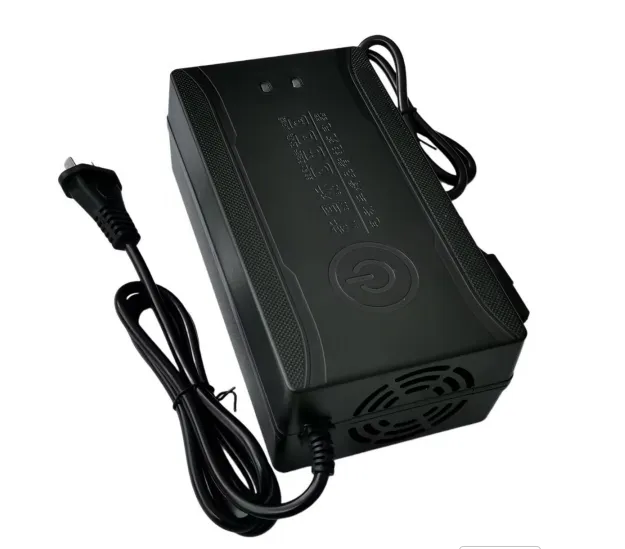
Step 3: Onboard vs External — Where the Charger Lives
Floor scrubber chargers split into two physical form factors, and the choice is operationally significant.
Onboard charger
Integrated into the machine chassis, usually behind a service panel near the battery compartment. The operator plugs a standard NEMA 5-15 / IEC C14 cord into the wall outlet and the onboard electronics handle the rest. This is the dominant form factor on Tennant T7, T16, Kärcher B 90 R, Nilfisk SC1500, Hako Scrubmaster and most ride-on platforms above 24V/175 Ah. Advantages: nothing to lose, nothing to mismatch, the cleaner does not need to know which charger goes with which scrubber. Disadvantages: a charger failure means the machine goes to the service shop, not just a charger swap on the floor; and the onboard charger has to share the machine's thermal envelope with the brush motor electronics, which gets warm.
A common operator question on onboard units: does the charger turn off automatically when the pack is full, or do I need to unplug it? A properly designed onboard charger transitions automatically from bulk to absorption to float and will hold float indefinitely without damaging the pack — leaving it plugged in over the weekend is fine on FLA and AGM. The exception is LFP, which should not be held at float; an LFP-profile onboard charger terminates current at end-of-charge and only reconnects when pack voltage drops below a reconnect threshold.
External charger
A separate box with a power cord into the wall and a DC output cable into the scrubber's charge port. Common on walk-behind machines (Tennant T300, Kärcher BD 50/50 C Bp, Nilfisk SC500, Viper AS510B, IPC Eagle CT15) where the chassis is too small for an onboard unit, and on fleet-charging stations where one external charger services multiple machines on a rotation. Advantages: cheaper to replace if the charger fails, easier to upgrade when the pack chemistry changes (FLA → AGM → LFP retrofit), and one charger can be specified to OEM-grade quality and shared across a fleet of machines that originally shipped with a lower-grade OEM unit. Disadvantages: the cleaner has to remember which charger goes with which scrubber, and the DC cable is a wear-and-loss item.
For fleet operators running 20+ scrubbers across multiple buildings, external chargers in a central charging room — often with one charger per dedicated machine bay — give the best blend of standardisation and serviceability. The Sanyi SY-C500W series and SY-C260W series are commonly specified in this central-room configuration for 24V walk-behind and small ride-on fleets.
Step 4: Pick the Connector — SB50, SB175, DIN 43589, or OEM Proprietary
Scrubber OEMs are less standardised than forklift OEMs on the connector side, but four families dominate.
Anderson SB50 (grey, red, or blue housing): the de facto standard on 24V walk-behind and compact ride-on scrubbers in North America. Used on most Tennant T300/T500 external chargers, Nilfisk SC500/SC450, Viper, IPC Eagle and Advance walk-behinds. Rated 50 A continuous, 120 V working voltage, 10,000 mating cycles. Colour-keyed housing prevents cross-connecting different voltages on a mixed fleet.
Anderson SB175 / SB350: stepped up for larger 24V and 36V ride-on platforms (Tennant T16, T17; Kärcher B 150 R; Nilfisk SC6500) where charge currents exceed 30 A or where opportunity-charging stations need to deliver 50–80 A bulk current to a 240+ Ah pack in a 3–4 hour window.
DIN 43589 (REMA / Schaltbau): the European standard, used on Kärcher EU-spec ride-on machines, Hako Scrubmaster, Comac, Numatic and any platform built for EU-market fleet contracts. The DIN connector is colour-keyed by voltage (24V, 36V, 48V) and rated for 80 A or 160 A depending on housing size. North American OEMs do not use DIN by default — if you are sourcing a charger for a Kärcher or Hako unit built for the EU market, check the connector on the machine itself, not the OEM nameplate.
OEM proprietary 3-pin or 4-pin plugs: Tennant in particular uses several proprietary onboard charge port shapes across the T-series generations, and Kärcher uses a proprietary 3-pin connector on some BD-series walk-behinds. These are sometimes specified for OEM warranty-tracking reasons; replacement chargers usually adapt to SB50 at the next service interval.
The connector is not a trivial choice. A mismatch between the machine inlet and the charger output cable means a field technician with a crimp tool and the wrong connector body, which is how a 24V charger ends up on a 36V scrubber inlet and a $2,400 pack goes pop on a Tuesday morning. Specify the connector at the same time as the charger output spec; do not assume.
Step 5: Application Scenarios — Where Scrubbers Actually Get Charged
The recharge schedule is dictated by where the scrubber works. Seven application scenarios cover the bulk of commercial scrubber service, and each pushes the charger spec in a different direction.
Shopping malls and retail
Single overnight shift, machine charged from 22:00 (mall close) to 08:00 (mall open). 10 hours of wall time, 24V/140 Ah pack typically discharged to 40% SoC. A 15–20 A onboard charger is comfortable.
Logistics warehouses and distribution centres
24/7 three-shift operation. The scrubber runs ~5 hours per shift, three shifts per day, with two 90-minute breaks for charging during shift change. This is the hardest case for charger sizing — the only way to make 90-minute opportunity charging work is to step up to a high-current charger (30–50 A on a 24V pack, 40–60 A on a 36V pack) and to operate on AGM or LFP chemistry, never FLA. The SY-C1000W series at 36V/30A is sized for this duty cycle.
Hospitals and sterile environments
Single overnight shift with absolute requirement for silent operation and zero electrolyte spillage. AGM or LFP only — no flooded packs. The charger must be quiet (no fans audible from 3 metres) and must be safe for unattended overnight charging in a corridor outside the patient ward. UL 1564 listing is mandatory for any major hospital chain in North America.
Airport terminals
Mix of overnight and inter-flight opportunity charging. Large 32–40" ride-on scrubbers (Tennant T16, Kärcher B 150 R) running the concourse between flight banks. 36V/240+ Ah packs, often AGM on first-generation units and LFP on 2024+ refresh fleets. Charger must handle UL 1564 plus airport-specific EMC requirements (the avionics RF environment is unforgiving).
Food processing plants
Wash-down environment. The machine and the charger both get hosed down between shifts. IP65 minimum on the charger enclosure, IP66 preferred. AGM is the workhorse chemistry; FLA is rare because the wash-down environment is incompatible with watering caps that can collect dirty water above the cell.
Education and schools
Single overnight shift, sometimes only weekday operation with weekend dwell. 24V walk-behind dominant (Tennant T300, Kärcher BD 50/50 C Bp, Nilfisk SC500). Cost-sensitive — facility teams want a charger that lasts ten years on the same machine, no premium features. The SY-C260W and SY-C500W series hit this segment.
Hotels
Mixed-floor operation — carpet vacuum in guest corridors, hard-floor scrubber in the lobby and conference levels. Often two smaller walk-behinds rather than one large ride-on, charged in a single closet near housekeeping. Standardisation across the small fleet matters more than absolute charger performance.
Step 6: Opportunity Charging and Fleet Rotation
A scrubber charger in a 24/7 contract-cleaning fleet is not a one-off purchase; it is an operational tool. Three practices materially extend pack life and cut warranty exposure.
Rotation: rotate scrubbers through the duty schedule based on cycle count, not on machine ID. A Tennant T7 with 800 deep cycles on its AGM pack should rotate to a lighter contract before it gets parked on a 24/7 warehouse shift. Modern chargers with onboard cycle counters (or a simple log on the wall) let the facility manager track this without telematics.
Opportunity charging: top up between shifts at 60–90 minute breaks. A flooded pack does not like opportunity charging — it accelerates positive-plate corrosion and forces the operator to skip the absorption stage. An AGM pack tolerates it occasionally, particularly if the charger has a "partial state of charge" mode that suppresses the full absorption-and-float cycle until the next overnight. An LFP pack thrives on it — partial-state-of-charge operation is the LFP optimum and is the main reason 24/7 warehouse cleaning fleets are converting to lithium faster than any other scrubber segment.
Telematics: 2024+ Tennant (IRIS), Nilfisk (TrackClean) and Kärcher Fleet platforms ship with optional fleet-telematics modules that report pack voltage and charge cycles back to the facility manager. A charger with a closed-protocol pairing to those telematics modules lets the manager see "scrubber 014 finished charge at 04:38, ready for 06:00 dispatch" without a walk to the charging room. For fleets moving in this direction, the Sanyi SY-C260W and SY-C500W series chargers include the digital control hooks needed to integrate at the fleet-management layer.
Step 7: Certification — UL 1564, EN 1175, IEC 60335-2-29
Three certification standards apply to commercial scrubber chargers, and the right combination depends on the target market.
UL 1564 (Industrial Battery Chargers) is the North American standard for chargers feeding industrial traction batteries. UL 1564 covers electrical isolation, abnormal-operation fault tolerance, enclosure construction, and the marking requirements that let an OSHA-inspected facility accept the charger. A charger without UL 1564 listing is not legal for indoor commercial charging in any major US hospital, mall or airport contract.
EN 1175 (Industrial Trucks - Safety Requirements, Electrical/Electronic Requirements) is the European equivalent and is required for any commercial scrubber charger sold into EU fleet contracts. EN 1175 covers similar ground to UL 1564 but with EU-specific EMC limits (EN 12895), low-voltage directive compliance (LVD 2014/35/EU), and CE marking.
IEC 60335-2-29 (safety of household and similar appliances — battery chargers) is the global standard for portable plug-in chargers used outside of dedicated charging rooms. Most external scrubber chargers in walk-behind service should carry IEC 60335-2-29 in addition to UL 1564 or EN 1175.
Beyond the big three, ask for:
- CB Scheme certification — international cross-recognition of safety testing, important for OEMs selling into multiple country markets without re-testing in each.
- CE marking with full technical file, not just a self-declaration.
- IEC 61000-6-2 / -6-4 EMC immunity / emission for industrial environments.
- IP54 minimum for indoor-room mounting, IP65 for wash-down food-processing and outdoor patio scrubber applications.
A charger that ships with only a CE self-declaration and no UL, EN or CB test-house listing is not a commercial product — it is a hobby charger with a label.
Step 8: Industry-Specific Engineering Constraints
Floor scrubber service has three engineering quirks that don't apply to forklift or scissor-lift chargers.
Brush motor + vacuum motor inrush. When the operator drops the brush deck and starts the vacuum simultaneously, the pack sees a 120–200 A spike for 200–400 milliseconds. The charger isn't supplying that current — the pack is — but the charger's pack-voltage sensing has to ride through the voltage sag without spuriously dropping out of float or into a fault mode. A charger that misreads the inrush sag as a pack-disconnect event will repeatedly cycle through its restart sequence and never finish a charge.
Wash-down environment and IP rating. The scrubber is a water-spraying machine. The charger lives on or next to that machine. Specify IP54 minimum for onboard charger enclosures, IP65 for any external charger that gets washed down with the squeegee deck, IP66 for food-processing service. The water-spray test is not theatre — failed gaskets at the connector terminals are the #1 warranty issue on chargers that were designed for indoor-rack service and then relabelled for scrubber duty.
Automatic water-fill and recovery-tank linkage. Modern scrubbers (Tennant T7AMR, Kärcher B 90 R Bp Adv) have solenoid valves that automatically fill the clean-water tank and pump out the recovery tank when the machine is docked at the charging station. The charger does not directly drive those solenoids, but on integrated charging-station designs the charger and the water-management electronics share the same 24V auxiliary rail. The charger's auxiliary output must be able to sustain the 2–3 A solenoid load during the water-cycle without dropping the main pack-charging current. Most commercial scrubber chargers handle this without comment; light-duty repurposed chargers do not.
Step 9: Sanyi Charger Product Map for Commercial Scrubber Service
Sanyi manufactures industrial battery chargers across the full voltage and power range that commercial scrubber fleets need. Three product families cover the major use cases.
- SY-C260W series (260W, 5 A): right-sized for 12V auxiliary banks on hybrid wet/dry scrubbers, small 24V walk-behind machines in the 17–20" deck class (Tennant T300, Kärcher BD 50/50 C Bp, Nilfisk SC500), and as a maintenance / desulfation float charger for off-rotation scrubbers sitting in long-term storage.
- SY-C500W series (500W, 10 A): the volume product for 24V mid-size walk-behind and compact ride-on scrubbers in the Tennant T500 / Kärcher BD 50/70 R Bp / Nilfisk SC450 class. Configurable for FLA / AGM / gel / LFP via front-panel chemistry select. The right unit for school, hotel, mall, and small-warehouse contracts.
- SY-C1000W series (1000W / 1200W / 1600W, up to 30 A): the large-format workhorse for 36V Tennant T16, T17; Kärcher B 150 R; Nilfisk SC6500; Hako Scrubmaster B175 R; Comac Optima 100 BS. Also fits opportunity-charging stations on 24/7 three-shift logistics-warehouse and airport-terminal fleets.
All Sanyi commercial scrubber chargers are built for UL 1564 / EN 1175 / IEC 60335-2-29 listing on request, IP54 / IP65 enclosure options, and IUoU three-stage / CC-CV configurable charge algorithms. For a full product line walkthrough or to discuss a fleet-specific OEM pairing, see the Sanyi product catalog or contact our engineering team.
FAQ
Can I use my existing AGM scrubber charger to charge a LiFePO4 retrofit pack?
No. An AGM-profile charger holds 28.8–29.2 V (on 24V) or 43.2–43.8 V (on 36V) at the absorption stage and then drops to a float voltage of around 27 V / 40.5 V, holding indefinitely. An LFP pack does not need or want either of those behaviours. The LFP cells will continue accepting current past their safe top voltage and the pack BMS will trigger over-voltage protection and disconnect. Best case: a BMS hard-reset is needed before the pack will accept charge again. Worst case: permanent cell imbalance and a pack replacement. An LFP retrofit requires a new charger, full stop — either a chemistry-select capable charger like the SY-C500W series switched to the LFP profile, or a dedicated LFP charger.
Does an onboard floor scrubber charger turn off automatically, or do I need to unplug it when the pack is full?
A properly designed onboard charger transitions automatically from bulk to absorption to float when the pack reaches full charge, and holds float indefinitely without damaging an FLA or AGM pack. Leaving the machine plugged in over a weekend is fine on lead-acid chemistries. For LFP packs the picture is different: the LFP-profile charger terminates current at end-of-charge and only reconnects when pack voltage drops below a reconnect threshold, so leaving it plugged in is also fine but no charging current is flowing most of the time. The only case where unplugging matters is on older non-microprocessor "ferroresonant" chargers (pre-2005, mostly on legacy Tennant 5680 / 5700 machines) that do not have a proper float stage — those should be unplugged within an hour of full charge.
Why does my Tennant T500 only run for 1 hour after a "full" charge?
Three common causes. (1) The pack is at end of life — AGM packs typically deliver 600–1000 cycles before capacity drops below 50%, and a scrubber pack four years into daily service is often there. Load-test the pack with a carbon-pile tester. (2) The charger has aged and the absorption voltage has drifted low — measure absorption at the pack terminals; if below 28.8 V on a 24V AGM pack, the charger needs service. (3) One or more cells in the pack has gone open-circuit or developed a high-resistance internal short — common on AGM packs that have been hot-stored or repeatedly deep-discharged. Individual-cell voltage measurement under load identifies the bad cell.
Do I need a new charger when I upgrade from AGM to LiFePO4 on a Kärcher BD 50/70?
Yes — see the first FAQ above. An AGM charger will not safely charge LFP. The good news is that a chemistry-select charger purchased today (Sanyi SY-C500W with the LFP profile, for example) can handle both chemistries from a single SKU, which simplifies the procurement decision for a facility that is part-way through an AGM-to-LFP retrofit rollout across a mixed fleet.
Can I charge my floor scrubber in a warehouse where summer ambient temperature hits 40°C?
Yes, but with caveats. Most commercial scrubber chargers are rated for 0–40°C ambient operation and will derate above 40°C — meaning charging time gets longer as the charger thermally throttles its output. The pack itself becomes the bigger concern: charging an AGM pack at 45°C+ ambient accelerates positive-plate corrosion and shortens cycle life. A charger with automatic temperature compensation (which adjusts absorption and float voltages downward in hot ambient) is essential for summer-warehouse service. LFP tolerates high charging temperature better than AGM but still benefits from a charger that throttles current above 45°C cell temperature.
Is UL 1564 certification mandatory for floor scrubber chargers in the United States?
For commercial use in any facility that hosts public visitors (malls, hospitals, airports, schools, hotels, restaurants), yes, in practice. UL 1564 listing is not federally mandated in the same way that, say, an electrical permit is, but every major facility-services contract (ISS, ABM, Aramark, Sodexo, Compass) and every major OEM warranty (Tennant, Kärcher, Nilfisk) requires UL 1564 listing on chargers used with their equipment. OSHA inspectors will flag non-UL chargers in a workplace inspection and the facility insurer will deny claims on fire incidents traced to non-listed equipment. EN 1175 plays the equivalent role in the EU. Treat both as mandatory for any commercial deployment; a CE self-declaration alone is not a substitute.
How do I tell if my Hako Scrubmaster needs the European DIN 43589 charger or the US Anderson SB50?
Look at the inlet on the machine, not the OEM nameplate. A Hako built for the EU market typically ships with DIN 43589; a unit imported into North America and re-marketed by a US distributor often has the inlet swapped to Anderson SB50 at port. If the inlet is square-bodied with two large round pins, that is DIN; if it is rectangular grey-bodied with two flat blades, that is SB50. When in doubt, the machine serial-number plate carries a build-spec code that identifies the original-market configuration.
Can the same charger handle a Tennant T7 and a Nilfisk SC1500?
Yes if both are 24V and both run the same battery chemistry — and most contract-cleaning fleets standardise on AGM across mixed OEM fleets exactly for this reason. The SY-C500W series at 24V/10A covers both platforms with the same SKU, which simplifies central-charging-room spares inventory. Connector spec on the charger cable may need a one-step swap (the SB50 housing is identical; the cable length and lug may differ between OEM cable harnesses), but the charger body is the same unit.
For sizing and certification support on a specific floor scrubber platform or contract-cleaning fleet retrofit, contact the Sanyi engineering team with the machine model number, pack chemistry, target recharge window, and operating environment. We size and certify chargers across the full 24V–80V commercial cleaning range and ship UL 1564 / EN 1175 / IEC 60335-2-29 listed units globally.
.webp)