


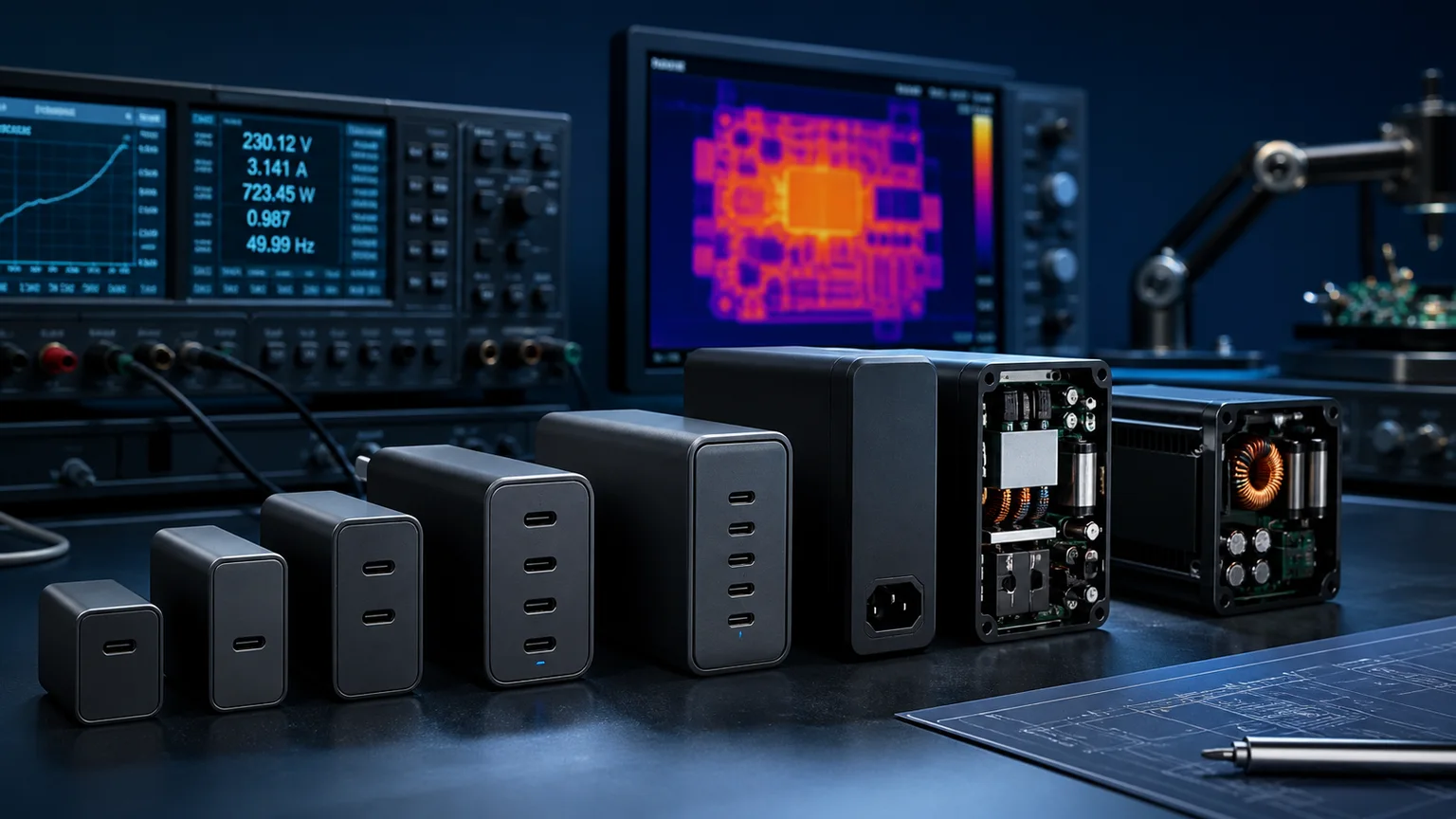

Every wall adapter, laptop brick and USB-C charger you ship into North America or Europe has to clear an energy-efficiency hurdle before it can legally cross the border. It is not a marketing badge or a nice-to-have — it is a market-access gate. In the United States that gate is DOE Level VI; in the European Union it is ErP Lot 6 Tier 2. Miss the active-mode efficiency target or the no-load power limit by a fraction of a percent and customs, importers and large retailers will turn the shipment away.
This guide compares DOE Level VI vs ErP Lot 6 external power supply efficiency head to head, then adds the two regimes most teams forget: the voluntary but stricter CoC Tier 2, and Australia/New Zealand's mandatory GEMS MEPS. We cover the Pnet-tier efficiency formulas, no-load power ceilings, the DOE PY registration number, EU EPREL declaration, the USB-PD multi-output trap, and five migration pitfalls that sink real products. It is the energy-compliance companion to our IEC 62368-1 safety standard migration guide — safety and efficiency are two separate gates, and a product must clear both.
Why External Power Supply Efficiency Decides Market Access
An external power supply (EPS) is the AC-DC converter that lives outside the end product — the adapter, the desktop brick, the charger. Because billions ship every year and most spend their lives idling, regulators target them directly: a single percentage point of average efficiency, multiplied across a global fleet, is gigawatt-hours of waste. So the US, EU and several other markets each wrote minimum-efficiency rules and made them a condition of sale.
The practical consequence is blunt. If your adapter does not meet the regional EPS rule, you cannot lawfully place it on that market — and the obligation lands on whoever imports or sells it, not just the factory. For an OEM this means efficiency compliance must be designed in from the first schematic, certified before mass production, and documented for every model and voltage variant.
The Four Regimes at a Glance: DOE Level VI, ErP Lot 6 Tier 2, CoC Tier 2, GEMS MEPS
Four frameworks dominate global EPS efficiency:
- US DOE Level VI — mandatory, the toughest broadly enforced federal floor in the United States.
- EU ErP Lot 6 Tier 2 — mandatory across the European Union (and mirrored by Great Britain and Northern Ireland), closely aligned with Level VI in its targets.
- CoC Tier 2 (Code of Conduct) — voluntary, set by the European Commission's Joint Research Centre, and stricter than both mandatory regimes; favoured by green-procurement and eco-label buyers.
- AU/NZ GEMS MEPS — mandatory minimum energy performance standards for Australia and New Zealand, requiring a registration number before sale.
Level VI and ErP Lot 6 Tier 2 share almost the same numeric targets, which is why a well-designed adapter can satisfy both. CoC Tier 2 raises the bar another step. GEMS runs on its own registration track but tests to comparable methods.
US DOE Level VI Explained (10 CFR Part 430)
DOE Level VI is defined in 10 CFR Part 430, Subpart B, Appendix Z, administered by the US Department of Energy. It became mandatory on 10 February 2016, superseding the older Level V, and applies to single-voltage and multiple-voltage external power supplies across a wide power range — including, after later expansions, many previously exempt categories.
Compliance is not just a test result; it is a registration obligation. Covered products must be certified into the DOE's Compliance Certification Database, where each basic model receives a tracking identifier (manufacturers commonly reference these as PY-series certification numbers). Adapters also carry the efficiency-level marking — the Roman numeral "VI" within the international efficiency marking protocol — so an inspector can read the compliance level off the label. Selling a non-compliant EPS in the US is a federal violation, with the liability falling on the importer of record.
EU ErP Lot 6 Tier 2 Explained (Regulation 2019/1782)
The EU rule lives in Commission Regulation (EU) 2019/1782, adopted under the Ecodesign (ErP) Directive, and its Tier 2 requirements have been mandatory since 1 April 2020. It sets minimum average active efficiency and maximum no-load power for external power supplies placed on the EU market, with targets closely tracking DOE Level VI.
Demonstrating conformity follows the CE route: the manufacturer compiles technical documentation, issues an EU Declaration of Conformity, and affixes the CE mark. Many energy-related products must additionally be registered in the EU's EPREL (European Product Registry for Energy Labelling) database. Post-Brexit, Great Britain enforces an equivalent regime under the UKCA mark, while Northern Ireland continues to follow the EU rule — so a single adapter family often needs both CE and UKCA documentation to cover the whole region.
CoC Tier 2 — The Voluntary Standard That Sets the High Bar
The Code of Conduct on Energy Efficiency of External Power Supplies (CoC), Tier 2 is published by the European Commission's Joint Research Centre. It is voluntary — no law forces it — but its efficiency and no-load targets are stricter than both DOE Level VI and ErP Lot 6 Tier 2, typically by one to a few percentage points of active efficiency plus tighter no-load limits.
Why design to a rule nobody mandates? Because major buyers do. Green public procurement, environmental eco-labels and large brand-owner specifications frequently require CoC Tier 2 as a purchasing condition. Hitting CoC also future-proofs a design: today's voluntary bar tends to become tomorrow's mandatory floor. For an OEM chasing premium accounts, CoC Tier 2 is effectively the real target, with Level VI and Lot 6 satisfied automatically along the way.
AU/NZ GEMS MEPS for External Power Supplies
Australia and New Zealand regulate EPS efficiency through the Greenhouse and Energy Minimum Standards (GEMS) framework, descended from the External Power Supplies Determination 2012. The minimum energy performance standards (MEPS) are mandatory: an external power supply cannot legally be supplied in either country until the model is registered in the GEMS Registry and issued a Registration Number.
The efficiency methodology is harmonised with the international approach, so an adapter engineered for Level VI / Lot 6 usually meets the GEMS numeric targets. The work that catches teams out is administrative — the registration must be completed, the number obtained, and the marking applied before the first unit ships, not after a buyer asks for it.
Efficiency and No-Load Power Formulas (by Pnet Tier)
All four regimes share the same skeleton. Active-mode efficiency is the average of the efficiencies measured at 25%, 50%, 75% and 100% of rated load. The required minimum is not a flat number — it is a formula keyed to nameplate output power (Pnet), because small adapters physically cannot reach the same efficiency as larger ones. Separately, a maximum no-load power caps what the supply may draw while plugged in with nothing connected.
The table below shows representative DOE Level VI / ErP Lot 6 Tier 2 targets for single-voltage AC-DC supplies (Pnet in watts, efficiency as a decimal; figures are the standard published forms, rounded for illustration):
| Pnet range | Min. average active efficiency | Max. no-load power |
|---|---|---|
| ≤ 1 W | ≥ 0.5 × Pnet + 0.16 | ≤ 0.100 W |
| > 1 W to ≤ 49 W | ≥ 0.071 × ln(Pnet) − 0.0014 × Pnet + 0.67 | ≤ 0.100 W |
| > 49 W to ≤ 250 W | ≥ 0.880 | ≤ 0.210 W |
| > 250 W to ≤ 500 W | ≥ 0.875 | ≤ 0.500 W |
Two things matter here. First, in the 1–49W band the requirement rises logarithmically with power, so a 24W adapter faces a higher percentage target than a 6W one. Second, the no-load ceiling is brutally tight — 100 mW for most adapters — which is why standby behaviour, not full-load efficiency, is where many designs actually fail. CoC Tier 2 applies the same structure with higher coefficients and lower no-load caps.
Four-Regime Comparison Table
| US DOE Level VI | EU ErP Lot 6 Tier 2 | CoC Tier 2 (voluntary) | AU/NZ GEMS MEPS | |
|---|---|---|---|---|
| Legal basis | 10 CFR Part 430 App. Z | Reg. (EU) 2019/1782 | JRC Code of Conduct | GEMS / EPS Determination 2012 |
| Status | Mandatory | Mandatory | Voluntary | Mandatory |
| In force since | 10 Feb 2016 | 1 Apr 2020 | Ongoing (revised periodically) | 2012, updated |
| Stringency | High | High (≈ Level VI) | Highest | High |
| Marking | Efficiency mark "VI" | CE mark | CoC tier reference | GEMS Registration No. |
| Registration | DOE database (PY no.) | EU DoC + EPREL | None (self-declared) | GEMS Registry (Reg. No.) |
| Test method | Avg. of 25/50/75/100% load + no-load | Same harmonised method | Same method, tighter limits | Same harmonised method |
Compliance Marking and Certification Workflow
Each regime leaves a different fingerprint on the product and its paperwork:
- DOE Level VI — the "VI" efficiency marking on the label, plus a basic-model entry (PY-series number) in the DOE Compliance Certification Database.
- EU ErP Lot 6 — the CE mark, an EU Declaration of Conformity in the technical file, and EPREL registration where applicable.
- CoC Tier 2 — a self-declared reference to the achieved tier in the technical documentation; no central registry, but buyers audit the test report.
- GEMS MEPS — a GEMS Registration Number issued after registry submission, shown per local marking rules.
A practical shortcut ties them together: the CB Scheme (IEC's mutual-recognition system). A single CB Test Report and Certificate, issued by a recognised lab, can be leveraged into multiple national approvals, cutting duplicate testing. The efficiency data underpinning Level VI, Lot 6, CoC and GEMS is collected the same way, so one well-run test campaign can feed all four declarations. Note the CB Scheme is a market reference here — Sanyi is not an authorised agent of any certification body, and lab selection rests with the customer.
The Multi-Output, USB-PD and Multi-Protocol Compliance Blind Spot
Modern adapters are no longer single-voltage bricks. A USB-C Power Delivery charger negotiates 5V, 9V, 15V, 20V — and with PD 3.1 EPR, 28V/36V/48V rails up to 140W and 240W. This breaks the naive reading of the efficiency rules in two ways.
First, which Pnet do you test against? For a multiple-output or multi-voltage supply, the rated output power used to pick the formula band is the maximum Pnet the supply can deliver — so a 100W PD adapter is judged on the 49–250W rule, not on some lower default profile. Second, efficiency must hold across the negotiated points, not just at the headline 240W. A design that is brilliant at 20V/5A but mediocre at 9V/3A can still fail the averaged target, because real-world load profiles live in the lower rails. This is exactly where protocol design meets compliance, a theme we develop in the USB-C PD 3.1 EPR 240W charger buying guide. Treat every voltage rail as a compliance case, not just the maximum.
Five Migration Pitfalls That Sink Real Products
- Assuming DOE = CoC. They are different bars. Passing mandatory Level VI does not mean you meet voluntary CoC Tier 2 — CoC sits one to several percentage points higher on efficiency and tighter on no-load. Designing only to Level VI then losing a green-procurement tender is a classic miss.
- No-load power failures. The single most common rejection. A leaky standby controller, a bleeder resistor, or an always-on indicator LED can push no-load past the 100 mW ceiling even when full-load efficiency is excellent. Measure no-load early, not at the end.
- Mislabelled product name / model. The label's marked output, model and efficiency level must match the registered basic model exactly. A mismatched model name or output rating invalidates the registration and stops the shipment at inspection.
- Expired or stale certificates. Regulations are revised; a certificate issued under a superseded tier, or one whose test report predates a methodology update, may no longer be accepted. Track expiry and revision dates per model.
- Multi-output models registered only at one rail. For USB-PD and multi-voltage adapters, every relevant output profile must be covered, and the supply judged at its maximum Pnet. Registering only the flagship rail leaves the lower-voltage modes — and the whole SKU — non-compliant.
A sixth trap worth naming: confusing the international efficiency mark (the Roman numeral) with a safety or quality logo. The "VI" marking states an energy level only; it says nothing about safety, which is governed separately under IEC 62368-1.
How This Differs from 80 PLUS Titanium (Internal vs External Supplies)
It is easy to lump all efficiency programs together, but DOE Level VI / ErP Lot 6 apply to external power supplies — the adapter outside the device — while 80 PLUS certifies the internal PSU inside a server or desktop PC. The test conditions differ too: 80 PLUS measures at 10/20/50/100% load and is voluntary (a market badge), whereas Level VI and Lot 6 average 25/50/75/100% load, enforce a no-load ceiling, and are the law. An adapter cannot earn 80 PLUS Titanium, and a server PSU is not subject to Level VI. If your product is the brick on the cord, EPS rules apply; if it is the unit bolted inside the chassis, the 80 PLUS framework is the right reference. The internal-PSU efficiency tiers are covered in our Active PFC vs Passive PFC 80 PLUS efficiency guide.
Sanyi External Power Supplies — DOE Level VI & ErP Lot 6 Tier 2 Compliant
Sanyi engineers its USB-PD, GaN and desktop adapter lines to clear DOE Level VI and ErP Lot 6 Tier 2 as a baseline, with headroom toward CoC Tier 2 where buyers require it:
- HP-series high-power desktop adapters (up to 240W) — workstation and industrial desktop power, designed to the >49W efficiency band with tight no-load behaviour.
- APN-series desktop adapters — mid-power desktop reference engineered for the Pnet-tier active-efficiency targets across the load curve.
- SY-C260W multi-protocol charger — multi-rail USB-PD charging tuned to hold efficiency across negotiated voltages, judged at maximum Pnet.
- SY-C500W high-power charger — high-output charging with no-load and active-mode efficiency targeted for the upper power bands.
Every unit is built for the relevant regional efficiency floor and documented per model and voltage variant, with safety handled separately to IEC 62368-1. References to DOE, the EU Commission, the CB Scheme and certification bodies are for market context only; Sanyi is not their authorised representative. Contact Sanyi for region-by-region efficiency-compliance support and OEM/ODM adapter programs.
FAQ
Is DOE Level VI the same as ErP Lot 6 Tier 2? Their numeric efficiency and no-load targets are very close, so a well-designed adapter typically meets both — but they are separate legal instruments with separate paperwork. Level VI needs DOE database certification and the "VI" mark; ErP Lot 6 needs a CE mark, an EU Declaration of Conformity and often EPREL registration. You must satisfy each regime's documentation, not just hit one set of numbers.
Why design to voluntary CoC Tier 2 if no law requires it? Because large buyers do require it. Green public procurement, eco-labels and major brand specifications often list CoC Tier 2 as a purchasing condition, and its tighter targets future-proof a design against the next mandatory revision. Meeting CoC Tier 2 also means Level VI and Lot 6 are satisfied automatically.
How is a USB-PD multi-voltage adapter tested for efficiency? The output power band used to select the efficiency formula is the supply's maximum Pnet — so a 100W PD adapter is held to the 49–250W rule. Efficiency is then averaged across 25/50/75/100% load, and the design must hold up across the negotiated voltage rails, not just at the headline maximum. Every rail is effectively a compliance case.
Can I import an adapter with no efficiency marking? No. In the US the "VI" efficiency mark and DOE certification are required; in the EU the CE mark plus conformity documentation are required; in Australia/New Zealand a GEMS Registration Number must exist before supply. An unmarked, unregistered EPS will be stopped at customs or rejected by importers and major retailers.
How does this differ from 80 PLUS Titanium? DOE Level VI and ErP Lot 6 apply to external power supplies (the adapter on the cord) and are mandatory law, tested at 25/50/75/100% load with a no-load cap. 80 PLUS Titanium is a voluntary badge for internal PSUs in servers and desktops, tested at 10/20/50/100% load. They cover different products under different rules and are not interchangeable.
.webp)
.webp)