


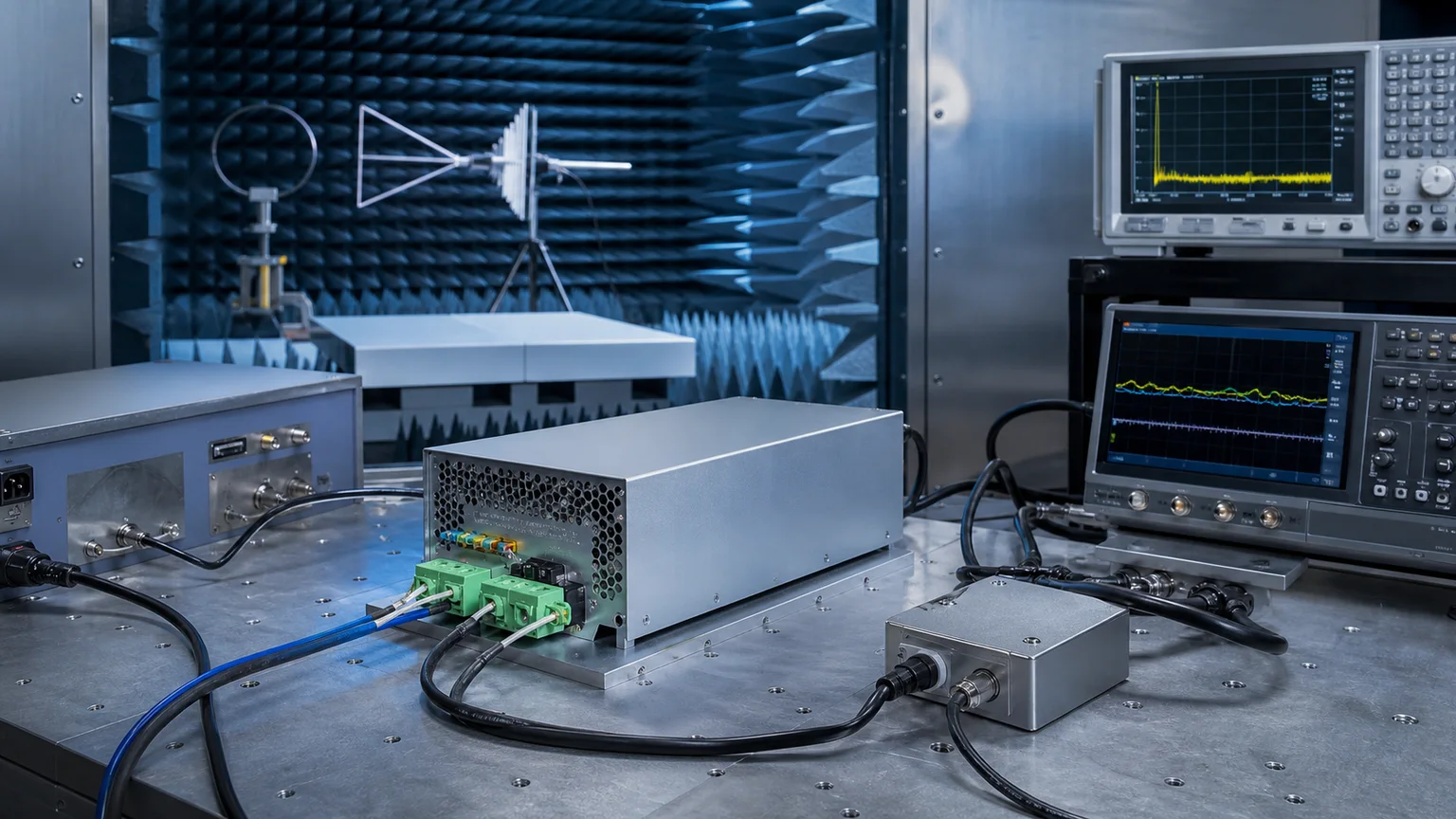

A power adapter can have best-in-class efficiency and a flawless safety file and still be illegal to sell — because it failed EMI testing. Electromagnetic interference compliance is the third mandatory gate every external power supply must clear, alongside safety and energy efficiency, and it is the one that catches engineers by surprise most often. A switching converter is, by its nature, a noise generator: every time the MOSFET switches, it dumps a fast current edge onto the mains and radiates fields into the air. The two regulatory frameworks that decide whether that noise is acceptable are CISPR 32 / EN 55032 in Europe and FCC Part 15 Subpart B Class B in the United States — with Japan's VCCI and China's GB/T 9254 closely tracking them.
This guide compares the four EMI regimes side by side: what they limit, how conducted and radiated emissions are measured, where the Class A / Class B line falls, and how to design an EMI filter that passes without breaking your safety leakage budget.
Why EMI Failure Sinks an Otherwise Perfect Power Supply
EMI is not a "nice to have." In the EU, the EMC Directive (2014/30/EU) makes EN 55032 a hard prerequisite for the CE mark; in the US, 47 CFR Part 15 makes FCC compliance a precondition for marketing the device at all, not just selling it. A unit that hits DOE Level VI efficiency and carries an IEC 62368-1 safety listing is still unsellable if it overshoots the radiated limit at 80 MHz by 6 dB. Worse, EMI problems surface late — often only when a near-final unit reaches an accredited chamber — so a failure can blow up a launch schedule. Treating EMI as a co-equal design constraint from day one, not a final-week formality, is the single biggest lesson seasoned power engineers carry. Think of safety, efficiency and EMC as a compliance triangle: all three edges must hold.
The Four Regimes at a Glance: FCC Part 15 B, CISPR 32 / EN 55032, VCCI, GB/T 9254
For multimedia and IT-style equipment — which is what an external adapter is treated as — four documents dominate the world's major markets:
- US — FCC Part 15 Subpart B: mandatory federal rule for "unintentional radiators." Class A (commercial/industrial) and Class B (residential).
- EU — CISPR 32 / EN 55032: the harmonised emission standard for multimedia equipment (MME), covering both ITE and AV. Class A and Class B, supporting the CE mark under the EMC Directive.
- Japan — VCCI: a voluntary industry scheme that, in practice, every responsible brand follows; its limits are aligned with CISPR 32.
- China — GB/T 9254: China's adoption of the CISPR ITE emission standard, tied into the CCC (3C) system.
All four descend from the same CISPR (International Special Committee on Radio Interference) source documents, which is why their limit lines look so similar — but the legal status, paperwork and a few numeric thresholds differ in ways that matter.
FCC Part 15 Subpart B Class B Explained
47 CFR Part 15 Subpart B governs unintentional radiators — any digital or switching device that emits RF as a byproduct rather than on purpose. It splits the world into two classes:
- Class A — equipment marketed for use in a commercial, industrial or business environment. Looser limits.
- Class B — equipment marketed for use in a residential environment. Tighter limits (typically ~10 dB stricter) because consumer radios and TVs sit nearby.
A consumer USB charger or laptop adapter is almost always Class B. The compliance route for most adapters is the Supplier's Declaration of Conformity (SDoC) — the manufacturer self-declares conformity based on testing at an accredited lab, keeps the report on file, and applies the required labeling. (The older "Verification" and "Certification/FCC ID" routes apply to other device categories; an adapter's host equipment may carry an FCC ID, but the bare power supply typically ships under SDoC.) Self-declaration does not mean "no testing" — you still need a measured report from a competent lab; it only means no upfront filing with the Commission.
CISPR 32 / EN 55032 Explained
CISPR 32 (adopted in Europe as EN 55032) is the emission standard for multimedia equipment — it merged the older EN 55022 (ITE) and EN 55013 (broadcast receivers) into one document. Like FCC, it defines:
- Class A — for commercial/industrial environments; the user manual must warn that the product may cause interference in a domestic setting.
- Class B — for domestic/residential environments; the default expectation for consumer adapters.
EN 55032 covers only emissions. Immunity is handled by its sister standard EN 55035. Together with the IEC 62368-1 safety standard, EN 55032 forms the complete technical chain behind a legitimate CE mark — safety, emissions and immunity each proven separately. For the full safety half of that chain, see our IEC 62368-1 power supply safety standard migration guide.
VCCI and GB/T 9254: The Asian Market Gates
VCCI (Voluntary Control Council for Interference) is, as its name says, voluntary — but in Japan it is a de-facto market entry requirement. Major retailers and OEMs expect the VCCI mark, and because VCCI limits mirror CISPR 32, a product that already passes EN 55032 Class B usually clears VCCI with the same data, subject to VCCI's registration and labeling rules.
GB/T 9254 is China's adoption of the CISPR ITE emission standard and feeds into the CCC / 3C mandatory certification scheme for many product categories. The limit lines track CISPR closely, but China requires testing in a recognised domestic lab and its own certificate paperwork — a foreign EN 55032 report is a strong technical basis but is not, by itself, a Chinese certificate. The practical upshot: design once to the CISPR limit line and you are close on all of Europe, Japan and China; the differences are mostly procedural.
Conducted Emission (CE, 9 kHz–30 MHz)
Conducted emissions are the RF noise an adapter pushes back onto the AC mains wiring. Measurement uses a LISN (Line Impedance Stabilization Network), which presents a defined 50 Ω/50 µH impedance to the device and taps the noise voltage for the receiver. Results are read in dBµV.
Two detectors matter:
- Quasi-peak (QP) — weights bursts by how annoying they would be to a listener; the primary pass/fail line.
- Average (AV) — a lower limit that catches continuous, narrow-band noise (a switching converter's fundamental and harmonics).
A signal must pass both the QP and AV limits where both apply. The CISPR 32 / EN 55032 conducted band runs 0.15–30 MHz; FCC Part 15 B starts at 0.15 MHz too (CISPR also extends down to 9 kHz for some equipment). Typical Class B conducted limits:
| Frequency band | CISPR 32 / EN 55032 Class B (QP) | CISPR 32 / EN 55032 Class B (AV) | FCC Part 15 B (QP) |
|---|---|---|---|
| 0.15–0.5 MHz | 66 → 56 dBµV (decreasing) | 56 → 46 dBµV | 66 → 56 dBµV |
| 0.5–5 MHz | 56 dBµV | 46 dBµV | 56 dBµV |
| 5–30 MHz | 60 dBµV | 50 dBµV | 60 dBµV |
The conducted band is where the switching fundamental (typically 65–150 kHz in classic designs) and its low harmonics live — and where a good input EMI filter earns its keep.
Radiated Emission (RE, 30 MHz–1 GHz)
Radiated emissions are the fields the adapter throws into the air. They are measured in a semi-anechoic chamber (SAC) or on an open-area test site, at a 3 m or 10 m measurement distance, using a biconical antenna (30–200 MHz) and a log-periodic antenna (200 MHz–1 GHz), with the turntable and antenna height swept to find the worst-case field. Results are in dBµV/m.
Representative Class B radiated limits at 3 m:
| Frequency band | CISPR 32 / EN 55032 Class B @ 3 m (QP) | FCC Part 15 B @ 3 m (QP) |
|---|---|---|
| 30–230 MHz | 40 dBµV/m | ~40 dBµV/m |
| 230–1000 MHz | 47 dBµV/m | ~46 dBµV/m |
The numbers are close because both trace back to CISPR. The radiated band is dominated by common-mode currents on cables and by the high-frequency harmonics of fast switching edges — which is exactly why GaN designs (next section) need extra attention here.
Four-Regime Limit Comparison
Because all four regimes share CISPR roots, a single Class B design target gets you most of the way everywhere. The summary below shows how closely they align for residential-class adapters:
| Aspect | FCC Part 15 B | CISPR 32 / EN 55032 B | VCCI B | GB/T 9254 B |
|---|---|---|---|---|
| Conducted band | 0.15–30 MHz | 0.15–30 MHz (9 kHz for some) | 0.15–30 MHz | 0.15–30 MHz |
| Radiated band | 30 MHz–1 GHz (up to 40 GHz w/ clock) | 30 MHz–1 GHz (+ above) | 30 MHz–1 GHz | 30 MHz–1 GHz |
| Conducted QP @ 0.5–5 MHz | 56 dBµV | 56 dBµV | 56 dBµV | 56 dBµV |
| Radiated QP @ 30–230 MHz (3 m) | ~40 dBµV/m | 40 dBµV/m | 40 dBµV/m | 40 dBµV/m |
| Legal status | Mandatory (SDoC) | Mandatory (CE / EMC Directive) | Voluntary (de-facto) | Mandatory (3C) |
| Detectors | QP / AV | QP / AV | QP / AV | QP / AV |
The takeaway: design to the CISPR 32 Class B line with margin and you will clear FCC, VCCI and GB/T 9254 on the same hardware — the work that remains is procedural (each market's lab, certificate and label), not a redesign.
EMI Filter Design Essentials
The input EMI filter is the single most important block for passing conducted emissions. Three components do the heavy lifting:
- X-capacitor (differential-mode): connected line-to-neutral, it shunts differential-mode noise. X-caps are safety-rated (X1/X2) so a failure cannot create a fire hazard.
- Y-capacitor (common-mode): connected line/neutral-to-ground, it shunts common-mode noise. Y-caps are also safety-rated (Y1/Y2) because they bridge the isolation barrier.
- Common-mode choke: two windings on one core that present high impedance to common-mode current while letting differential (load) current pass.
The critical trade-off: bigger Y-caps suppress common-mode noise better, but they also raise earth leakage current, which is bounded by safety standards — commonly ≤0.25 mA for a Class II adapter. Push the Y-cap up to fix a radiated problem and you can fail the safety touch-current test. This is precisely where the EMC and safety files collide, and why the two have to be engineered together rather than in sequence. (For the related low-frequency story — harmonic current under EN 61000-3-2, below 2 kHz — see our Active vs Passive PFC selection guide; PFC and EMI are different bands of the same "what you put back on the mains" problem.)
The USB-PD / GaN High-Frequency EMI Blind Spot
GaN-based USB-PD adapters win on size and efficiency, but they shift the EMI problem in two ways. First, higher switching frequency — moving fsw from ~100 kHz up to 300 kHz–1 MHz shrinks the magnetics but pushes harmonic energy straight into the sensitive radiated band above 30 MHz. Second, faster edges — GaN's high dV/dt slew rate has rich high-frequency content that couples into cables and the PCB ground as common-mode current, the dominant radiated-emission mechanism. The countermeasures are layout-centric: tight switching loops, careful shielding of the transformer and switch node, controlled gate drive to tame the edge without killing efficiency, and disciplined PCB ground partitioning. A GaN design that ignores these will often pass conducted and then fail radiated at 100–300 MHz. Our GaN USB-PD lines are laid out specifically to keep that radiated margin intact while holding Class B.
Five Common EMI Debug Pitfalls
- Treating Class A limits as the target for a consumer product. Class A is ~10 dB looser; design to Class A and your residential adapter fails the Class B line it actually has to meet.
- Cranking up the Y-cap and breaking the leakage budget. A bigger Y-cap fixes common-mode noise but can push earth leakage past the ≤0.25 mA safety limit. Fix the noise source and the choke first.
- Answering every radiated overshoot with more shielding. Shielding hides a symptom; if the real source is a common-mode current on the output cable, a ferrite or a layout fix beats a metal can.
- Letting the common-mode choke saturate. An undersized core saturates at full load, collapsing its impedance exactly when you need it — the filter looks fine on the bench at light load and fails at rated power.
- Missing the PD handshake EMI peak. USB-PD voltage negotiation and renegotiation create transient operating points; if the test only sweeps one fixed output, the noise spike during a protocol handshake or a load step can go unmeasured and surface in the field.
Sanyi Power Supply Ecosystem — FCC Class B + CISPR 32 B Certified
Sanyi engineers its USB-PD, GaN and desktop adapter lines to clear FCC Part 15 Class B, CISPR 32 / EN 55032 Class B and GB/T 9254 Class B together, so a single platform ships into the US, EU, Japan and China without a per-market redesign. For high-power applications, the HP high-power adapter series (up to 240W) is built with the input filtering and shielding needed to hold Class B at high throughput. The APN desktop adapter series covers mid-power desktop and IT loads with the same EMC discipline. For multi-port and workstation charging, the SY-C260W multi-mode charger and the higher-output SY-C500W high-power charger carry the conducted/radiated margin that GaN-dense designs demand.
Because efficiency, safety and EMC are a single triangle, our adapters are designed to satisfy all three at once — pairing this EMC work with the energy-efficiency rules covered in our DOE Level VI vs ErP Lot 6 efficiency guide and the safety chain in the IEC 62368-1 guide above. Contact our power engineering team with your power, port and destination-market requirements and we will recommend a compliant platform and the matching test data.
FAQ
Is passing FCC Part 15 Class B the same as passing CISPR 32? Almost, but not legally. Both descend from CISPR source documents and their Class B limit lines are very close, so a design with margin under one usually clears the other on the same hardware. But they are separate legal regimes: FCC requires its own SDoC report and US labeling, while CISPR 32 / EN 55032 supports the CE mark under the EU EMC Directive. You still need a report and paperwork for each market — you just rarely need a hardware redesign.
What is the real difference between Class A and Class B? Class A is for commercial/industrial environments; Class B is for residential environments and is roughly 10 dB stricter because consumer radios and TVs are nearby. A consumer adapter is almost always Class B. Designing to Class A and shipping into homes is one of the most common — and most expensive — EMI mistakes.
Why are GaN USB-PD adapters so hard to pass on radiated emissions? Two reasons: their switching frequency is much higher (300 kHz–1 MHz), pushing harmonic energy into the 30 MHz–1 GHz radiated band, and GaN's fast switching edges have rich high-frequency content that couples onto cables as common-mode current — the main driver of radiated emission. Tight loops, shielding, controlled gate drive and careful PCB grounding are essential.
Does an FCC SDoC self-declaration mean I can skip testing? No. SDoC means you do not file with the Commission upfront, but you still need a measured emissions report from a competent (accredited) lab, kept on file, plus correct labeling. Self-declaration shifts the paperwork, not the physics — an untested product that overshoots a limit is still non-compliant and subject to enforcement.
How do I balance Y-capacitor value against earth leakage current? A larger Y-cap suppresses common-mode (radiated and high-band conducted) noise but raises earth leakage current, which safety standards cap — commonly ≤0.25 mA for a Class II adapter. The right approach is to minimise the noise source and rely on the common-mode choke first, then use the smallest Y-cap that meets the EMI limit while staying inside the leakage budget. This is why the EMC and safety files must be engineered together.
.webp)
.webp)