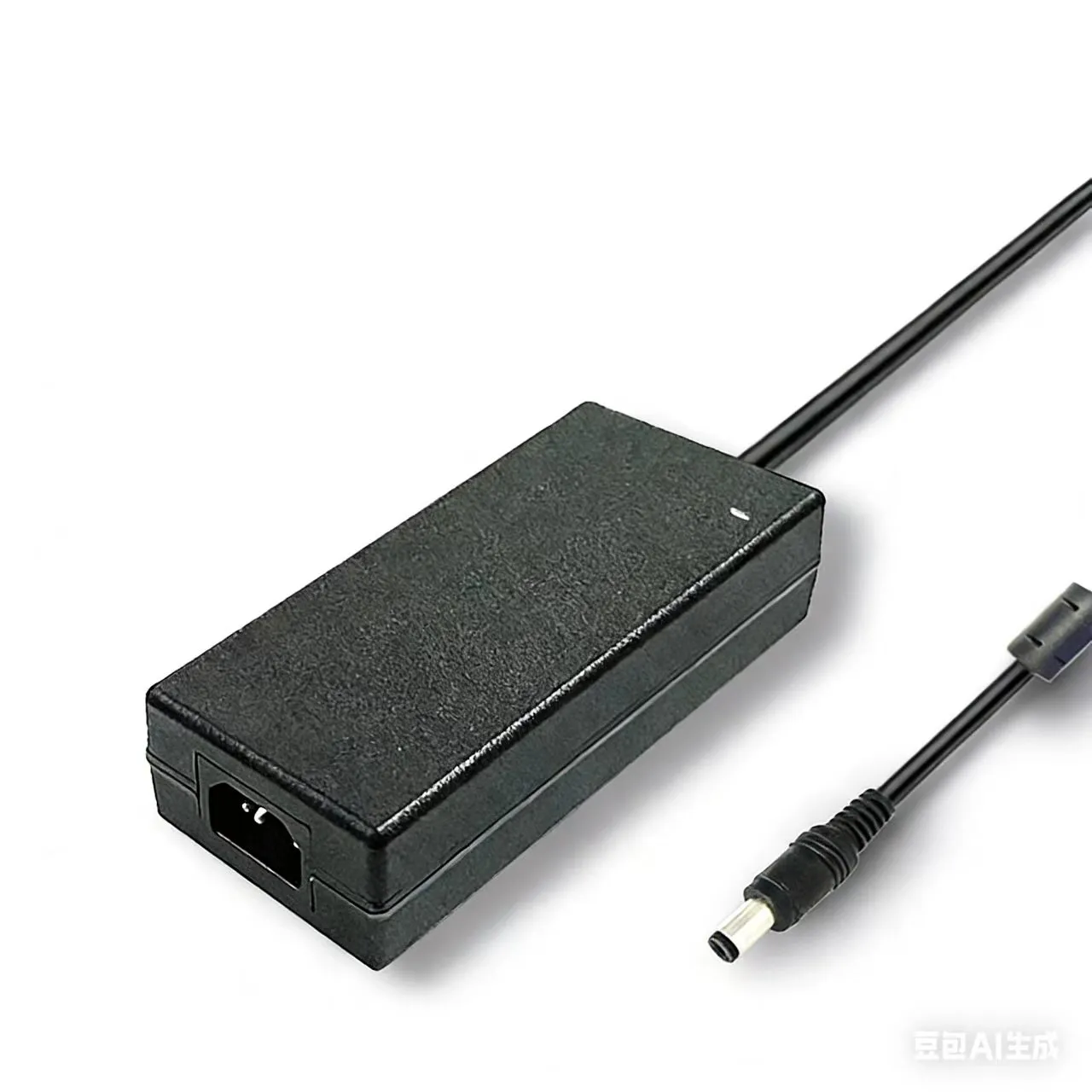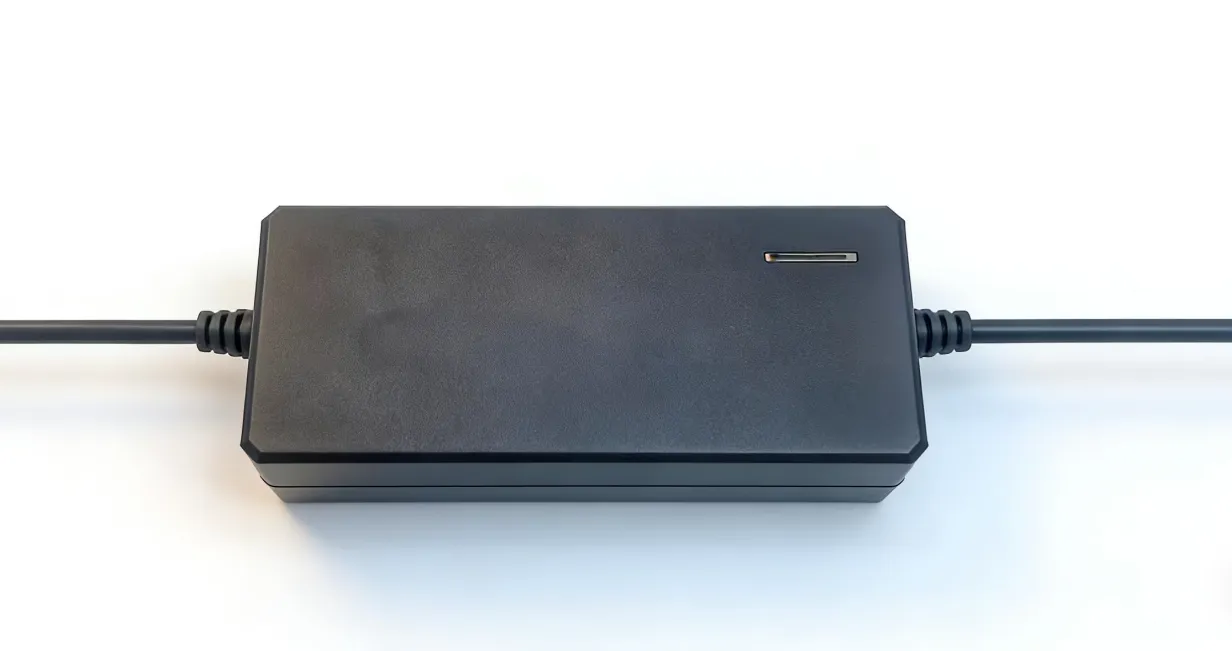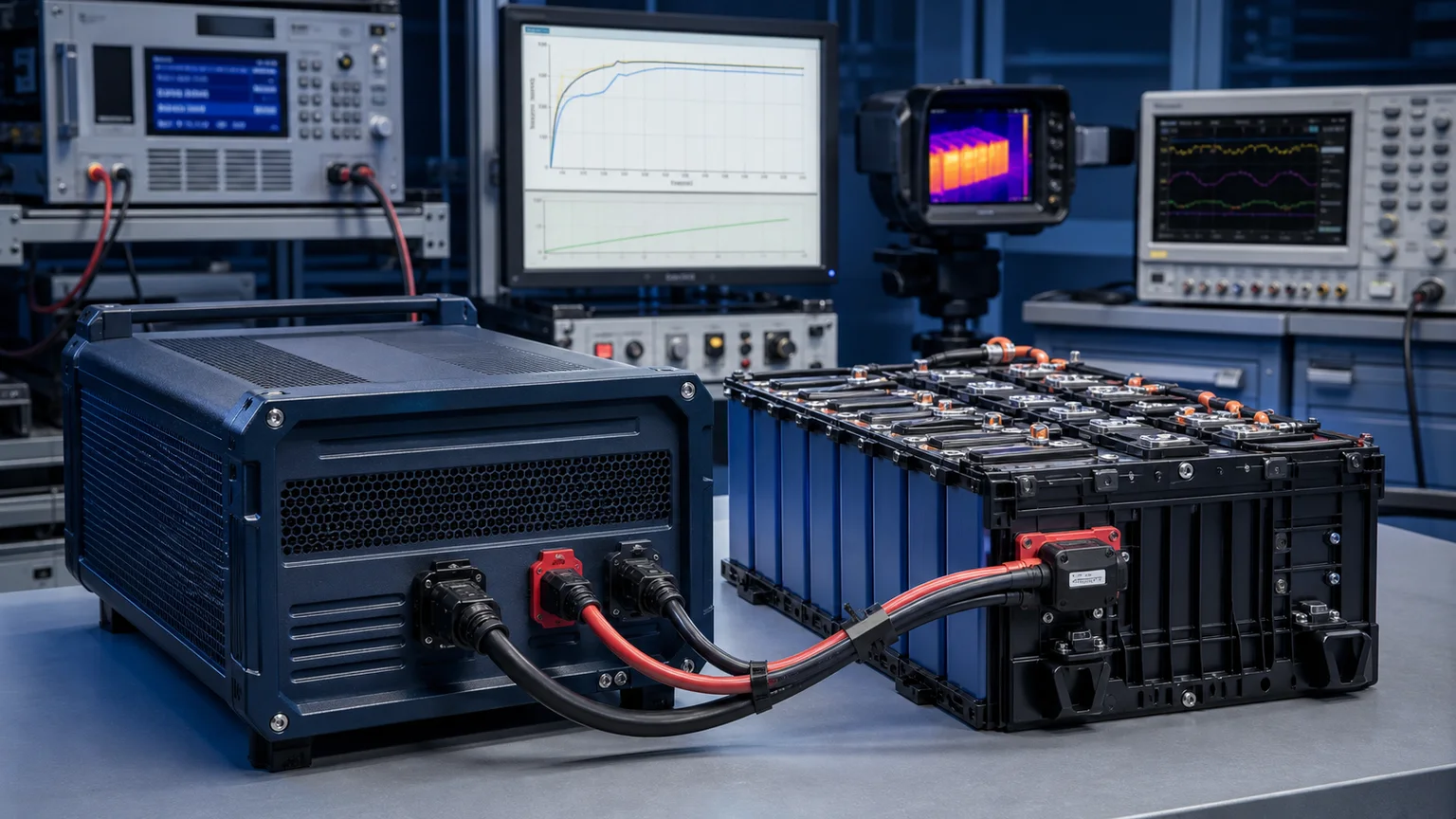

A boom lift battery charger sits in a different design corner from any other MEWP charger. The pack it has to feed is bigger — a Genie Z-60/37 FE or a JLG E450AJ carries three to four times the kilowatt-hours of a slab scissor lift — the platform itself reaches 60–135 feet of working height, the duty cycle is dominated by traverse rather than lift, and the work envelope is almost always outdoors. A charger that does fine on a Skyjack SJIII 3219 in an indoor warehouse will undersize badly on a Genie S-65 outdoors in February, or will gas an AGM pack on a Haulotte HA20RTJ Pro stranded under tarps on a winter jobsite.
This guide covers boom lift battery charger selection in 2026 — how to size for the three voltage classes (24V compact electric, 48V mid-size articulating, 80V large telescopic and hybrid), how to pick an algorithm for FLA / AGM / Gel / LiFePO4 retrofits, why boom lift connectors skipped the SB50 generation and jumped to SBE 320 / SB175 / SB350, what UL 1564 and EN 1175 actually require on outdoor MEWPs, and how rental yards design opportunity-charging schedules for the high-rotation S-series fleet.
Why Boom Lift Chargers Are Their Own Category
A scissor lift charger has it easy: it runs indoors, the pack is rarely below 5 °C, the charger lives bolted to a chassis on a flat warehouse floor and the operator plugs it into a 120 V wall outlet every night. None of that applies to a boom lift. Articulating booms (Genie Z, JLG 600AJ/800AJ, Haulotte HA, Snorkel A) are deployed for façade work, steel-erection, bridge inspection — outdoors, often at altitude, often at –10 °C. Telescopic straight booms (Genie S, JLG 600S/800S, Skyjack SJ45/63, Snorkel T46/T62) traverse jobsites at 4 mph all day before they ever raise the boom, so the drive motors draw 60–80% of pack capacity in transit and only the remaining 20% is left for actual elevation work. That means the recharge target is steeper, faster, and has to happen in less wall time than a scissor lift gets.
Three design pressures fall out of that profile. The charger must finish a 60–80% depth-of-discharge recharge inside a 10-hour overnight window even at single-phase 220 V shore power. The enclosure must survive horizontal rain, jobsite dust and chassis vibration that easily exceeds 5 G peak — minimum IP54, IP65 preferred for chassis-mounted units on telescopic booms. And the algorithm must handle a pack temperature swing of 40 K from a frosty 6 a.m. plug-in to a hot 3 p.m. opportunity top-up, with temperature compensation that actually tracks the pack rather than the charger's own heat sink.
For the IP-rating digit-by-digit breakdown that underpins outdoor MEWP charger selection, our waterproof power supply selection guide is the long-form reference.
Step 1: Identify Your Boom Lift's Voltage Class
The lift forces the voltage; the charger follows. Boom lift packs cluster into three nominal voltages — and crucially, the cut between 48V and 80V usually correlates with whether the unit is purely electric or a fuel-electric (FE) hybrid.
| Boom class | Typical models | Pack voltage | Typical pack capacity | Typical charger output |
|---|---|---|---|---|
| Compact electric articulating (slab + light outdoor) | Genie Z-34/22 N (electric), Snorkel A38E, Haulotte Compact 12 DX (boom variant) | 24V (4× 6V FLA, or 2× 12V AGM) | 215–245 Ah | 24V / 25–30 A |
| Mid-size articulating, 40–45 ft | Genie Z-45/25 DC, JLG E450AJ, Skyjack SJ45 AJ+, Snorkel A46JE | 48V (8× 6V FLA, or 4× 12V AGM/LFP) | 280–375 Ah | 48V / 25–30 A |
| Mid-size straight telescopic, 45–63 ft | JLG 600S electric variants, Skyjack SJ63 AJ+, Haulotte HA20 LE Pro | 48V or 80V | 315–415 Ah | 48V/30A or 80V/20–25 A |
| Large telescopic / hybrid FE | Genie Z-60/37 FE, Genie S-65/85 (FE variants), JLG H800AJ (hybrid), Haulotte HA32 RTJ Pro, Snorkel A62JRT | 80V (FE traction pack) | 280–415 Ah | 80V / 20–25 A |
| Pure electric large telescopic (2024+) | Genie Z-80/60 E-Drive (where available), JLG 1200SJP electric variants | 80V LFP | 400–600 Ah | 80V / 25–30 A |
The 24V boom class is small in volume — most rental yards run more Genie Z-34s than they run Z-45s, but the Z-34 N is overshadowed by Genie's own scissor-lift volume. The real fleet workhorses are the 48V articulating mid-sizes (Genie Z-45/25, JLG E450AJ, Skyjack SJ45 AJ+) and the 80V hybrid telescopics (Genie Z-60/37 FE, JLG H800AJ, Haulotte HA32 RTJ Pro). Get the charger right for those two segments and the rest of the fleet falls into place.
The Sanyi SY-C500W series charger covers the 24V and 48V slab-to-mid boom class at 10–20 A output, and the Sanyi SY-C1000W ultra-high-power charger is the workhorse for 48V/80V large packs at 20–30 A output. Both are configurable to chemistry profile and IP-rated for outdoor mounting.
Step 2: Why 80V Wins on Large Booms
80V is not just "48V plus a bit." It is a deliberate architectural choice on telescopic and hybrid booms. Two physical realities drive it.
Traction current scales with mass. A Genie S-65 FE weighs around 11,500 kg with the boom retracted; a JLG 800S sits at 14,300 kg; a Haulotte HA32 RTJ Pro is 17,200 kg. Driving that mass at 4 mph on a sloped jobsite requires drive-motor torque that, at 48V, would mean phase currents over 400 A continuous. Stepping to 80V cuts the steady-state current to under 250 A — which directly cuts the cable cross-section in the chassis loom, the contactor weight, the controller's MOSFET count, and the resistive losses across the traction pack. Every charger pair manufacturer faces the same trade: higher voltage, smaller copper, lower thermal load.
Pack energy density is higher at 80V. A 48V 415 Ah pack delivers ~19.9 kWh; an 80V 280 Ah pack delivers ~22.4 kWh in roughly the same physical footprint because the cell-balance / BMS overhead and inter-cell busbars amortise better across the higher voltage. For a boom designed to run an 8-hour outdoor shift without an opportunity charge, that 10–15% energy gain at the same battery-tray volume is the difference between an honest day's work and a 3 p.m. low-battery alarm.
The downside is that 80V chargers are not interchangeable with 48V units — the output stage transformer, the rectifier topology and the output capacitor bank are sized differently, and a 48V charger forced to charge an 80V pack will simply trip on over-voltage feedback at the top of bulk. Rental yards running a mixed 48V/80V fleet should colour-code the chargers on the wall and use physically incompatible connectors between the two classes (SB175 grey for 48V, SBE 320 black for 80V) to make cross-plugging impossible. Pulled wrong, an operator can put 80V on a 48V pack and cook all eight cells in under 90 seconds.
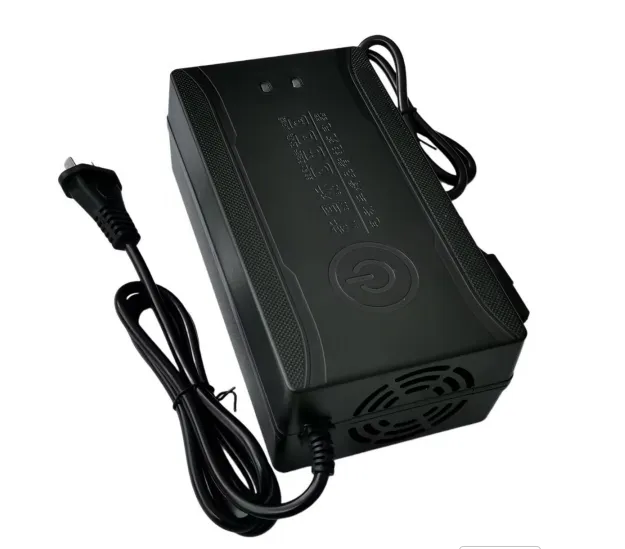
Step 3: Match the Charge Algorithm to the Chemistry
A boom lift pack is one of four chemistries, and the charger algorithm must explicitly support that chemistry — there is no universal MEWP charger that does all four correctly out of the box.
Flooded Lead Acid (FLA)
Still the volume chemistry on rental boom lifts because of cost, abuse tolerance and the watering routine being acceptable on a yard with a maintenance crew. FLA needs a true IUoU three-stage profile: constant-current bulk at 0.10–0.15 C up to absorption (28.8–29.4 V for 24V packs, 57.6–58.8 V for 48V, 96–98 V for 80V at 25 °C), constant-voltage absorption until taper to ~3% of pack capacity, then float at 26.4 V / 52.8 V / 88 V. A periodic equalisation cycle (31.2 V / 62.4 V / 104 V for 2–4 hours every 30–60 cycles) is mandatory to reverse stratification on heavy-traverse boom packs that spend most of their cycle in partial-state-of-charge service. A charger that skips equalisation will let a flooded pack stratify within a year.
AGM (Absorbed Glass Mat)
The default on indoor-only articulating booms and on units rented to airport, hospital and food-processing customers where electrolyte spillage is unacceptable. AGM uses the same IUoU framework but with tighter absorption (28.8–29.2 V / 57.6–58.4 V / 96–97 V) and no equalisation — the sealed VRLA construction is destroyed by the high-voltage equalisation cycle that FLA tolerates. Cross-pollinating an FLA-profile charger onto an AGM pack will gas it and halve its cycle life.
Gel
Less common on booms but used in temperature-sensitive applications (cold-storage retrofit work, outdoor northern fleets). Absorption voltage drops to 28.4–28.8 V / 56.8–57.6 V, current limit is capped tighter, and float of 27 V used on AGM is too high for gel.
LiFePO4
The fastest-growing segment of MEWP battery service since 2024. LFP retrofits on Genie Z-45/25 and JLG E450AJ are widely available at 48V / 280 Ah; new pure-electric large-telescopic platforms (Genie Z-80/60 E-Drive, JLG 1200SJP electric variants) ship from the OEM as 80V LFP. LFP demands a fundamentally different algorithm: CC-CV (constant current to 29.2 V / 58.4 V / 96 V at 25 °C, then constant voltage to taper of 0.05 C), no float, no equalisation. The charger must communicate with the pack BMS over CAN or RS-485 and gate charging on per-cell voltage and per-cell temperature limits — pure voltage-based charging without BMS feedback will cause cell-imbalance failures within a few months on a fleet-rotated boom.
For the side-by-side LFP vs lead-acid algorithm comparison and the retrofit considerations on industrial equipment, our LiFePO4 vs lead-acid battery charger selection guide covers the algorithm differences end-to-end. For the scissor-lift edge of the same family (24V / 48V slab platforms), the scissor lift battery charger selection guide is a useful companion.
Step 4: Boom Lift Connectors — Why SB50 Isn't Enough
Scissor lifts run Anderson SB50 because the pack current is small. Boom lifts cannot. With 48V × 30 A continuous on a mid-size articulating boom and 80V × 25 A continuous on a hybrid telescopic, the connector has to carry 25–30 A continuous over 10,000+ mating cycles in an outdoor rental environment. Four families dominate.
Anderson SB175 (red, grey, or blue housing): 175 A continuous, 600 V working voltage rating, ~10,000 mating cycles. The de facto rental-industry standard on 48V North-American articulating booms — most Skyjack SJ45 AJ+, JLG E450AJ and Genie Z-45/25 chargers ship with SB175 grey housing. Colour-keyed shells prevent cross-connecting different voltages on a multi-platform rental yard.
Anderson SB350 (red or grey housing): 350 A continuous, 600 V. Used on large 80V hybrid telescopic platforms (Genie S-85 FE, JLG H800AJ) where peak inrush from the opportunity-charging algorithm exceeds the SB175 ceiling.
SBE 320 (REMA / SB-style high-current connector, often colour-coded for voltage): 320 A continuous, designed specifically for 80V LFP and high-voltage MEWP service. Found on European Genie Z-80/60 E-Drive units and on Haulotte H21TX 80V variants.
DIN 43589: the European industrial-truck standard, used on Haulotte HA / HT and Snorkel A46JRT/A62JRT 80V chargers sold in EU markets. The connector is mechanically keyed by amperage tier (160 A, 320 A, 500 A) and cannot cross-mate between tiers — a real safety feature on a mixed-voltage rental yard.
The takeaway: a charger sold without the right connector is not a complete product. Rental yards should specify the exact OEM connector at order time, and lithium-retrofit shops should stock SBE 320 in addition to SB175 / SB350 because every LFP retrofit on an 80V boom needs the higher-current contact set.
Step 5: UL 1564, EN 1175 and CE Certification
UL 1564 (Industrial Battery Chargers) is the North-American safety standard a boom lift charger must meet to ship to a rental yard buyer in the US or Canada. It covers electrical isolation, output-voltage tolerance, single-fault thermal performance, leakage current and enclosure flammability ratings. A charger marked "UL Listed to UL 1564" has been third-party tested at a Nationally Recognised Testing Laboratory (NRTL); a charger marked "UL Recognised Component" has not — recognised components are sub-assemblies and cannot be sold standalone for MEWP service. Buyers should reject any boom lift charger that claims UL coverage without a listed file number on the nameplate.
EN 1175 (Safety of Industrial Trucks — Electrical / Electronic Requirements) is the European equivalent. It mandates galvanic isolation between input and output, defined behaviour on input over-voltage / under-voltage, and specific test procedures for the charge-inhibit / over-temperature interlocks. Combined with the Low Voltage Directive (LVD, 2014/35/EU) and the EMC Directive (2014/30/EU), EN 1175 compliance is what the CE mark on a European boom lift charger actually means.
Site-specific power: a boom lift charger sold into the rental market needs auto-ranging input (90–264 V, 47–63 Hz, single phase) because the shore power on a jobsite is brutally variable — the same charger has to work on a 230 V Australian outlet, a 120 V US construction-trailer panel, and a 100-foot extension cord behind a contractor's diesel generator with 4% THD on the waveform.
Step 6: Rental Fleet Strategy — Rotation, Opportunity, Overnight
A rental yard does not run boom lifts on a single charge profile. There are three operational patterns and a competent charger has to handle all three.
Overnight slow charge (10–14 hour wall time) is the default on yards with single-shift jobsites. A 48V 315 Ah FLA pack at 30% SoC needs roughly 220 Ah back in the pack to reach 100%; at a 30 A bulk rate it finishes bulk in ~6 hours and absorption in another 2–3 hours, so the lift is ready before the 7 a.m. truck. This is the easiest case and any properly-sized IUoU charger handles it.
Opportunity charging (lunchtime / shift-change top-ups) is harder. The pack lands at 60–70% SoC, the operator plugs in for 45–60 minutes, and the charger has to deliver as much energy as it can without overheating the pack or violating the chemistry's max-current limit. The right algorithm is constant current at a higher rate (0.20–0.25 C on FLA, 0.5 C on LFP) with a hard cut-off on pack temperature rise. The charger must measure pack temperature in real time and back off current automatically — a fixed-current charger without temperature feedback will overheat the pack on a second consecutive opportunity charge on a hot day.
Fleet rotation charging (multi-lift yards, weekend turnover) is where many rental yards lose money. A yard with twelve booms returning Sunday afternoon and dispatching Monday morning needs twelve chargers, on twelve dedicated outlets, on a panel sized for the simultaneous peak demand. Twelve 48V/30A chargers at 92% efficiency draw roughly 12 × 1.6 kW = 19.2 kW peak — well over a single 100 A subpanel circuit at 240 V single-phase. A properly designed boom-lift fleet charge bay either staggers start times (the charger supports a programmable delay-start input) or operates on three-phase 400 V input for power factor advantage.
For yards transitioning from FLA to LFP, the rotation calculus changes — LFP packs accept 0.5 C continuous, so the same physical bay charges 2–3× the fleet in the same wall time, but the upfront cost per charger is roughly 30% higher.
Step 7: Outdoor Survival — IP54, Temperature Compensation, Surge Protection
A boom lift charger lives outdoors. Three protection layers separate a fleet-grade unit from a rebadged industrial supply.
IP54 minimum, IP65 preferred on the enclosure. IP54 stops dust and splash water from a wash-down. IP65 is required for chassis-mounted chargers on telescopic booms because the unit gets exposed to direct rain when the lift is parked on the yard pad. The IP rating must be on the certificate, not on the marketing brochure — an IP54 enclosure with a poorly-gasketed display window is functionally IP30.
Temperature compensation on a remote pack sensor, not on the charger heat sink. A 48V FLA pack absorbs 1.5–3 mV/°C/cell below 25 °C — meaning the absorption voltage has to rise as the pack cools. The charger must read a thermistor wired to the pack terminals, not a thermistor on its own heat sink (which reads charger thermal load, not pack temperature). On a winter jobsite at –10 °C this is the difference between finishing absorption at the right voltage and stopping short, leaving the pack at 85% SoC overnight.
Surge protection at the input to survive shore-power surges from generator hookups, lightning-adjacent strikes, and contactor switching on a shared yard panel. A boom lift charger without input MOV / TVS protection will fail in service within two seasons on an outdoor rental yard.
For routing or sourcing decisions on charger output for a specific fleet, the Sanyi product catalogue and contact form are the right starting points.
Boom Lift Charger FAQ
Q1. Can I use a 48V charger on a 24V boom lift if I only need to top it up? No. The output stage is hard-set to 48V nominal and will deliver 56–58 V into a 24V pack within seconds, gassing the pack and risking thermal runaway. The voltage is not configurable on a normal MEWP charger; spec a 24V unit for a 24V boom.
Q2. My Genie Z-45/25 is showing the "battery low" alarm at 70% SoC. Is the charger wrong? Usually no — the charger is fine and the battery is sulfated from chronic partial-state-of-charge service. Run a manual equalisation cycle (FLA only) at 62.4 V for 4 hours and re-test. If the alarm clears, schedule an equalisation every 30 cycles going forward.
Q3. What's the right charger output for a JLG E450AJ at 48V / 315 Ah? A 30 A unit finishes a 70% DoD overnight recharge in roughly 9 hours, which fits the standard rental yard shift. A 25 A unit works but extends recharge time to 11+ hours, which is risky on a Sunday-to-Monday rotation.
Q4. Why does my 80V Genie Z-60/37 FE charger trip on input over-voltage when I move it between bays? The yard's shared panel is probably exhibiting line-voltage rise on light load. The charger's input over-voltage threshold (typically 264 V) is being exceeded transiently when contactors switch on the same circuit. Move the charger to a dedicated circuit, or specify a charger with input transient suppression rated 4 kV class.
Q5. Can I convert my JLG H800AJ from AGM to LFP and keep the existing charger? Almost never. The existing charger runs an IUoU profile that holds float voltage indefinitely — LFP cannot tolerate float, and cell-balance failures appear within weeks. Spec a CC-CV LFP charger with CAN/RS-485 BMS communication when retrofitting the pack.
Q6. What's the difference between SB175 and SBE 320 — can I just use SB175 on an 80V boom? Mechanically they will mate to similar housings, but SB175 is rated 600 V working voltage at 175 A continuous and SBE 320 is rated for 320 A continuous in a higher-current LFP-class application. On an 80V boom drawing 25 A from the charger and 200+ A peak from the traction pack into the same connector during regenerative braking events, SB175 is below the safety margin the OEM specifies. Use SBE 320 (or SB350 if SBE 320 is unavailable) on 80V boom lift service.
Q7. The charger gets hot enough to be uncomfortable to touch after 3 hours of bulk charging — is it failing? On a 1.5 kW boom-lift charger, an enclosure surface temperature of 50–60 °C during sustained bulk is normal. A properly designed unit derates output current automatically when ambient exceeds 40 °C. If the enclosure exceeds 70 °C or the unit cycles off / on every few minutes, the cooling fan or the internal heat sink is failing — return it to service.
Sanyi Boom Lift Charger Product Map
For 24V slab and compact electric articulating boom packs (Genie Z-34/22 N, Snorkel A38E) the SY-C500W series covers 24V × 10–20 A in an IP54 rental-grade enclosure with selectable FLA / AGM / Gel / LFP profiles.
For 48V mid-size articulating boom packs (Genie Z-45/25, JLG E450AJ, Skyjack SJ45 AJ+) the same SY-C500W series at the 48V / 10–15 A configuration handles overnight slow-charge service, and the SY-C1000W ultra high-power series (1000 W / 1200 W / 1600 W output, 25–30 A at 48V) handles weekend fleet rotation and opportunity-charge bays.
For 80V hybrid telescopic and large electric boom packs (Genie Z-60/37 FE, JLG H800AJ, Haulotte HA32 RTJ Pro, Snorkel A62JRT) the SY-C1000W series in 80V configuration (20–25 A) is the right-scale charger. All three chemistry-select profiles (FLA / AGM / Gel) plus LFP retrofit profile are factory-configurable, and SB175 / SB350 / SBE 320 / DIN 43589 connector options are stocked.
For OEM-volume programs, lithium-retrofit shops, or rental-yard fleet upgrades, the contact form routes directly to the Sanyi power engineering team for sizing, connector specification, and certification (UL 1564 / EN 1175 / CE) confirmation.
.webp)