
Two power supplies can carry the same "300W output" label and pass the same load test, yet behave like completely different appliances on the mains side. One draws a clean, near-sinusoidal current that the grid barely notices; the other pulls sharp current spikes that pump harmonics back into the building wiring. The difference is power factor correction (PFC) — specifically whether the supply uses passive PFC (a heavy line-frequency choke) or active PFC (a high-frequency boost stage). That single design choice decides whether your product passes EN 61000-3-2, whether it can earn an 80 PLUS badge, and how big and heavy it ends up.
This is not a story about saving electricity at the wall meter. Power factor governs how much reactive current the grid has to carry, not how many kilowatt-hours your device burns. This guide covers active PFC vs passive PFC power supply selection, why regulators effectively mandate active PFC above 75W, how 80 PLUS efficiency tiers fit in, and where passive PFC still earns its place. It pairs naturally with our look at industrial power supply inrush current limiting, since both are about being a well-behaved load on the grid.
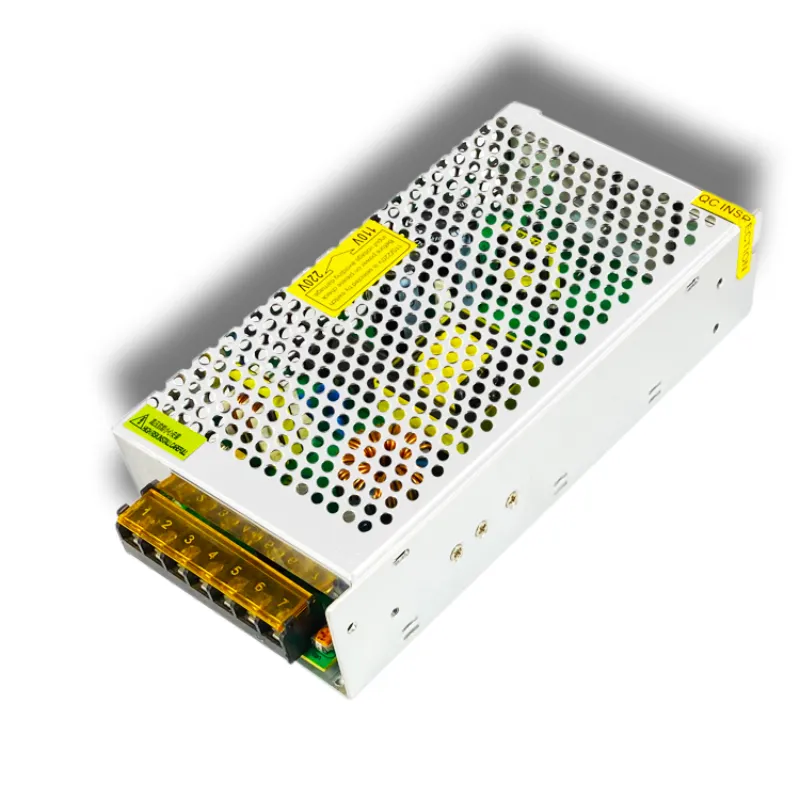
What Is Power Factor and Why It Matters for Switching Power Supplies
Power factor (PF) is the ratio of real power (the watts that do useful work) to apparent power (the volt-amps the grid must actually supply). A purely resistive load — an old incandescent bulb — has PF = 1.0: voltage and current rise and fall in perfect step. Reactive or non-linear loads pull PF below 1.0, forcing the utility to deliver more current than the real power alone would suggest.
A switch-mode power supply is a deeply non-linear load. Its front end rectifies AC and dumps charge into a large bulk capacitor, which only draws current near the peak of each mains half-cycle. The result is not a smooth sine wave of input current but a series of tall, narrow current spikes. An uncorrected supply of this kind typically sits at PF 0.5–0.7, and those spikes are rich in harmonics. Multiply that across thousands of devices on a feeder and you get overloaded neutrals, overheated transformers and distorted line voltage — which is exactly why standards bodies stepped in.
How Passive PFC Works — Line-Frequency Choke and Capacitor Filtering
Passive PFC is the simplest fix: insert a bulky line-frequency inductor (a boost choke wound for 50/60 Hz) in series with the input, sometimes paired with capacitive compensation. The inductor resists sudden changes in current, so it stretches and flattens those sharp peaks into something closer to a sine wave. There are no transistors and no control loop — just passive magnetics doing their job.
The upside is genuine: passive PFC adds no switching losses, generates no high-frequency noise of its own, and is rugged and cheap in parts count. The downside is equally real. It only lifts PF to roughly 0.7–0.85, and it leaves substantial harmonic content — often 30–40% total harmonic distortion (THD). Worse, the choke is enormous: a passive PFC inductor for a 300W supply can weigh 0.5–1 kg on its own, because magnetics sized for 50 Hz are inherently large. That weight and bulk are the reason passive PFC has been squeezed out of most modern designs.
How Active PFC Works — Boost Converter with High-Frequency Switching
Active PFC attacks the problem electronically. After the rectifier, a boost converter switches at high frequency, and a PFC controller forces the input current to track the shape of the input voltage. The supply is made to look like a resistor to the grid: current follows voltage smoothly, half-cycle by half-cycle. The output of the boost stage is a stable high-voltage DC rail that the downstream converter then steps down.
Because the switching happens at high frequency rather than line frequency, the boost inductor shrinks dramatically — under 50g for the same 300W rating where passive PFC needed nearly a kilogram. Active PFC routinely achieves PF ≥0.95, commonly 0.98–0.99, and pushes THD below 5%. The cost is added switching loss, a more complex control stage and a higher bill of materials. For nearly every supply above 75W, that trade is worth making — and increasingly it is not optional.
Total Harmonic Distortion (THD) Comparison — Why Active PFC Wins for Compliance
Harmonics are the heart of the regulatory case. THD measures how much of the input current sits at multiples of the fundamental 50/60 Hz frequency rather than at the fundamental itself. Those harmonics don't do useful work; they just heat conductors, saturate transformers and distort the shared voltage waveform for everyone on the circuit.
| Approach | Typical PF | Typical THD | Inductor mass (300W) |
|---|---|---|---|
| No PFC | 0.5–0.7 | 80–130% | — |
| Passive PFC | 0.7–0.85 | 30–40% | 0.5–1 kg |
| Active PFC | 0.95–0.99 | <5% | <50 g |
The gap is not subtle. Passive PFC narrows the harmonic problem; active PFC essentially eliminates it. That order-of-magnitude THD difference is precisely what compliance limits are written around.
EN 61000-3-2 / IEC 61000-3-2 Harmonic Limits — When Active PFC Is Legally Required
EN 61000-3-2 (the European harmonised version of IEC 61000-3-2) sets mandatory limits on the harmonic current a mains-connected device may inject, for equipment drawing up to 16A per phase. Products are sorted into classes; most general equipment and lighting falls under Class D, which imposes the strictest per-watt harmonic limits and effectively applies to active equipment above 75W.
In practice, a supply above 75W cannot meet Class D limits with passive PFC alone — the residual 30–40% THD blows past the harmonic ceilings. So while the standard never literally says "use active PFC," it is written tightly enough that active PFC becomes the only practical way to comply for the vast majority of products sold into the EU and the many markets that mirror IEC 61000-3-2. There are narrow exceptions (very low power devices, certain Class A categories, some purely linear supplies), but for mainstream switch-mode designs above 75W, active PFC is the default route to a CE mark.
80 PLUS Efficiency Tiers (Bronze, Silver, Gold, Platinum, Titanium) and Their PFC Requirements
80 PLUS is a separate axis from EN 61000-3-2, and conflating the two is a common mistake. EN 61000-3-2 governs harmonics; 80 PLUS certifies efficiency. A supply must do well on both, but they measure different things.
The 80 PLUS program certifies that a supply hits minimum efficiency at 10%, 20%, 50% and 100% load, climbing through tiers:
- 80 PLUS Bronze / Silver / Gold / Platinum / Titanium — progressively higher efficiency floors.
- Every tier requires PF ≥0.9 at the rated load points — which in practice means active PFC is mandatory to earn any 80 PLUS badge.
- Titanium adds the toughest condition: efficiency ≥90% even at 10% (light) load, where many designs sag.
So an 80 PLUS sticker tells you two things at once: the supply is efficient and it carries active PFC. Server and data-center PSUs targeting Platinum or Titanium have no passive-PFC option at all.
Cost, Size, and Weight Trade-Offs — When Passive PFC Still Makes Sense
Active PFC is not a free win in every dimension. It costs more in components, adds a switching stage that itself dissipates some power, and introduces high-frequency content that must be filtered. Passive PFC, despite its bulk, remains valid in a few corners:
- Below the 75W threshold, where Class D harmonic limits don't bite and the simpler, rugged passive approach can be cheaper.
- Cost-sensitive, fixed installations where size and weight are irrelevant and the supply never needs an 80 PLUS badge.
- Designs prizing simplicity and robustness over compactness, with no high-frequency switching node to filter.
But the moment a product must clear 75W into the EU, earn 80 PLUS, or fit a slim modern enclosure, the calculus flips decisively to active PFC. The shrinking magnetics alone often justify it.
Application Scenarios — Industrial DC, LED Driver, Server PSU, USB-C Adapter, EV Charger, UPS
- Industrial DC power (DIN-rail / desktop) — Any unit ≥75W ships with active PFC to clear EN 61000-3-2 on factory feeders. Our HP-series high-power desktop adapters (120W–480W) and DIN-rail industrial supplies are fully active-PFC across the range.
- LED drivers — Outdoor and high-bay luminaires combine EN 61347 with EN 61000-3-2, making active PFC compulsory for large fixtures.
- Server / data-center PSU — 80 PLUS Platinum and Titanium mandate active PFC outright. This dovetails with the front-end PFC discussion in our data-center UPS vs industrial UPS guide.
- USB-C power adapters — Desktop adapters above 65W now routinely carry active PFC, especially in the compact GaN era. Our APN-series desktop adapters (48W–144W) fit active PFC as standard from 75W up.
- Offline UPS / EPS — The charger front end uses PFC to stay grid-friendly while topping the battery.
- EV charging (on-board chargers, DC fast charge) — Active PFC is universal here, often bidirectional, to handle kilowatt-class power cleanly. Smart chargers such as the Sanyi SY-C260W charger and the higher-power SY-C500W charger apply active PFC on the AC input for compliant, efficient charging.
GaN/SiC + Active PFC — How Wide-Bandgap Semiconductors Shrink PFC Inductors
The march toward smaller active PFC stages runs straight through wide-bandgap semiconductors. GaN and SiC devices switch faster and cleaner than silicon, letting the PFC boost stage run at a higher frequency. Higher frequency means the boost inductor stores less energy per cycle, so the magnetics shrink even further — the same compounding density win that makes modern compact adapters possible. The result is high-PF, low-THD front ends in a fraction of yesterday's volume. We unpack the device physics in our GaN vs silicon power adapter selection guide; active PFC is one of the biggest beneficiaries of that material shift.
Common Selection Pitfalls
- "Passive PFC is efficient enough, so it's fine." Efficiency isn't the bar. Passive PFC's PF and THD still violate EN 61000-3-2 above 75W — you can be efficient and non-compliant at the same time.
- "Active PFC always means PF 0.99." Only across the rated load band. At very light load, many active PFC stages let PF sag; check the curve, not just the headline figure.
- "PFC and 80 PLUS are the same thing." They're orthogonal. PFC fixes power factor and harmonics; 80 PLUS certifies efficiency. A supply needs both, measured separately.
- "Cheap supplies just skip PFC entirely." Many budget units fit a poor-quality passive PFC to scrape by on paper while still injecting heavy harmonics — worse than honest no-PFC in some respects.
- "PFC lowers my electricity bill." Largely a myth for households: residential meters bill real energy, which PFC barely changes. PFC mainly helps the grid; it only saves money where industrial demand/reactive charges apply.
Sanyi Power Supply Ecosystem with Active PFC for Industrial and Adapter Lineups
Sanyi builds active-PFC front ends across the catalog so you can buy compliance in, rather than retrofit it:
- HP-series high-power desktop adapters (120W–480W) — workstation and industrial desktop power, fully active-PFC for EN 61000-3-2 and 80 PLUS-class efficiency.
- APN-series desktop adapters (48W–144W) — mid-power desktop reference with active PFC standard from 75W up.
- SY-C260W smart charger — active PFC on the AC input for clean, grid-friendly charging.
- SY-C500W charger — high-power off-grid and industrial charging with active PFC front end.
Every unit ships with CE / UL / FCC compliance as applicable, plus over-voltage, over-current, short-circuit and over-temperature protection. Contact Sanyi for PFC and efficiency-tier recommendations and OEM/ODM options across industrial and adapter lineups.
FAQ
Do I legally need active PFC for a power supply sold in Europe? If the supply draws more than about 75W and falls under Class D of EN 61000-3-2 (which covers most general equipment and lighting), then in practice yes — passive PFC cannot meet the harmonic limits, so active PFC is the only realistic route to a CE mark. Below 75W the requirement eases and passive or no PFC may be acceptable.
Will active PFC reduce my electricity bill? For a home or small office, almost not at all — your meter charges real energy, and PFC mainly reduces reactive current the utility carries. Where it does save money is industrial sites billed on peak demand or low power factor, where lifting PF from 0.7 to 0.99 can cut demand-related charges.
Is passive PFC ever the better choice today? Yes, in narrow cases: below the 75W harmonic threshold, in cost-sensitive fixed installations where size and weight don't matter, and where no 80 PLUS badge is needed. But for anything above 75W, anything chasing an efficiency certification, or anything that must fit a slim enclosure, active PFC wins decisively — and modern GaN/SiC designs have shrunk its size penalty to almost nothing.