


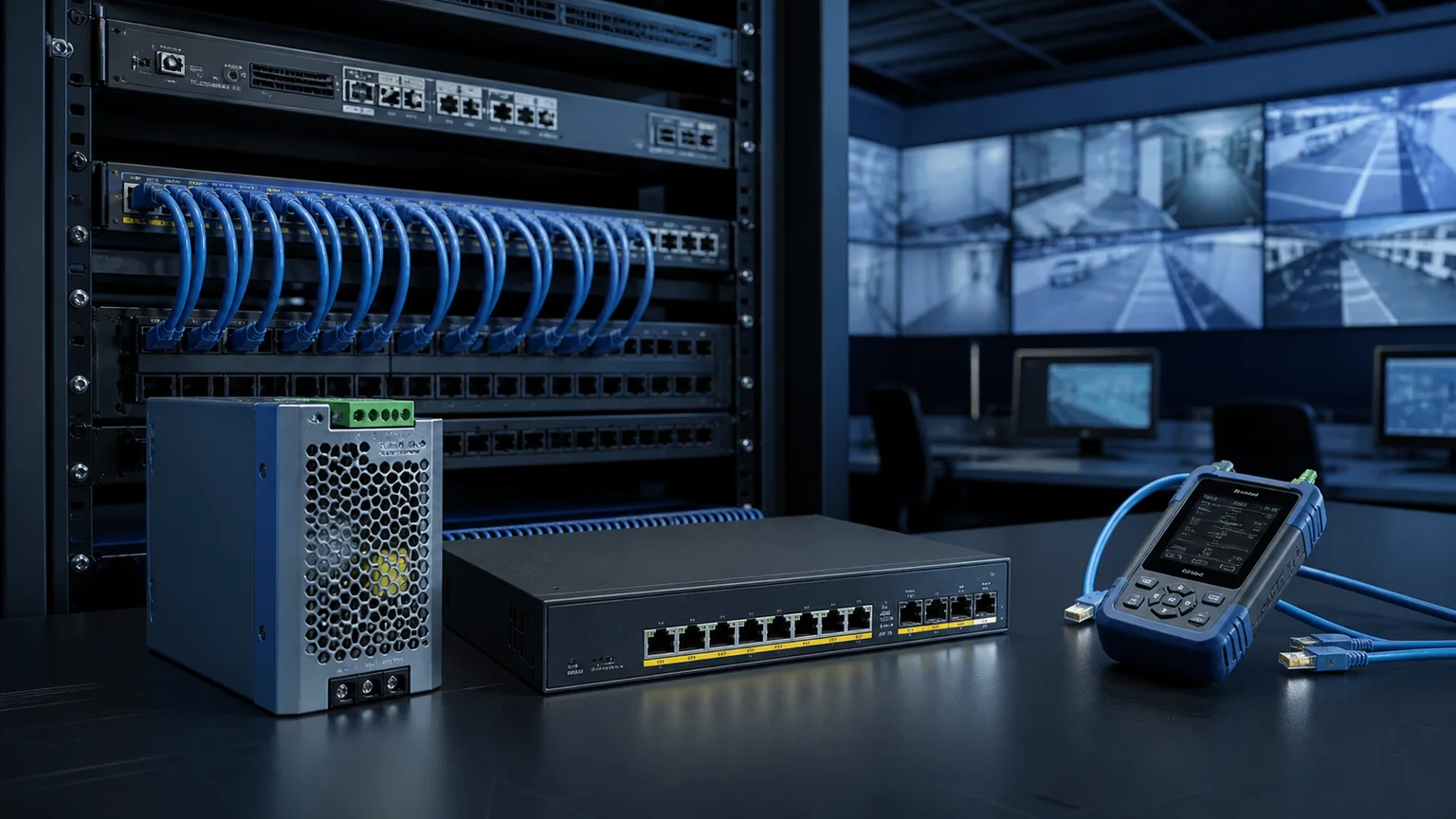

A CCTV camera that drops offline during a power outage is not a security system — it is a blinking LED on the wall. Yet most small-business and residential installs treat the surveillance power supply as an afterthought: a 12V adapter from the camera box and a wall outlet, both of which die together the moment a tripped breaker, summer brownout, or a deliberately cut mains line takes the building dark. That is the gap a 12V battery backup UPS for CCTV camera systems is built to close — and the gap that decides whether the recorded footage on your NVR includes the actual incident or just thirty seconds of black.
This guide covers 12V CCTV battery backup UPS selection in 2026 — DC UPS vs AC UPS topology, sealed lead-acid battery sizing (7Ah / 12Ah / 24Ah), how to handle PoE NVR and hybrid analog/IP installs, runtime math for typical 4-channel and 16-channel rigs, and which Sanyi centralized distribution boxes integrate the battery position so you do not buy a separate UPS box you do not need.
Why CCTV Backup Power Is Its Own Category
A "UPS for CCTV" sounds like it should be the same problem as a UPS for a PC: plug the camera into a battery-backed AC outlet and you are done. In practice, three things make CCTV power continuity a distinct category from desktop UPS sizing.
First, the load is native 12V DC. Almost every analog CCTV camera, most IP cameras under PoE budget thresholds, every DVR, and most small NVRs run on a 12V DC barrel jack. Powering them from a 220 V AC UPS means: AC → battery (DC) → inverter (back to AC) → AC adapter (back to DC) at each camera. Each conversion costs 8–15% efficiency. A 100 Wh battery that should run a 30 W camera load for 3 hours runs it for 2 hours because half the energy is lost in the round-trip.
Second, the runtime requirement is measured in hours, not minutes. A desktop UPS exists to give you 5 minutes to save the file and shut down gracefully. A CCTV UPS exists to keep recording through the entire outage — and the outages that matter (deliberate cuts, multi-hour blackouts) are exactly the events you most need to capture. The math changes from "10 minutes at 600 W" to "4 hours at 30 W," and the right battery for that is not the small VRLA cell inside a consumer UPS.
Third, the install is distributed. A 16-camera retail install has cameras strung 30–80 meters from a central wiring closet, and the voltage drop on small-gauge security wire eats most of a 12V budget before it reaches the camera. The backup architecture has to live where the power source lives — at the central distribution panel — not at each camera.
For the wattage and voltage-drop side of CCTV power, our CCTV power supply sizing guide covers the math; this article is its backup-power companion.
DC UPS vs AC UPS — Why the DC Side Wins for CCTV
The single biggest decision is topology. Two architectures dominate.
AC UPS upstream of the camera AC adapter. A standard consumer or small-business UPS feeds 220 V (or 110 V) into the camera AC adapter as before. Pros: works with any camera; cheap commodity hardware; recognizable to non-specialist installers. Cons: the double-conversion loss described above; the runtime per dollar is poor; and the UPS itself has to live near a mains outlet, not at the camera distribution panel — so the backup window only protects whatever is plugged into the UPS, often not including the cameras themselves.
DC UPS at the 12V distribution panel. A 12V DC UPS sits between the mains-powered 12V switching supply and the camera distribution rail. In normal operation, the switching supply feeds the cameras directly at 12V and trickle-charges a sealed lead-acid (SLA) 7Ah, 12Ah or 24Ah backup battery. When mains drops, a hot-swap diode or MOSFET network reroutes the load to the battery in under 4 ms — well below any camera's brown-out reset threshold. The cameras never even know the mains went away.
DC UPS efficiency is dramatically better: there is no inverter stage, no battery → AC → DC round trip. A 12V/26 Ah pack delivering 30 W of camera load runs almost the full theoretical 10 hours instead of the 5–6 hours an AC UPS of equivalent capacity would deliver.
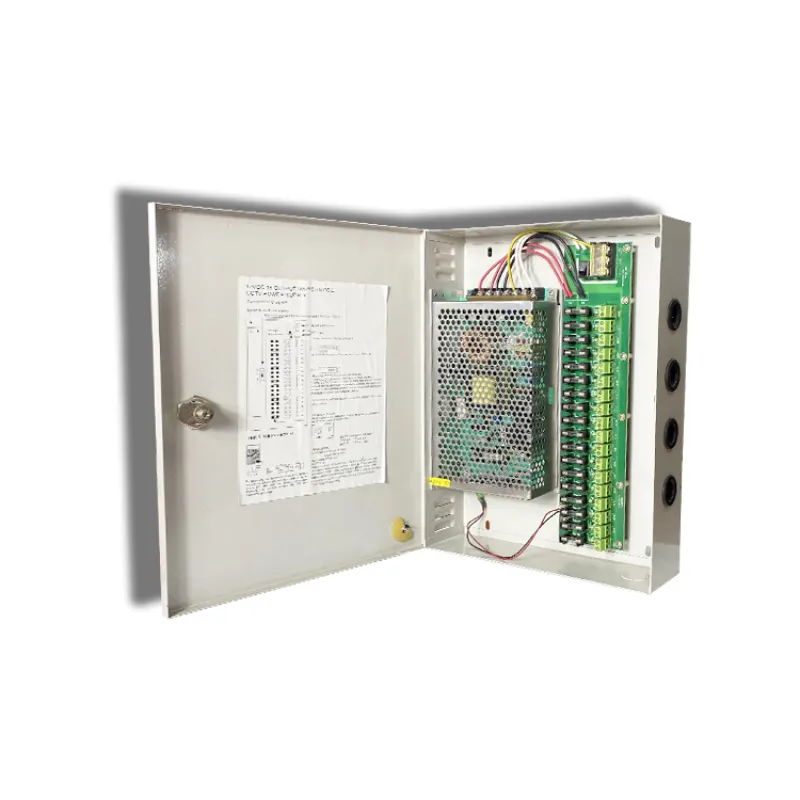
Sanyi's centralized CCTV distribution boxes — including the 9-channel centralized power distribution box (48W–120W) and 5-channel centralized box (36W–72W) — are designed for this DC UPS topology. Each unit provides multiple individually-fused 12V channels, a built-in SLA battery position, and automatic float charging — so the entire camera fleet inherits backup-power behavior without a separate UPS box on the wall.
Step 1: Build the DC Load Budget
The sizing question starts with the load, not the battery. List every device that has to survive the outage and add up steady-state 12V draw:
| Device class | Typical 12V draw | Notes |
|---|---|---|
| Analog dome/bullet camera (no IR) | 0.1–0.2 A | Day mode only |
| Analog dome/bullet camera (IR on) | 0.3–0.5 A | Night mode peak |
| 2 MP IP camera (PoE or 12V) | 0.4–0.7 A | + 0.2 A in IR mode |
| 4 MP / 4K IP camera | 0.6–1.0 A | Higher in IR |
| PTZ (pan-tilt-zoom) camera | 1.5–3.0 A peak | Bursts during slew |
| 4-channel DVR | 1.0–1.5 A | + HDD spin |
| 16-channel NVR | 2.5–4.0 A | + 1–4 HDDs |
| PoE switch (8-port, mid-span) | 2.0–4.0 A 12V input | If powered by 12V |
For a small retail install of 8 IR cameras + a 4-channel DVR you are usually around 4–5 A at 12V — call it 60 W. A 16-channel commercial install with a PoE NVR is closer to 8–12 A at 12V (100–144 W). These are the numbers that drive battery capacity.
Step 2: Pick the Battery — 7Ah / 12Ah / 24Ah SLA
The de facto backup battery for distributed 12V CCTV is sealed lead-acid (SLA / VRLA) in three standard sizes. Each is shaped to fit the standard battery position inside a centralized distribution box.
- 7Ah SLA — the entry-level cell. Fits inside compact access-control boxes (like the 60W–75W access control power box) and small 5-channel distribution boxes. Gives ~1.2 hours runtime on a 60 W CCTV load.
- 12Ah SLA — the volume choice for 8–16 channel installs. Runtime ~2 hours on a 60 W load or 1 hour on a 120 W load.
- 24Ah SLA — high-runtime perimeter and bank-vault installs. ~4 hours on 60 W, ~2 hours on 120 W. Often deployed as a parallel pair (2× 12Ah) inside a larger 18-channel box.
The right sizing answer for most retail and small-commercial cases is the 12Ah — runtime fits the typical 90-minute outage window of a regional blackout, and the cell physically fits inside standard distribution-box enclosures without requiring a separate UPS housing.
For installs that need overnight runtime (unmanned remote sites, residential vacation homes, bank vaults), step up to 24Ah parallel pairs or switch to a LiFePO4 12.8V pack. The LFP route quadruples runtime for the same physical volume — 12.8V / 50Ah LFP modules now drop into the same battery footprint as a 24Ah SLA and deliver 6–8 hours on a 60 W CCTV load.
Step 3: Handle PoE and Hybrid Installs
Modern IP camera installs are split between native 12V DC and PoE (Power over Ethernet). The backup architecture differs for each.
Pure PoE installs — cameras get power from the PoE switch, which itself is powered from AC mains. To back this up, you either UPS the PoE switch or use a PoE switch that accepts a 48V DC input from a DC UPS. Industrial PoE switches with DC input are now common; pair them with a 48V battery UPS or a step-up DC-DC from a 12V CCTV battery. For installs already centralized on a 48V PoE switch, the POE Switch Power Supply 480W or POE Switch Power Supply 300W modules carry the upstream load that the backup battery must support during an outage.
Hybrid analog + IP installs — typical for small businesses migrating from legacy DVR rigs. The DVR/NVR sits on 12V DC, the analog cameras sit on 12V DC, and a handful of newer IP cameras are PoE. The cleanest backup: one centralized 12V distribution box with battery position covers everything except the PoE switch, which gets a dedicated small UPS (or its own 48V DC input from a second backup channel).
4G/LTE remote-monitoring sites — the LTE router is the long-pole-in-the-tent. Without router uptime, recorded footage never gets to the cloud during an outage. Include the router in the 12V load budget; many cell routers run on 12V or 9–24V wide-input.
Step 4: Float Charging, Battery Health, and the 3-Year Replacement Rule
SLA batteries do not last forever. Plan for replacement on a 3-year cycle in normal indoor conditions and 18–24 months in hot environments (above +35 °C ambient).
The charger inside the distribution box must support a float charge profile: 13.5–13.8 V at 25 °C, automatic temperature compensation (–3 mV per °C per cell), and a current taper that prevents thermal runaway in older cells. A box that just dumps a fixed 13.8 V into the SLA pack without temperature compensation will boil cells in a hot ceiling-void install in two summers.
Three practical maintenance rules:
- Test under load once a year — disconnect mains for 10 minutes, measure terminal voltage at 1 A draw. If voltage drops below 11.5 V, the battery is at end-of-life and the next outage will not be covered.
- Replace before the third anniversary — the failure curve for SLA is steep after year 3. A $40 battery that fails in year 4 took the entire CCTV system offline during the one outage of the year.
- Use matched pairs — never mix a new 12Ah cell with an aged 12Ah cell in parallel. The new cell will source current into the aged cell and both degrade faster.
For installs where the operator does not have the maintenance discipline to track 3-year battery cycles, switching to LiFePO4 changes the math: a 12.8V / 12Ah LFP module survives 8–10 years of float-charge service vs. 3 for SLA, eliminating the most common cause of "the cameras didn't come up during the outage" complaints.
Step 5: Certifications and Enclosure for Field Deployment
For commercial installs in the US and EU, the CCTV power box that contains the backup battery has to meet a specific certification stack:
- UL 60950 / UL 62368 — information-technology equipment safety, applies to the 12V switching supply feeding the box. Replaced UL 1950 in 2020.
- UL 1481 — fire-protective signalling system power supplies, the relevant standard if the CCTV install is integrated with a fire-alarm system.
- FCC Part 15 Class A or B — EMC emissions for the switching power stage.
- CE marking under LVD 2014/35/EU and EMC 2014/30/EU for EU deployments.
- IP54 for indoor wall-mount enclosures; IP65 for outdoor or perimeter installs.
Beyond the certifications, two enclosure features matter for the battery-backup case: a locking front cover (so a vandal cutting mains cannot also remove the battery) and a vented but rain-tight enclosure (so SLA outgassing during float charge does not concentrate inside a sealed box).
The surveillance dedicated centralized power distribution box line ships with these enclosure features as standard, alongside the 5/9/18-channel fused 12V outputs and the SLA battery position. For perimeter or rooftop installs that need outdoor IP65 rating, ask for the IP65 enclosure option.
Step 6: Sanyi Product Map for CCTV Backup-Power Deployment
Sanyi's CCTV distribution and backup-power product line covers the typical install sizes:
- Access Control Power Box 60W–75W — 1-channel or 2-channel 12V output with integrated 7Ah SLA battery position. Right for small access-control + 2-camera entry-monitoring deployments.
- 5-Channel Centralized Power Distribution Box 36W–72W — 5 individually-fused 12V outputs, integrated 7Ah or 12Ah battery position. Standard for 4–6 camera small-business installs.
- 9-Channel Centralized Power Distribution Box 48W–120W — 9 fused channels, 12Ah battery position. Volume product for 8-camera retail rigs.
- Surveillance Dedicated Centralized Power Distribution Box — 18-channel variants for 16-camera and larger commercial installs, 24Ah battery position or parallel 12Ah pairs.
All Sanyi CCTV distribution boxes ship with the float-charge circuit, temperature compensation, and the hot-swap source-selection network that defines a true DC UPS — not a battery on the side of a power supply. For sizing a specific install or for OEM enclosure customization, browse the full Sanyi product catalog or contact our engineering team.
FAQ
Can I just plug my DVR into a $50 consumer UPS instead?
You can, but you protect only the DVR — not the cameras, the PoE switch, or the LTE router. A $50 consumer UPS gives 5–15 minutes of runtime on a 100 W combined load and uses the inefficient AC → battery → AC → DC adapter path. For a real CCTV continuity plan, the backup belongs at the 12V distribution panel where the cameras get power, not on the desk where the DVR sits. The consumer UPS may still be useful as a layer-2 backup for the PoE switch, but it should not be the primary continuity solution.
How long should a 12Ah SLA last in a 16-camera install?
Depends on the load. A 16-camera install pulling 8 A total at 12V draws ~96 W. A 12Ah SLA at 12V is nominally 144 Wh, but you can only discharge SLA to about 50% depth without halving cycle life — so the usable energy is ~72 Wh, giving ~45 minutes of runtime. That is enough for typical regional blackouts but not for a deliberate multi-hour mains-cut scenario. Step up to 24Ah or parallel pairs for ≥90-minute coverage.
Why does the camera reboot when mains drops, even though I have a UPS?
Two common causes. (1) The UPS is upstream of the AC adapter, not downstream of the 12V output — the AC adapter takes 100–300 ms to re-stabilize on UPS battery output, which is longer than the camera's brown-out threshold. Fix: move the backup to the DC side at the distribution box. (2) The battery has aged past its float-charge support voltage and the source-selection diode is letting the camera see a voltage sag below its drop-out spec during the switchover. Fix: replace the SLA cell, then verify the cutover with a scope or a logger.
Can I run cameras directly from a 12V car battery during an outage?
Physically yes — a 12V automotive battery delivers more than enough current for a CCTV load. But the float-charge circuit in a CCTV distribution box is not built for an 80 Ah deep-cycle car battery; the trickle current limit is sized for 7–24 Ah SLA cells and a car battery will sit forever at partial charge if connected without a separate marine-grade charge controller. For an emergency one-off bypass during a multi-day outage where the regular SLA has died, a car battery on the 12V rail with mains disconnected will keep cameras up for 12–24 hours — but it is not a permanent install.
Should I switch the entire CCTV install to LiFePO4 backup?
For installs requiring >2 hours runtime, or for installs where the operator does not have the discipline to swap SLA cells every 3 years, yes. LFP at 12.8V drops into the same physical battery position as a 24Ah SLA, delivers 2.5× the usable energy (LFP tolerates 80% depth of discharge vs. 50% for SLA), and survives 8–10 years of float service instead of 3. The cost premium is roughly 2× at purchase, but the lifecycle cost is lower because you skip 2–3 SLA replacements over a decade. The only caveat: the CCTV distribution box must support an LFP charge profile (CC-CV, no equalization, no indefinite float). Confirm with the supplier before retrofitting.
Do I need a separate UPS for the LTE / 4G router on a remote site?
Yes if the site is remote-monitored. The router and the cameras both have to survive the outage or the footage stays on the local NVR until mains returns. Most LTE routers run on 12V or 9–24V wide-input, so they can share the same centralized distribution box and battery as the cameras — just add the router's draw to the load budget when sizing the battery. For sites where the router is the only thing that matters during an outage, a small dedicated 12V battery for the router buys disproportionate value.
For a sized backup-power solution for your CCTV install — including SLA / LFP battery selection, distribution box channel count, runtime calculation, and certification support — contact the Sanyi engineering team with your camera count, location count, target runtime, and operating environment. We ship globally with UL- and CE-listed CCTV distribution boxes integrated for SLA or LiFePO4 backup batteries.
.webp)